Within Idaho UFOs
How Idaho Joined the First Saucer Craze
Idaho's first saucer reports show how headlines, expectation and uncertain observations turned scattered sightings into a statewide wave.
On this page
- Kenneth Arnold's Boise connection
- Sightings reported across Idaho
- How publicity shaped interpretation
Page outline Jump by section
Introduction
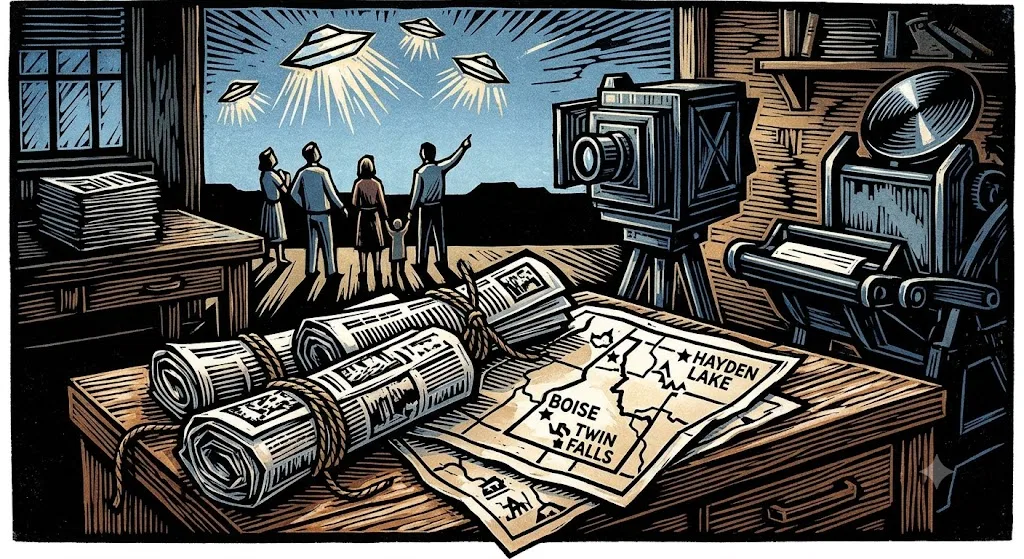
Idaho joined America’s first flying-saucer craze almost immediately after Boise businessman and pilot Kenneth Arnold reported nine strange objects near Mount Rainier on 24 June 1947. Within days, Idaho newspapers were carrying reports from Galena Summit, Malta, Hollister, Richfield, Twin Falls, Boise and Hayden Lake. A professional airline crew leaving Boise then reported unidentified objects on 4 July, while a supposed crashed disc discovered at Twin Falls a week later proved to be a teenage hoax.
The resulting “wave” is best understood not as one continuous aerial event but as a fast-moving mixture of uncertain observations, repeated newspaper publicity, public expectation and deliberate imitation. Some witnesses were experienced and apparently sincere; others supplied descriptions too vague to test. No Idaho report produced verified exotic technology, reliable physical evidence or measurements sufficient to establish extraordinary flight. What makes the episode important is that Idaho shows, unusually clearly, how the modern UFO phenomenon formed: a striking report created a new interpretive label, that label reshaped later observations, and a flood of stories briefly made almost anything unusual in the sky look like a “flying saucer”.[si.edu]airandspace.si.edu1947 year flying saucerRainier on June 24, 1947, remains a mystery. He calculated the objects were flying at about 1,200 mph…
Kenneth Arnold’s Boise connection
Although Arnold’s famous sighting took place over Washington State, he was closely associated with Idaho. He lived in Boise, operated a fire-control equipment business and travelled extensively as a private pilot. His Idaho identity was repeatedly mentioned in national coverage, making the story feel local even before saucers were reported over Idaho itself. The episode therefore entered the state’s aviation community and newspapers not as distant news, but as the extraordinary claim of a recognisable regional pilot.[National Air and Space Museum]airandspace.si.edu1947 year flying saucerRainier on June 24, 1947, remains a mystery. He calculated the objects were flying at about 1,200 mph…
Arnold said that, while flying near Mount Rainier on 24 June, he saw nine bright objects moving in a chain or formation. He attempted to calculate their speed by timing their passage between mountain landmarks, arriving at an estimate of at least about 1,200 miles per hour—far beyond the speed of publicly known aircraft at the time. The Smithsonian National Air and Space Museum notes that exactly what Arnold observed remains unknown, while also emphasising that his report changed popular language and culture almost overnight.[National Air and Space Museum]airandspace.si.edu1947 year flying saucerRainier on June 24, 1947, remains a mystery. He calculated the objects were flying at about 1,200 mph…
The familiar claim that Arnold described only the objects’ motion as saucer-like is an oversimplification. He did compare their movement to a saucer skipping across water, but early accounts also described the objects themselves as thin, flat, pie-plate-like or rounded at the front and pointed towards the rear. In a recorded radio interview on 26 June, he compared their appearance to a pie plate cut in half with a convex triangular section behind it. Newspaper wording nevertheless simplified an uncertain and rather unusual description into the much easier image of a circular “flying saucer”.[Wikipedia]WikipediaKenneth Arnold UFO sightingKenneth Arnold UFO sighting
That simplification mattered. “Flying saucer” was memorable, visual and easy to repeat. It gave readers a ready-made category for interpreting flashes, distant aircraft, balloons, birds and unfamiliar atmospheric effects. Arnold’s report did not prove that later observers copied him or imagined what they saw, but it changed the questions people asked when they looked upwards. Instead of merely seeing an unidentified light, they could now report one of the mysterious objects dominating the news.
How the reports spread across Idaho
The Idaho reports appeared in quick succession rather than as a carefully documented body of evidence. Their concentration in the press during the first days of July is itself important: the sightings multiplied after Arnold’s story had supplied both a name and a basic visual script.
On 1 July, the Twin Falls Times-News reported that forest ranger Walter Nicholson and a companion had seen eight to ten shining objects in a wavering V-shaped formation near Galena Summit. They reportedly heard a buzzing noise and said the objects did not resemble ordinary aircraft. The following day, Mr and Mrs J. F. Meuser described a brilliant ball of fire near Malta, approximately moon-sized but much brighter. That description was already notably different from Arnold’s chain of thin objects, demonstrating how varied phenomena were being grouped under the same saucer story.[Wikipedia]WikipediaTwin Falls saucer hoaxTwin Falls saucer hoax
On 3 July, railway foreman B. G. Tiffany told the newspaper that he and his crew had seen nine noiseless discs in formation over Hollister roughly a month earlier. The delayed report illustrates a recurring feature of publicity-driven waves: people reconsider past observations after a new category becomes prominent. An event that had not originally been reported as a flying-saucer encounter could be reclassified once newspapers had made the idea familiar.[Wikipedia]WikipediaTwin Falls saucer hoaxTwin Falls saucer hoax
Further claims followed from Twin Falls and Richfield on 4 July. On 5 July, newspapers reported that about 60 picnickers in Twin Falls had watched as many as 35 discs during a period of roughly 20 minutes. Reports also circulated that a much larger gathering at Hayden Lake had watched an object for an extended period, while several Boise residents said they had seen discs. These group accounts sounded impressive, but contemporary summaries generally lacked precise viewing directions, angular sizes, weather data, photographs or independent records that might establish whether everyone was observing the same thing.[Wikipedia]Wikipedia1947 flying disc craze1947 flying disc craze
Numbers of witnesses should therefore not be treated as equivalent to quality of evidence. Groups can provide useful corroboration when their accounts are recorded separately and promptly, but crowd observations can also be mutually influential. Once one person points out an object and calls it a saucer, others may adopt the description without independently judging its shape, distance or motion.
The reports also did not form a consistent technological pattern. Idaho witnesses variously described formations of discs, solitary bright bodies, fireballs, wheel-sized objects and lights. Some were said to move rapidly; others remained visible for long periods. Some were silent, while the Galena Summit witnesses mentioned buzzing. This variety weakens the idea that all the reports concerned one type of unknown vehicle. It fits more comfortably with several ordinary or unresolved stimuli being interpreted through a common cultural label.[Wikipedia]WikipediaTwin Falls saucer hoaxTwin Falls saucer hoax
Flight 105 gave the wave credibility
The strongest Idaho-linked report of the period came from United Airlines Flight 105 on the evening of 4 July. The Douglas DC-3 left Boise for Pendleton, Oregon, with Captain Emil Smith and First Officer Ralph Stevens in the cockpit. Flight attendant Marty Morrow was also called forward to observe the objects. Because the principal witnesses were professional aircrew rather than anonymous members of the public, their story gave the saucer wave a significant boost in credibility.[American Heritage]americanheritage.comAmerican Heritage Was This the First Reported UFO?AMERICAN HERITAGEOn Independence Day, United Airlines Flight 105 sat on the tarmac before a scheduled flight from Boise to Pendleton. Bef…
The cultural setting was already apparent before take-off. Contemporary accounts state that the Boise control tower jokingly told the crew to watch for flying saucers. Soon afterwards, Stevens noticed several objects, initially wondering whether they might be approaching aircraft. Smith and Morrow also saw them. The crew described a loose group of four or five objects and later several more, apparently silhouetted or illuminated against the evening sky. They were uncertain about exact shape and distance, although Smith described them as flat and seemingly larger than conventional aeroplanes.[Wikipedia]Wikipedia1947 flying disc craze1947 flying disc craze
This was valuable testimony, but it was not instrumented evidence. No reliable range, altitude or physical dimensions were established. Apparent size depends heavily on assumed distance, and apparent speed cannot be calculated confidently without knowing how far away an object is. The sighting occurred near sunset, when glare, contrast, haze and reflections can make distant airborne objects unusually difficult to interpret.
The US military later suggested that the objects could have been ordinary aircraft, balloons, birds or visual illusion, noting the unfavourable sunset conditions and the atmosphere of suggestion surrounding the national craze. That conclusion was broad rather than a precise identification of each object, so it does not amount to a complete solution. Flight 105 is reasonably classed as unresolved in the limited sense that the exact stimulus was never firmly established. It is not, however, strong evidence for an exotic craft: the report lacks radar confirmation, photographs, physical traces and sufficiently reliable positional data.[Wikipedia]WikipediaFlight 105 UFO sightingFlight 105 UFO sighting
Its historical importance is greater than its evidential strength. Arnold had been an experienced civilian pilot, and Flight 105 now supplied three aviation professionals who said they had seen something they could not identify. For newspaper readers, this made dismissal more difficult. Yet the joking instruction from the tower also captures the central interpretive problem: before the crew saw anything, “flying saucers” were already in their minds and in the shared language of aviation.
Publicity changed what people thought they saw
The Idaho wave developed within a national feedback loop. Newspapers reported Arnold’s account; readers began watching the sky; new reports produced larger headlines; and those headlines encouraged still more observation and retrospective storytelling. Researcher Ted Bloecher’s later catalogue of the 1947 wave stressed that its surviving record is principally journalistic. That means historians can reconstruct what newspapers published more easily than they can reconstruct the original sensory events.[kirkmcd.princeton.edu]kirkmcd.princeton.edubloecher 67Bloecher gives us what will probably come to be regarded as the…
This distinction is crucial. A newspaper report is evidence that a claim was made, but not necessarily that the described object behaved exactly as printed. Early accounts were often assembled quickly from telephone calls, wire-service summaries and interviews conducted amid public excitement. Descriptions could be shortened, standardised or made more vivid as stories moved from local papers into national syndication.
The saucer label also encouraged categorical compression: very different observations were placed into one apparently coherent class. A brilliant fireball near Malta, a formation over Galena Summit and slow or prolonged objects seen by crowds did not necessarily share a cause. Once all were described as discs or saucers, however, the public record made them look like parts of a single invasion-like sequence.
Several mechanisms could have contributed without requiring witnesses to be dishonest:
- Expectation: people actively searched for the newly publicised objects and paid unusual attention to ambiguous lights.
- Distance errors: without familiar reference points, observers could mistake small nearby objects for large distant ones, or vice versa.
- Sunlight and twilight: reflections from aircraft, balloons or birds can appear as bright flashes and disappear when the viewing angle changes.
- Social influence: members of a group may converge on the description offered by the first or most confident observer.
- Retrospective reinterpretation: earlier unexplained events could be remembered and reported as saucer sightings after Arnold’s story became famous.
- Copying and play: jokes and imitations predictably appeared once the saucer story became a national craze.
These explanations do not identify every Idaho report. Rather, they explain why the number of claims could rise sharply without a corresponding increase in reliable physical evidence.
The Twin Falls disc exposed the wave’s weaknesses
On 11 July, the Idaho story seemed to move from sightings to physical proof. A disc about 30 inches across was found in a Twin Falls garden after residents recalled hearing a thud during the night. Police took possession of the object, and both Army and Federal Bureau of Investigation personnel became involved. Military officers travelled from Fort Douglas in Utah, while the temporary restriction of information helped create an impression that authorities might be dealing with something important.[Wikipedia]Wikipedia1947 flying disc craze1947 flying disc craze
The object was visually elaborate but technologically crude. Contemporary descriptions mentioned a metal body, a plastic or Plexiglas dome, wires, coils and radio or jukebox components. Within about a day, investigators announced that it was a hoax constructed by four local teenage boys. The youths were reportedly neither publicly named nor prosecuted. Army photographs showing an officer holding the small homemade device were subsequently distributed to the press.[Wikipedia]WikipediaTwin Falls saucer hoaxTwin Falls saucer hoax
The incident is sometimes treated simply as a comic footnote, but it reveals several important features of the 1947 wave. First, both officials and journalists had to take a purported disc seriously because genuine uncertainty surrounded the new reports. Second, the movement of the object between police, FBI and military hands briefly made routine investigation look like secrecy. Third, a crude construction could command national attention because the public had already been primed to expect recovered saucers.
The local Times-News later criticised the handling of the investigation, suggesting that the Army had created unnecessary mystery before acknowledging the hoax. That reaction shows how official caution could generate suspicion even when investigators reached the correct conclusion. The basic sequence—an extraordinary claim, restricted information, speculation and a mundane result—would recur throughout later UFO history.[Wikipedia]WikipediaUFO reports and disinformationUFO reports and disinformation
The exposed hoax also helped drain momentum from the wider craze. National flying-disc coverage had already peaked in early July and was beginning to decline as mistaken identifications and fabricated objects accumulated. The widely circulated Twin Falls photographs gave editors a particularly clear image of the story turning into farce. Reports did not cease altogether, but the first concentrated burst rapidly lost its authority.[Wikipedia]Wikipedia1947 flying disc craze1947 flying disc craze
What the evidence supports
Idaho’s 1947 wave cannot fairly be reduced to either “alien spacecraft” or “everyone imagined it”. The historical record supports a more layered conclusion.
Arnold and the Flight 105 crew appear to have reported genuine experiences: they saw something and could not identify it confidently. Their aviation backgrounds make their testimony worth examining, but expertise does not remove the limits of brief visual observation. Neither case supplied the distance, range, calibrated imagery or physical evidence required to prove extraordinary performance.
The scattered Idaho sightings are weaker. Many survive chiefly as short newspaper summaries, sometimes published after the alleged event and rarely supported by detailed independent statements. Large witness totals are difficult to evaluate because the original interviews, viewing geometry and degree of interaction within the groups are generally unavailable.
The Twin Falls object is not unresolved. It was a constructed hoax, identified quickly through ordinary investigation. It therefore weakens rather than strengthens claims that recovered technology appeared in Idaho during the 1947 wave.
The overall evidence is most consistent with several processes operating together: some sincerely unexplained observations, probable misidentifications, press amplification, social expectation and deliberate fabrication. No single explanation need account for every report, and no unexplained remainder automatically becomes evidence of an extraterrestrial vehicle.
Why the 1947 wave still matters in Idaho
Idaho’s place in early UFO history rests on an unusual sequence. A Boise pilot helped launch the modern saucer idea; Idaho communities quickly produced their own sighting cluster; a commercial crew leaving Boise gave the story professional-witness authority; and Twin Falls supplied one of the first nationally reported recovered-disc hoaxes.
The sequence also demonstrates that “unidentified” is not a permanent description of a special class of object. Some reports remain unresolved because the original information is inadequate. Others become weak once distance and perception problems are considered. A few, such as the Twin Falls disc, can be decisively debunked. Treating all three categories as equally mysterious obscures what the records actually show.
Most importantly, the Idaho wave illustrates how publicity can shape perception without requiring mass dishonesty or irrationality. People were responding to a genuinely novel story during an era of rapid aviation development, military secrecy and growing awareness that aircraft performance could exceed ordinary expectations. When they encountered ambiguous sights, “flying saucer” had become the most available explanation.
Idaho therefore matters less as the site of proven extraordinary machines than as an early laboratory of UFO culture. Its 1947 reports show the complete life cycle of a flap: an influential initial claim, rapid multiplication, increased authority through credible witnesses, sensational expectation of physical proof, exposure of a hoax and an equally rapid decline. The surviving cases leave room for uncertainty about particular observations, but the wave as a whole is explained most convincingly by the interaction of unfamiliar sights with headlines, expectation and the contagious power of a new idea.
Amazon book picks
Further Reading
Books and field guides related to How Idaho Joined the First Saucer Craze. Use these as the next step if you want deeper reading beyond the article.
The Report on Unidentified Flying Objects
Strongly connected to the post-1947 flying-saucer era.
The UFO Experience: A Scientific Inquiry
Provides historical and investigative context.
UFOs: Generals, Pilots, and Government Officials Go on the Re...
Adds broader historical perspective.
Encounter in Rendlesham Forest
Appeals to readers exploring famous sightings and reporting waves.
eBay marketplace picks
Marketplace Samples
Live-tested eBay searches with available results related to this page.
Selected fromflying saucer poster oneBay.co.uk.
Endnotes
1.
Source: kirkmcd.princeton.edu
Title: bloecher 67
Link:https://kirkmcd.princeton.edu/JEMcDonald/bloecher_67.pdf
Source snippet
Bloecher gives us what will probably come to be regarded as the...
2.
Source: Wikipedia
Title: [Twin Falls saucer]({{ ‘twin-falls-hoax/’ | relative_url }}) hoax
Link:https://en.wikipedia.org/wiki/Twin_Falls_saucer_hoax
3.
Source: Wikipedia
Title: Kenneth Arnold UFO sighting
Link:https://en.wikipedia.org/wiki/Kenneth_Arnold_UFO_sighting
4.
Source: Wikipedia
Title: 1947 flying disc craze
Link:https://en.wikipedia.org/wiki/1947_flying_disc_craze
5.
Source: Wikipedia
Title: Flight 105 UFO sighting
Link:https://en.wikipedia.org/wiki/Flight_105_UFO_sighting
6.
Source: Wikipedia
Title: UFO reports and disinformation
Link:https://en.wikipedia.org/wiki/UFO_reports_and_disinformation
7.
Source: Wikipedia
Title: Flying saucer
Link:https://en.wikipedia.org/wiki/Flying_saucer
8.
Source: Wikipedia
Title: Kenneth Arnold
Link:https://en.wikipedia.org/wiki/Kenneth_Arnold
9.
Source: magicvalley.newspapers.com
Title: the times news
Link:https://magicvalley.newspapers.com/paper/the-times-news/7839/?tab=browse
10.
Source: time.graphics
Link:https://time.graphics/event/10182928
11.
Source: airandspace.si.edu
Title: 1947 year flying saucer
Link:https://airandspace.si.edu/stories/editorial/1947-year-flying-saucer
Source snippet
Rainier on June 24, 1947, remains a mystery. He calculated the objects were flying at about 1,200 mph...
Published: June 24, 1947
12.
Source: americanheritage.com
Title: American Heritage Was This the First Reported UFO?
Link:https://www.americanheritage.com/was-first-reported-ufo
Source snippet
AMERICAN HERITAGEOn Independence Day, United Airlines Flight 105 sat on the tarmac before a scheduled flight from Boise to Pendleton. Bef...
13.
Source: facebook.com
Link:https://www.facebook.com/groups/397526214154529/posts/437467070160443/
14.
Source: facebook.com
Link:https://www.facebook.com/groups/1018678435262692/posts/2493585017772019/
15.
Source: spacedoutclassroom.com
Title: flight 105
Link:https://spacedoutclassroom.com/tag/flight-105/
16.
Source: spacedoutclassroom.com
Link:https://spacedoutclassroom.com/tag/ufo/
Additional References
17.
Source: facebook.com
Link:https://www.facebook.com/libraryofcongress/posts/on-this-day-in-1947-what-many-consider-to-be-the-first-modern-ufo-sighting-took-/1150298620475987/
Source snippet
The Library of CongressWhat is regarded as the first modern "flying saucer" sighting occurred on June 24, 1947, when Boise busine...
Published: June 24, 1947
18.
Source: youtube.com
Link:https://www.youtube.com/watch?v=01sVLTO8xmo
Source snippet
Ep. 2 | Flying Saucer UFOs | Roswell, Kenneth Arnold, McMinnville, Rex Heflin | The Basement Office...
Published: June 1947
19.
Source: youtube.com
Title: The First UFO Sighting In America | UFOs: The Lost Evidence
Link:https://www.youtube.com/watch?v=MJp-YR34XBs
Source snippet
24th June 1947: The first widely-reported UFO sighting was made by private pilot Kenneth Arnold...
Published: June 1947
20.
Source: youtube.com
Title: Kenneth Arnold and the First UFOs
Link:https://www.youtube.com/watch?v=qdXNAOxs6mo
Source snippet
The UFO Deluge of July 4th, 1947 | Part 1: Omens (Before the Storm)...
21.
Source: youtube.com
Link:https://www.youtube.com/watch?v=sSY6NB6m2PU
Source snippet
The First UFO Sighting In America | UFOs: The Lost Evidence...
22.
Source: archives.gov
Link:https://www.archives.gov/research/alic/periodicals/nara-citations/old-army.html
23.
Source: archives.gov
Link:https://www.archives.gov/research/americans-with-disabilities/reference-info-paper.html
24.
Source: cia.gov
Link:https://www.cia.gov/readingroom/document/cia-rdp81r00560r000100010001-0
25.
Source: researchgate.net
Link:https://www.researchgate.net/publication/261854096_Extraterrestrial_encounters_UFOs_science_and_the_quest_for_transcendence
26.
Source: researchgate.net
Link:https://www.researchgate.net/publication/304652761_A_Ghost_in_the_Machine_How_Sociology_Tried_to_Explain_Away_American_Flying_Saucers_and_European_Ghost_Rockets