Notable UFO Cases Across Alaska
Alaska’s UFO history is best understood not as a catalogue of proven extraterrestrial visits, but as a series of difficult observations made in one of the world’s most demanding aviation environments.
Page outline Jump by section
Introduction
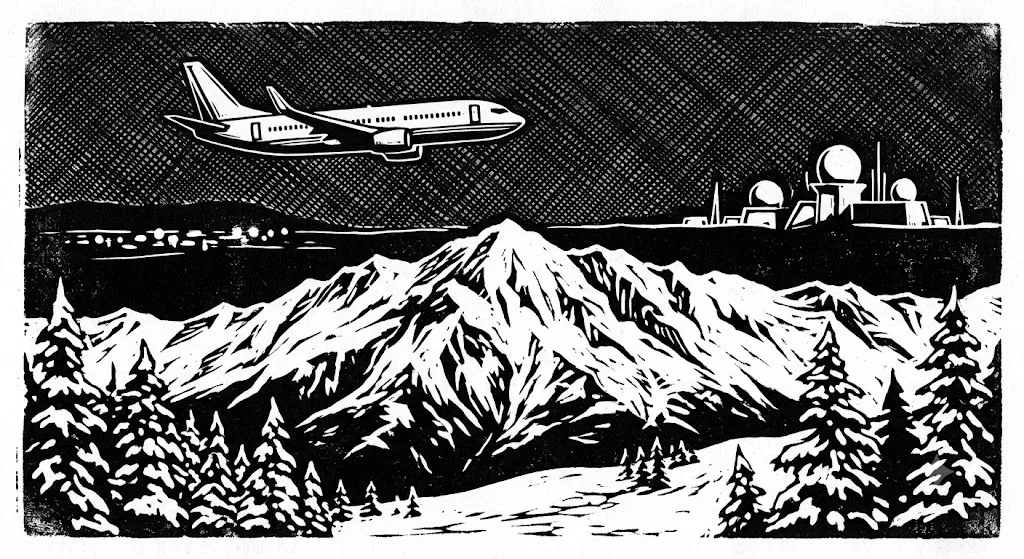
Two incidents stand above the rest. A January 1952 radar encounter near Nenana became an early military case that the US Air Force could not readily resolve. More than three decades later, Japan Air Lines Flight 1628 reported lights and an enormous dark object while crossing eastern Alaska, prompting extensive Federal Aviation Administration documentation. Both cases contain stronger evidence than an ordinary distant-light sighting, yet neither proves the presence of an extraordinary craft. Later technical reviews weakened some of their most dramatic elements while leaving narrower questions unanswered.[wikimedia.org]upload.wikimedia.orgWikimedia Commons…
Why Alaska produces unusually difficult cases
Alaska matters within American UFO history because aviation, surveillance and geography overlap there more strongly than in most states. Aircraft travelling between North America, Europe and Asia use northern routes; the state also hosts major military installations and radar systems because it faces the Arctic approaches to the United States. Reports can therefore involve professional pilots, air-traffic controllers and defence personnel rather than witnesses on the ground alone.
That does not automatically make the reports reliable. Darkness can remove the visual references needed to judge an object’s size and distance. Ice crystals, clouds, planets, stars, ground lights reflected from snow and unusual atmospheric refraction can all appear unfamiliar from a cockpit. Radar adds another source of evidence, but radar returns may represent weather, equipment effects, transponder-correlation errors or objects unrelated to what a witness sees. The strongest Alaska cases are consequently those in which investigators can compare testimony with recorded communications, radar data, weather information and the positions of known aircraft.
The state’s remoteness creates a further problem: physical evidence is rarely recovered. An observation may occur hundreds of kilometres from the nearest community, over mountains, tundra or sea ice. Even a genuine unidentified object can remain unidentified simply because investigators cannot reach the area, preserve debris or reconstruct the viewing geometry.
From the 1947 wave to military radar reports
Alaska participated in the national “flying disc” excitement that followed Kenneth Arnold’s June 1947 report in Washington state. Anchorage newspapers carried local claims during July, but the surviving accounts are generally brief and retrospective. They show that the new flying-saucer idea reached the territory almost immediately, not that the early reports were well investigated. A later survey of the 1947 wave included an Anchorage case among hundreds of newspaper-derived observations, while acknowledging the limitations of reconstructing events from press reports rather than contemporary technical files.[Wikipedia]WikipediaTable of reports during the 1947 flying disc crazeJul 10, Decatur… The UFO evidence. New York: Barnes & Noble Books. ISBN 0-7607-0627-1. OCLC…Read more…
The more substantial early Alaska record comes from the US Air Force’s investigation programmes—Project Sign, Project Grudge and, from 1952, Project Blue Book. Nationally, the Air Force recorded 12,618 reports between 1947 and 1969 and ultimately listed 701 as unidentified. “Unidentified” meant that the available information did not support a satisfactory explanation; it was not an official finding that the objects were alien spacecraft.[archives.gov]archives.govOf these 701 remain "Unidentified." The project wasNational ArchivesProject BLUE BOOK - Unidentified Flying ObjectsAugust 15, 2016 — 25 Jun 2024 — From 1947 to 1969, a total of 12, 618 sig…
The Nenana radar encounter
On 22 January 1952, a radar station at Murphy Dome, northwest of Fairbanks, detected an unknown target apparently travelling at roughly 1,500 miles per hour. According to the Air Force status report, it seemed to reverse direction, disappeared and then reappeared near its original position. An F-94 interceptor was sent to investigate. Its airborne radar operator later obtained two contacts near Nenana, including indications of rapid closure at short range, but neither crew member made a visual sighting. No malfunction was found in either radar set.[Wikimedia Commons]upload.wikimedia.orgWikimedia Commons…
This is one of Alaska’s more interesting archival cases because it involved separate ground and airborne radar systems and an active interception attempt. Yet the evidence remains incomplete. The contacts were intermittent, no object was seen, no photograph or radar-scope film is known to survive with the public report, and the document did not reach a firm conclusion. The case therefore deserves the label “unresolved radar incident”, but claims that it established the presence of a structured craft go beyond the surviving evidence.
The report also illustrates why the Cold War setting matters. Air Force investigators were concerned first with unidentified aircraft, possible hostile technology and failures in air defence. The federal UFO projects were intelligence and security programmes as much as scientific studies. Their files preserve useful observations, but the quality of investigation varies sharply from case to case.[Pieces of History]prologue.blogs.archives.govPieces of History Saucers Over Washington: the History of Project Blue BookPieces of History Saucers Over Washington: the History of Project Blue Book

JAL Flight 1628: Alaska’s landmark UFO incident
On 17 November 1986, Japan Air Lines cargo Flight 1628 was travelling towards Anchorage over eastern Alaska. Captain Kenju Terauchi, accompanied by a first officer and flight engineer, reported bright objects near the Boeing 747 and later described a much larger dark form behind or alongside the aircraft. The incident continued through a series of radio exchanges with Anchorage air-traffic controllers, course changes and requests for other aircraft to look for the reported traffic.[theblackvault.com]documents.theblackvault.com733667-001-015.pdfINFORMATION: Transcription concerning the incident involving Japan Airlines Flight 1628 on November 18, 1986 at approxi…
The event became famous because it appeared to offer an unusually strong combination of evidence:
- three professional crew members were present;
- the captain reported the objects in real time;
- the FAA retained communications, interviews and radar material;
- controllers discussed possible radar returns;
- another aircraft and a military transport were directed towards the area.
Contemporary news coverage initially presented the radar element as confirmation that an enormous object had accompanied the 747. Terauchi estimated that the largest form dwarfed his aircraft and later used terms such as “spaceship” and “mothership”. Those dramatic descriptions made the incident one of the best-known pilot UFO cases in the United States.[latimes.com]latimes.comla xpm 1987 01 01 mn 1922 storyla xpm 1987 01 01 mn 1922 story
What the records actually support
The surviving documentation supports the basic fact that the crew reported unexplained lights and that controllers took the report seriously. It also shows that one radar system intermittently displayed an additional return near the JAL aircraft. The FAA assembled a substantial data package containing radio communications, crew interviews and technical material rather than dismissing the report without examination.[centerforinquiry.s3.amazonaws.com]centerforinquiry.s3.amazonaws.comOpen source on amazonaws.com.
However, the records do not support every later version of the story. The crews of the other aircraft sent towards Flight 1628 did not report seeing the alleged object. The FAA’s technical review concluded that the intermittent secondary return was consistent with an “uncorrected primary and beacon target”: in effect, radar energy reflected from the 747 and its transponder signal were not perfectly matched, producing a duplicate or uncorrelated return. Such effects were not considered unusual in that equipment.[centerforinquiry.s3.amazonaws.com]centerforinquiry.s3.amazonaws.comOpen source on amazonaws.com.
The FAA also stressed that it was not a scientific UFO-investigation agency and had not attempted a full astronomical or atmospheric reconstruction. Its release of data therefore should not be mistaken for an official conclusion that the sighting was either extraordinary or fully explained.[centerforinquiry.s3.amazonaws.com]centerforinquiry.s3.amazonaws.comOpen source on amazonaws.com.
Why sceptics remain unconvinced
The principal sceptical interpretation, developed by aviation writer Philip J. Klass, argues that the radar evidence did not independently confirm the reported objects and that the visual experience probably involved misidentified celestial or terrestrial lights. Jupiter and Mars were prominent in the relevant part of the sky, while the captain himself acknowledged that darkness over Alaska could make lights difficult to identify. He described having previously been confused by lights from pipeline facilities reflecting in snowy terrain.[skepticalinquirer.org]skepticalinquirer.orgOpen source on skepticalinquirer.org.
Klass also noted differences between the captain’s vivid later narrative and the more restrained real-time communications. Terauchi had reported other UFOs and was already convinced that some represented extraterrestrial spacecraft, which critics regard as a possible source of expectation or interpretation. A subsequent report by him in the same broad region was later attributed by the FAA and the pilot to village lights diffused through ice-crystal cloud.[centerforinquiry.s3.amazonaws.com]centerforinquiry.s3.amazonaws.comOpen source on amazonaws.com.
These points weaken the claim that Flight 1628 was tracked by several independent sensors while manoeuvring around the aircraft. They do not prove that every light seen by the crew was a planet or reflection. The first officer and flight engineer also observed lights, and the duration and changing descriptions make a single simple explanation difficult to demonstrate conclusively from the surviving material.
The fairest assessment is therefore divided:
Strongly supported: an experienced crew reported unusual lights during flight; controllers documented the event; the FAA investigated the available operational data.
Weakened by later analysis: the claim of independent radar confirmation; claims that nearby aircraft saw the same object; estimates of enormous size and close distance.
Still uncertain: exactly which lights or visual effects produced the crew’s experience.
JAL 1628 remains unresolved at the level of precise identification, but its most sensational interpretation is considerably weaker than early headlines suggested.
A short cluster of later aviation reports
The publicity surrounding Flight 1628 was followed by further reports in Alaskan airspace. In January 1987, Captain Terauchi again described unusual lights on a similar route. That episode did not produce radar confirmation and was later accepted as an atmospheric distortion of ground lights.[centerforinquiry.s3.amazonaws.com]centerforinquiry.s3.amazonaws.comOpen source on amazonaws.com.
On 30 January, the crew of Alaska Airlines Flight 53 reported a bright object west of McGrath. FAA documentation records that controllers checked with Alaska Air Command and were told that no military aircraft were known to be operating in the relevant area. The surviving report demonstrates that the FAA continued to record unusual pilot observations after JAL 1628, but it does not provide enough independent data to establish the object’s nature.[documents.theblackvault.com]documents.theblackvault.cominterview with crewinterview with crew
These cases are sometimes presented as an “Alaska flap”: a concentrated wave proving that the same phenomenon repeatedly appeared over the state. A more cautious reading is that the JAL story increased attention among pilots, controllers and journalists, making subsequent ambiguous lights more likely to be noticed and reported. Some may have had ordinary explanations; others remain too poorly documented to classify. A cluster of reports is historically significant without necessarily representing a cluster of extraordinary craft.

Military connections without conspiracy claims
Alaska’s UFO story is inseparable from its military geography. Joint Base Elmendorf-Richardson near Anchorage, Eielson Air Force Base near Fairbanks and numerous radar installations have supported continental defence, interception and Arctic surveillance. This creates several reasons for UFO reports to occur around military systems:
- radar operators are actively searching for unknown tracks;
- interceptors can be launched quickly;
- classified or unfamiliar aircraft may be present;
- weather and radar propagation at northern latitudes can create confusing returns;
- military records are more likely than civilian memories to preserve times, bearings and equipment details.
The presence of a base or radar contact should therefore raise the investigative value of a report, but not automatically its exotic significance. Military witnesses can make mistakes, radar can generate artefacts, and secrecy around conventional defence activities can leave gaps that later invite speculation. The Nenana case is valuable because the official record documents what the systems and crew reported; it is not proof that military authorities secretly identified an alien vehicle.
The 2023 shoot-down near Alaska
On 10 February 2023, an F-22 shot down an unidentified high-altitude object over the Beaufort Sea near Deadhorse. Officials said it was roughly the size of a small car, uncrewed and flying at about 40,000 feet, where it posed a potential hazard to civilian aircraft. The incident was operationally real: radar detected an object, military aircraft inspected it, and a missile destroyed it.[Vanity Fair]vanityfair.comOpen source on vanityfair.com.
It should not, however, be treated as evidence of an unexplained advanced craft. The event occurred during an exceptional period of heightened radar sensitivity following the discovery of a Chinese surveillance balloon. US officials said the additional objects detected over North America were probably balloons associated with private, recreational or research activity rather than alien or hostile technology.[AP News]apnews.comAP News US jets down 4 objects in 8 days, unprecedented in peacetimeAP News US jets down 4 objects in 8 days, unprecedented in peacetime
Severe Arctic conditions prevented recovery of debris from the Alaska object, so its ownership and exact design were never conclusively established. That makes it technically unidentified, but the leading explanation remains a small balloon or similar benign platform. The case is an important modern lesson in terminology: an “unidentified flying object” can be a real manufactured object whose origin is unknown, without exhibiting anything beyond ordinary technology.[AP News]apnews.comAP News US ends search for objects shot down over Alaska, Lake HuronAP News US ends search for objects shot down over Alaska, Lake Huron
What usually explains Alaska sightings
No single explanation fits every report, but Alaska repeatedly presents the same practical difficulties.
Celestial objects: Bright planets and stars may appear to follow an aircraft because their immense distance prevents an observer from seeing normal changes in relative position. Without a visible horizon, pilots may overestimate movement, proximity and size.
Ice crystals and atmospheric optics: Thin ice-cloud layers can spread or duplicate lights, produce luminous patches and make distant ground sources appear suspended in the sky. The explanation accepted for Terauchi’s January 1987 report is a particularly relevant example.[centerforinquiry.s3.amazonaws.com]centerforinquiry.s3.amazonaws.comOpen source on amazonaws.com.
Ground lights: Villages, pipeline facilities, vehicles and industrial sites can be unexpectedly visible across snow-covered terrain. Reflections and refraction may detach the apparent light from its source.
Aircraft and balloons: Alaska’s military activity, polar aviation and meteorological work place conventional objects in areas where observers may not expect them. The 2023 episode showed how small high-altitude balloons can become national-security concerns when their operators are unknown.
Radar effects: A radar return is not a photograph of a solid craft. Duplicate tracks, anomalous propagation, weather and mismatched primary and transponder returns must be excluded before radar can be regarded as independent confirmation.
Meteors and re-entering space debris: Long darkness and clear northern horizons can make brief atmospheric events especially conspicuous. These explanations work best for fast, short-lived sightings, not reports of objects pacing aircraft for tens of minutes.
How strong is the state’s UFO evidence?
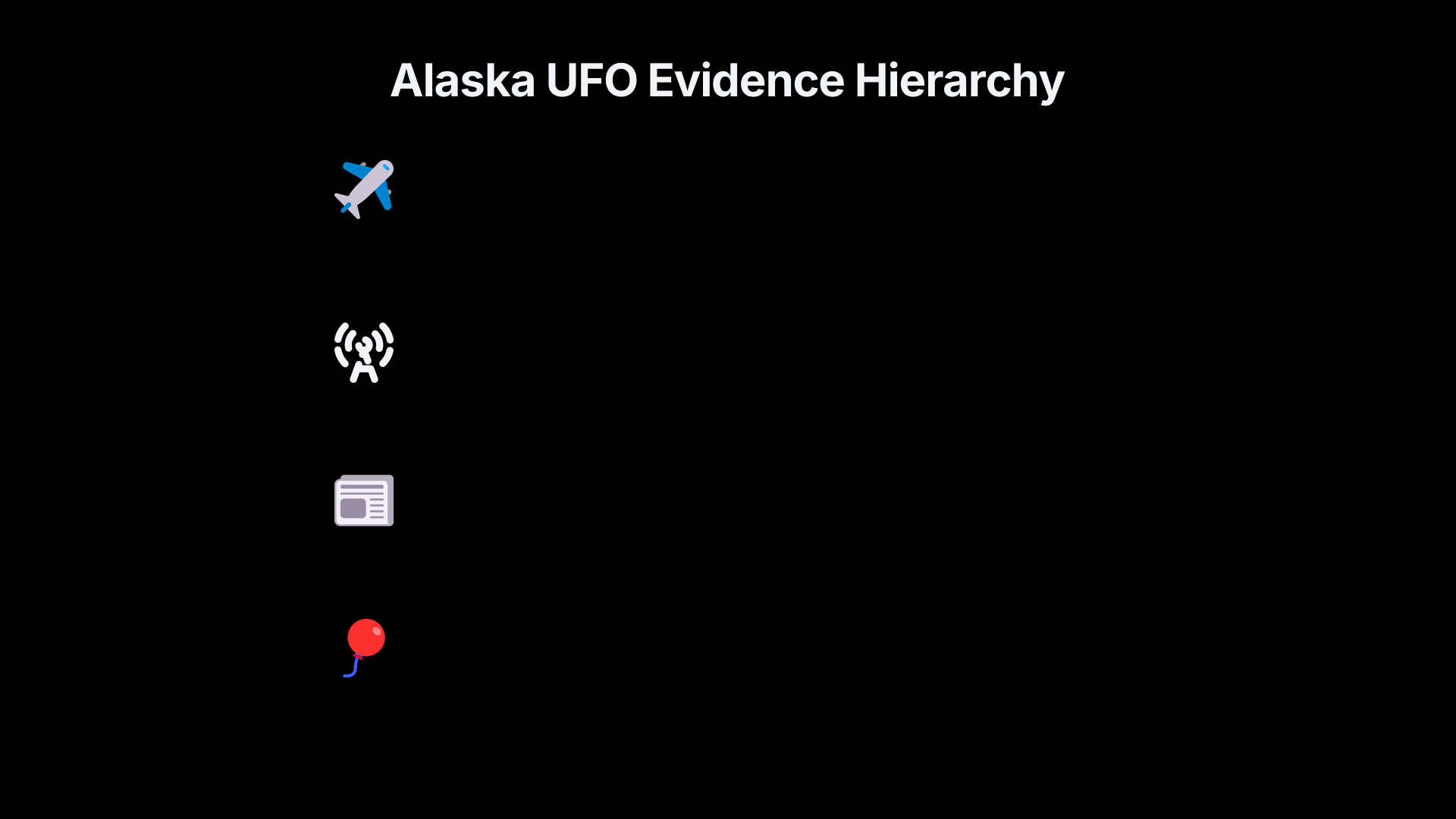
Alaska has several cases worth preserving and studying, but no publicly available incident establishes the presence of extraterrestrial technology. The evidence falls into three broad levels.
Historically important but weakly sourced: many reports from the 1947 wave, newspaper anecdotes and later stories about unnamed military witnesses. These reveal local UFO culture but lack sufficient records for serious reconstruction.
Unresolved but limited: the 1952 Nenana radar contacts and some later aviation reports. They contain official documentation or trained observers but lack visual confirmation, physical evidence or complete sensor records.
Well documented but substantially challenged: JAL Flight 1628. It has extensive testimony and operational records, yet later radar analysis and the failure of other aircraft to see the object undercut the strongest claims of multi-sensor confirmation.
This distinction matters because “unresolved” is often misunderstood. A case may remain open because its data are incomplete, not because investigators have exhausted ordinary explanations. Conversely, identifying weaknesses in one part of a story does not prove that witnesses invented the experience. A balanced history must allow both conclusions: people probably saw something that puzzled them, and the evidence may still be insufficient to determine what it was.
Where the documentary trail leads
The principal official archive for early Alaska cases is the National Archives collection of Project Blue Book records. The files include individual reports, status summaries and investigative correspondence, although witness names may be redacted and the surviving documentation is uneven. The National Archives explains that Blue Book ended in 1969 and that its remaining unidentified cases were never certified as extraterrestrial.[National Archives]archives.govOf these 701 remain "Unidentified." The project wasNational ArchivesProject BLUE BOOK - Unidentified Flying ObjectsAugust 15, 2016 — 25 Jun 2024 — From 1947 to 1969, a total of 12, 618 sig…
For JAL Flight 1628, the most valuable material is the FAA data package: air-traffic communications, crew interviews, incident paperwork and radar analysis. Later popular retellings frequently merge the captain’s later descriptions, early press reports and technical records into a single seamless story. Reading the documents separately shows where they agree and where the narrative grew more dramatic.
A sound assessment of any Alaska case should ask four questions:
- Was the report made at the time, or reconstructed years later?
- Did independent witnesses or sensors observe the same thing?
- Were their observations genuinely independent, rather than responses to a controller’s prompt?
- Is there enough information to test weather, astronomy, aircraft, balloons and equipment effects?
Cases that cannot answer those questions may still be culturally interesting, but they should not carry the same evidential weight as recorded aviation incidents.
Alaska’s place in American UFO history
Alaska is not important because it has produced proof of alien visitation. It is important because it shows how UFO reports emerge where unusual skies, strategic airspace and imperfect observation meet. Its best cases include exactly the elements readers often request—pilots, radar, military aircraft and official files—yet those elements do not always reinforce one another when examined closely.
The Nenana encounter remains an intriguing early radar case with too little surviving information for a confident explanation. JAL Flight 1628 remains the state’s landmark incident: genuine, extensively documented and still not reconstructed to everyone’s satisfaction, but less evidentially secure than its reputation suggests. The 2023 Deadhorse shoot-down, meanwhile, demonstrates that a real object can remain unidentified for practical reasons while still being most plausibly ordinary.
Alaska’s record therefore rewards neither blanket belief nor blanket dismissal. Its strongest lesson is methodological: witness credibility matters, but recorded data matter more; radar is valuable, but only after technical artefacts are excluded; and an unresolved label marks the limit of the evidence, not the discovery of an extraordinary craft.
Amazon book picks
Further Reading
Books and field guides related to What Really Happened in Alaska's Skies?. Use these as the next step if you want deeper reading beyond the article.
UFOs: Generals, Pilots, and Government Officials Go on the Re...
Strong fit for aviation-based sightings and documented cases.
The Report on Unidentified Flying Objects
Relevant to military and radar-linked cases.
The UFO Experience: A Scientific Inquiry
Provides a framework for assessing classic UFO reports.
eBay marketplace picks
Marketplace Samples
Live-tested eBay searches with available results related to this page.
Selected fromUFO poster oneBay.co.uk.



Endnotes
1.
Source: upload.wikimedia.org
Link:https://upload.wikimedia.org/wikipedia/commons/c/c0/Project_Blue_Book%2C_BBA-PBSR6-300.pdf
Source snippet
Wikimedia Commons...
2.
Source: documents.theblackvault.com
Link:https://documents.theblackvault.com/documents/ufos/jal1628/733667-001-015.pdf
Source snippet
733667-001-015.pdfINFORMATION: Transcription concerning the incident involving Japan Airlines Flight 1628 on November 18, 1986 at approxi...
Published: November 18, 1986
3.
Source: centerforinquiry.s3.amazonaws.com
Link:https://centerforinquiry.s3.amazonaws.com/wp-content/uploads/sites/29/1987/07/22165315/p04.pdf
4.
Source: Wikipedia
Title: Table of reports during the 1947 flying disc craze
Link:https://en.wikipedia.org/wiki/Table_of_reports_during_the_1947_flying_disc_craze
Source snippet
Jul 10, Decatur... The UFO evidence. New York: Barnes & Noble Books. ISBN 0-7607-0627-1. OCLC...Read more...
5.
Source: archives.gov
Title: Of these 701 remain “Unidentified.” The project was
Link:https://www.archives.gov/research/military/air-force/ufos
Source snippet
National ArchivesProject BLUE BOOK - Unidentified Flying ObjectsAugust 15, 2016 — 25 Jun 2024 — From 1947 to 1969, a total of 12, 618 sig...
Published: August 15, 2016
6.
Source: osi.af.mil
Title: project blue book part 1 ufo reports
Link:https://www.osi.af.mil/News/Features/Display/Article/2302429/project-blue-book-part-1-ufo-reports/
Source snippet
Project Blue Book Part 1 (UFO Reports)6 Aug 2020 — A total of 12,618 sightings were reported to Project Blue Book, with 701 remaining “un...
7.
Source: prologue.blogs.archives.gov
Title: Pieces of History Saucers Over Washington: the History of Project Blue Book
Link:https://prologue.blogs.archives.gov/2019/12/19/saucers-over-washington-the-history-of-project-blue-book/
8.
Source: skepticalinquirer.org
Link:https://skepticalinquirer.org/1987/07/faa-data-sheds-new-light-on-jal-pilots-ufo-report/
9.
Source: documents.theblackvault.com
Title: interview with crew
Link:https://documents.theblackvault.com/documents/ufos/jal1628/733667-001-030.pdf
10.
Source: time.com
Link:https://time.com/6254743/us-shoots-down-object-alaska/
11.
Source: Wikipedia
Title: 2023 Alaska high altitude object
Link:https://en.wikipedia.org/wiki/2023_Alaska_high-altitude_object
12.
Source: documents.theblackvault.com
Link:https://documents.theblackvault.com/documents/ufos/jal1628/733667-001-005.pdf
13.
Source: theblackvault.com
Title: the vault files 1986 alaska jal flight 1628
Link:https://www.theblackvault.com/casefiles/the-vault-files-1986-alaska-jal-flight-1628/
14.
Source: documents.theblackvault.com
Link:https://documents.theblackvault.com/documents/ufos/jal1628/733667-001-024.pdf
15.
Source: documents.theblackvault.com
Link:https://documents.theblackvault.com/documents/ufos/jal1628/733667-001-003.pdf
16.
Source: archives.gov
Title: A through Edevelopment project proposals. Alaska Territorial Guard members
Link:https://www.archives.gov/files/federal-register/the-federal-register/1999-annual1.txt
17.
Source: archives.gov
Link:https://www.archives.gov/files/federal-register/the-federal-register/2006-annual3.txt
18.
Source: Wikipedia
Title: Japan Air Lines Cargo Flight 1628
Link:https://en.wikipedia.org/wiki/Japan_Air_Lines_Cargo_Flight_1628
19.
Source: Wikipedia
Title: Project Blue Book
Link:https://en.wikipedia.org/wiki/Project_Blue_Book
20.
Source: upload.wikimedia.org
Title: Project Blue Book, BBA PBSR8 300
Link:https://upload.wikimedia.org/wikipedia/commons/5/5c/Project_Blue_Book%2C_BBA-PBSR8-300.pdf
21.
Source: archive.org
Link:https://archive.org/details/jal1628
22.
Source: files.secure.website
Title: usa alaska
Link:https://files.secure.website/wscfus/10517518/25903886/usa-alaska.pdf
23.
Source: history.com
Title: Project Blue Book
Link:https://www.history.com/articles/project-blue-book
24.
Source: latimes.com
Title: la xpm 1987 01 01 mn 1922 story
Link:https://www.latimes.com/archives/la-xpm-1987-01-01-mn-1922-story.html
25.
Source: washingtonpost.com
Link:https://www.washingtonpost.com/archive/politics/1987/01/02/ufo-sighting-confirmed-by-faa-air-force-radar/c186c4b7-54ed-459e-b94d-eeeff7b3322e/
26.
Source: vanityfair.com
Link:https://www.vanityfair.com/news/2023/02/pentagon-shoots-down-unidentified-flying-object-over-alaska
27.
Source: apnews.com
Title: AP News US jets down 4 objects in 8 days, unprecedented in peacetime
Link:https://apnews.com/article/acc1a333326c50ee9649760c569c300f
28.
Source: apnews.com
Title: AP News US ends search for objects shot down over Alaska, Lake Huron
Link:https://apnews.com/article/3a6f05a2b3158d104b4921860849495f
29.
Source: cia.gov
Link:https://www.cia.gov/readingroom/document/06741377
30.
Source: x.com
Link:https://x.com/ANC_Historian/status/2074901506495484377
31.
Source: wral.com
Link:https://www.wral.com/archive/17744754/
Additional References
32.
Source: nsa.gov
Title: Of a total of 12,618 sightings reported to Project Blue Book
Link:https://www.nsa.gov/portals/75/documents/news-features/declassified-documents/ufo/usaf_fact_sheet_95_03.pdf
Source snippet
Unidentified Flying Objects and Air Force Project Blue Bookby UF Sheet · Cited by 3 — From 1947 to 1969, the Air Force investigated Un...
33.
Source: youtube.com
Link:https://www.youtube.com/watch?v=PgDrHJ2IJ3M
Source snippet
Japan Airlines Saw a UFO Bigger Than an Aircraft Carrier | Kevin Knuth...
34.
Source: youtube.com
Title: Inside Alaska’s Most Unexplainable Mystery | Twisted Tales
Link:https://www.youtube.com/watch?v=PtmjirV9VUM
Source snippet
Missing Aircrafts and Flying Objects | The Alaska Triangle | Travel Channel...
35.
Source: youtube.com
Title: Japan Airlines Saw a UFO Bigger Than an Aircraft Carrier | Kevin Knuth
Link:https://www.youtube.com/watch?v=J3uHbff-GRw
Source snippet
UFO Sighting at 35,000 Feet | JAL Cargo Flight 1628...
36.
Source: youtube.com
Link:https://www.youtube.com/watch?v=h4wK6LTERss
Source snippet
Inside Alaska's Most Unexplainable Mystery | Twisted Tales...
37.
Source: facebook.com
Link:https://www.facebook.com/discoveryplusUK/videos/the-alaska-triangle-discovery/740443190381850/
38.
Source: instagram.com
Link:https://www.instagram.com/reel/DZnBn_tGolg/
39.
Source: instagram.com
Link:https://www.instagram.com/p/DZ-V_AVju2S/?hl=en-gb
40.
Source: gutenberg.org
Link:https://www.gutenberg.org/ebooks/17346.epub.images
41.
Source: sacred-texts.com
Link:https://sacred-texts.com/ufo/rufo/rufo12.htm