Within Alaska UFOs
Did Radar Confirm the JAL 1628 Sighting?
The famous 1986 pilot report combined real-time testimony and radar records, but later reviews weakened claims of independent confirmation.
On this page
- What the crew reported over eastern Alaska
- What the FAA communications and radar records show
- Why later reviews challenged the strongest claims
Page outline Jump by section
Introduction
Japan Air Lines Flight 1628 remains Alaska’s best-known UFO incident because it combined professional witnesses, real-time radio calls, an onboard weather-radar indication and apparent ground-radar returns. Yet the strongest popular claim — that radar independently confirmed a huge object shadowing the aircraft — is not supported by the Federal Aviation Administration’s later technical review. The records show that the crew genuinely reported unusual lights and that controllers briefly saw ambiguous returns near the aircraft. They do not establish that every visual report and radar response came from one physical object.
The case is therefore neither a simple fabrication nor a securely confirmed radar-visual encounter. Its lasting value lies in the unusually rich documentation: recorded communications, radar data, crew interviews and internal FAA memoranda. Those materials preserve a credible aviation mystery while also revealing how uncertain observations, normal radar effects and later retelling can turn a complicated incident into a much stronger story than the evidence warrants.[documents.theblackvault.com]documents.theblackvault.comOpen source on theblackvault.com.
What the crew reported over eastern Alaska
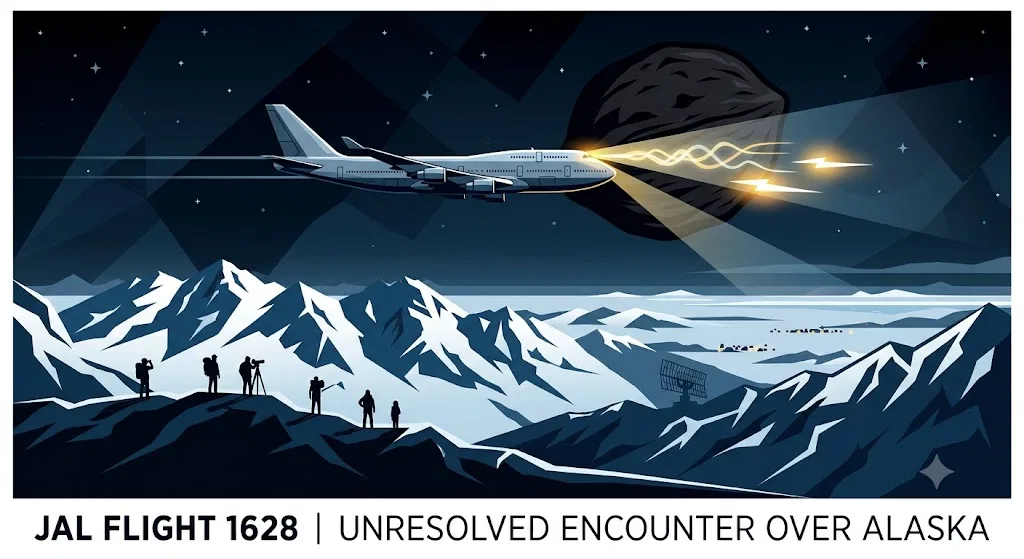
On 17 November 1986 local time — recorded in FAA documents as 18 November in Coordinated Universal Time — JAL Flight 1628, a Boeing 747 cargo aircraft, was flying towards Anchorage across eastern Alaska. Captain Kenju Terauchi, co-pilot Takanori Tamefuji and flight engineer Yoshio Tsukuba began observing unusual lights ahead and to the left of the aircraft.
At about 02:19 UTC, Terauchi asked Anchorage Center for information about nearby traffic. The controller replied that none was known in the vicinity. Terauchi said the apparent traffic was roughly one mile ahead, travelling in the same direction and near the 747’s altitude. He described white and yellow flashing lights. Six minutes later, the crew reported that the target appeared on the aircraft’s weather radar at about the 11 o’clock position and a range of eight miles.[documents.theblackvault.com]documents.theblackvault.comOpen source on theblackvault.com.
As the episode continued, Terauchi’s account became more dramatic. He said the object was “quite big”, requested permission to descend from 35,000 to 31,000 feet and later changed course. At one point the aircraft performed a full turn so that controllers and crew could see whether the reported traffic remained nearby. The captain subsequently described an enormous dark or walnut-shaped body, often called the “mothership” in later coverage, accompanied by smaller luminous objects. Contemporary press reports emphasised his estimate that the large object dwarfed the 747.[theblackvault.com]documents.theblackvault.comOpen source on theblackvault.com.
The basic fact that all three crew members saw unusual lights is reasonably well supported. Their later interviews, however, show less agreement about what those lights represented. Tsukuba described the first phenomenon as an undulating cluster of lights but said he could not identify a definite shape. He remained unsure whether it was genuinely extraordinary. Tamefuji described lights resembling two small aircraft and did not endorse Terauchi’s later drawing of a huge structured object. When shown the captain’s sketch, he said he had not seen anything like it, although connecting the lights could imply something large.[centerforinquiry.s3.amazonaws.com]centerforinquiry.s3.amazonaws.comOpen source on amazonaws.com.
This distinction matters. The evidence is strongest for an unusual light observation shared by three people. It is weaker for the claim that all three independently saw a single enormous solid craft. Much of the famous “mothership” imagery came from the captain’s interpretation rather than a consistent description agreed by the full crew.
What the communications and radar records show
The live communications are the case’s most valuable evidence because they record events before publicity and later reconstruction could alter the story. They confirm that Terauchi reported unidentified traffic, that controllers treated the report seriously and that both civilian and military radar facilities were asked to check the area.
At approximately 02:26 UTC, the military Regional Operations Control Center reported a primary radar return near the 747’s ten o’clock position at about eight miles. One minute later, it said that the return had disappeared. At 02:35, Fairbanks Approach reported no corresponding target. A few minutes later, the military centre referred to a possible “flight of two” and a primary-only target, but again lost the return. These exchanges explain why early reports said that radar had confirmed the sighting: controllers did see intermittent indications that appeared, in real time, to fit part of the crew’s account.[documents.theblackvault.com]documents.theblackvault.comOpen source on theblackvault.com.
That is not the same as a stable radar track. There was no continuous secondary target following JAL 1628 through its turns, descent and course changes. The returns were intermittent, not consistently linked to the visually reported positions, and not simultaneously confirmed by every available radar facility.
The FAA also directed another airliner towards the area. At about 02:50 UTC, the crew of a northbound United Airlines flight reported seeing the JAL aircraft against the lighter sky but no other traffic. A nearby US Air Force C-130 crew likewise saw the 747 but no accompanying object. The United observation is especially relevant because Terauchi was still reporting the light in a position that should have made some form of visual corroboration possible, although differences in viewing direction and background mean the negative sighting cannot by itself prove that nothing was present.[documents.theblackvault.com]documents.theblackvault.comOpen source on theblackvault.com.
The onboard weather radar is sometimes presented as a second independent confirmation. All three crew members recalled a weak green indication at roughly the same bearing and distance as the first lights. However, a weather radar is designed principally to show precipitation and storm intensity, not to identify nearby aircraft. The reported return was weak and stream-like rather than the powerful, compact echo that might be expected from an enormous solid object only several miles away. Thin cloud or ice-crystal returns are therefore a plausible alternative.[centerforinquiry.s3.amazonaws.com]centerforinquiry.s3.amazonaws.comOpen source on amazonaws.com.
Why the FAA rejected firm radar confirmation
After the flight, the FAA preserved and regenerated approximately 61 minutes of radar data. Its technical specialists found no abnormal target that could be reliably associated with the object described by the captain. The Anchorage air traffic manager’s December memorandum stated plainly that recorded radar data did not confirm the presence of the reported traffic.[documents.theblackvault.com]documents.theblackvault.comOpen source on theblackvault.com.
The most important technical finding concerned an “uncorrelated primary and beacon target”. Air traffic radar could receive both a primary reflection from an aircraft’s physical surface and a secondary reply from its transponder. Ideally, the computer combined them into one track. Small timing differences could place the two responses in adjacent radar cells, briefly making one aircraft appear as two nearby returns.
FAA specialists found that this was normal in the JAL data. About 72 per cent of the responses were correctly combined primary and beacon returns. Roughly 25 per cent appeared initially as beacon-only responses, and in 90 per cent of those instances a nearby primary return was present within about one-eighth of a mile. The technical analysis concluded that these slight separations were common effects of transponder timing and radar-correlation circuitry, not evidence of another aircraft.[documents.theblackvault.com]documents.theblackvault.comOpen source on theblackvault.com.
This does not mean that every military comment made during the incident was imagined. Controllers were responding correctly to what they could see at the time, under the added pressure of a captain reporting nearby traffic. A return that later looks like a routine split or uncorrelated target may appear more significant during a live safety situation. The post-event review had access to repeated regenerated displays and could compare patterns across the full dataset, something the controllers could not do in real time.[documents.theblackvault.com]documents.theblackvault.comOpen source on theblackvault.com.
Researchers sympathetic to the UFO interpretation have argued that the FAA’s own uncertainty deserves more weight. Aviation researcher Richard Haines cited an Anchorage manager’s comment that the agency could “neither confirm nor deny” the event and that, without the crew’s report, the radar response might simply have been dismissed as a split beacon. Haines treated this as evidence that unusual returns can be filtered out as routine noise. That is a reasonable warning about the limits of radar interpretation, but it does not overturn the detailed technical finding that the recorded returns behaved like known correlation effects.[Squarespace]static1.squarespace.comairufocl.doc…
Which ordinary explanations fit the observations?
No single conventional explanation accounts neatly for every statement in the record. The most plausible sceptical reconstruction separates the incident into at least two visual phases rather than assuming that one object performed everything described.
The first phase involved shifting or undulating amber-white lights ahead and to the left. Thin cloud containing ice crystals could have diffused or reflected light, producing luminous patches that changed as the aircraft moved. The weak, elongated green weather-radar response is compatible with cloud rather than a solid vehicle. A later incident involving Terauchi in the same broad region was eventually attributed by the pilot and FAA to village lights diffused through ice-crystal cloud, showing that this type of misperception was possible in Alaskan winter conditions.[centerforinquiry.s3.amazonaws.com]centerforinquiry.s3.amazonaws.comOpen source on amazonaws.com.
The longer second phase may have involved a bright celestial object. Sceptical investigator Philip Klass calculated that Jupiter was low and conspicuous in the south-eastern sky, close to some of the reported directions. Mars was also visible but less bright. Against a dark sky with few distance cues, a planet can seem to match an aircraft’s movement because it remains in approximately the same direction while the aircraft turns or descends. This interpretation is strengthened by the United crew’s failure to see a large object where Terauchi placed it, although the geometry was not identical for both aircraft.[centerforinquiry.s3.amazonaws.com]centerforinquiry.s3.amazonaws.comOpen source on amazonaws.com.
There are limits to this explanation. The crew initially described more than a single steady point, and Terauchi reported rapid changes in intensity and relative position. Planets do not produce nearby radar returns, illuminate a cockpit or form two distinct objects. The sceptical model therefore depends on a combination of effects: cloud or reflected lights during the early phase, a bright planet during the later phase, and normal radar artefacts occurring at roughly the same time. Such a combined explanation can appear less satisfying than a single extraordinary craft, but mixed-cause incidents are common when observers try to impose one narrative on several ambiguous stimuli.
The captain’s experience does not settle the question either way. Professional pilots are valuable witnesses because they understand aircraft, traffic lights and cockpit procedures. They are still vulnerable to mistaken distance, scale and motion judgements at night, particularly over sparsely lit terrain without a clear horizon. Terauchi also entered the investigation with a strong belief that the objects were extraterrestrial and had reported other UFO sightings, which does not invalidate his testimony but makes his interpretation less neutral.[centerforinquiry.s3.amazonaws.com]centerforinquiry.s3.amazonaws.comOpen source on amazonaws.com.
Why later reviews weakened the strongest version
The story that entered popular UFO history is more definite than the contemporary documents. In its strongest form, it says that three expert witnesses saw an immense structured craft, airborne radar detected it, civilian and military ground radar independently tracked it, and the object followed the 747 through evasive manoeuvres for more than 40 minutes. Each part contains some truth, but the combined claim overstates the evidence.
The three witnesses agreed that they saw lights, not that they all saw Terauchi’s giant walnut-shaped body. The onboard radar indication was weak and suitable for an atmospheric return. Ground radar produced intermittent, ambiguous responses rather than a sustained track, and the FAA’s analysis found no abnormal target. Other nearby crews saw JAL 1628 but no accompanying object.[amazonaws.com]centerforinquiry.s3.amazonaws.comOpen source on amazonaws.com.
There was also a delay before the most detailed interviews. The FAA interviewed the crew separately in January, around six weeks after the flight, rather than conducting complete recorded interviews immediately after landing. By then the incident had attracted press attention, and the captain had prepared an extensive narrative and drawings. Memory delay does not make the testimony false, but it increases the risk that later interpretation will become blended with the original perception.[centerforinquiry.s3.amazonaws.com]centerforinquiry.s3.amazonaws.comOpen source on amazonaws.com.
The FAA’s role is sometimes misunderstood. It documented the event because it concerned possible unidentified traffic and aviation safety, but officials said the agency lacked both the resources and the mandate to conduct a broad scientific investigation of UFO claims. Its work was strongest where it had relevant expertise: communications, traffic procedures and radar analysis. It did not produce a definitive astronomical or atmospheric reconstruction of every light the crew reported.[centerforinquiry.s3.amazonaws.com]centerforinquiry.s3.amazonaws.comOpen source on amazonaws.com.
The most defensible verdict
JAL Flight 1628 is best classified as a well-documented but unresolved visual incident whose supposed radar confirmation was substantially weakened by later analysis. There is strong evidence that the crew encountered lights they could not identify and that the captain was sufficiently concerned to request altitude and course changes. There is also good evidence that controllers briefly considered unidentified radar traffic possible.
What the records do not demonstrate is a huge physical craft independently tracked by several radar systems. The FAA’s technical reconstruction found ordinary uncorrelated returns associated with the 747, while nearby aircraft supplied no visual confirmation. Differences between the crew members further weaken the claim that all three witnessed the same enormous structured object.
Within Alaska’s UFO history, the case matters less as proof of an extraordinary vehicle than as an unusually clear lesson in evidence quality. Real-time testimony can be sincere without providing reliable estimates of size and distance. Radar can appear corroborative without representing a second object. Later reporting can merge separate observations into one dramatic pursuit. JAL 1628 remains more substantial than a lone anecdote, but its surviving evidence supports uncertainty, not confirmation.
Amazon book picks
Further Reading
Books and field guides related to Did Radar Confirm the JAL 1628 Sighting?. Use these as the next step if you want deeper reading beyond the article.
UFOs: Generals, Pilots, and Government Officials Go on the Re...
Directly aligned with pilot testimony, radar evidence and official records.
The Report on Unidentified Flying Objects
Explains how military and radar cases are analyzed.
The UFO Experience: A Scientific Inquiry
Useful for evaluating multi-witness and instrument-supported reports.
eBay marketplace picks
Marketplace Samples
Live-tested eBay searches with available results related to this page.
Selected fromUFO poster oneBay.co.uk.




Endnotes
1.
Source: documents.theblackvault.com
Link:https://documents.theblackvault.com/documents/ufos/jal1628/733667-001-012.pdf
2.
Source: documents.theblackvault.com
Link:https://documents.theblackvault.com/documents/ufos/jal1628/733667-001-022.pdf
3.
Source: centerforinquiry.s3.amazonaws.com
Link:https://centerforinquiry.s3.amazonaws.com/wp-content/uploads/sites/29/1987/07/22165315/p04.pdf
4.
Source: upi.com
Title: JAL pilot describes UFO
Link:https://www.upi.com/Archives/1986/12/31/JAL-pilot-describes-UFO/6559536389200/
Source snippet
JAL pilot describes UFO - UPI Archives31 Dec 1986 — FAA officials Monday confirmed the controller who handled Flight 1628 saw a myster...
5.
Source: static1.squarespace.com
Link:https://static1.squarespace.com/static/5cf80ff422b5a90001351e31/t/5d02ea1772637c00014776c5/1560472092579/narcap.TR1.AvSafety.pdf
Source snippet
airufocl.doc...
6.
Source: earthworm-owl-l76t.squarespace.com
Link:https://earthworm-owl-l76t.squarespace.com/s/narcap_TR-3_2001.pdf
7.
Source: documents.theblackvault.com
Link:https://documents.theblackvault.com/documents/ufos/jal1628/733667-001-003.pdf
8.
Source: documents.theblackvault.com
Link:https://documents.theblackvault.com/documents/ufos/jal1628/733667-001-015.pdf
9.
Source: theblackvault.com
Title: the vault files 1986 alaska jal flight 1628
Link:https://www.theblackvault.com/casefiles/the-vault-files-1986-alaska-jal-flight-1628/
10.
Source: upi.com
Title: Radar review fails to confirm UFO
Link:https://www.upi.com/Archives/1987/01/08/Radar-review-fails-to-confirm-UFO/8875537080400/
11.
Source: upi.com
Title: Controller confirms UFO sighting
Link:https://www.upi.com/Archives/1986/12/30/Controller-confirms-UFO-sighting/4431536302800/
12.
Source: scribd.com
Title: JAL flight1628
Link:https://www.scribd.com/document/94376509/JAL-flight1628
Additional References
13.
Source: latimes.com
Title: la xpm 1987 01 01 mn 1922 story
Link:https://www.latimes.com/archives/la-xpm-1987-01-01-mn-1922-story.html
Source snippet
Los Angeles TimesPlane Maneuvered to Avoid Object: Pilot Recounts...1 Jan 1987 — A veteran pilot whose UFO sighting was confirmed on ra...
14.
Source: jal.co.jp
Title: JAPA N AIRLINES (JAL)
Link:https://www.jal.co.jp/ar/en/
Source snippet
JAPAN AIRLINES (JAL) - Flights to Japan from US & CanadaBook flights & vacations to Tokyo, Osaka & more destinations in Japan & Asia with...
15.
Source: jal.co.jp
Title: JAPA N AIRLINES (JAL)
Link:https://www.jal.co.jp/in/en/
Source snippet
JAPAN AIRLINES (JAL) - Flights to Japan from IndiaBook flights to Tokyo and more destinations in Japan with Japan Airlines (JAL). Manage...
16.
Source: youtube.com
Link:https://www.youtube.com/watch?v=DXNfyOVoi7g
Source snippet
"Japan Airlines Flight 1628 — Pilot Encounters Flying Object The Size Of 4 Aircraft Carriers...
17.
Source: arxiv.org
Link:https://arxiv.org/html/2502.06794v1
18.
Source: jal.co.jp
Title: JAPA N AIRLINES
Link:https://www.jal.co.jp/jp/en/inter/
Source snippet
JAPAN AIRLINES - International FlightsJAL International Flights.You can book and purchase international airline tickets, as well as searc...
19.
Source: tripadvisor.com
Link:https://www.tripadvisor.com/Airline_Review-d8729095-Reviews-Japan-Airlines-JAL
20.
Source: facebook.com
Link:https://www.facebook.com/viceuk/posts/the-former-astronaut-did-not-see-the-objects-on-his-radar-and-was-not-notified-a/959094232755326/
21.
Source: researchgate.net
Link:https://www.researchgate.net/publication/336062892_Estimating_Flight_Characteristics_of_Anomalous_Unidentified_Aerial_Vehicles
22.
Source: audioboom.com
Title: 8914705 japan airlines 1628 the ufo case alaska couldn t explain
Link:https://audioboom.com/posts/8914705-japan-airlines-1628-the-ufo-case-alaska-couldn-t-explain