Within Mc Minnville
Did the Photos Really Show a Distant Object?
The pale underside once suggested a large distant craft, but that conclusion depends on uncertain assumptions about light, surface reflectivity and film
On this page
- How Hartmann used brightness to estimate distance
- Why reflectivity and exposure weaken the calculation
- What later critics and defenders concluded
Page outline Jump by section
Introduction
One of the most influential arguments in favour of the McMinnville photographs was not the shape of the object but its brightness. When astronomer William K. Hartmann examined the original negatives for the University of Colorado UFO study in the late 1960s, he concluded that the object’s lighting appeared more consistent with a relatively large, distant object than with a small model hanging close to the camera. For decades, supporters of the photographs pointed to this photometric analysis as one of the strongest reasons to reject the suspended-model explanation.[files.ncas.org]files.ncas.orgCondon Report, Photographic Case Studies: Cases 4659To the extent that the photometric analysis is reliable, (and the measurements appear to be consistent), the photographs indicate an ob…

The difficulty is that brightness alone cannot directly reveal distance. To estimate how far away an object is from a photograph, investigators must make assumptions about its surface reflectivity, shape, orientation to the Sun, atmospheric conditions and the camera’s exposure characteristics. The McMinnville debate eventually turned on whether those assumptions were secure enough to support Hartmann’s conclusion. Most later critics argued that they were not.[files.ncas.org]files.ncas.orgCondon Report, Photographic Case Studies: Cases 4659To the extent that the photometric analysis is reliable, (and the measurements appear to be consistent), the photographs indicate an ob…
How Hartmann Used Brightness to Estimate Distance
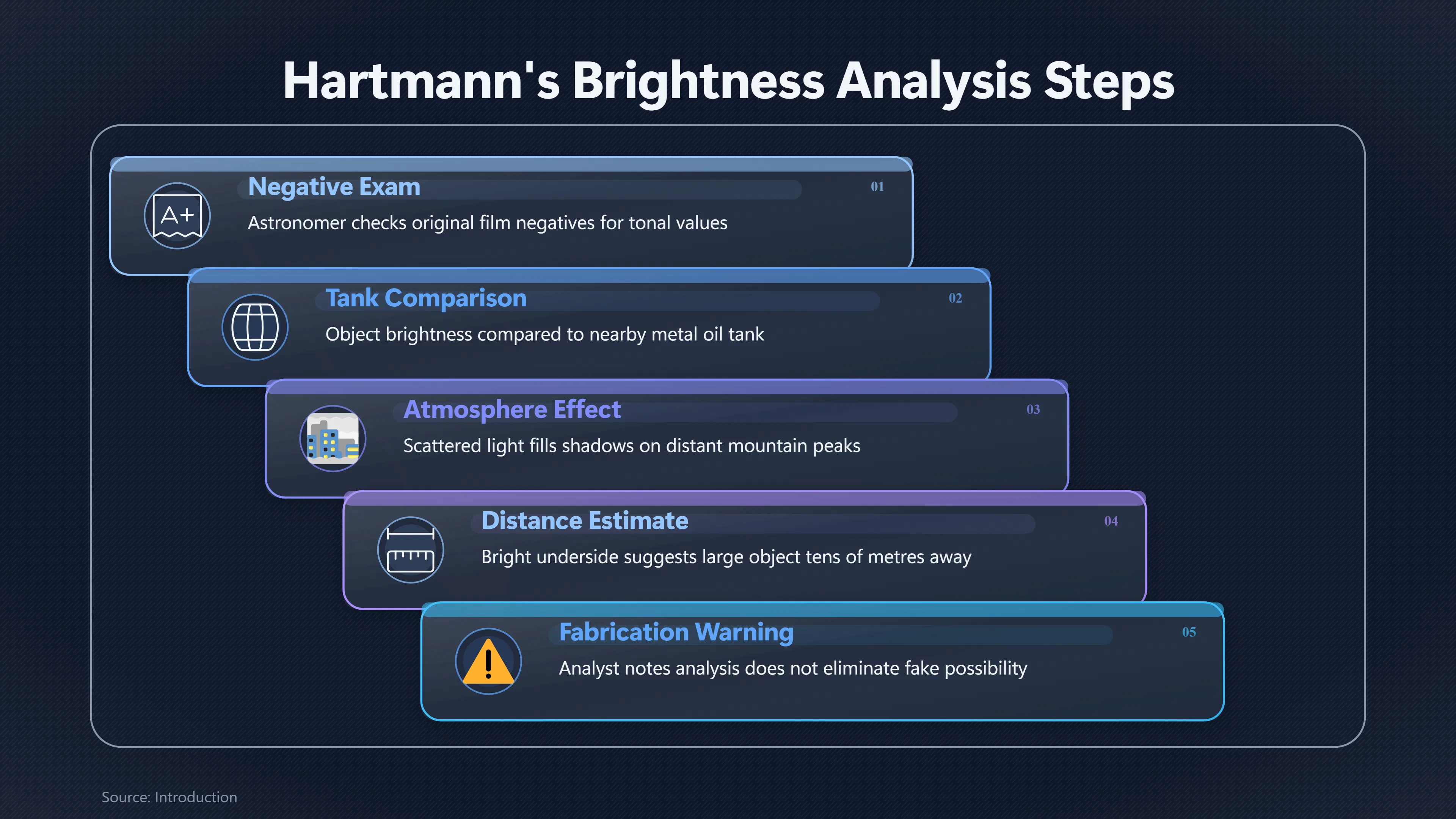
Hartmann’s analysis compared the tonal values of the alleged UFO with other visible objects in the scene. He paid particular attention to the brightness of the object’s underside relative to known structures on the Trent farm, including a nearby metal oil tank. The underside of the photographed object appeared surprisingly bright rather than deeply shadowed.[files.ncas.org]files.ncas.orgCondon Report, Photographic Case Studies: Cases 4659To the extent that the photometric analysis is reliable, (and the measurements appear to be consistent), the photographs indicate an ob…
His reasoning was based on a familiar photographic effect. Distant objects viewed through the atmosphere can lose contrast because scattered light partially fills in shadows. Mountains on the horizon, for example, often appear lighter and less contrasty than nearby objects. Hartmann suggested that the object’s bright underside could indicate a sizeable object at some distance rather than a small object hanging only a few metres from the camera.[Wikipedia]WikipediaMc Minnville UFO photographsMc Minnville UFO photographs
Using photometric measurements from the negatives, Hartmann concluded that the simplest interpretation was a shiny object located a considerable distance away, potentially tens of metres in diameter. He regarded this as broadly consistent with what the witnesses claimed to have seen. At the same time, he explicitly warned that the analysis did not eliminate the possibility of fabrication.[files.ncas.org]files.ncas.orgCondon Report, Photographic Case Studies: Cases 4659To the extent that the photometric analysis is reliable, (and the measurements appear to be consistent), the photographs indicate an ob…
This distinction is important. Hartmann did not claim that brightness proved the object was distant. He argued that, if the photometric assumptions were correct, the measurements pointed in that direction.[files.ncas.org]files.ncas.orgCondon Report, Photographic Case Studies: Cases 4659To the extent that the photometric analysis is reliable, (and the measurements appear to be consistent), the photographs indicate an ob…
Why Reflectivity and Exposure Weaken the Calculation
The weakness in the argument becomes clear once the unknowns are examined.
A photograph records brightness on film, not distance. To move from one to the other, investigators must know or estimate several factors:
- How reflective the object’s surface was.
- Whether the surface was polished, matte or partly reflective.
- The angle between the Sun, the object and the camera.
- The exact exposure behaviour of the film and camera.
- Atmospheric haze and scattered light.
- The object’s orientation in three-dimensional space.[Reddit]reddit.comThe Trent UFO was a large, distant objectThe Trent UFO was a large, distant object.September 2, 2025 — the McMinnville UFO was a model hanging. If the object was in the sam…
Even small changes in these assumptions can produce large changes in estimated distance.
For example, a highly reflective nearby model can appear brighter than a less reflective distant object. Likewise, a curved metallic surface may direct sunlight towards the camera in unexpected ways, producing bright areas that are not simply a function of range. If the object’s orientation changed between the two photographs—as most analysts agree it did—then brightness differences become even harder to interpret because surface angles influence reflected light.[Reddit]reddit.comThe Trent UFO was a large, distant objectThe Trent UFO was a large, distant object.September 2, 2025 — the McMinnville UFO was a model hanging. If the object was in the sam…
Film photography adds another layer of uncertainty. Mid-twentieth-century photographic emulsions do not record brightness in a perfectly linear way. Small errors in estimating exposure or film response can alter conclusions drawn from densitometric measurements of the negative. Later researchers therefore questioned whether the available data were precise enough to support a confident distance calculation.[files.ncas.org]files.ncas.orgCondon Report, Photographic Case Studies: Cases 4659To the extent that the photometric analysis is reliable, (and the measurements appear to be consistent), the photographs indicate an ob…
What Later Critics Concluded
By the 1980s and afterwards, sceptical investigators increasingly argued that the brightness evidence had been given too much weight.
Philip Klass and Robert Sheaffer focused primarily on geometric and contextual issues rather than photometry, but their broader conclusion was that a small suspended object remained entirely plausible. Hartmann himself had noted that the object appeared beneath the overhead wires and that a hanging model could not be ruled out.[Wikipedia]WikipediaMc Minnville UFO photographsMc Minnville UFO photographs
The later IPACO reanalysis, which used modern image-analysis techniques, concentrated on geometry and the possible detection of a suspension thread. Its authors argued that the photographs were consistent with a small object hanging several metres from the camera. Their reconstruction did not depend on accepting Hartmann’s brightness-based distance estimate.[ipaco.fr]ipaco.frThe Mc Minnville picturesThe McMinnville pictures - IPACO.frA deep photogrammetric analysis has been conducted by Bruce Maccabee. Based on physical data obtained…
Critics of the photometric argument therefore made a narrower claim than is sometimes assumed. They did not necessarily show that Hartmann’s measurements were wrong. Instead, they argued that the chain of assumptions connecting brightness to distance was too uncertain to settle the case.[ipaco.fr]ipaco.frThe Mc Minnville picturesThe McMinnville pictures - IPACO.frA deep photogrammetric analysis has been conducted by Bruce Maccabee. Based on physical data obtained…
What Defenders of the Photographs Still Argue
Supporters of the photographs, especially researcher Bruce Maccabee, continued to regard the brightness measurements as significant. Maccabee performed extensive densitometric work and argued that the object’s tonal characteristics remained more consistent with a distant object than with a small nearby model. He maintained that no convincing evidence of a suspension thread had been demonstrated and that the photometric results should not be dismissed.[Wikipedia]WikipediaMc Minnville UFO photographsMc Minnville UFO photographs
From this perspective, brightness does not stand alone but forms part of a wider pattern that includes the object’s apparent structure, the absence of obvious support hardware and the witnesses’ account. Defenders therefore see Hartmann’s analysis as supportive evidence rather than as a mathematical proof.[Wikipedia]WikipediaMc Minnville UFO photographsMc Minnville UFO photographs
The Real Lesson of the Brightness Test
The brightness argument remains one of the most interesting aspects of the McMinnville photographs because it shows both the promise and the limits of photographic evidence.
Hartmann’s work demonstrated that the images contained enough information to invite serious quantitative analysis, something rarely possible in classic UFO photographs. Yet the same analysis also revealed how dependent such conclusions are on assumptions that cannot be fully verified decades later.[files.ncas.org]files.ncas.orgCondon Report, Photographic Case Studies: Cases 4659To the extent that the photometric analysis is reliable, (and the measurements appear to be consistent), the photographs indicate an ob…
As a result, few investigators today regard brightness as capable of proving that the McMinnville object was distant. The photometric evidence may be compatible with a large object far from the camera, but it does not uniquely require that interpretation. In the broader suspended-model dispute, brightness remains a suggestive clue rather than a decisive test.[ncas.org]files.ncas.orgCondon Report, Photographic Case Studies: Cases 4659To the extent that the photometric analysis is reliable, (and the measurements appear to be consistent), the photographs indicate an ob…
Amazon book picks
Further Reading
Books and field guides related to Did the Photos Really Show a Distant Object?. Use these as the next step if you want deeper reading beyond the article.
UFOs: Generals, Pilots, and Government Officials Go on the Re...
Provides broad context for evaluating prominent UFO cases, including the standards of evidence used in photographic claims.
The Report on Unidentified Flying Objects
Offers historical context for official investigations and evidence evaluation surrounding famous UFO reports.
The UFO Enigma: A New Review of the Physical Evidence
Discusses scientific approaches to assessing UFO evidence, relevant to debates over photographic interpretation.
The World of Flying Saucers A Scientific Examination of a Maj...
Examines photographic and observational claims from a critical scientific perspective.
eBay marketplace picks
Marketplace Samples
Live-tested eBay searches with available results related to this page.
Selected fromvintage film camera oneBay.co.uk.
Endnotes
1.
Source: files.ncas.org
Title: Condon Report, Photographic Case Studies: Cases 46
Link:https://files.ncas.org/condon/text/case46.htm
Source snippet
59To the extent that the photometric analysis is reliable, (and the measurements appear to be consistent), the photographs indicate an ob...
2.
Source: Wikipedia
Title: [Mc Minnville]({{ ‘mc-minnville/’ | relative_url }}) UFO photographs
Link:https://en.wikipedia.org/wiki/McMinnville_UFO_photographs
3.
Source: reddit.com
Title: The Trent UFO was a large, distant object
Link:https://www.reddit.com/r/UFOs/comments/1n69tm4/the_trent_ufo_was_a_large_distant_object/
Source snippet
The Trent UFO was a large, distant object.September 2, 2025 — the McMinnville UFO was a model hanging. If the object was in the sam...
Published: September 2, 2025
4.
Source: ipaco.fr
Title: The Mc Minnville pictures
Link:https://www.ipaco.fr/ReportMcMinnville.pdf
Source snippet
The McMinnville pictures - IPACO.frA deep photogrammetric analysis has been conducted by Bruce Maccabee. Based on physical data obtained...
5.
Source: reddit.com
Title: 1950 mcminnville ufo sighting one of the oldest
Link:https://www.reddit.com/r/UFOs/comments/ta3xrh/1950_mcminnville_ufo_sighting_one_of_the_oldest/
Additional References
6.
Source: medium.com
Link:https://medium.com/on-the-trail-of-the-saucers/the-classic-mcminnville-ufo-photos-are-70-years-old-5af8c5cf3b11
Source snippet
McMinnville UFO Photos Still Mystify | Point of ContactMaccabee argued that the brightness of the object's underside suggested it w...
7.
Source: facebook.com
Link:https://www.facebook.com/blurrycreatures/posts/one-of-the-best-documented-ufo-encounters-with-photoswidely-considered-credible-/1245165104060404/
Source snippet
even by some skeptics—is the McMinnville UFO incident of...
8.
Source: facebook.com
Link:https://www.facebook.com/art.chantry/posts/maybe-my-all-time-favorite-flying-saucer-photos/10162151390263873/
Source snippet
e UFO's lighting and shadowing. distance calculated...
9.
Source: youtube.com
Title: Evelyn Trent’s First-hand Testimony on the Mc Minnville UFO Sighting
Link:https://www.youtube.com/watch?v=3syjdja7hpc
Source snippet
How the McMinnville UFO sighting inspired [Oregon]({{ 'which-oregon-ufo-cases-still-resist/' | relative_url }})'s famous UFO festival...
10.
Source: youtube.com
Title: How the Mc Minnville UFO sighting inspired Oregon’s famous UFO festival
Link:https://www.youtube.com/watch?v=I70VGsQ6ZVw
Source snippet
Where We Live: McMinnville's famous UFO Festival...
11.
Source: youtube.com
Title: UFO confirmed!? The Mc Minnville Mystery | Photographiliac
Link:https://www.youtube.com/watch?v=M8gUCGLjea4
Source snippet
Evelyn Trent's First-hand Testimony on the McMinnville UFO Sighting...
12.
Source: facebook.com
Title: Forgotten Oregon
Link:https://www.facebook.com/groups/ForgottenOregon/posts/2033590760242185/
Source snippet
Anyone remember the 1950 UFO sighting in McMinnville...The McMinnville UFO photographs were taken on a farm near McMinnville, Oregon, Un...
13.
Source: instagram.com
Link:https://www.instagram.com/reel/DYa_tbyA72M/
14.
Source: scottbakal.com
Link:https://www.scottbakal.com/mcminnvilleufo
15.
Source: bmva-archive.org.uk
Link:https://bmva-archive.org.uk/bmvc/2014/files/paper057.pdf