Within Des Moines
Could Airport Radar Have Missed the Lights?
The tower's lack of unusual radar reports neither confirmed a craft nor proved that no visible object was present near Centerville.
On this page
- What the Des Moines tower actually reported
- Why primary radar and transponder systems differ
- What a negative radar response can and cannot prove
Page outline Jump by section
Introduction
When reports of mysterious lights near Centerville, Iowa, reached the news in October 1989, a Federal Aviation Administration supervisor at the Des Moines airport reportedly said there had been no unusual radar activity. That statement is often misunderstood. It did not prove that witnesses saw nothing, nor did it confirm that an unknown craft had evaded detection. It simply meant that the airport had no corresponding radar report at the time.[UPI]upi.comResidents see silent glowing UFOsResidents see silent glowing UFOs - UPI Archives12 Oct 1989 — An Iowa farmer who thought flying saucers were 'nonsense' now is not so…
Understanding why matters because the reported lights were roughly 70 miles from Des Moines, and airport radar systems are designed primarily to monitor aircraft traffic, not to create a complete record of every visible light in the night sky. Radar and human eyesight detect different things, operate under different limitations, and can produce apparently conflicting observations without either side being wrong.[UPI]upi.comResidents see silent glowing UFOsResidents see silent glowing UFOs - UPI Archives12 Oct 1989 — An Iowa farmer who thought flying saucers were 'nonsense' now is not so…
Could Airport Radar Have Missed the Lights?
The short answer is yes. A visible light can sometimes be seen by observers even when no corresponding radar target is recorded.
In the Centerville case, the key point is geographical. The sighting occurred in southern Iowa, while the enquiry was made to the Des Moines airport tower. A negative response from the tower therefore reflected what controllers knew from their surveillance systems, not necessarily what every observer in the region could see.[UPI]upi.comResidents see silent glowing UFOsResidents see silent glowing UFOs - UPI Archives12 Oct 1989 — An Iowa farmer who thought flying saucers were 'nonsense' now is not so…
Radar systems have practical limits. Coverage depends on distance, altitude, line of sight, terrain, the strength of the radar return, and whether an aircraft is transmitting identification information. FAA guidance notes that radar performance is affected by earth curvature, obstacles, and low-altitude geometry, meaning some objects can be difficult or impossible to detect under certain conditions.[FAA]faa.gov4-5-2. Air Traffic Control Radar Beacon System (ATCRBS)8 Jan 2015 — Relatively low altitude aircraft will not be seen if they are scre…
This is especially relevant to visual-light reports. Witnesses may notice a bright point of light from many miles away without knowing its exact distance, altitude, or size. A light that appears close overhead can in reality be much farther away than it seems.
What the Des Moines Tower Actually Reported
The contemporary wire-service report did not describe a radar track that controllers failed to identify. Instead, it quoted an FAA supervisor saying there had been no report of unusual radar activity following the sighting.[UPI]upi.comResidents see silent glowing UFOsResidents see silent glowing UFOs - UPI Archives12 Oct 1989 — An Iowa farmer who thought flying saucers were 'nonsense' now is not so…
That distinction is important.
A statement that no unusual radar activity was reported means:
- Controllers were not aware of a corresponding anomalous radar target.
- No radar confirmation was publicly reported.
- No direct radar evidence was offered to support the sighting.
It does not mean:
- Every object visible from Centerville was definitely detected and identified.
- Every part of the sky between Centerville and Des Moines was continuously monitored without limitation.
- Witnesses could not have seen a genuine light source.
The radar response was therefore negative evidence rather than disproof. It weakened claims of a tracked unknown aircraft, but it did not automatically explain what witnesses saw.[UPI]upi.comResidents see silent glowing UFOsResidents see silent glowing UFOs - UPI Archives12 Oct 1989 — An Iowa farmer who thought flying saucers were 'nonsense' now is not so…
Why Primary Radar and Transponder Systems Differ
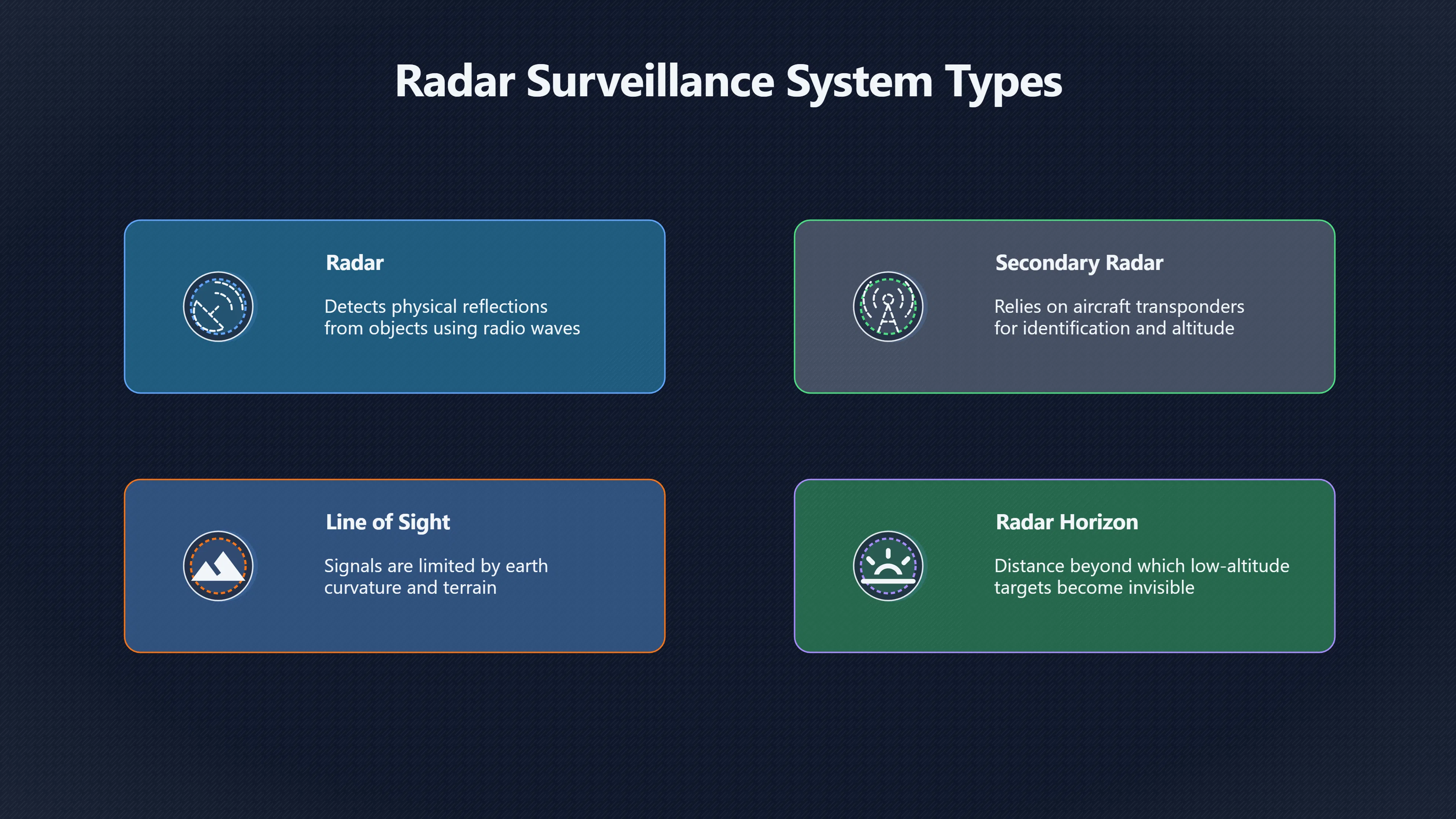
A common misunderstanding in UFO discussions is that all radar works the same way. In reality, air-traffic surveillance relies on multiple systems.
Primary radar sends out radio waves and detects reflections from physical objects. If an object reflects enough energy back to the radar, it may appear as a target. Primary radar can detect objects that are not actively cooperating, but detection depends on range, altitude, radar cross-section, and environmental conditions.[wikipedia.org]WikipediaSecondary surveillance radarSecondary surveillance radar
Secondary surveillance radar, by contrast, depends on aircraft transponders. The ground station sends an interrogation signal, and the aircraft replies with identification and altitude information. If there is no transponder reply, the system may have much less information available.[Wikipedia]WikipediaSecondary surveillance radarSecondary surveillance radar
For investigators looking back at the Centerville report, this means a simple question such as “Did radar see it?” can be misleading. The answer depends on which radar system is being discussed, what kind of object was supposedly present, where it was located, and whether it was transmitting any identifying signal.[Wikipedia]WikipediaSecondary surveillance radarSecondary surveillance radar
Why Distance and Low-Altitude Geometry Matter
Radar does not see infinitely far. Like visible light, radar is constrained by line-of-sight geometry.
FAA guidance notes that low-altitude aircraft may not be detected when they are screened by terrain or fall below the radar beam because of the curvature of the Earth. Coverage is therefore not identical at every altitude and distance from a radar site.[faa.gov]faa.gov4-5-2. Air Traffic Control Radar Beacon System (ATCRBS)8 Jan 2015 — Relatively low altitude aircraft will not be seen if they are scre…
Even in relatively flat states such as Iowa, radar performance changes with:
- Distance from the radar installation.
- Height of the target above the ground.
- Local terrain and obstacles.
- The strength of the reflected signal.
Technical discussions of radar coverage frequently describe a “radar horizon”, beyond which low-level targets become increasingly difficult to observe because of geometry rather than equipment failure.[Wikipedia]WikipediaRadar horizonRadar horizon
For a light reported near Centerville, roughly 70 miles from Des Moines, these limitations are more relevant than many casual readers realise. A light visible to a witness is not automatically equivalent to a radar target visible to airport surveillance equipment.[UPI]upi.comResidents see silent glowing UFOsResidents see silent glowing UFOs - UPI Archives12 Oct 1989 — An Iowa farmer who thought flying saucers were 'nonsense' now is not so…
What a Negative Radar Response Can and Cannot Prove
The most careful interpretation of the 1989 report lies between two extremes.
One extreme claims that the absence of radar evidence proves the witnesses were mistaken. The other claims that radar somehow failed to detect a confirmed unknown craft.
Neither conclusion follows from the available evidence.
What the record supports is much narrower:
- Witnesses reported bright lights near Centerville.
- An enquiry reached the Des Moines airport.
- No unusual radar activity was reported by the FAA supervisor quoted in contemporary coverage.[UPI]upi.comResidents see silent glowing UFOsResidents see silent glowing UFOs - UPI Archives12 Oct 1989 — An Iowa farmer who thought flying saucers were 'nonsense' now is not so…
Because there was no publicly documented radar track, the case lacks one of the strongest forms of corroboration available in aviation-related UFO reports. At the same time, the lack of a radar report does not establish that no visible object existed. Radar systems and human observers measure different aspects of the sky and can produce different results.[wikipedia.org]WikipediaSecondary surveillance radarSecondary surveillance radar
Within Iowa’s UFO history, this makes the Centerville lights a useful example of the limits of airport identification rather than a strong radar case. The Des Moines tower’s response neither confirmed an unknown craft nor conclusively ruled out a visible light source. It simply highlighted the gap that can exist between what witnesses report seeing and what air-traffic surveillance systems record.[UPI]upi.comResidents see silent glowing UFOsResidents see silent glowing UFOs - UPI Archives12 Oct 1989 — An Iowa farmer who thought flying saucers were 'nonsense' now is not so…

Amazon book picks
Further Reading
Books and field guides related to Could Airport Radar Have Missed the Lights?. Use these as the next step if you want deeper reading beyond the article.
UFOs: Generals, Pilots, and Government Officials Go on the Re...
Includes radar, pilot, and air-traffic related cases.
The Report on Unidentified Flying Objects
Discusses Air Force investigations involving radar evidence.
The UFO Experience: A Scientific Inquiry
Explains evidence standards and limitations of sightings.
UFOs and Government: A Historical Inquiry
Covers military and governmental handling of radar-related reports.
eBay marketplace picks
Marketplace Samples
Live-tested eBay searches with available results related to this page.
Selected fromufo poster oneBay.co.uk.




Endnotes
1.
Source: upi.com
Title: Residents see silent glowing UFOs
Link:https://www.upi.com/Archives/1989/10/12/Residents-see-silent-glowing-UFOs/7247624168000/
Source snippet
Residents see silent glowing UFOs - UPI Archives12 Oct 1989 — An Iowa farmer who thought flying saucers were 'nonsense' now is not so...
2.
Source: faa.gov
Link:https://www.faa.gov/air_traffic/publications/atpubs/aim_html/chap4_section_5.html
Source snippet
Section 5. Surveillance SystemsRelatively low altitude aircraft... As in (d) above, TIS is dependent on two-way, “line of sight” comm...
3.
Source: faa.gov
Link:https://www.faa.gov/air_traffic/publications/atpubs/aim/aim0405.html
Source snippet
4-5-2. Air Traffic Control Radar Beacon System (ATCRBS)8 Jan 2015 — Relatively low altitude aircraft will not be seen if they are scre...
4.
Source: faraim.org
Link:https://faraim.org/faa/aim/chapter-4/section-4-5-6.html
Source snippet
AIM § 4-5-6 Traffic Information Service (TIS)S Radar Sites. This maximum range can vary by radar site and is always subject to "line of s...
5.
Source: Wikipedia
Title: Secondary surveillance radar
Link:https://en.wikipedia.org/wiki/Secondary_surveillance_radar
6.
Source: sciencedirect.com
Title: ScienceDirect Secondary Surveillance Radar
Link:https://www.sciencedirect.com/topics/engineering/secondary-surveillance-radar
Source snippet
Secondary Surveillance Radar - an overviewA radar or 'primary' radar (to distinguish it from a secondary surveillance radar...
7.
Source: faa.gov
Link:https://www.faa.gov/air_traffic/technology/radardivestiture/terminology
Source snippet
Radar Surveillance Terminology8 Jan 2024 — Cooperative Radars (Secondary radar) are Beacon Interrogators that identify and track an ai...
8.
Source: Wikipedia
Title: Radar horizon
Link:https://en.wikipedia.org/wiki/Radar_horizon
9.
Source: faa.gov
Link:https://www.faa.gov/
10.
Source: faa.gov
Link:https://www.faa.gov/air_traffic/publications/atpubs/atc_html/chap5_section_3.html
11.
Source: faa.gov
Title: asr 11
Link:https://www.faa.gov/air_traffic/technology/asr-11
12.
Source: faraim.org
Link:https://faraim.org/faa/aim/chapter-4/section-4-5-1.html
13.
Source: Wikipedia
Title: Automatic Dependent Surveillance–Broadcast
Link:https://en.wikipedia.org/wiki/Automatic_Dependent_Surveillance%E2%80%93Broadcast
14.
Source: Wikipedia
Title: Airport surveillance radar
Link:https://en.wikipedia.org/wiki/Airport_surveillance_radar
15.
Source: Wikipedia
Title: Terrain following radar
Link:https://en.wikipedia.org/wiki/Terrain-following_radar
16.
Source: sciencedirect.com
Link:https://www.sciencedirect.com/science/article/pii/S1270963824000798
17.
Source: airresearch.com
Link:https://www.airresearch.com/Pilots/AIM-08/Chap4/aim0405.html
Source snippet
#4-5-1... Radar Sites. This maximum range can vary by radar site and is always subject to "line of sight" limitations; the radar and data...
Additional References
18.
Source: studyaircrafts.com
Link:https://www.studyaircrafts.com/atc-transponder
Source snippet
Study AircraftsAir Traffic Control (ATC) TransponderIn the case of ATC primary radar, the energy is reflected from the aircraft's body to...
19.
Source: youtube.com
Title: STAR NG, the new Primary Surveillance Radar for Air Traffic Control
Link:https://www.youtube.com/watch?v=0zbNJsGQH5U
Source snippet
Seeing Isn't Always Believing: Side Lobe Effects in Marine Radar...
20.
Source: ecfr.gov
Link:https://www.ecfr.gov/current/title-14/chapter-I/subchapter-F/part-91
21.
Source: weather.gov
Link:https://www.weather.gov/media/publications/front/14dec-front.pdf
22.
Source: regulations.gov
Link:https://www.regulations.gov/document/FAA-2007-29305-0289
23.
Source: cia.gov
Link:https://www.cia.gov/readingroom/document/cia-rdp81r00560r000100010001-0
24.
Source: youtube.com
Title: Seeing Isn’t Always Believing: Side Lobe Effects in Marine Radar
Link:https://www.youtube.com/watch?v=U7zgRscRo2w
Source snippet
How to calculate line of sight from an antenna?...
25.
Source: youtube.com
Title: How Radar vs Li DAR Differ | Waves vs Light
Link:https://www.youtube.com/watch?v=pb6EzskvgxM
Source snippet
STAR NG, the new Primary Surveillance Radar for Air Traffic Control...
26.
Source: youtube.com
Title: RADAR System Basics, Working, and Limitations Explained
Link:https://www.youtube.com/watch?v=K1pOShhWGhk
Source snippet
How Radar vs LiDAR Differ | Waves vs Light...
27.
Source: cfinotebook.net
Link:https://www.cfinotebook.net/notebook/air-traffic-control/radar