Within New Hampshire
Was the Exeter UFO a Military Aircraft?
The Exeter sighting rests on immediate testimony from a young man and two police officers, but disputed aircraft explanations remain central.
On this page
- What the witnesses reported near Exeter
- Why Pease Air Force Base mattered
- The disputed aircraft explanation
Page outline Jump by section
Introduction
The Exeter incident remains one of New Hampshire’s strongest-looking UFO cases, but not because it produced photographs, radar data or physical evidence. Its reputation rests on immediate testimony from Norman Muscarello, an 18-year-old hitchhiker, followed by observations from Exeter police officers Eugene Bertrand and David Hunt in the early hours of 3 September 1965. All described intensely bright red lights moving in sequence above fields near Kensington, south of Exeter.[Center for Inquiry]centerforinquiry.s3.amazonaws.comCenter for Inquiry
A military aircraft is the leading conventional explanation, especially because nearby Pease Air Force Base was active that night. Yet the original Air Force suggestion was poorly demonstrated, and a later theory identifying the lights as those of a KC-97 refuelling tanker also lacks a confirmed aircraft record placing such a tanker at the right location and time. The fairest conclusion is that Exeter is unresolved rather than inexplicable: aircraft remain plausible, but no proposed aircraft explanation has conclusively reconstructed the event.
What the witnesses reported near Exeter
Muscarello reached the Exeter police station at about 2.24 am, visibly shaken after walking and hitchhiking home along Route 150. In the signed statement preserved in accounts of the case, he described five extremely bright lights arranged along a sloping line. The lights flashed one at a time, moving through a sequence from one to five and back again. He said that they illuminated the surrounding area, disappeared behind trees and houses, and moved in a way he compared to a floating leaf. He could not see a solid outline behind the glare.[Center for Inquiry]centerforinquiry.s3.amazonaws.comCenter for Inquiry
That last point is important. Popular retellings often describe a clearly observed, enormous structured craft, but the strongest contemporary descriptions concern lights rather than a visible body. Muscarello believed the source was close and at one point jumped into a ditch because he feared being struck. However, without a clear outline, known distance or reliable scale, estimates of an object’s size and altitude are necessarily uncertain.
Officer Bertrand took Muscarello back to the field shortly before 3 am. Bertrand then reported seeing the same arrangement of five brilliant red lights, flashing one after another. He said they appeared to approach closely enough that he dropped down and began to draw his revolver before retreating to the police car. Officer Hunt arrived after being called by radio and also saw the lights before they moved away.[Center for Inquiry]centerforinquiry.s3.amazonaws.comCenter for Inquiry
The police involvement gave Exeter unusual weight. Muscarello was no longer the sole witness recounting a frightening experience after the event; an officer accompanied him back to the location and reported a similar display. Hunt provided a third observer, although he arrived later and apparently watched for a shorter period. The men submitted statements promptly, reducing the opportunity for the basic account to evolve over months or years.
Their testimony is still not equivalent to instrumental confirmation. There is no known photograph, film, radar trace, recovered material or recorded measurement of the lights. The witnesses were observing at night, across uneven rural ground, with trees and buildings interrupting the view. Bright airborne lights can appear to stop, descend, enlarge or pass behind nearby objects when their true distance is unknown. The officers’ presence strengthens the evidence that an unusual display was seen, but it cannot by itself establish the display’s nature.
Why Pease Air Force Base mattered
Pease Air Force Base, then a Strategic Air Command installation near Portsmouth, placed Exeter beneath or close to airspace used by military bombers, tankers and returning aircraft. This was not incidental background. Military activity offered a ready source of unusual lights and manoeuvres, and the Exeter police chief reported the sighting to the base. Pease personnel interviewed the witnesses and inspected the area. Project Blue Book, the US Air Force programme responsible for UFO reports, subsequently accumulated a substantial file on the incident.[Internet Archive]archive.org1965 09 9373271 Exeter NewHampshireAir Force5 Dec 2015 — Publication date: 1965; Topics: UFO, UFOs, Unidentified Flying Object, Unidentified Flying Objects, Air Force, U.S…
An early Air Force report did not dismiss the witnesses as unreliable. The investigating officer described the three observers as stable and credible, particularly the policemen, and stated that he had been unable to identify a probable cause. He also noted that five B-47 bombers had been flying in the area but did not believe they were connected to the sighting.[Wikimedia Commons]upload.wikimedia.orgWikimedia Commons…. ________ ~_.. or Exeter. ~scarallo arrived at midnight at the local police station. with a hair-rafsi…
That preliminary assessment is one reason Exeter became so influential. It showed that local Air Force investigators recognised a genuine identification problem rather than immediately treating the account as a hoax or obvious astronomical error.
The Pentagon nevertheless circulated an explanation involving stars and planets distorted by atmospheric conditions. Even the later sceptical reassessment of the case regards that proposal as incompatible with the reported moving, sequenced red lights. An alternative suggestion that the witnesses had seen the glare or approach strobes from Pease was reportedly tested by switching runway and approach lighting on and off; observers at the Exeter location did not see a corresponding effect.[Center for Inquiry]centerforinquiry.s3.amazonaws.comCenter for Inquiry
Project Blue Book then concentrated on military flying. Its chief, Major Hector Quintanilla, suggested that aircraft participating in a Strategic Air Command and North American Air Defence Command exercise called Operation Big Blast might account for the report. He also mentioned the five B-47s operating near Pease and observed that Exeter lay within a traffic pattern used as aircraft returned to the base.[Center for Inquiry]centerforinquiry.s3.amazonaws.comCenter for Inquiry
This was a reasonable line of inquiry, but the wording was speculative. The Air Force argued that the lights “might” have been associated with the operation; it did not identify a particular aircraft, crew or flight path matching the witnesses’ observations.
The timing problem with Operation Big Blast
The main objection was chronological. According to the Blue Book correspondence discussed in later analyses, Operation Big Blast was active between midnight and 2 am. Muscarello’s sighting began after 2 am, while Bertrand’s observation occurred nearer 3 am. Bertrand therefore argued that the exercise had ended too early to explain what he and Muscarello saw in the field.[Center for Inquiry]centerforinquiry.s3.amazonaws.comCenter for Inquiry
The timing does not prove that no military aircraft remained airborne. An exercise can end administratively while participating aircraft continue returning to base, circling or completing other procedures. Indeed, a B-47 was heard or seen near the time the unexplained lights departed. That supports the general proposition that military flying continued in the area.[Center for Inquiry]centerforinquiry.s3.amazonaws.comCenter for Inquiry
It also creates a difficulty for a simple B-47 identification. Hunt reportedly distinguished the recognisable bomber, including its engine noise, from the earlier silent display. The original investigating officer likewise knew that B-47s had been flying but doubted that they caused the reported phenomenon. This does not rule out another aircraft, but it weakens the idea that the witnesses merely failed to recognise an ordinary returning B-47.
Bertrand and Hunt wrote to Blue Book objecting that they had observed the lights at close apparent range, heard no jet, propeller or helicopter noise, and saw neither wings nor a tail. They also emphasised that the lights illuminated the field and nearby houses. Their correspondence later appeared in material submitted during a 1966 congressional hearing, where Exeter was discussed as an Air Force “unknown” rather than a conclusively identified event.[GovInfo]govinfo.govCHRG 89hhrg50066OGovInfo•1W,It is heartening to see that the U.S. Air Force regards the UFO sighted by. Officers Bertrand and Hunt as an unknown. I am sur…
The dispute therefore concerned more than whether aircraft were present. Aircraft certainly were present around Pease. The unanswered question was whether any known flight reproduced the precise time, location, lighting pattern, apparent movement and absence of sound described by the witnesses.
The disputed KC-97 tanker explanation
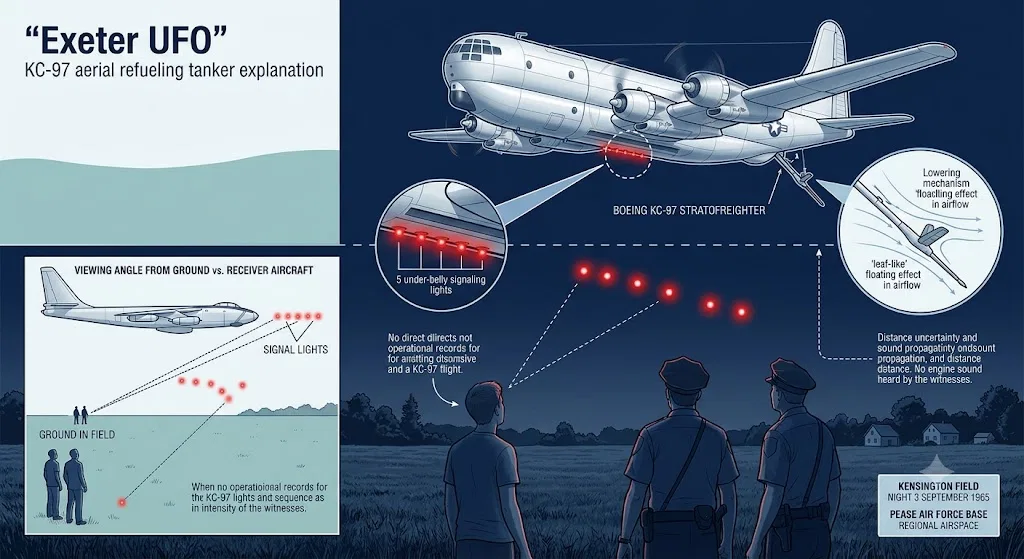
In 2011, retired Air Force pilot James McGaha and sceptical investigator Joe Nickell proposed a much more specific aircraft theory. They argued that the five red lights belonged to a Boeing KC-97 aerial-refuelling tanker, a piston-engined aircraft used to refuel bombers. Their theory focused on the most distinctive feature of Muscarello’s statement: the repeated sequence of five lights flashing in order and then reversing.[Center for Inquiry]centerforinquiry.s3.amazonaws.comCenter for Inquiry
KC-97 tankers carried visual signalling equipment to guide an approaching receiver aircraft during refuelling. McGaha and Nickell identified a row of five red panels on the tanker’s underside and argued that these could match the witnesses’ sequence. They also noted that the tanker’s refuelling boom, when lowered, extended at roughly the same steep angle described by Muscarello. Movement of the boom in airflow was offered as an explanation for his comparison with a floating leaf.[Center for Inquiry]centerforinquiry.s3.amazonaws.comCenter for Inquiry
The theory has genuine strengths:
- It attempts to explain the exact number, colour and sequence of the lights rather than merely pointing to general aircraft traffic.
- It fits the military setting around a Strategic Air Command base.
- A tanker making wide circuits could appear repeatedly from behind trees and buildings.
- Brilliant lights against a dark sky could conceal the body of the aircraft and distort estimates of distance, size and speed.
- Refuelling activity would be compatible with B-47 operations in the region.
These details make the KC-97 proposal more serious than the earlier explanations involving stars, airport strobes or an advertising aircraft. It shows how a specialised piece of aviation equipment could look highly unfamiliar even to observers accustomed to ordinary aeroplanes.
However, the proposed match is not complete. The theory assumes that a KC-97 was actually flying near Kensington at the necessary time, with its refuelling boom deployed and its signalling lights operating. McGaha and Nickell did not produce a flight log, crew record, radar track or mission sheet establishing that chain of events. Instead, they reasoned that a tanker would likely have taken part in an exercise involving Strategic Air Command bombers and might still have been airborne after the exercise ended.[Center for Inquiry]centerforinquiry.s3.amazonaws.comCenter for Inquiry
That is plausible inference, not direct identification.
Why the tanker theory remains contested
Technical critics of the KC-97 explanation argue that the proposed light system and viewing geometry do not fit the reports as neatly as the theory suggests. The lights on a tanker were designed as signals for a receiving pilot positioned behind and below the aircraft, not as a dramatic row visible equally well from every point on the ground. Their apparent brightness, colour and sequence would depend on orientation, distance, obstructions and whether the system was actually in its bright operating mode.[martinshough.com]martinshough.comExeunt Exeter?Exeunt Exeter?
The sound issue is also significant. A KC-97 was a large aircraft powered principally by four radial piston engines. At the close distances claimed by Muscarello and Bertrand, it should have been conspicuously noisy. The sceptical answer is that the witnesses badly underestimated the aircraft’s distance because the lights were exceptionally bright. That is possible, but it means the theory must reject one of the account’s most memorable features: the impression that the source approached to within roughly field-scale distance.
Distance uncertainty cuts both ways. It weakens witness estimates of a huge nearby craft, but it also prevents a precise reconstruction showing that a more distant tanker would have occupied the reported part of the sky. No surveyed lines of sight, verified altitude or recorded bearing survive to settle the question.
The reported movement creates another problem. Muscarello and Bertrand described the lights as descending behind trees, reappearing and moving towards them with a rocking or leaf-like motion. A circling aircraft viewed through foreground trees can produce some of these effects, particularly when the observer is frightened and lacks a fixed reference. Yet the KC-97 theory does not demonstrate a specific circuit or approach path that recreates the sequence from the witnesses’ location.
Nor does the presence of a B-47 at the end of the sighting prove that it had just refuelled from the alleged tanker. McGaha and Nickell presented this as a possibility, not a documented link. The bomber could simply show that Pease traffic was active while being unrelated to the red lights.
The tanker hypothesis is therefore best regarded as a plausible candidate rather than a solved identification. It has a stronger mechanism than the original Air Force statements, but the missing operational records prevent it from closing the case.
How much weight should the police testimony carry?
Police officers are often considered valuable UFO witnesses because they are expected to observe carefully and report accurately. Bertrand and Hunt also risked ridicule by challenging the Air Force’s public explanation. Their prompt statements and consistent insistence that the display differed from a conventional aircraft are meaningful evidence of sincerity.[GovInfo]govinfo.govCHRG 89hhrg50066OGovInfo•1W,It is heartening to see that the U.S. Air Force regards the UFO sighted by. Officers Bertrand and Hunt as an unknown. I am sur…
Professional status does not remove the ordinary limits of perception. Neither officer was conducting a controlled aviation observation. They had no calibrated instruments, and Bertrand entered the field after hearing a frightened young man’s account. Once the lights appeared, both men interpreted them under stress. Bertrand’s impulse to draw his weapon indicates how threatening and close the display seemed, but fear can intensify perceived proximity and size.
Hunt’s evidence is useful but less extensive. He arrived after the principal encounter had begun and confirmed unusual lights before their departure. He helps establish that Muscarello and Bertrand were not responding to something visible only to them, but his testimony does not independently establish all the dramatic details attributed to the object.
The most defensible reading is that three people, including two officers, saw an unusual airborne light display. Their agreement makes fabrication or a purely private psychological experience unlikely. It does not decide whether the source was an unknown machine, a misperceived military aircraft or some combination of aircraft lights, darkness and mistaken distance.
Did later reporting strengthen or weaken the case?
Later investigation strengthened Exeter as a historical case by preserving signed statements, police correspondence and Air Force paperwork. The declassified Project Blue Book file shows that the military received the report, interviewed the witnesses and struggled to provide a persuasive public explanation. The National Archives confirms that Blue Book’s records are available as declassified federal material, allowing the dispute to be examined rather than relying entirely on folklore.[Internet Archive]archive.org1965 09 9373271 Exeter NewHampshireAir Force5 Dec 2015 — Publication date: 1965; Topics: UFO, UFOs, Unidentified Flying Object, Unidentified Flying Objects, Air Force, U.S…
At the same time, later retellings sometimes strengthened the story rhetorically more than evidentially. Journalist John G. Fuller’s 1966 book, Incident at Exeter, embedded the sighting within a wider regional wave and helped establish it as a national UFO landmark. The case subsequently acquired descriptions such as a close encounter with a barn-sized craft, although the central written testimony repeatedly notes that the lights were too bright for the witnesses to distinguish a form.[Center for Inquiry]centerforinquiry.s3.amazonaws.comCenter for Inquiry
The passage of time has not produced corroborating physical or operational evidence. No photograph has emerged, the unidentified female motorist encountered earlier that night was never made available for detailed investigation, and no definitive Pease flight documentation has been tied to the sighting. The KC-97 proposal added a credible aviation mechanism, but because it was introduced decades later without a confirmed aircraft record, it both weakens the extraterrestrial interpretation and falls short of proving a conventional one.

Was the Exeter UFO a military aircraft?
A military aircraft is a credible explanation, but the evidence does not justify stating that Exeter was definitively a KC-97, a B-47 or part of Operation Big Blast.
The aircraft case is supported by the location near Pease, known military traffic, the presence of B-47 bombers and the remarkable resemblance between the reported light sequence and specialised refuelling signals. Night-time misjudgement of distance could explain why a large but conventional aircraft seemed silent, close and enormous.
Against that, the Air Force never identified a particular flight responsible for the event. Its initial local investigator doubted the B-47 connection, the exercise timing did not comfortably match the police observation, and the later KC-97 theory depends on an undocumented tanker being in the correct place with its boom and lights deployed. The witnesses also reported behaviour and apparent proximity that have not been convincingly recreated.
For New Hampshire’s UFO history, Exeter matters precisely because it occupies this middle ground. It is stronger than a vague report of a distant light: several witnesses gave prompt, detailed accounts, and official investigators treated them as credible. It is weaker than a case supported by radar, imagery or physical traces. The incident remains unresolved in the ordinary sense that no explanation has been demonstrated beyond reasonable dispute. “Unresolved”, however, does not mean extraterrestrial. It means that a plausible military-aircraft explanation exists, but the evidence required to turn that possibility into a secure identification is missing.
Amazon book picks
Further Reading
Books and field guides related to Was the Exeter UFO a Military Aircraft?. Use these as the next step if you want deeper reading beyond the article.
The UFO Experience: A Scientific Inquiry
Provides the investigative framework for assessing sightings such as Exeter and weighing conventional explanations.
UFOs and Government: A Historical Inquiry
Explores government investigations and Air Force involvement that provide context for the Exeter incident.
UFOs: Generals, Pilots, and Government Officials Go on the Re...
Evaluates credible military and aviation UFO cases using evidence-based standards relevant to aircraft explanations.
Incident at Exeter
Focuses directly on the 1965 Exeter sightings, witnesses, and competing explanations including aircraft.
eBay marketplace picks
Marketplace Samples
Live-tested eBay searches with available results related to this page.
Selected fromExeter UFO poster oneBay.co.uk.

Endnotes
1.
Source: centerforinquiry.s3.amazonaws.com
Title: Center for Inquiry
Link:https://centerforinquiry.s3.amazonaws.com/wp-content/uploads/sites/29/2011/11/22164321/p16.pdf
2.
Source: archive.org
Title: 1965 09 9373271 Exeter NewHampshire
Link:https://archive.org/details/1965-09-9373271-Exeter-NewHampshire
Source snippet
Air Force5 Dec 2015 — Publication date: 1965; Topics: UFO, UFOs, Unidentified Flying Object, Unidentified Flying Objects, Air Force, U.S...
3.
Source: archives.gov
Title: National Archives Project BLUE BOOK
Link:https://www.archives.gov/research/military/air-force/ufos
Source snippet
Project BLUE BOOK has been declassified. The project closed in...
4.
Source: upload.wikimedia.org
Link:https://upload.wikimedia.org/wikipedia/commons/8/81/Project_Blue_Book_report_-_1965-09-9373271-Exeter-NewHampshire.pdf
Source snippet
Wikimedia Commons...__. __________________ ~_.. or Exeter. ~scarallo arrived at midnight at the local police station. with a hair-rafsi...
5.
Source: archive.org
Title: ufo 1966 1 djvu.txt
Link:https://archive.org/stream/ufo_1966_1/ufo_1966_1_djvu.txt
Source snippet
Internet ArchiveFull text of "Unidentified Flying Objects (1966)"Blue Book press releases. the September 8, 1965, UFO sightings in the Ke...
Published: September 8, 1965
6.
Source: govinfo.gov
Title: CHRG 89hhrg50066O
Link:https://www.govinfo.gov/content/pkg/CHRG-89hhrg50066O/pdf/CHRG-89hhrg50066O.pdf
Source snippet
GovInfo•1W,It is heartening to see that the U.S. Air Force regards the UFO sighted by. Officers Bertrand and Hunt as an unknown. I am sur...
7.
Source: martinshough.com
Title: Exeunt Exeter?
Link:https://www.martinshough.com/aerialphenomena/EXETER%20N.H.%20Sep%202-3%201965.pdf
8.
Source: archive.org
Link:https://archive.org/stream/TheHynekUFOReport/The_Hynek_UFO_Report_djvu.txt
9.
Source: archive.org
Title: Brad Sparks Comprehensive Catalog of 1,600 Project Blue Book UFO Unknowns
Link:https://archive.org/download/BernardSieglerTechnicsAndTime1TheFaultOfEpimetheus/Brad%20Sparks%20-%20Comprehensive%20Catalog%20of%201%2C600%20Project%20Blue%20Book%20UFO%20Unknowns.pdf
10.
Source: archive.org
Title: Time Life Mysteries of the Unknown The UFO Phenomenon djvu.txt
Link:https://archive.org/stream/DavidJacobsTheUFOControversyInAmerica/Time-Life%20-%20Mysteries%20of%20the%20Unknown%20-%20The%20UFO%20Phenomenon_djvu.txt
11.
Source: ia600600.us.archive.org
Title: 492780987 The UFO Book Encyclopedia of the Extraterrestrial PDFDrive
Link:https://ia600600.us.archive.org/32/items/492780987-the-ufo-book-encyclopedia-of-the-extraterrestrial-pdfdrive/492780987-The-UFO-Book-Encyclopedia-of-the-Extraterrestrial-PDFDrive.pdf
12.
Source: archive.org
Title: DTIC AD0688332 djvu.txt
Link:https://archive.org/stream/DTIC_AD0688332/DTIC_AD0688332_djvu.txt
13.
Source: archive.org
Link:https://archive.org/stream/pdfy-4vyHjooOJagoGAwN/Scientific%2BStudy%2BOf%2BUnidentified%2BFlying%2BObjects_djvu.txt
14.
Source: ia600600.us.archive.org
Title: UFOs The Definitive Casebook LQ2
Link:https://ia600600.us.archive.org/10/items/ufos-the-definitive-casebook-lq-2/UFOs_The_Definitive_Casebook_LQ2.pdf
15.
Source: dn721804.ca.archive.org
Title: Bad UFOs critical thinking about UFO claims
Link:https://dn721804.ca.archive.org/0/items/bad-ufos/Bad%20UFOs%20-%20critical%20thinking%20about%20UFO%20claims.pdf
16.
Source: commons.wikimedia.org
Title: File:Incident at Exeter map.png
Link:https://commons.wikimedia.org/wiki/File%3AIncident_at_Exeter_map.png
17.
Source: upload.wikimedia.org
Title: Project Blue Book, BBA PBSR1 300
Link:https://upload.wikimedia.org/wikipedia/commons/3/3b/Project_Blue_Book%2C_BBA-PBSR1-300.pdf
18.
Source: upload.wikimedia.org
Title: Project Blue Book, BBA PBSR8 300
Link:https://upload.wikimedia.org/wikipedia/commons/5/5c/Project_Blue_Book%2C_BBA-PBSR8-300.pdf
19.
Source: Wikipedia
Title: Exeter incident
Link:https://en.wikipedia.org/wiki/Exeter_incident
20.
Source: Wikipedia
Title: Project Blue Book
Link:https://en.wikipedia.org/wiki/Project_Blue_Book
21.
Source: journalofscientificexploration.org
Link:https://journalofscientificexploration.org/index.php/jse/article/view/991/675
22.
Source: news.exeter.gov.uk
Title: leader column i want to thank all of those involved in the bomb incident
Link:https://news.exeter.gov.uk/leader-column-i-want-to-thank-all-of-those-involved-in-the-bomb-incident/
Additional References
23.
Source: baaa-acro.com
Link:https://www.baaa-acro.com/crash-archives?field_crash_aircraft_target_id=Boeing+KC-97+Stratotanker+%2830525%29
24.
Source: aviation-safety.net
Link:https://www.aviation-safety.net/wikibase/332775
25.
Source: cufos.org
Link:https://cufos.org/PDFs/pdfs/Skeptical_explanations_for_UFOs.pdf
26.
Source: scribd.com
Link:https://www.scribd.com/document/30873703/Exeter-Part-1-MUFON-Case-File
27.
Source: facebook.com
Link:https://www.facebook.com/100064860391226/posts/flashback-friday-back-to-the-summer-of-2019-when-chief-poulin-deputy-chief-munck/1173134121525257/
28.
Source: incidentatexeter.com
Link:https://www.incidentatexeter.com/
29.
Source: facebook.com
Link:https://www.facebook.com/sheffieldstar/posts/judge-slams-avalanche-of-lies-by-man-49-whose-bomb-hoax-brought-sheffield-to-sta/1468034512036915/
30.
Source: amcmuseum.org
Link:https://www.amcmuseum.org/at-the-museum/aircraft/kc-97l-stratofreighter/
31.
Source: scribd.com
Link:https://www.scribd.com/document/201539750/Paranthropology-Vol-5-No-1
32.
Source: newenglandaviationhistory.com
Link:https://newenglandaviationhistory.com/tag/pease-air-force-base-history/