Within Piedmont Wave
Did Project Identification Produce Convincing UFO Evidence?
Harley Rutledge's field team documented puzzling lights, yet weak range data and limited instrumentation prevented firm identification.
On this page
- How Rutledge organised the field investigation
- What the team observed and ruled out
- Why the measurements remained inconclusive
Page outline Jump by section
Introduction
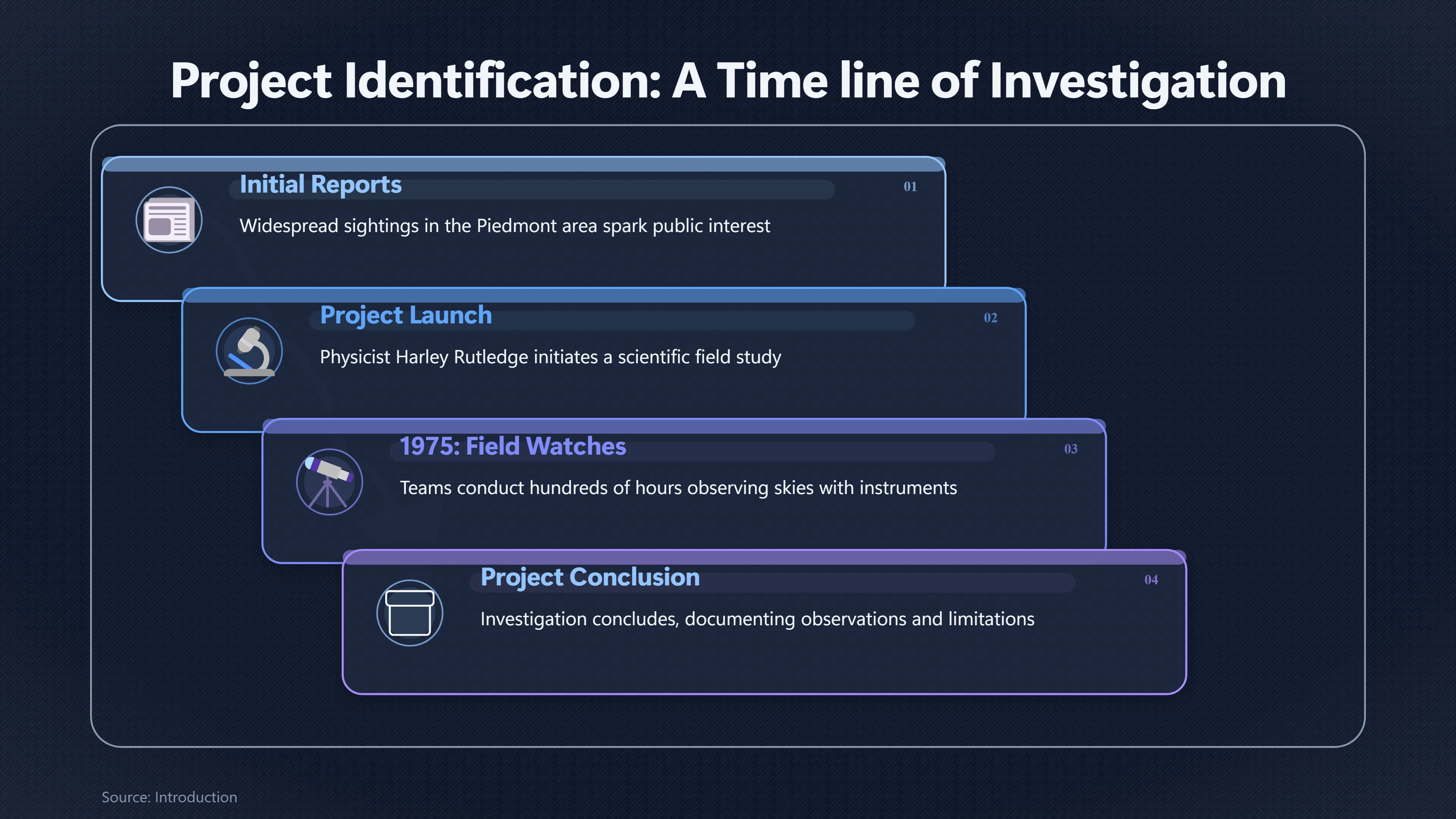
Did Project Identification produce convincing UFO evidence? The fairest answer is that it produced some of the most serious field observations associated with the 1973 Piedmont wave, but not the kind of measurements needed to establish what the objects actually were. Led by Southeast Missouri State University physicist Harley D. Rutledge, Project Identification was unusual because it moved beyond witness interviews and attempted direct observation using trained observers, telescopes, cameras and other instruments in the area where reports were occurring. Rutledge and his team documented lights that they believed could not easily be explained by ordinary aircraft, stars or planets. Yet the project’s strongest weakness was the same problem that affects many UFO investigations: the inability to obtain precise, repeatable measurements of distance, size, altitude and speed. As a result, Project Identification remains an important chapter in Missouri’s UFO history, but not a conclusive scientific demonstration of an unknown technology.[Wikipedia]WikipediaHarley RutledgeHarley Rutledge
How Rutledge Organised the Field Investigation
Project Identification began after the Piedmont sightings attracted widespread attention in 1973. Unlike many civilian UFO investigations of the period, Rutledge approached the reports as a physicist rather than as a UFO campaigner. Contemporary accounts and later summaries describe him as initially sceptical and concerned with collecting data rather than promoting a particular explanation.[Wikipedia]WikipediaHarley RutledgeHarley Rutledge
The project assembled a team that included students and observers with scientific or technical backgrounds. Rather than relying solely on reports submitted after an event, the group spent hundreds of hours conducting field watches in the regions around Piedmont, Clearwater Lake and surrounding parts of Wayne County. They used a range of equipment that reportedly included telescopes, cameras, audio detectors and other measurement devices intended to record physical characteristics of unusual aerial lights.[Wikipedia]WikipediaHarley RutledgeHarley Rutledge
What made the effort distinctive within Missouri’s UFO history was its attempt to observe phenomena as they occurred. Rutledge argued that many previous UFO investigations suffered because investigators arrived only after an event had ended. Project Identification sought to place observers in the field repeatedly so that sightings could be watched directly rather than reconstructed from memory.[Wikipedia]WikipediaHarley RutledgeHarley Rutledge
What the Team Observed and Ruled Out
Rutledge reported numerous observations of bright lights and luminous objects during the project’s years of operation. Some appeared as stationary lights, some reportedly changed brightness, and others were described as moving in ways the observers considered unusual. The project became known for reports of recurring lights seen from specific observation locations rather than for a single dramatic close encounter.[Wikipedia]WikipediaHarley RutledgeHarley Rutledge
A key part of the team’s work involved attempting to eliminate ordinary explanations. Observers compared sightings against known stars, planets, aircraft routes and other conventional aerial objects. Rutledge later stated that many reports could indeed be explained by ordinary causes and that only a smaller subset remained unidentified after investigation. This is an important point because the project was not claiming that every light seen over Piedmont represented an anomaly.[Wikipedia]WikipediaHarley RutledgeHarley Rutledge
The team’s most interesting observations were those in which multiple observers watched the same light simultaneously through optical equipment. Rutledge believed some of these events displayed characteristics that did not match straightforward astronomical or aviation explanations. These observations helped persuade him that the Piedmont wave contained at least some genuinely puzzling cases.[Wikipedia]WikipediaHarley RutledgeHarley Rutledge
However, the evidence remained heavily dependent on visual observation. Even when several observers agreed that a light behaved oddly, visual agreement alone could not establish whether the object was distant or nearby, large or small, slow or fast. Those missing measurements would become the central scientific limitation of the project.
Why the Measurements Remained Inconclusive
The strongest criticism of Project Identification is not that it failed to collect observations, but that it failed to collect enough quantitative data to identify what was being observed.
The most important missing variable was range. Observers often knew the direction of a light but not its distance. Without reliable distance measurements, estimates of speed, altitude and size become highly uncertain. A distant light can appear to move dramatically because of perspective effects, while a nearby light can appear much larger or faster than it really is. Without triangulation from multiple precisely synchronised observation points, these ambiguities are difficult to resolve.[arXiv]arxiv.orgThe Scientific Investigation of Unidentified Aerial Phenomena (UAP) Using Multimodal Ground-Based ObservatoriesMay 29, 2023…
The photographic evidence faced similar problems. Cameras could record that a light existed, but photographs of bright points against a dark sky rarely provide enough information to determine physical characteristics. A photograph may show brightness or colour, yet reveal little about shape, distance or motion. This limitation is now widely recognised in modern scientific discussions of unidentified aerial phenomena and was equally relevant during the 1970s.[arXiv]arxiv.orgThe Scientific Investigation of Unidentified Aerial Phenomena (UAP) Using Multimodal Ground-Based ObservatoriesMay 29, 2023…
Another challenge was instrument integration. Project Identification employed a variety of devices, but it lacked the kind of coordinated, multi-sensor system now considered desirable for studying unexplained aerial events. Modern proposals emphasise simultaneous optical, radar, radio-frequency and environmental measurements so that one sensor can verify what another records. Rutledge’s project was pioneering for its era, but the technology available to it was far less capable of generating such corroborating datasets.[arXiv]arxiv.orgThe Scientific Investigation of Unidentified Aerial Phenomena (UAP) Using Multimodal Ground-Based ObservatoriesMay 29, 2023…
The Tension Between Serious Observation and Scientific Proof
One reason Project Identification continues to attract attention is that it occupies an unusual middle ground. It was more rigorous than many UFO investigations of the 1970s, yet it fell short of producing definitive scientific evidence.
Supporters point to several strengths:
- A trained physicist directed the investigation.
- Observations occurred during an active sighting wave rather than years later.
- Multiple observers sometimes viewed the same events.
- The project attempted to eliminate ordinary explanations rather than automatically embracing extraordinary ones.[Wikipedia]WikipediaHarley RutledgeHarley Rutledge
Critics point to equally important weaknesses:
- Most observations remained visual rather than instrumentally measured.
- Distance and altitude estimates were often uncertain.
- Independent replication was limited.
- The strongest conclusions depended on interpretations of ambiguous lights rather than on unambiguous physical traces or sensor records.[Wikipedia]WikipediaIdentification studies of UFOsIdentification studies of UFOs
These competing assessments explain why the project remains debated decades later. The evidence was sufficient to convince Rutledge that some observations deserved further study, but insufficient to convince the wider scientific community that an unknown phenomenon had been demonstrated.

What Project Identification Means for the Piedmont Wave
Within the broader story of the Piedmont UFO wave, Project Identification’s importance lies less in what it proved than in what it attempted. Missouri’s 1973 sightings generated large numbers of reports, but Rutledge’s investigation transformed the episode from a local media story into a documented field study. His work preserved observations that otherwise might have disappeared into folklore and encouraged later discussions about how unexplained aerial reports could be studied more systematically.[sos.mo.gov]sos.mo.govState UFO Capitals of MissouriHe issued a public paper in 1973, which he later turned into a book called Project Identification: The Firs…
The project’s lasting lesson is also its scientific limit. Rutledge documented phenomena that he regarded as difficult to explain, yet he never obtained the precise measurements needed to move from “unidentified” to “identified.” Even his own public statements stopped short of claiming proof of extraterrestrial craft. The result is a body of evidence that remains intriguing, historically important and genuinely unusual in the context of Missouri UFO history, while still falling short of a conclusive demonstration of what was actually seen over Piedmont.[Wikipedia]WikipediaHarley RutledgeHarley Rutledge
Amazon book picks
Further Reading
Books and field guides related to Did Project Identification Produce Convincing UFO Evidence?. Use these as the next step if you want deeper reading beyond the article.
UFOs: Generals, Pilots, and Government Officials Go on the Re...
Discusses evidence standards in UFO cases.
Project Identification: The First Scientific Field Study of U...
The original account of the project.
eBay marketplace picks
Marketplace Samples
Live-tested eBay searches with available results related to this page.
Selected fromUFO poster oneBay.co.uk.




Endnotes
1.
Source: Wikipedia
Title: Harley Rutledge
Link:https://en.wikipedia.org/wiki/Harley_Rutledge
2.
Source: sos.mo.gov
Link:https://www.sos.mo.gov/symbol/ufo
Source snippet
State UFO Capitals of MissouriHe issued a public paper in 1973, which he later turned into a book called Project Identification: The Firs...
3.
Source: Wikipedia
Title: Identification studies of UFOs
Link:https://en.wikipedia.org/wiki/Identification_studies_of_UFOs
4.
Source: arxiv.org
Link:https://arxiv.org/abs/2305.18566
Source snippet
The Scientific Investigation of Unidentified Aerial Phenomena (UAP) Using Multimodal Ground-Based ObservatoriesMay 29, 2023...
Published: May 29, 2023
5.
Source: arxiv.org
Link:https://arxiv.org/html/2502.06794v1
6.
Source: books.google.com
Title: Project Identification
Link:https://books.google.com/books/about/Project_Identification.html?id=3claAAAAYAAJ
Source snippet
Google BooksProject Identification: The First Scientific Field Study of UFO...Project Identification: The First Scientific Field Study o...
Additional References
7.
Source: academia.edu
Link:https://www.academia.edu/123649529/Exploring_Unidentified_Aerospace_Phenomena_through_Instrumented_Field_Studies_Historical_Insights_Current_Challenges_and_Future_Directions
Source snippet
Exploring Unidentified Aerospace Phenomena through...This study emphasizes the transition from historical narratives to scientif...
8.
Source: professorwham.com
Link:https://www.professorwham.com/post/project-identification-and-harley-d-rutledge-part-1-challenges-opportunities-synchronicities
Source snippet
In fact, Dr Hynek visited Piedmont early on in the 1973 UFO flap...Read more...
9.
Source: youtube.com
Title: Missouri Mysteries, Chapter Two
Link:https://www.youtube.com/watch?v=8MS1s5YlhCM
Source snippet
Investigators Visit The Site Of The 1973 Clearwater Lake UFO Sighting | Alien Highway...
10.
Source: youtube.com
Title: How Piedmont became the UFO Capitol of Missouri | Living St. Louis
Link:https://www.youtube.com/watch?v=JDTIqTJMBZ0
Source snippet
Missouri Mysteries, Chapter Two - Unexplained Lights Near Piedmont, Missouri...
11.
Source: youtube.com
Link:https://www.youtube.com/watch?v=LHWxWNy6VO0
Source snippet
Why NOBODY Talks About The Real UFO Geography...
12.
Source: vaticanobservatory.org
Title: ufos in mo
Link:https://www.vaticanobservatory.org/sacred-space-astronomy/ufos-in-mo/
Source snippet
4 Oct 2025 — He issued a public paper in 1973, which he later turned into a book called Project Identification: The First Scientific Fiel...
13.
Source: vaticanobservatory.org
Title: M O UFOs
Link:https://www.vaticanobservatory.org/sacred-space-astronomy/mo-ufos-and-miracles/
Source snippet
and Miracles - Vatican...11 Oct 2025 — He issued a public paper in 1973, which he later turned into a book called Project Identification...
14.
Source: youtube.com
Title: Why NOBODY Talks About The Real UFO Geography
Link:https://www.youtube.com/watch?v=OZn3kge28e4
Source snippet
This small Missouri town could become state's 'UFO Capital'...
15.
Source: facebook.com
Link:https://www.facebook.com/StarTalk/posts/80-years-of-ufo-reports-coincidence-or-something-more/1549827950109592/
16.
Source: facebook.com
Link:https://www.facebook.com/groups/1565114127094467/posts/2906047826334417/