Within Evidence Test
What Can a Tennessee UFO Photo Really Prove?
A strange image may preserve appearance while missing the distance, direction, metadata and reference points needed to identify its source.
On this page
- How cameras turn lights into discs and streaks
- Why original files and metadata matter
- How investigators test aircraft, satellites and visual effects
Page outline Jump by section
Introduction
A striking photograph can preserve an unusual moment, but it rarely proves what caused it. That is especially true for Tennessee UFO reports, where many modern sightings are accompanied by mobile-phone images or short videos that appear convincing at first glance but lack the information needed to identify the object confidently. A photograph can show that something was present in the sky when the picture was taken. It usually cannot, by itself, establish the object’s distance, size, speed or origin.
This distinction matters within Tennessee’s UFO history because some of the state’s best-known photographic cases, from the early Cold War through to recent reports of lights over East Tennessee, remain debated largely because the surviving images are incomplete rather than because they demonstrate extraordinary technology. The strongest lesson from Tennessee’s photographic record is not that cameras prove unusual craft, but that good investigation depends on the information surrounding the image as much as the image itself.
Why a photograph is only one piece of evidence
People naturally treat photographs as objective records. In practice, they capture only a two-dimensional view through a particular lens, exposure and sensor. Without additional information, investigators cannot calculate basic physical properties.
A single photograph generally cannot determine:
- how far away the object was;
- its actual size;
- whether it was moving or stationary;
- its altitude;
- whether it was reflecting sunlight or producing its own light; or
- whether an apparent shape resulted from camera optics rather than the object itself.
These limitations have been recognised for decades. The photographic analysis conducted for the Condon Committee concluded that UFO photographs are often less conclusive than they first appear because they must be interpreted alongside independent evidence rather than in isolation. Likewise, many Project Blue Book files contain photographs that were preserved for study but ultimately could not establish what had actually been photographed.[files.ncas.org]files.ncas.orgCondon Report Section III, Chapter 2: Photographic EvidenceCondon Report Section III, Chapter 2: Photographic Evidence
For Tennessee cases, this means an intriguing image may keep a report open while still falling well short of proving an unknown craft.
How cameras turn lights into discs and streaks
Many modern Tennessee reports involve bright lights seen at night over cities, valleys or mountain ridges. Smartphone cameras frequently transform these lights into shapes that differ markedly from what witnesses saw with the naked eye.
Several common effects can create misleading images:
- Out-of-focus lights. Distant aircraft, stars or planets often become soft discs when a camera cannot achieve proper focus.
- Motion blur. Slight hand movement during longer exposures turns lights into streaks or zigzag patterns.
- Lens flare. Bright streetlights, the Moon or vehicle headlights can produce floating shapes elsewhere in the frame.
- Digital image processing. Modern phones sharpen, brighten and reduce noise automatically, sometimes exaggerating unusual-looking features.
- Zoom artefacts. Heavy digital zoom can create blocky edges or apparent structures that disappear in the original image.
These effects do not mean a witness imagined the event. They simply mean that the recorded image may be documenting the behaviour of the camera as much as the object in the sky.
In Tennessee, where many sightings occur against dark rural landscapes or during humid summer evenings, atmospheric haze and moisture can further scatter light and complicate photographic interpretation.
Why original files and metadata matter
The original image file often contains more useful evidence than the visible picture itself.
Investigators look for metadata such as:
- the precise date and time;
- GPS location, if recorded;
- camera model;
- exposure settings;
- focal length;
- orientation of the device; and
- whether the file has been edited.
If only a screenshot or compressed social-media upload survives, much of this information disappears. That makes it far harder to compare the sighting with aircraft movements, satellite passes, astronomical objects or weather conditions.
For Tennessee reports submitted years after the event, investigators frequently face an additional problem: the original file has been deleted, replaced by a lower-quality copy or stripped of metadata during online sharing. In those situations, a dramatic-looking image becomes significantly weaker evidence because key verification steps are no longer possible.
Modern scientific recommendations for studying unidentified aerial phenomena likewise emphasise calibrated instruments, accurate timing and multiple independent measurements rather than isolated photographs.[arXiv]arxiv.orgThe Scientific Investigation of Unidentified Aerial Phenomena (UAP) Using Multimodal Ground-Based ObservatoriesMay 29, 2023…
What Tennessee’s historical photographs actually demonstrate
The state’s historical record illustrates both the value and the limits of photographic evidence.
One of the best-known examples comes from the Oak Ridge area in 1947. Federal agencies preserved photographs submitted during the flying saucer wave because the sighting occurred near an important atomic installation. The existence of those records demonstrates that officials considered the report worth documenting and analysing.
However, the photographs themselves did not establish the object’s physical nature. Later technical reviews suggested that at least one image could be explained by a photographic or processing defect rather than an unknown object. Even where disagreement remained, the photographs lacked enough measurable information to determine range, size or speed conclusively.[ufologie.patrickgross.org]ufologie.patrickgross.orgufo - UFOs at close sight: pictures from Project Blue Book Files, 1947 - before Blue Book…
Other Tennessee Project Blue Book files include photographs or photographic references from places such as Gatlinburg and the Memphis area. Their preservation shows that unusual images were investigated rather than ignored, but the surviving records also illustrate how often investigators lacked sufficient information to reach a firm conclusion.[Wikimedia Commons]commons.wikimedia.orgCommons File:Project Blue Book reportWikimedia CommonsFile:Project Blue Book report - 1954-09-8727038-Gatlinburg-Tennessee.pdf - Wikimedia CommonsSeptember 1, 1954…
In other words, the photographs prove that unusual visual events were reported. They do not independently prove extraordinary aircraft.
How investigators test ordinary explanations
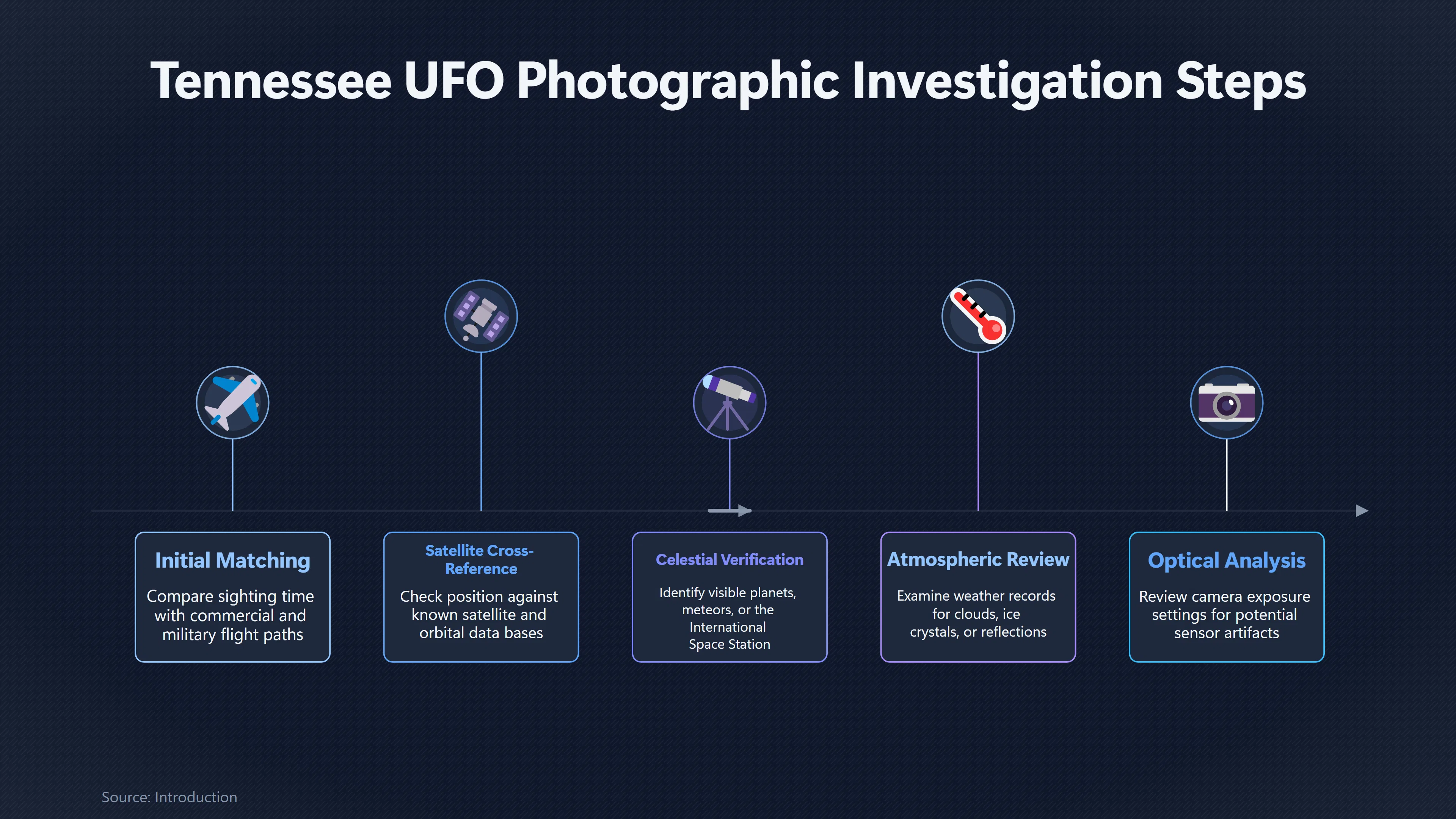
When examining a Tennessee UFO photograph today, investigators usually begin by asking whether known objects can account for the image before considering rarer possibilities.
Typical checks include:
- matching the time with commercial and military flight paths;
- comparing the position with satellite databases;
- checking whether bright planets, meteors or the International Space Station were visible;
- reviewing weather records for clouds, ice crystals or atmospheric reflections;
- examining exposure settings for camera artefacts;
- comparing multiple witness locations to estimate direction and distance.
If a photograph survives with precise timing and location, many ordinary explanations can be tested directly. If those details are missing, several explanations may remain plausible without any one being provable.
That distinction explains why some Tennessee cases remain officially unresolved. The unresolved status often reflects incomplete evidence rather than evidence for an extraordinary object.
What a Tennessee UFO photo can genuinely prove
The strongest conclusion most Tennessee UFO photographs can support is modest but still valuable.
A well-documented image may reliably show that:
- the witness photographed something at a particular time and place;
- an unusual light or object appeared from that viewing position;
- multiple photographs or witnesses recorded the same event; or
- further investigation is justified.
On their own, however, photographs rarely prove:
- that the object was a structured craft;
- that it performed impossible manoeuvres;
- that it was not an aircraft, balloon or astronomical object; or
- that it represented technology beyond current human capabilities.
Within Tennessee’s broader history of unresolved sightings versus ordinary explanations, photographs therefore occupy an important middle ground. They can preserve genuine observations, encourage careful investigation and occasionally eliminate some conventional explanations. Yet without original files, reliable metadata, independent witnesses or supporting sensor information, even the clearest-looking image usually documents an unanswered question rather than providing a definitive answer.
Amazon book picks
Further Reading
Books and field guides related to What Can a Tennessee UFO Photo Really Prove?. Use these as the next step if you want deeper reading beyond the article.
UFOs: Generals, Pilots, and Government Officials Go on the Re...
Includes discussion of evidential standards.
The Report on Unidentified Flying Objects
Illustrates why photos alone seldom solve cases.
The Demon-Haunted World
Rating: 4.5/5 from 43 Google Books ratings
Promotes evidence-based interpretation of extraordinary images.
eBay marketplace picks
Marketplace Samples
Live-tested eBay searches with available results related to this page.
Selected fromUFO poster oneBay.co.uk.




Endnotes
1.
Source: files.ncas.org
Title: Condon Report Section III, Chapter 2: Photographic Evidence
Link:https://files.ncas.org/condon/text/s3chap02.htm
2.
Source: arxiv.org
Link:https://arxiv.org/abs/2305.18566
Source snippet
The Scientific Investigation of Unidentified Aerial Phenomena (UAP) Using Multimodal Ground-Based ObservatoriesMay 29, 2023...
Published: May 29, 2023
3.
Source: ufologie.patrickgross.org
Link:https://ufologie.patrickgross.org/htm/bluepics47.htm
Source snippet
ufo - UFOs at close sight: pictures from Project Blue Book Files, 1947 - before Blue Book...
4.
Source: commons.wikimedia.org
Title: Commons File:Project Blue Book report
Link:https://commons.wikimedia.org/wiki/File%3AProject_Blue_Book_report_-_1954-09-8727038-Gatlinburg-Tennessee.pdf
Source snippet
Wikimedia CommonsFile:Project Blue Book report - 1954-09-8727038-Gatlinburg-Tennessee.pdf - Wikimedia CommonsSeptember 1, 1954...
Published: September 1, 1954
5.
Source: commons.wikimedia.org
Title: Commons File:Project Blue Book report
Link:https://commons.wikimedia.org/wiki/File%3AProject_Blue_Book_report_-_1967-05-9077346-EastMemphis-Tennessee.pdf
Source snippet
Wikimedia CommonsFile:Project Blue Book report - 1967-05-9077346-EastMemphis-Tennessee.pdf - Wikimedia Commons...
6.
Source: history.com
Title: Project Blue Book
Link:https://www.history.com/articles/project-blue-book
Source snippet
Alien, Definition & Files | HISTORYFebruary 22, 2010 — By: HISTORY.com Editors Mysteries & Folklore PROJECT BLUE BOOK HISTORY.com Editors...
Published: February 22, 2010
7.
Source: commons.wikimedia.org
Title: File:Project Blue Book report xxxx 07 7272640 Oakridge Tennessee 26
Link:https://commons.wikimedia.org/wiki/File%3AProject_Blue_Book_report_-_xxxx-07-7272640-Oakridge-Tennessee-26-.pdf
8.
Source: commons.wikimedia.org
Title: File:Project Blue Book report 1960 04 7811649 5MiEOfOcoll Tennessee
Link:https://commons.wikimedia.org/wiki/File%3AProject_Blue_Book_report_-_1960-04-7811649-5MiEOfOcoll-Tennessee.pdf
9.
Source: cufos.org
Title: Project Blue Book
Link:https://cufos.org/resources/project-blue-book/
Additional References
10.
Source: archives.gov
Link:https://www.archives.gov/news/articles/project-blue-book-50th-anniversary
Source snippet
Public Interest in UFOs Persists 50 Years After Project Blue Book Termination | National ArchivesDecember 5, 2019 — PUBLIC INTEREST IN UF...
Published: December 5, 2019
11.
Source: youtube.com
Link:https://www.youtube.com/watch?v=1krk9u_5XYA
Source snippet
Why The US Suddenly Released Classified UFO Files Near Nuclear Sites | WION Podcast...
12.
Source: youtube.com
Title: Declassified UFO Photos over East Tennessee NUCLEAR WEAPON Facility
Link:https://www.youtube.com/watch?v=Lj9XiXuOCdI
Source snippet
'Source of great concern' | Newly-released Pentagon documents outline decades-old Oak Ridge UFO sightings...
13.
Source: youtube.com
Link:https://www.youtube.com/watch?v=NwmXXPDGOYI
Source snippet
UFOs over Memphis - Originally Aired July 30, 2015...
Published: July 30, 2015
14.
Source: youtube.com
Title: UFOs over Memphis
Link:https://www.youtube.com/watch?v=nsxgymkGZP8
Source snippet
PROJECT TWINKLE: The Secret FBI Files on Cold War UFOs. By Wiki Brigades...
Published: July 30, 2015
15.
Source: uap-watch-flame.vercel.app
Title: doc 012
Link:https://uap-watch-flame.vercel.app/document/doc-012
Source snippet
go Bb HY AT g G7 23g BD1SSMF 40-1830'S‘A Tag GUV1-Q3A139 34 GBA sau —s STANDARD FORM NO. 64 | €: ia}; Office Memor dum * UNITED/STATES G...
16.
Source: theprojectbluebookarchive.org
Link:https://theprojectbluebookarchive.org/archive/
17.
Source: youtube.com
Title: PROJECT TWINKLE: The Secret FBI Files on Cold War UFOs. By Wiki Brigades
Link:https://www.youtube.com/watch?v=hSvwIiDqptM
18.
Source: cufon.org
Title: foia 001
Link:https://www.cufon.org/cufon/foia_001.htm