Within Nenana Radar
Could Weather Really Explain the Nenana Contacts?
Weather effects could explain the shifting radar returns, but the published record lacks the atmospheric data needed for a full reconstruction.
On this page
- Why investigators suspected a weather target
- How anomalous propagation can create false returns
- What evidence was missing from the official explanation
Page outline Jump by section
Introduction
The weather explanation for the 1952 Nenana radar encounter is plausible, but not especially strong by modern standards. Project Blue Book eventually reclassified the case as a weather-related radar event after initially leaving it unresolved, yet the published record does not contain the detailed meteorological data needed to demonstrate exactly how the reported radar contacts were produced. As a result, the Air Force explanation remains possible rather than proven.[Wikimedia Commons]upload.wikimedia.orgProject Blue Book, BBA PBSR6 300Wikimedia CommonsThe Project Blue Book ArchiveProject Blue Book was the code name of the U.S. Air Force's UFO investigation…. At 1020Z…

This distinction matters because the Nenana incident sits at the intersection of two Cold War realities in Alaska: military radar operators were watching for potential intruders approaching North America, while early radar systems were also vulnerable to unusual atmospheric effects. The central question is therefore not whether weather can create strange radar targets—it can—but whether the available evidence shows that weather actually did so in this specific case. On that narrower question, the historical record leaves important gaps.[Wikipedia]WikipediaAnomalous propagationAnomalous propagation
Why Investigators Suspected a Weather Target
The strongest argument for a weather-related explanation comes from the behaviour of the radar returns themselves.
According to Project Blue Book summaries, the Murphy Dome radar tracked an apparent target whose estimated speed reached roughly 1,500 miles per hour, which then appeared to reverse direction, disappear, reappear, and begin another turn. Such behaviour would be highly unusual for an aircraft operating in Alaska in early 1952. Investigators therefore had reason to consider whether the radar was not tracking a solid object continuously, but instead displaying intermittent or misleading returns generated by atmospheric conditions.[Wikimedia Commons]upload.wikimedia.orgProject Blue Book, BBA PBSR6 300Wikimedia CommonsThe Project Blue Book ArchiveProject Blue Book was the code name of the U.S. Air Force's UFO investigation…. At 1020Z…
The later Air Force conclusion reflected a broader pattern in early radar investigations. During the 1950s, military analysts repeatedly found that some apparently extraordinary radar tracks could be produced by unusual propagation conditions in the atmosphere rather than by fast-moving craft. Similar debates surrounded other famous radar cases of the era, including the Washington sightings of 1952, where temperature inversions and abnormal radar propagation became a central part of the official explanation.[Wikipedia]Wikipedia1952 Washington, D.C. UFO incident1952 Washington, D.C. UFO incident
From an investigator’s perspective, the Nenana case contained several warning signs:
- Extremely high calculated speeds.
- Apparent abrupt changes in direction.
- Targets that disappeared and reappeared.
- Lack of visual confirmation despite close radar approaches.
- Inconsistencies between ground radar and airborne radar observations.
Those features do not automatically prove a weather effect, but they are exactly the sort of characteristics that often lead radar analysts to examine atmospheric causes first.[Wikimedia Commons]upload.wikimedia.orgProject Blue Book, BBA PBSR6 300Wikimedia CommonsThe Project Blue Book ArchiveProject Blue Book was the code name of the U.S. Air Force's UFO investigation…. At 1020Z…
How Anomalous Propagation Can Create False Returns
The weather theory usually centres on a radar phenomenon known as anomalous propagation, often abbreviated to “AP”.
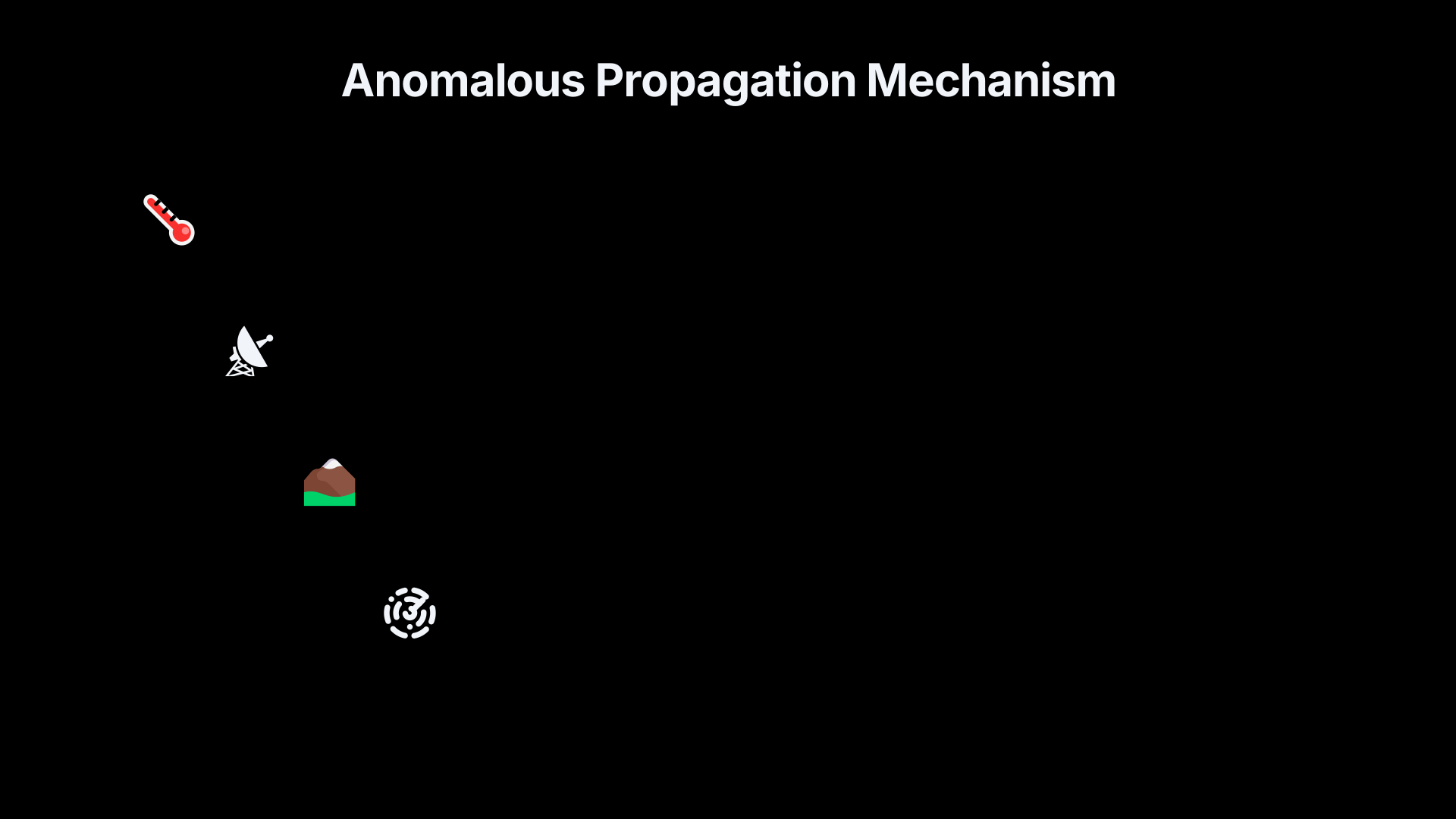
Radar systems assume that radio waves travel through the atmosphere in a predictable way. In reality, temperature, humidity and air-density layers can bend radar beams. Under stable atmospheric conditions, especially during temperature inversions, radar energy may travel farther than expected or be redirected towards the ground and then reflected back to the receiver. The radar operator may then see echoes that appear to represent airborne targets even though the signal originated from terrain or other distant objects.[Wikipedia]WikipediaAnomalous propagationAnomalous propagation
This mechanism can create several effects that resemble aspects of the Nenana reports:
- Returns appearing where no aircraft exists.
- Sudden disappearance of targets.
- Targets seeming to jump position.
- Erratic changes in apparent speed.
- Radar tracks that cannot be matched visually.
Because the geometry of the reflected beam changes as atmospheric layers evolve, the resulting target can seem to move even when the reflecting surface is stationary. Modern radar systems include processing techniques that help suppress such effects, but early-1950s military radars had far fewer tools for distinguishing genuine aircraft from atmospheric artefacts.[Wikipedia]WikipediaAnomalous propagationAnomalous propagation
The fact that the Nenana event occurred during a period when radar technology was still developing strengthens the general plausibility of the weather hypothesis. It is not an explanation invented specifically for this case; it is a recognised radar phenomenon documented throughout the history of air-defence and weather-radar operations.[Wikipedia]WikipediaAnomalous propagationAnomalous propagation
What Evidence Was Missing From the Official Explanation
The biggest weakness of the weather explanation is not the mechanism itself but the lack of supporting data.
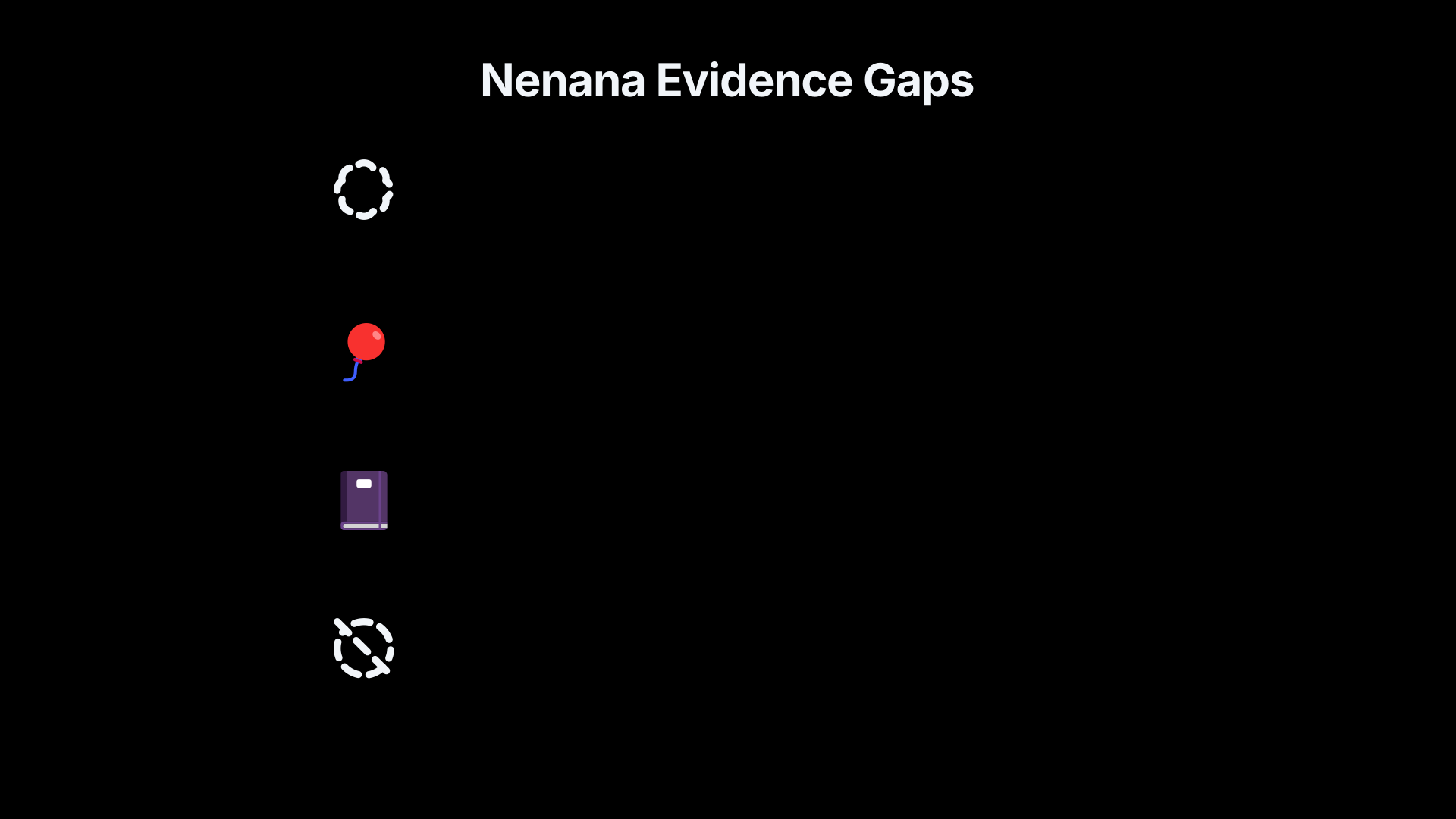
To demonstrate anomalous propagation convincingly, investigators normally want detailed atmospheric information from the time of the event. This can include upper-air soundings, temperature profiles, humidity measurements and evidence of inversion layers. Such information helps determine whether the atmosphere was capable of bending radar beams in the way required by the proposed explanation.[Wikipedia]WikipediaAnomalous propagationAnomalous propagation
In the publicly available Blue Book material relating to Nenana, those meteorological details are largely absent. The Air Force ultimately classified the incident as weather-related, but the surviving summaries do not provide a step-by-step reconstruction showing how specific atmospheric conditions generated the reported radar contacts.[Wikimedia Commons]upload.wikimedia.orgProject Blue Book, BBA PBSR6 300Wikimedia CommonsThe Project Blue Book ArchiveProject Blue Book was the code name of the U.S. Air Force's UFO investigation…. At 1020Z…
This creates an important evidential problem. A weather explanation can be reasonable without being demonstrated. Historians examining the case today can see why investigators reached for an atmospheric interpretation, yet they cannot independently verify the chain of reasoning because crucial supporting measurements are not part of the published record.[Wikimedia Commons]upload.wikimedia.orgProject Blue Book, BBA PBSR6 300Wikimedia CommonsThe Project Blue Book ArchiveProject Blue Book was the code name of the U.S. Air Force's UFO investigation…. At 1020Z…
The absence of radar-scope photographs, detailed tracking records and comprehensive weather data also makes retrospective analysis difficult. Without those materials, later researchers are largely limited to narrative summaries rather than the raw evidence needed to test competing explanations.[Wikimedia Commons]upload.wikimedia.orgProject Blue Book, BBA PBSR6 300Wikimedia CommonsThe Project Blue Book ArchiveProject Blue Book was the code name of the U.S. Air Force's UFO investigation…. At 1020Z…
Does the Airborne Radar Contact Strengthen or Weaken the Weather Theory?
The most challenging aspect of the case is the F-94 interceptor’s airborne radar contacts near Nenana.
Supporters of the weather explanation argue that radar anomalies are not restricted to ground stations. Airborne radar can also be affected by unusual propagation conditions, side-lobe reflections and other technical artefacts. The mere existence of radar contacts aboard the interceptor therefore does not automatically rule out a non-object explanation.[Wikipedia]WikipediaAnomalous propagationAnomalous propagation
However, critics of the Air Force conclusion point out that the F-94 crew reported apparently coherent targets during interception attempts. Even though no object was seen visually, the repeated radar acquisitions have often been cited as a reason why some observers remained dissatisfied with the final weather verdict. The issue is not that the contacts prove an extraordinary object existed; rather, it is that the available records do not clearly demonstrate how one atmospheric mechanism accounted for all phases of the event.[Wikimedia Commons]upload.wikimedia.orgProject Blue Book, BBA PBSR6 300Wikimedia CommonsThe Project Blue Book ArchiveProject Blue Book was the code name of the U.S. Air Force's UFO investigation…. At 1020Z…
This uncertainty helps explain why the Nenana encounter continues to appear in discussions of unresolved Cold War radar incidents despite its official classification.
A Balanced Assessment
Viewed strictly as an evidential question, the weather explanation for Nenana is moderately plausible but incompletely documented.
The Air Force had legitimate reasons to suspect a weather-related radar effect. The reported speeds, reversals and intermittent returns resemble characteristics that radar specialists have long associated with anomalous propagation and other atmospheric artefacts. Early radar systems were particularly vulnerable to such problems.[Wikipedia]WikipediaAnomalous propagationAnomalous propagation
At the same time, the published record does not contain the meteorological evidence needed to show exactly what atmospheric conditions existed over interior Alaska that night or how they produced the specific contacts reported by both ground and airborne radar operators. As a result, the official explanation remains a reasonable hypothesis rather than a conclusively demonstrated solution.[wikimedia.org]upload.wikimedia.orgProject Blue Book, BBA PBSR6 300Wikimedia CommonsThe Project Blue Book ArchiveProject Blue Book was the code name of the U.S. Air Force's UFO investigation…. At 1020Z…
Within Alaska’s UFO history, that makes Nenana less a story about a mysterious craft than a case study in the limits of early Cold War radar interpretation. The weather theory may well be correct, but the surviving evidence is not detailed enough to settle the matter beyond dispute.[Wikimedia Commons]upload.wikimedia.orgProject Blue Book, BBA PBSR6 300Wikimedia CommonsThe Project Blue Book ArchiveProject Blue Book was the code name of the U.S. Air Force's UFO investigation…. At 1020Z…
Amazon book picks
Further Reading
Books and field guides related to Could Weather Really Explain the Nenana Contacts?. Use these as the next step if you want deeper reading beyond the article.
The Report on Unidentified Flying Objects
Relevant to Air Force efforts to explain radar incidents.
The Demon-Haunted World
Rating: 4.5/5 from 43 Google Books ratings
Encourages evidence-based assessment of unusual observations.
Why People Believe Weird Things
Explores interpretation errors and extraordinary claims.
eBay marketplace picks
Marketplace Samples
Live-tested eBay searches with available results related to this page.
Selected fromradar station patch oneBay.co.uk.


Endnotes
1.
Source: upload.wikimedia.org
Title: Project Blue Book, BBA PBSR6 300
Link:https://upload.wikimedia.org/wikipedia/commons/c/c0/Project_Blue_Book%2C_BBA-PBSR6-300.pdf
Source snippet
Wikimedia CommonsThe Project Blue Book ArchiveProject Blue Book was the code name of the U.S. Air Force's UFO investigation.... At 1020Z...
2.
Source: govweird.com
Link:https://www.govweird.com/topics/ufo/project-blue-book/nenana-ak-january-1952
Source snippet
Project Blue Book: NENANA, ALASKA, January 1952 - govweirdOn January 22, 1952, radar operators at Murphy's Dome, Alaska, spotted...
Published: January 22, 1952
3.
Source: Wikipedia
Title: Anomalous propagation
Link:https://en.wikipedia.org/wiki/Anomalous_propagation
4.
Source: Wikipedia
Title: 1952 Washington, D.C. UFO incident
Link:https://en.wikipedia.org/wiki/1952_Washington%2C_D.C._UFO_incident
5.
Source: upload.wikimedia.org
Title: Project Blue Book, BBA PBSR10 300
Link:https://upload.wikimedia.org/wikipedia/commons/5/54/Project_Blue_Book%2C_BBA-PBSR10-300.pdf
Source snippet
Project Blue Book ArchiveThe F-9^ report involves a radar contact by the radar observer with a simultaneous. Weather conditions were fair...
6.
Source: Wikipedia
Title: Project Blue Book
Link:https://en.wikipedia.org/wiki/Project_Blue_Book
7.
Source: dggs.alaska.gov
Link:https://dggs.alaska.gov/webpubs/usgs/p/text/p0501a.pdf
8.
Source: archives.gov
Title: Project BLUE BOOK
Link:https://www.archives.gov/research/military/air-force/ufos
Additional References
9.
Source: sacred-texts.com
Link:https://sacred-texts.com/ufo/rufo/rufo12.htm
Source snippet
had been in Alaska on TDY when the UFO had been picked up at the outpost radar site. In fact, he had made a trip to both the radar site a...
10.
Source: headlines.ametsoc.org
Title: wireless wonder a history of radar use for weather operations part i
Link:https://headlines.ametsoc.org/2023/07/31/wireless-wonder-a-history-of-radar-use-for-weather-operations-part-i/
Source snippet
AMS HeadlinesWireless Wonder: A History of Radar Use for Weather...31 Jul 2023 — Radar weather observations were taken, recorded, and tr...
11.
Source: youtube.com
Link:https://www.youtube.com/watch?v=N9aCRbqw2bk
Source snippet
10 Cases From Project Blue Book: The CIA's Hunt For UFOs...
12.
Source: cia.gov
Link:https://www.cia.gov/readingroom/document/cia-rdp81r00560r000100010001-0
13.
Source: science.gov
Link:https://www.science.gov/topicpages/m/magnetic%2Bcontour%2Bmaps
14.
Source: youtube.com
Title: 10 Cases From Project Blue Book: The CIA’s Hunt For UFOs
Link:https://www.youtube.com/watch?v=OoKm417zKOA
Source snippet
Module 5.6: Radar Brightband and Anomalous Propagation...
15.
Source: wral.com
Link:https://www.wral.com/archive/17744754/
Source snippet
WRAL NewsA Radar Blip, a Flash of Light: How UFOs 'Exploded' Into...3 Aug 2018 — One theory promoted by the Air Force was that a layer o...
16.
Source: youtube.com
Title: Module 5.6: Radar Brightband and Anomalous Propagation
Link:https://www.youtube.com/watch?v=Rq_ExHqg7TE
Source snippet
1952 - The Invasion of Washington | Full Documentary...
17.
Source: facebook.com
Title: between 1952 and 1969 the us air force investigated over 12000 reported sighting
Link:https://www.facebook.com/CablelinkTV/posts/between-1952-and-1969-the-us-air-force-investigated-over-12000-reported-sighting/1901991103202331/
18.
Source: youtube.com
Title: Washington UFO Wave
Link:https://www.youtube.com/watch?v=wCB-DQwq3EQ
Source snippet
Radar Anomaly That Looks Like a "HAARP Ring"....But Isn't! Anomalous Propagation...