Within South Carolina UFOs
Did Congaree Radar Track a Real High Speed Object?
A military radar crew tracked an apparent 6,000 mph target, but technical interference remained a serious alternative explanation.
On this page
- The five minute radar contact
- Why the operators were considered reliable
- Interference, propagation and false targets
Page outline Jump by section
Introduction
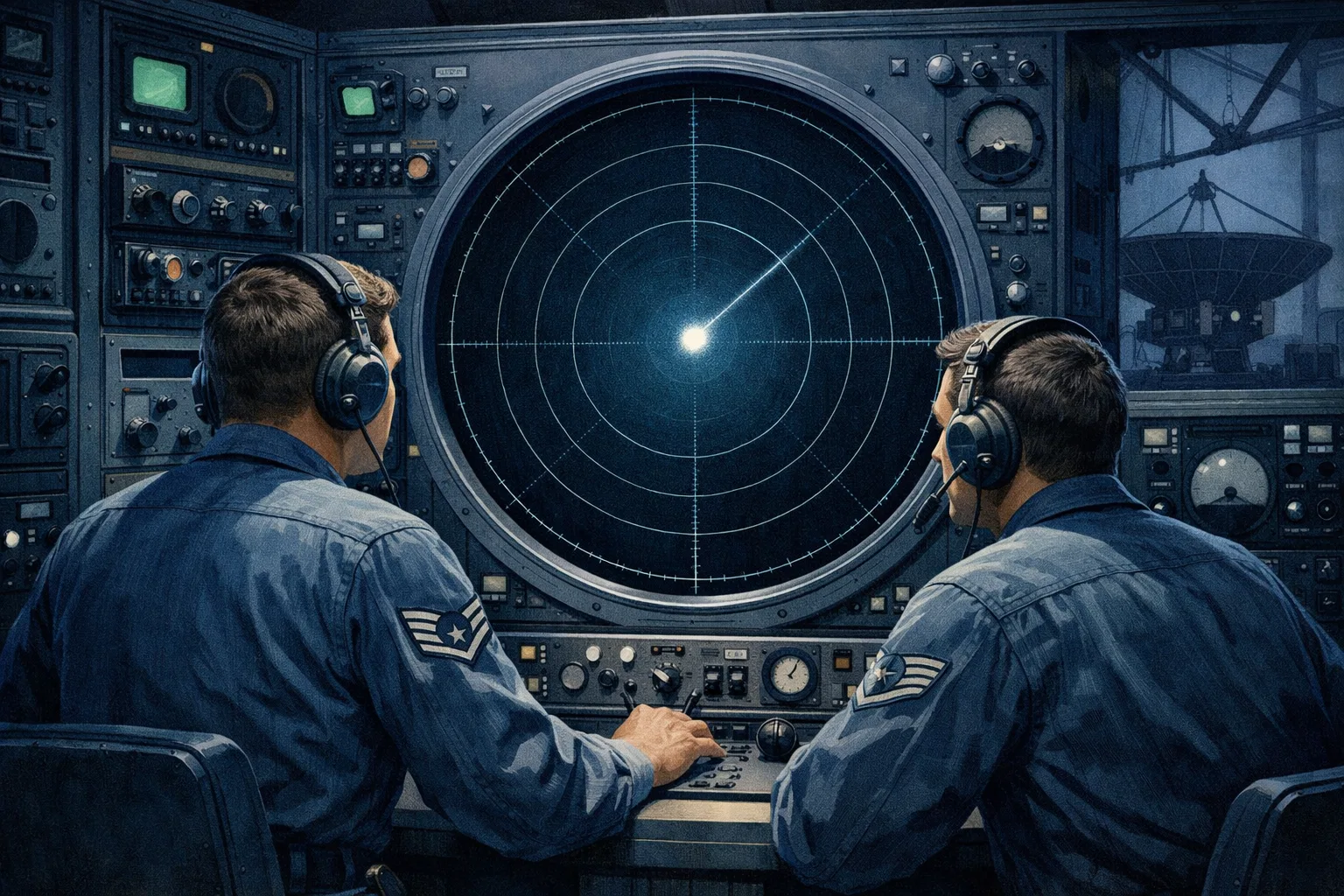
On 4 December 1952, radar operators at Congaree Air Force Base near Columbia detected a return that appeared to travel at about 6,000 miles per hour. The contact lasted roughly five minutes, was observed by trained personnel and remained officially classified as “unknown”. Yet the Air Force file itself stopped well short of treating the return as a real high-speed craft. Investigators thought interference from another radar station was a serious possibility, partly because the apparent target seemed tied to the radar antenna’s rotating sweep. They also lacked the atmospheric measurements needed to test whether unusual propagation conditions had produced a false echo.[Wikimedia Commons]upload.wikimedia.orgWikimedia Commons…
The Congaree case matters within South Carolina’s UFO history because it combines an extraordinary performance claim with unusually explicit technical doubt. It is stronger than a vague light-in-the-sky report, but much weaker than a confirmed physical track supported by independent radar, aircraft interception or visual observation.
The five-minute radar contact
The surviving Project Blue Book status report places the detection at 3.42 am Eastern Standard Time. It says an AN/MPS-5 radar set registered an unidentified object about 100 miles north-east of Congaree Air Force Base. The apparent speed was estimated at 6,000 mph, and contact continued for five minutes. Conditions at the base were recorded as low stratus cloud, no precipitation and a light north-easterly wind. Most importantly, the report states that the sighting was “strictly electronic, not visual”.[Wikimedia Commons]upload.wikimedia.orgWikimedia Commons…
Some later UFO catalogues add more dramatic movement, claiming that the target travelled south, stopped for about a minute and then reversed along its previous course. They also sometimes give the time as 8.42 am rather than 3.42 am. Those details appear in later compilations, but the concise Air Force summary available in the Project Blue Book status report does not describe a stop or reversal, and it clearly prints 0342 EST. The discrepancy is a warning against treating every retelling as equally authoritative.[govweird.com]govweird.comcongaree afb s c december 1952 28951768Project Blue Book: Congaree AFB, S.C., December 1952 · govweirdDecember 1, 1952 — On the morning of December 4, 1952, radar opera…
The headline speed also requires care. Radar does not directly photograph an object travelling between two known points. A conventional primary radar sends pulses, measures the delay of returned energy to estimate range, and uses the direction of its antenna to assign a bearing. Apparent speed is then derived from successive displayed positions. If the returns do not come from one physical object—or if their positions are linked to the antenna scan—the calculated velocity can be spectacular but meaningless.[NWS Training Portal]training.weather.govIn the radar receiver, the received "echo" is amplified, mixed with a local oscillator signal, amplified more, and then converted to a "v…
The record does not preserve the kind of supporting information that would make the 6,000 mph estimate secure. There is no known visual confirmation, photograph of the display, second radar track, measured altitude, aircraft interception or recovered flight data. Nor does the short Blue Book summary give the precise sequence of ranges and bearings from which the speed was calculated. The contact is therefore evidence that an unusual pattern appeared on a radar screen, not proof that a solid object crossed South Carolina’s airspace at hypersonic speed.[Wikimedia Commons]upload.wikimedia.orgWikimedia Commons…
Why the operators were considered reliable
Project Blue Book described the observers as Air Force personnel who had graduated from radar-operator school, possessed between two and five years of experience, and were considered “excellent and reliable sources”. That assessment is one of the case’s genuine strengths. It reduces the likelihood that the report arose from a casual observer misunderstanding an ordinary radar display.[Wikimedia Commons]upload.wikimedia.orgWikimedia Commons…
Reliability, however, answers only one question: whether the operators accurately reported what they saw on their scope. It does not establish what generated the signal. A competent operator can correctly observe a convincing return that originates from interference, anomalous propagation, ground clutter or another electronic effect. Modern radar guidance still stresses that false and misleading echoes can create difficult interpretation problems even for trained users.[noaa.gov]prod-01-alb-www-noaa.woc.noaa.govWhen atmospheric conditions are such that there are low-level inversions (air temperature increasing with height instead of the typical d…
This distinction is central to the Congaree dispute. The case is not well described as “trained men versus sceptics”. The Air Force accepted the operators’ competence while simultaneously questioning whether the displayed target represented an object. In other words, witness credibility and target reality were treated as separate issues.
The lack of visual confirmation is particularly important. Low cloud could have obstructed observers’ view, so the absence of a sighting does not prove that nothing was there. Nevertheless, without an independent sensor or eyewitness, every extraordinary feature—including speed, course and any reported manoeuvre—depends upon a single radar system behaving normally. That makes technical artefacts much harder to exclude.
Why interference became the leading doubt
The Air Technical Intelligence Center, which handled Blue Book analysis, wrote that it had received several similar radar reports that were assessed as probable interference from another station. Investigators thought Congaree might eventually fall into the same category. They specifically cited two warning signs: the extreme 6,000 mph figure and the return’s “tendency to the radar beam’s sweep”.[Wikimedia Commons]upload.wikimedia.orgWikimedia Commons…
That wording is more damaging to an exotic-object interpretation than the bare label “unknown” suggests. A genuine aircraft or other physical target should occupy positions determined by its movement through space. A spurious signal linked to the rotating antenna may instead appear at repeated points governed by the radar’s own scan cycle or by the timing relationship between two unsynchronised systems. Plotting those appearances as though they belonged to one moving object could produce enormous apparent speeds or abrupt changes of direction.
The Blue Book report does not identify the suspected second station or explain whether technicians compared frequencies, pulse timing or antenna rotation rates. It therefore does not prove interference. But the investigators were not introducing a generic excuse after the event: they identified a specific feature of the display that, in their judgement, resembled earlier interference cases.[Wikimedia Commons]upload.wikimedia.orgWikimedia Commons…
Later retellings often foreground the estimated speed and operator experience while giving less attention to this scan-linked behaviour. That reverses the emphasis of the original analysis. The Air Force considered the speed not merely impressive evidence, but one of the clues that the target might be false.
Could unusual weather have produced the return?
The original investigators also wanted information on temperature and moisture at different altitudes. Those measurements matter because radar beams do not always travel along the path assumed by the instrument. Sharp changes in temperature or humidity can bend radio energy more strongly towards the ground, an effect known as superrefraction. In extreme cases the beam becomes trapped in an atmospheric layer, or “duct”, and can illuminate distant terrain or structures that would ordinarily lie beyond the radar horizon. The resulting echoes may appear at unexpected ranges.[noaa.gov]prod-01-alb-www-noaa.woc.noaa.govWhen atmospheric conditions are such that there are low-level inversions (air temperature increasing with height instead of the typical d…
Low-level temperature inversions and sharp moisture gradients are recognised causes of anomalous propagation. Modern National Weather Service guidance notes that such echoes can look sufficiently real to require comparison with adjacent radars, satellite observations and atmospheric profiles. Early-morning conditions can be especially favourable because stable layers and inversions often weaken after daytime heating begins.[NOAA]prod-01-alb-www-noaa.woc.noaa.govWhen atmospheric conditions are such that there are low-level inversions (air temperature increasing with height instead of the typical d…
Congaree occurred before dawn and beneath low stratus, but those facts alone do not establish ducting. Cloud cover, surface wind and the absence of rain are not substitutes for a vertical temperature-and-humidity sounding. Blue Book explicitly stated that it did not yet have the necessary local data. The weather hypothesis was therefore plausible but untested, just as the interference hypothesis was plausible but unconfirmed.[Wikimedia Commons]upload.wikimedia.orgWikimedia Commons…
Atmospheric propagation and radar-to-radar interference should also not be blurred into one explanation. They are different mechanisms. Propagation changes where transmitted energy travels and what it reflects from; electronic interference can place another transmitter’s pulses into the receiver. The status report appears to have regarded station interference as the stronger precedent while seeking weather data to complete the assessment.
What “unknown” meant in this case
Project Blue Book retained the Congaree report as “unknown” because the information needed to settle the technical alternatives had not arrived when the status report was prepared. The document does not say that interference was eliminated, that atmospheric effects were excluded or that a physical object was confirmed. Its classification reflects an unfinished diagnosis rather than a positive finding of extraordinary technology.[Wikimedia Commons]upload.wikimedia.orgWikimedia Commons…
This is consistent with the wider meaning of Blue Book’s unresolved category. The programme ultimately recorded 12,618 reports and left 701 unidentified, while the Air Force stated that it had found no evidence that the unresolved cases represented extraterrestrial vehicles or a threat to national security. “Unidentified” meant that the available evidence did not support a satisfactory conventional identification; it did not certify the reported interpretation as physically real.[National Archives]archives.govNational Archives Project BLUE BOOKNational Archives Project BLUE BOOK
For Congaree, three factors support taking the event seriously:
- the operators were trained and officially judged reliable;
- the contact lasted several minutes rather than appearing as a single fleeting blip;
- the case entered the formal Air Force reporting system and received a technical discussion.
Three larger limitations prevent a confident high-speed-object conclusion:
- the detection came from only one known radar and had no visual confirmation;
- the reported behaviour appeared related to the antenna sweep, a recognised warning sign for interference;
- essential technical and atmospheric records are absent from the accessible summary.
The most defensible assessment is therefore unresolved but technically weak as evidence of an unusual craft. Something abnormal appeared on the AN/MPS-5 display, and the surviving record does not prove exactly what caused it. At the same time, the Air Force’s own analysis provides a credible reason to doubt that the scope was tracking a physical object at 6,000 mph.
Why Congaree still matters in South Carolina
The former Congaree Air Base is now McEntire Joint National Guard Base, an enduring centre of military aviation in the Columbia area. Its official history confirms the continuity between the wartime Congaree installation and the later McEntire base.[169th Fighter Wing]169fw.ang.af.milOpen source on af.mil.
Within South Carolina’s UFO record, the 1952 contact remains notable because it reached official investigators with better-qualified witnesses and more measurable detail than most civilian sightings. Yet its greatest value is cautionary. Radar can provide range and bearing, but it can also turn interference or abnormal radio propagation into an apparently moving target. An impressive speed calculation is only as trustworthy as the underlying returns.
Later reporting has not substantially strengthened the case. Public retellings have added movement details and introduced conflicting times, but no widely available independent radar record, atmospheric profile or contemporary visual account has emerged to resolve the original dispute. The case survives as a genuine Blue Book unknown, though the surviving document leans more strongly towards an unresolved radar artefact than towards a demonstrated high-speed vehicle.
Amazon book picks
Further Reading
Books and field guides related to Did Congaree Radar Track a Real High Speed Object?. Use these as the next step if you want deeper reading beyond the article.
The Report on Unidentified Flying Objects
Written by the first head of Project Blue Book and covers radar cases and official investigations.
UFOs: Generals, Pilots, and Government Officials Go on the Re...
Provides balanced discussion of military and radar evidence.
UFOs and Government: A Historical Inquiry
Places Blue Book era investigations in context.
eBay marketplace picks
Marketplace Samples
Live-tested eBay searches with available results related to this page.
Selected fromUFO poster oneBay.co.uk.




Endnotes
1.
Source: upload.wikimedia.org
Link:https://upload.wikimedia.org/wikipedia/commons/5/54/Project_Blue_Book%2C_BBA-PBSR10-300.pdf
Source snippet
Wikimedia Commons...
2.
Source: govweird.com
Title: congaree afb s c december 1952 28951768
Link:https://www.govweird.com/topics/ufo/project-blue-book/congaree-afb-s-c-december-1952-28951768
Source snippet
Project Blue Book: Congaree AFB, S.C., December 1952 · govweirdDecember 1, 1952 — On the morning of December 4, 1952, radar opera...
Published: december 1952
3.
Source: nicap.org
Link:https://www.nicap.org/chronos/1952NEW.htm
Source snippet
new195215 Dec 2005 —... radar set. The object was approx. 100 miles NE of Congaree AFB and traveling at 6000 mph on a southern cour...
4.
Source: training.weather.gov
Link:https://training.weather.gov/nwstc/NEXRAD/RADAR/Section1-2.html
Source snippet
In the radar receiver, the received "echo" is amplified, mixed with a local oscillator signal, amplified more, and then converted to a "v...
5.
Source: prod-01-alb-www-noaa.woc.noaa.gov
Link:https://prod-01-alb-www-noaa.woc.noaa.gov/jetstream/anomalous-propagation
Source snippet
When atmospheric conditions are such that there are low-level inversions (air temperature increasing with height instead of the typical d...
6.
Source: weather.gov
Link:https://www.weather.gov/bmx/radar_aboutnwsradar_shortcomings
Source snippet
If the atmospheric condition that causes superrefraction bends the beam equal to or more than the earth's curvature then a condition call...
7.
Source: forecast.weather.gov
Title: National Weather Service NOAA’s National Weather Service
Link:https://forecast.weather.gov/glossary.php?word=PROPAGATION
Source snippet
If the beam is refracted downward sufficiently, it will illuminate the ground and return signals to the radar from distances further than...
8.
Source: weather.gov
Link:https://www.weather.gov/mlb/Doppler_Dual_Pol_Weather_Radar
9.
Source: archives.gov
Title: National Archives Project BLUE BOOK
Link:https://www.archives.gov/research/military/air-force/ufos
10.
Source: weather.gov
Title: Rare Sight- WSR-88D Sees Ships on the Lake
Link:https://www.weather.gov/dlh/shipsonradar
11.
Source: nicap.org
Title: 11/30/12 Category 09
Link:https://www.nicap.org/NSID_DBListingbyCat9.pdf
12.
Source: nicap.org
Link:https://www.nicap.org/chronos/1952FIXED.htm
13.
Source: nicap.org
Title: 521204congaree docs
Link:https://www.nicap.org/docs/521204congaree_docs.pdf
14.
Source: forecast.weather.gov
Link:https://forecast.weather.gov/glossary.php?word=AP
15.
Source: forecast.weather.gov
Link:https://forecast.weather.gov/glossary.php?word=clutter
16.
Source: weather.gov
Link:https://www.weather.gov/iwx/wsr_88d
17.
Source: forecast.weather.gov
Link:https://forecast.weather.gov/glossary.php?word=ground+clutter
18.
Source: forecast.weather.gov
Link:https://forecast.weather.gov/glossary.php?word=refraction
19.
Source: preview.weather.gov
Title: pcpn methods
Link:https://preview.weather.gov/abrfc/pcpn_methods
20.
Source: weather.gov
Link:https://www.weather.gov/ama/dualpol
21.
Source: ncei.noaa.gov
Title: next generation weather radar
Link:https://www.ncei.noaa.gov/products/radar/next-generation-weather-radar
22.
Source: repository.library.noaa.gov
Link:https://repository.library.noaa.gov/view/noaa/25688
23.
Source: vlab.noaa.gov
Title: dual pol quality control
Link:https://vlab.noaa.gov/web/wdtd/-/dual-pol-quality-control?selectedFolder=668047
24.
Source: nodc.noaa.gov
Link:https://www.nodc.noaa.gov/gtspp/document/qcmans/csiro/csiro.htm
25.
Source: vlab.noaa.gov
Title: reflectivity at x 1
Link:https://vlab.noaa.gov/web/wdtd/-/reflectivity-at-x-1
26.
Source: vlab.noaa.gov
Title: govxx d BZ Echo Top (ET)
Link:https://vlab.noaa.gov/web/wdtd/-/xx-dbz-echo-top-et-?selectedFolder=562123
27.
Source: repository.library.noaa.gov
Link:https://repository.library.noaa.gov/view/noaa/32023
28.
Source: repository.library.noaa.gov
Link:https://repository.library.noaa.gov/view/noaa/32558
29.
Source: prod-01-alb-www-noaa.woc.noaa.gov
Title: how radar works
Link:https://prod-01-alb-www-noaa.woc.noaa.gov/jetstream/doppler/how-radar-works
30.
Source: repository.library.noaa.gov
Link:https://repository.library.noaa.gov/view/noaa/32803
31.
Source: repository.library.noaa.gov
Link:https://repository.library.noaa.gov/view/noaa/31698
32.
Source: af.mil
Link:https://www.af.mil/About-Us/Fact-Sheets/Display/Article/104590/unidentified-flying-objects-and-air-force-project-blue-book/
33.
Source: 169fw.ang.af.mil
Link:https://www.169fw.ang.af.mil/About-Us/Fact-Sheets/Article/454063/history-of-the-south-carolina-air-national-guard/
34.
Source: 169fw.ang.af.mil
Link:https://www.169fw.ang.af.mil/News/Commentaries/Display/Article/1834040/may-retirees-corner/
35.
Source: af.mil
Title: Sec A F visits South Carolina Air National Guard > Air Force > Article Display
Link:https://www.af.mil/News/Article-Display/Article/3858833/secaf-visits-south-carolina-air-national-guard/
36.
Source: 169fw.ang.af.mil
Title: mil The Top 10 Moments in SCANG History > 169th Fighter Wing > Display
Link:https://www.169fw.ang.af.mil/News/Features/Display/Article/2862467/the-top-10-moments-in-scang-history/
37.
Source: 169fw.ang.af.mil
Title: mil December Commander’s Corner > 169th Fighter Wing > Commentaries
Link:https://www.169fw.ang.af.mil/News/Commentaries/Article/2859574/december-commanders-corner/
38.
Source: 169fw.ang.af.mil
Link:https://www.169fw.ang.af.mil/News/Article-Display/Article/1563556/scang-holds-change-of-command-ceremony/
39.
Source: 169fw.ang.af.mil
Title: mil New main gate opens in January > 169th Fighter Wing > Article Display
Link:https://www.169fw.ang.af.mil/News/Article-Display/Article/870078/new-main-gate-opens-in-january/
40.
Source: 169fw.ang.af.mil
Link:https://www.169fw.ang.af.mil/News/Article-Display/Article/870086/army-and-air-national-guard-units-join-in-for-carolina-thunder-exercise/
41.
Source: af.mil
Title: 20th FW hands off alert mission to Mc Entire ANG > Air Force > Article Display
Link:https://www.af.mil/News/Article-Display/Article/113323/20th-fw-hands-off-alert-mission-to-mcentire-ang/
42.
Source: 169fw.ang.af.mil
Link:https://www.169fw.ang.af.mil/About-Us/History/
43.
Source: Wikipedia
Title: Project Blue Book
Link:https://en.wikipedia.org/wiki/Project_Blue_Book
Additional References
44.
Source: faa.gov
Title: Federal Aviation Administration Chapter 4
Link:https://www.faa.gov/air_traffic/publications/atpubs/aim_html/chap4_section_5.html
Source snippet
Air Traffic ControlThe direction of a detected object from a radar site is determined by the position of the rotating antenna when the re...
45.
Source: youtube.com
Link:https://www.youtube.com/watch?v=aYJMEvt_RzU
Source snippet
The True Story Behind US Government Investigations Into UFOs | Project Blue Book...
46.
Source: youtube.com
Title: 10 Cases From Project Blue Book: The CIA’s Hunt For UFOs
Link:https://www.youtube.com/watch?v=OoKm417zKOA
Source snippet
Something very strange happened in 1952 - and scientists are baffled...
47.
Source: faa.gov
Link:https://www.faa.gov/air_traffic/publications/atpubs/atc_html/chap5_section_13.html
48.
Source: faa.gov
Link:https://www.faa.gov/air_traffic/publications/atpubs/atc_html/chap5_section_3.html
49.
Source: faa.gov
Link:https://www.faa.gov/air_traffic/publications/atpubs/atc_html/chap5_section_5.html
50.
Source: faa.gov
Link:https://www.faa.gov/air_traffic/publications/atpubs/aip_html/part2_enr_section_1.1.html
51.
Source: faa.gov
Link:https://www.faa.gov/data_research/research/med_humanfacs/oamtechreports/1970s/1979/197912
52.
Source: faa.gov
Link:https://www.faa.gov/Air_traffic/publications/atpubs/aim_html/chap6_section_3.html
53.
Source: faa.gov
Link:https://www.faa.gov/air_traffic/publications/atpubs/atbarc/03-2.htm