Within Massachusetts UFOs
Did Cape Cod Radar Track an Extraordinary Craft?
Reports from Teaticket and Otis Air Force Base show both the appeal and the limits of radar-backed UFO claims.
On this page
- The Teaticket cylinders and fireball
- The Otis radar target and reported turn
- Radar faults, missing data and unresolved claims
Page outline Jump by section
Introduction
Cape Cod’s best-known early UFO reports do not prove that military radar tracked an extraordinary craft, but they do show why such claims remain persuasive. In February 1950, experienced aviation witnesses at Teaticket described two luminous cylinders, one apparently releasing a fireball. Seven months later, an Massachusetts Institute of Technology radar team near Provincetown recorded a fast target crossing the path of fighter aircraft associated with Otis Air Force Base and making an apparently severe turn. Both incidents were retained among the US Air Force’s unidentified cases.[ufologie.patrickgross.org]ufologie.patrickgross.orgufo - UFOs at close sight: Project Blue Book unexplained cases summaries with witnesses names, 1950…
The Otis incident is the stronger of the two because it involved an instrument, several operators and known aircraft used as reference targets. Yet the surviving record lacks the radar plot, equipment logs, precise atmospheric measurements and a completed follow-up investigation. The Teaticket account has credible-sounding witnesses but no photograph, physical evidence or independent instrument record. Together, the cases illustrate a recurring lesson in Massachusetts UFO history: trained observers and radar returns can make a report worth investigating without making its extraordinary interpretation secure.
The Teaticket cylinders and fireball
At about 5.10 pm on 5 February 1950, witnesses at Teaticket, a village in Falmouth, reported two thin, illuminated cylindrical objects in the evening sky. The surviving Project Blue Book summary names Marvin Odom, described as a former US Navy fighter pilot, and Lieutenant Philip Foushee, an Air Force pilot from nearby Otis, along with two other observers. According to that summary, the cylinders manoeuvred together for roughly five minutes; one appeared to drop a fireball, after which both climbed or disappeared rapidly.[ufologie.patrickgross.org]ufologie.patrickgross.orgufo - UFOs at close sight: Project Blue Book unexplained cases summaries with witnesses names, 1950…
The involvement of two aviation-trained witnesses gives the report more weight than an anonymous light-in-the-sky claim. Pilots are familiar with aircraft movement and commonly encountered aerial lights. However, that experience does not provide an automatic safeguard against errors in distance, scale or identification, especially when an unfamiliar object is seen without a measurable reference point. The brief catalogue entry preserves the dramatic elements but supplies little of the information needed to reconstruct the observation: there is no reliable angular size, elevation, bearing sequence, weather record or description of how the witnesses established that the lights were solid cylinders rather than luminous effects.[ufologie.patrickgross.org]ufologie.patrickgross.orgufo - UFOs at close sight: Project Blue Book unexplained cases summaries with witnesses names, 1950…
The supposed fireball is particularly ambiguous. It might describe a separate meteor, burning debris, a flare-like light or an optical impression produced as one object changed brightness. There is no surviving evidence of material reaching the ground, and the summary does not establish whether all four witnesses independently saw and described the same release event. Nor does it show that investigators tested ordinary possibilities against the exact time, direction and viewing conditions.
Teaticket therefore matters less as proof of a structured craft than as an early Cape Cod example of the aviation–UFO connection. The sighting occurred during the first years of the flying-saucer era, close to a major military airfield, and included witnesses whose professional backgrounds encouraged officials and later researchers to take the account seriously. Its Air Force classification as unidentified means that the available investigators did not settle on a satisfactory explanation; it does not mean that they verified an exotic vehicle. The Air Force later emphasised that its 701 unidentified Blue Book reports provided no evidence of technology beyond contemporary scientific knowledge or extraterrestrial spacecraft.[National Archives]archives.govNational Archives Project BLUE BOOKNational ArchivesProject BLUE BOOK - Unidentified Flying Objects | National Archives…

What the Otis radar team reported
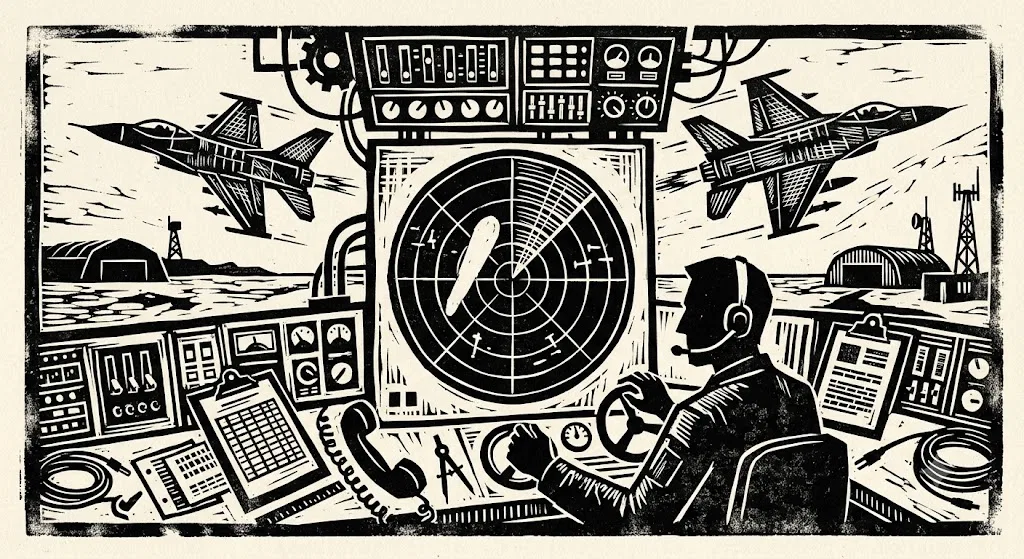
The more consequential Cape Cod case occurred on 21 September 1950 during a Massachusetts Institute of Technology weather-radar project conducted under contract to the US Army Signal Corps. An MIT research associate and Air National Guard major, M. H. Ligda, was working with two colleagues at a radar site near Provincetown. They were tracking a flight of Air Force fighters—identified in surviving summaries as F-86s, although some listings retain uncertainty between F-84 and F-86 aircraft—flying north-east at about 30,000 feet.[Internet Archive]archive.orgInternet Archive Full text of "The Hynek UFO ReportInternet Archive Full text of "The Hynek UFO Report
During the third tracking run, the operators saw another echo moving north on a converging course. Ligda’s contemporary letter to Major Tuttle, staff weather officer of the 33rd Fighter Wing at Otis, said that the unknown return caught up with the fighters, passed them, crossed their course and then made a tight right turn towards Boston. The target apparently passed over or under the fighter formation before leaving the radar beam. The fighter pilots were alerted but reported seeing nothing.[Internet Archive]archive.orgInternet Archive Full text of "The Hynek UFO ReportInternet Archive Full text of "The Hynek UFO Report
Ligda estimated the target’s speed at approximately 1,200 miles per hour, or about 22 miles per minute. His letter calculated that the turn imposed more than five times the force of gravity, although later case summaries sometimes give a higher estimate of 11 or 12 g. That difference is important: the widely repeated figures were calculations reconstructed from a radar trace, not direct measurements from an object carrying an accelerometer. Small errors in range, timing or the assumed shape of the turn could substantially alter the result.[Internet Archive]archive.orgInternet Archive Full text of "The Hynek UFO ReportInternet Archive Full text of "The Hynek UFO Report
The operators nevertheless considered the return unusually convincing. Ligda described it as an excellent echo that otherwise resembled a normal aircraft target. After briefly losing it while continuing to track the fighters, the team reportedly acquired it again for several seconds as it moved towards Boston. He believed its strength implied a sizeable reflecting object and was troubled that the pilots had not seen it.[Internet Archive]archive.orgInternet Archive Full text of "The Hynek UFO ReportInternet Archive Full text of "The Hynek UFO Report
The report is often described as a radar–visual encounter, but that wording is misleading. The unknown itself was not seen by the pilots or by observers on the ground. What happened was a radar-only detection occurring during a military flight, with visual non-confirmation by the aircrew. The known fighters acted as useful reference targets, but they did not independently verify that a physical craft crossed their route.
Why the radar turn looked extraordinary
Radar gives an incident an appearance of objectivity because it can record range and direction without relying entirely on human eyesight. In this case, the unknown echo was compared in real time with fighters whose general route and altitude were known. Three radar personnel were reportedly present, and the target’s movement was sufficiently coherent for Ligda to warn the pilots and sketch its path. Those details make the event more substantial than an isolated unexplained spot on a display.[Internet Archive]archive.orgInternet Archive Full text of "The Hynek UFO ReportInternet Archive Full text of "The Hynek UFO Report
The apparent manoeuvre was the feature that most impressed Ligda. At an estimated 1,200 mph, a tight turn would place severe loads on an occupied aircraft and demand aerodynamic performance beyond an ordinary 1950 fighter. Ligda considered a remotely controlled object but questioned why it would be deliberately flown across a military formation. His own reaction was cautious rather than explicitly extraterrestrial: he thought the event might concern a secret matter outside his authority and asked Otis personnel to raise it with intelligence officers.[Internet Archive]archive.orgInternet Archive Full text of "The Hynek UFO ReportInternet Archive Full text of "The Hynek UFO Report
That Cold War setting matters. Otis had been designated an Air Force base in 1948 and grew into a major air-defence installation, eventually becoming the largest Aerospace Defense Command base in the world before its reorganisation in the 1970s. An unidentified high-speed return near fighter operations therefore had an immediate security significance independent of any flying-saucer interpretation. It could have represented an unknown aircraft, experimental equipment, electronic interference or a radar phenomenon that might confuse air-defence operators.[102iw.ang.af.mil]102iw.ang.af.milOpen source on af.mil.
It is also easy to read later Cape Cod radar history back into the 1950 event. The prominent phased-array installation now associated with the region—the former Cape Cod Air Force Station’s Pave PAWS system—was not operational until 1980. Its missile-warning and space-surveillance role has no direct evidential connection to Ligda’s weather-radar observation three decades earlier.[102iw.ang.af.mil]102iw.ang.af.milOpen source on af.mil.
Radar faults and missing data
A radar echo establishes that a receiver detected returned or interfering energy; it does not by itself establish the identity, size or even the precise path of a physical aircraft. Atmospheric refraction can bend a radar beam and generate returns from the ground or objects beyond the expected radar horizon. Modern meteorologists call these false or displaced echoes anomalous propagation. Sea clutter, birds, electrical interference, sidelobe responses and equipment faults can also create misleading targets.[noaa.gov]noaa.govRadar return from AP is unpredictable, contaminates precipitationJetStream Max: Anomalous Propagation - NOAAAugust 9, 2023 — False echoes are known as anomalous propagation (AP) - an echo that is no…
Cape Cod’s coastal atmosphere makes propagation effects a legitimate line of enquiry. Temperature and humidity layers over land and sea can produce super-refraction or ducting, changing where the radar beam travels. That does not prove that Ligda saw an atmospheric artefact: his account said the target behaved like a normal, strong echo and followed a distinct moving course. It does mean that an adequate investigation required detailed weather profiles, radar settings, calibration records and repeated observations from another instrument. None of those materials is available in the commonly cited account.[Lincoln Laboratory]ll.mit.eduLincoln Laboratory[PDFIntroduction to Radar Systems - MIT Lincoln LaboratoryPropagation Effects on Radar Performance … highly weather dependent. Figure by MIT…
The absence of visual confirmation further weakens the claim that the echo represented a large, solid craft making an extraordinary interception. Ligda reasonably noted that the unknown could have passed thousands of feet above or below the fighters. Yet that uncertainty also shows why the radar geometry cannot be treated as a fully measured three-dimensional track. A conventional surveillance display principally supplies range and bearing; altitude may remain uncertain unless obtained through a separate measurement or calculated from assumptions. Apparent crossings on a two-dimensional scope need not mean that two objects came close in three-dimensional space.
Most importantly, the follow-up appears to have ended before the central questions were answered. According to J. Allen Hynek’s later reproduction of Ligda’s letter, the officer was told that someone from Otis would contact him, but nobody did and no further information was released. The surviving narrative therefore lacks interviews with the fighter pilots, an engineering inspection of the radar, a preserved scope photograph, raw plotting sheets or a documented Air Force analysis eliminating specific false-target mechanisms.[Internet Archive]archive.orgInternet Archive Full text of "The Hynek UFO ReportInternet Archive Full text of "The Hynek UFO Report
Hynek’s account is valuable because it preserves a substantial extract from what appears to have been a near-contemporary letter. It is not the same as a complete original case file. Hynek published The Hynek UFO Report decades later as a critic of Air Force handling of unexplained cases, so his selection and framing should be read alongside—not substituted for—the absent technical documentation. The National Archives confirms that Blue Book’s wider records contain chronological case files, administrative material and Office of Special Investigations records, but an official catalogue entry cannot supply measurements that were never retained or made publicly available.[National Archives]archives.govNational Archives Project BLUE BOOKNational ArchivesProject BLUE BOOK - Unidentified Flying Objects | National Archives…
Did later reporting strengthen the cases?
Later retellings strengthened the reputation of the Cape Cod incidents more than their evidential foundations. Concise UFO catalogues preserve the Teaticket cylinders and list the Provincetown radar event as an official unknown. They also provide memorable numbers—1,200 mph and an extreme turn—which make the Otis case sound comparable to a modern instrumented encounter. Yet the underlying evidence has not visibly expanded into a complete dataset that independent analysts can recalculate.[ufologie.patrickgross.org]ufologie.patrickgross.orgufo - UFOs at close sight: Project Blue Book unexplained cases summaries with witnesses names, 1950…
For Teaticket, later summaries repeat the witness qualifications, five-minute duration and released fireball, but do not add photographs, physical traces or detailed contemporary statements. The case remains a noteworthy multiple-witness observation with potentially strong witnesses and very limited reconstructable data. Its most dramatic feature is also its least testable.
For the Otis case, Ligda’s detailed letter makes the original claim more credible as a sincere report. It indicates that several radar operators observed a coherent return while deliberately tracking known fighters, rather than noticing an isolated unexplained blip after the fact. Against that, the missing radar record and lack of independent sensor confirmation prevent verification of the calculated speed and turn. The pilots’ failure to see the target does not disprove it, but it removes the corroboration that would have made the case substantially stronger.[Internet Archive]archive.orgInternet Archive Full text of "The Hynek UFO ReportInternet Archive Full text of "The Hynek UFO Report
The fairest assessment is therefore unresolved but under-documented. A false or displaced radar return is plausible, but no surviving technical investigation conclusively demonstrates one. A real conventional or experimental aircraft is possible, but the reported velocity and turn would require some measurements to be wrong. An unconventional physical craft cannot be excluded merely because the documentation is incomplete, yet the surviving record does not establish one. “Unidentified” remains the correct historical label precisely because the case lacks enough dependable information to move confidently from anomaly to explanation.
Why Cape Cod matters in Massachusetts UFO history
The Teaticket and Otis reports form a useful pair. Teaticket offers human testimony from witnesses with aviation backgrounds but no instrument record. The Provincetown–Otis case offers an instrument return and several operators but no visual identification or preserved data. Each supplies what the other lacks, yet neither combines the full set of evidence—independent sensors, precise records, visual confirmation and thorough investigation—needed for a robust extraordinary claim.
They also show why Cape Cod became a natural setting for military UFO stories. The region combined open sea approaches, rapidly developing radar research, fighter operations and a major air-defence base. Unfamiliar lights and unexplained radar returns were not merely curiosities there; they could be treated as potential intrusions into strategically important airspace. That security context explains official interest without implying that officials concluded the objects were extraterrestrial.
Within the wider Massachusetts record, these cases are more useful as studies of evidential limits than as proof of remarkable machines. The witnesses were not obviously frivolous, the reports entered official channels, and the Otis radar event deserved a more complete investigation than the surviving account records. At the same time, witness expertise cannot recover missing measurements, and an impressive radar track cannot be independently tested when the original trace, calibration and environmental data are absent. Cape Cod’s early sightings remain genuinely puzzling episodes—but the puzzle lies as much in the incomplete investigation as in whatever appeared in the sky or on the radar screen.
Amazon book picks
Further Reading
Books and field guides related to Did Cape Cod Radar Track an Extraordinary Craft?. Use these as the next step if you want deeper reading beyond the article.
UFOs: Generals, Pilots, and Government Officials Go on the Re...
Closely matches the Cape Cod radar and aviation theme.
The Report on Unidentified Flying Objects
Written by a key figure from the Air Force investigation program.
The UFO Experience: A Scientific Inquiry
Discusses investigative standards for radar and witness cases.
Encounter in Rendlesham Forest
Explores evidence assessment in military sighting reports.
eBay marketplace picks
Marketplace Samples
Live-tested eBay searches with available results related to this page.
Selected fromradar station poster oneBay.co.uk.


Endnotes
1.
Source: ufologie.patrickgross.org
Link:https://ufologie.patrickgross.org/htm/bluebooku50.htm
Source snippet
ufo - UFOs at close sight: Project Blue Book unexplained cases summaries with witnesses names, 1950...
2.
Source: archive.org
Title: Internet Archive Full text of “The Hynek UFO Report”
Link:https://archive.org/stream/TheHynekUFOReport/The_Hynek_UFO_Report_djvu.txt
3.
Source: archives.gov
Title: National Archives Project BLUE BOOK
Link:https://www.archives.gov/research/military/air-force/ufos
Source snippet
National ArchivesProject BLUE BOOK - Unidentified Flying Objects | National Archives...
4.
Source: 102iw.ang.af.mil
Link:https://www.102iw.ang.af.mil/About/Fact-Sheets/Display/Article/452385/otis-air-national-guard-base-and-the-massachusetts-military-reservation/
5.
Source: noaa.gov
Title: Radar return from AP is unpredictable, contaminates precipitation
Link:https://www.noaa.gov/jetstream/anomalous-propagation
Source snippet
JetStream Max: Anomalous Propagation - NOAAAugust 9, 2023 — False echoes are known as anomalous propagation (AP) - an echo that is no...
Published: August 9, 2023
6.
Source: ll.mit.edu
Title: Lincoln Laboratory[PDF]
Link:https://www.ll.mit.edu/media/6951
Source snippet
Introduction to Radar Systems - MIT Lincoln LaboratoryPropagation Effects on Radar Performance … highly weather dependent. Figure by MIT...
7.
Source: archive.org
Title: Brad Sparks Comprehensive Catalog of 1,600 Project Blue Book UFO Unknowns
Link:https://archive.org/download/BernardSieglerTechnicsAndTime1TheFaultOfEpimetheus/Brad%20Sparks%20-%20Comprehensive%20Catalog%20of%201%2C600%20Project%20Blue%20Book%20UFO%20Unknowns.pdf
8.
Source: ufologie.patrickgross.org
Link:https://ufologie.patrickgross.org/htm/bluebooku52.htm
9.
Source: af.mil
Link:https://www.af.mil/About-Us/Fact-Sheets/Display/Article/104590/unidentified-flying-objects-and-air-force-project-blue-book/
10.
Source: training.weather.gov
Title: Section1 1
Link:https://training.weather.gov/nwstc/NEXRAD/RADAR/Section1-1.html
11.
Source: Wikipedia
Title: Project Blue Book
Link:https://en.wikipedia.org/wiki/Project_Blue_Book
12.
Source: Wikipedia
Title: Anomalous propagation
Link:https://en.wikipedia.org/wiki/Anomalous_propagation
13.
Source: pdfcoffee.com
Title: J. Allen Hynek
Link:https://pdfcoffee.com/j-allen-hynek-the-hynek-ufo-report-1977-pdf-free.html
Additional References
14.
Source: nicap.org
Title: A Review of Twenty One Ground and Airborne Radar UAP
Link:https://www.nicap.org/radcatproject/RADCAT_Entries.pdf
Source snippet
radar site at. Provincetown. The following is from a report made to Major Tuttle, Staff Weather Officers. 33rd Fighter Wing, Otis AFB, M...
15.
Source: wx.erau.edu
Title: Embry-Riddle Meteorology Radar Intro
Link:https://wx.erau.edu/faculty/mullerb/Wx365/Radar_intro/radar_intro.html
Source snippet
Embry-Riddle MeteorologyRadar Intro - ERAU MeteorologyIt was not long before radar users noticed interference from weather systems maskin...
16.
Source: youtube.com
Title: How Military Sensors Proved UFO Craft Were Physically Real | WION Podcast
Link:https://www.youtube.com/watch?v=H6eK1VbrHPY
Source snippet
Top 10 Unidentified Aerial Objects Tracked by Military Systems...
17.
Source: youtube.com
Title: INSIDE the U.S. Space Force’s 6th Space Warning Squadron (TEAM 6)
Link:https://www.youtube.com/watch?v=oxsu9hs9c8I
Source snippet
How Military Sensors Proved UFO Craft Were Physically Real | WION Podcast...
18.
Source: youtube.com
Title: Top 10 Unidentified Aerial Objects Tracked by Military Systems
Link:https://www.youtube.com/watch?v=KB5UyDZ4jlk
Source snippet
PROJECT TWINKLE: The Secret FBI Files on Cold War UFOs. By Wiki Brigades...
19.
Source: youtube.com
Title: PROJECT TWINKLE: The Secret FBI Files on Cold War UFOs. By Wiki Brigades
Link:https://www.youtube.com/watch?v=hSvwIiDqptM
Source snippet
The Creepy Missing F-89 Pilot - The Kinross UFO Incident...
20.
Source: govinfo.gov
Link:https://www.govinfo.gov/content/pkg/CZIC-gb473-b35-1980/html/CZIC-gb473-b35-1980.htm
21.
Source: nsa.gov
Link:https://www.nsa.gov/portals/75/documents/news-features/declassified-documents/ufo/usaf_fact_sheet_95_03.pdf
22.
Source: spinnakerpress.com
Link:https://www.spinnakerpress.com/wp-content/uploads/2015/06/47-FT-MLB-Operator%E2%80%99s-Handbook.pdf
23.
Source: scribd.com
Link:https://www.scribd.com/document/51179838/UFOlogy-The-Book-NICAP-Database