Within Official Records
How Did a Kentucky Sighting Become Official?
Kentucky sightings became official cases through a chain linking police, control towers, nearby bases and Wright-Patterson investigators.
On this page
- From local report to nearest Air Force base
- What evidence investigators were expected to collect
- Why military linked sightings created fuller records
Page outline Jump by section
Introduction
A Kentucky UFO report did not become a Project Blue Book case simply because someone claimed to see something unusual in the sky. During the Cold War, reports generally moved through a structured chain linking local witnesses, police departments, airport control towers, military bases and, ultimately, investigators at Wright-Patterson Air Force Base in Ohio, where Project Blue Book was headquartered. The process mattered because the Air Force was trying to determine whether unknown aerial objects represented a national-security concern, a conventional aircraft, a weather or research balloon, or something that could not be readily identified. Kentucky’s proximity to major military facilities, including Fort Knox and Godman Army Airfield, often meant that reports generated more documentation than ordinary civilian sightings.[whs.mil]esd.whs.milDefense Logistics AgencyProject Blue BookIn the course of accomplishing these objectives, Project Blue Book strives to identify and expla…
How Did a Kentucky Sighting Become Official?
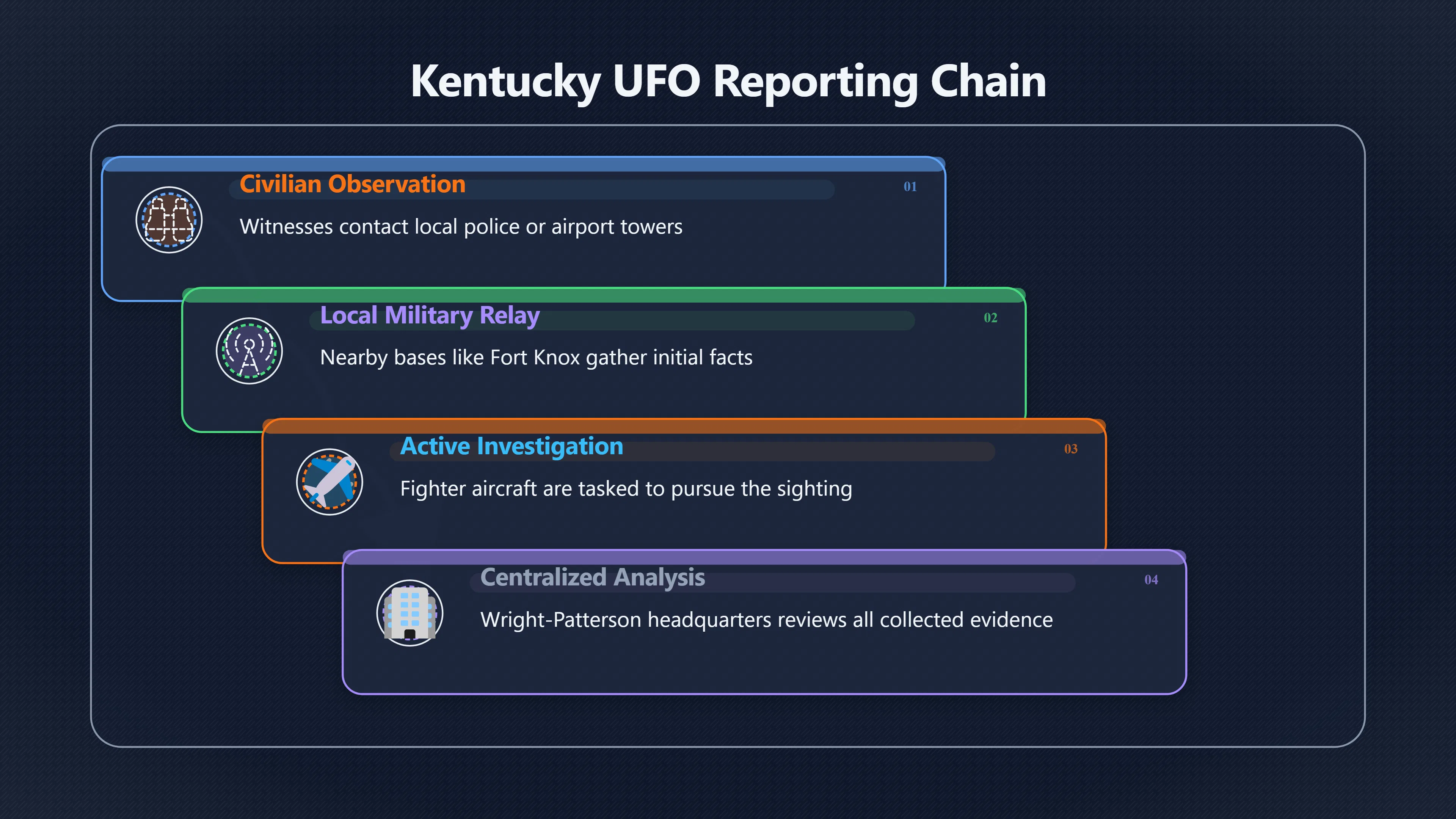
For most Kentucky cases, the route into official records began locally. A witness might contact police, a sheriff’s office, a newspaper, an airport tower or a nearby military installation. If the report appeared credible, involved multiple observers, affected aviation, or occurred near sensitive facilities, military personnel could become involved quickly.
Project Blue Book’s procedures placed responsibility for the first investigation on the nearest Air Force installation. Local military personnel were expected to gather facts, interview witnesses and assemble supporting information before forwarding the material to Wright-Patterson for review. The headquarters staff then compared the report with known aircraft activity, weather data, astronomical conditions and other intelligence sources.[whs.mil]esd.whs.milDefense Logistics AgencyProject Blue BookIn the course of accomplishing these objectives, Project Blue Book strives to identify and expla…
In Kentucky, this reporting pathway was particularly visible because important military facilities already possessed communications networks capable of receiving and relaying unusual reports. A sighting that might otherwise have remained a local story could become part of a formal Air Force file.
From Local Report to Nearest Air Force Base
The best-known Kentucky example illustrates the reporting chain in action.
On 7 January 1948, reports of an unusual aerial object reached authorities through the Kentucky Highway Patrol. Information was passed to Godman Army Airfield at Fort Knox, where tower personnel attempted to observe the object themselves. Once military observers concluded that the object could not be immediately identified, fighter aircraft from the Kentucky Air National Guard were directed toward it. The resulting pursuit by Captain Thomas Mantell became one of the most famous early UFO incidents in American history.[Wikipedia]wikipedia.orgMantell UFO incidentMantell UFO incident
The details of the Mantell case are less important here than the administrative process it revealed:

- Civilian witnesses reported an object.
- Law-enforcement agencies relayed information.
- Military personnel attempted independent observation.
- Air operations were tasked to investigate.
- Reports entered the Air Force’s growing UFO-investigation system.[origins.osu.edu]origins.osu.eduair force investigation ufosair force investigation ufos
- Later investigators at Wright-Patterson reviewed and re-examined the evidence. Wikipedia
Although the Mantell incident occurred during the era of Project Sign rather than Project Blue Book itself, it established the pattern later used throughout the Blue Book years: local observation first, military inquiry second, central analysis third. Wikipedia
What Evidence Investigators Were Expected to Collect
Project Blue Book was not designed to collect stories alone. Investigators sought information that could be checked against military and scientific records.
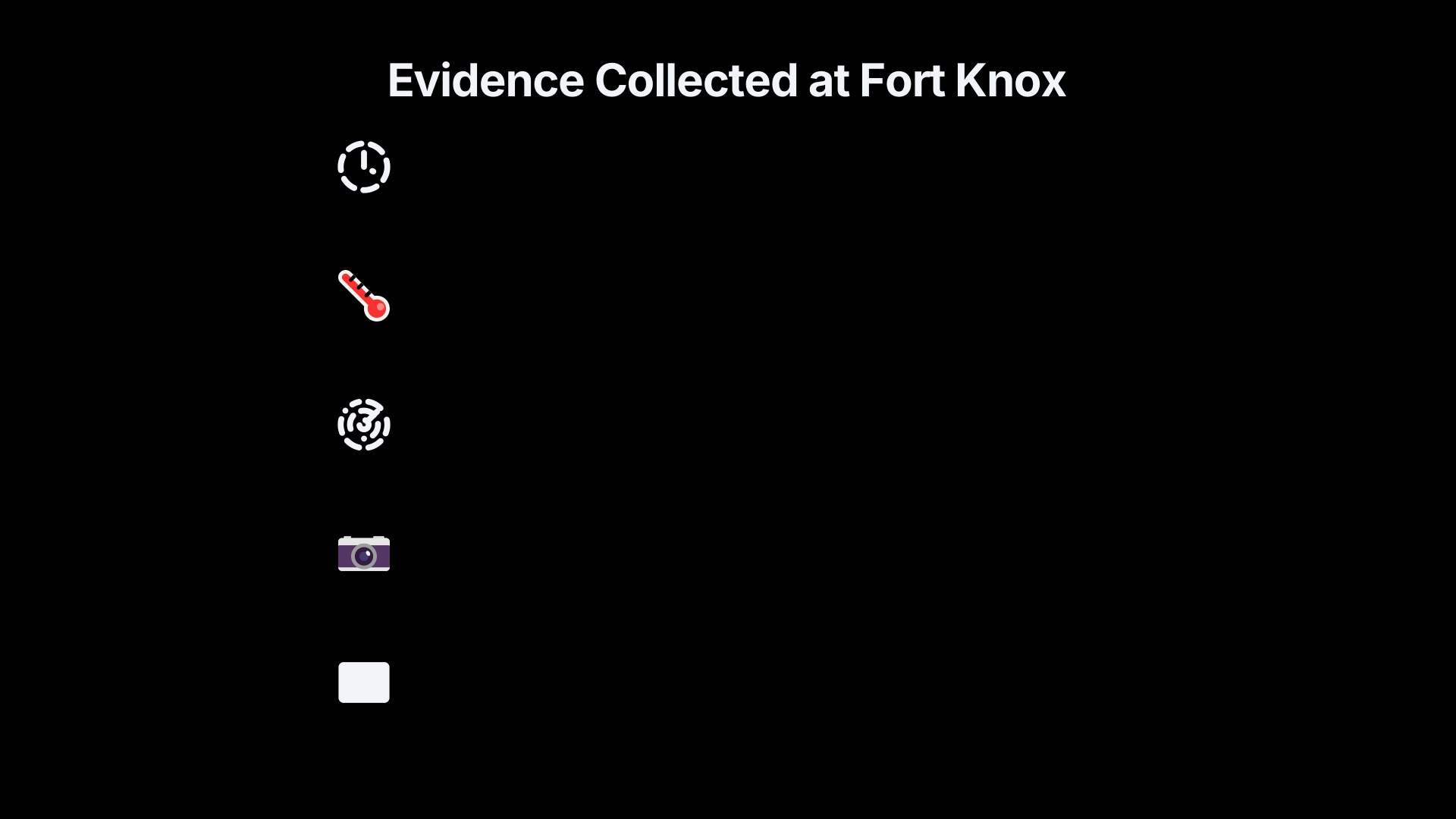
A Kentucky base handling an unusual report was generally expected to gather:
- Precise date and time of the observation.
- Location and direction of travel.
- Weather conditions.
- Names and backgrounds of witnesses.
- Aircraft activity in the area.
- Radar information when available.
- Photographs, sketches or physical evidence.
- Statements from pilots, tower operators or military personnel who had observed the event. Defense Logistics Agency
The goal was not to prove extraordinary claims but to eliminate ordinary explanations. A report might be compared with known weather-balloon launches, astronomical objects, military exercises or civilian flights. If a convincing explanation emerged, the case could be closed as identified. If evidence remained incomplete or contradictory, it could remain unresolved. Defense Logistics Agency
This helps explain why some Kentucky cases generated thick files while others disappeared quickly. The determining factor was often the amount of verifiable information collected during the initial investigation rather than the strangeness of the claim itself.
Why Military-Linked Sightings Created Fuller Records
Reports involving military facilities tended to leave a richer documentary trail than purely civilian sightings.
Personnel at installations such as Fort Knox and Godman Army Airfield were trained observers operating within formal reporting systems. They could record times accurately, communicate with other facilities, preserve witness statements and compare observations with aviation activity. When pilots, control-tower staff or military police became witnesses, investigators often regarded the reports as requiring closer examination. Wikipedia
This did not mean military witnesses were always correct. The Mantell case itself demonstrates the limits of observation under uncertain conditions. Later Blue Book reviews suggested that the object involved was probably a high-altitude Skyhook research balloon rather than an unknown craft. Yet the case continued to attract attention because the military response generated extensive records, radio communications and official correspondence. Wikipedia
The same principle applied to later Kentucky reports. Cases linked to airfields, radar installations, military flights or defence facilities often survived in archives because official organisations were required to document what they had seen and what actions they had taken.
Why Wright-Patterson Became the Final Destination
The reporting chain ultimately converged on Wright-Patterson Air Force Base in Ohio, where Project Blue Book maintained its headquarters. Investigators there assembled reports from across the United States, including Kentucky, and attempted to classify them using a standard evaluation process. Wikipedia
For Kentucky reports, Wright-Patterson served several functions:
- Central repository for case files.
- Clearinghouse for technical analysis.
- Point of contact with scientific consultants.
- Final authority for official case classifications. Defense Logistics Agency
This centralisation is one reason Kentucky remains prominent in UFO history. Reports that entered military channels often ended up preserved within the broader Blue Book archive, allowing later researchers to reconstruct how information moved from a local sighting to a federal investigation. National Archives
What the Reporting Chain Tells Us About Kentucky UFO History
The most important lesson from Kentucky’s Blue Book-era cases is not that military involvement confirmed extraordinary events. Rather, it shows how uncertainty was managed.
A Kentucky sighting became an official case when it passed through institutions capable of documenting it: police departments, control towers, military bases and Air Force investigators. The resulting files reveal how Cold War authorities responded when they encountered something they could not immediately identify. Some reports were eventually explained as balloons, aircraft or astronomical objects. Others remained unresolved because the evidence was incomplete. Air Force+2Defense Logistics Agency
For historians of Kentucky’s UFO record, the reporting chain itself is often as significant as the sighting. It explains why certain incidents generated extensive archives while countless ordinary observations never progressed beyond local conversation. The path from witness to base, and from base to Wright-Patterson, transformed a fleeting observation into an enduring historical record. National Archives
Amazon book picks
Further Reading
Books and field guides related to How Did a Kentucky Sighting Become Official?. Use these as the next step if you want deeper reading beyond the article.
The UFO Experience: A Scientific Inquiry
Provides the analytical framework used on many reports.
UFOs: Generals, Pilots, and Government Officials Go on the Re...
Shows how official witnesses document unusual events.
eBay marketplace picks
Marketplace Samples
Live-tested eBay searches with available results related to this page.
Selected fromUS Air Force collectible oneBay.co.uk.


Endnotes
1.
Source: Wikipedia
Title: Project Blue Book
Link:https://en.wikipedia.org/wiki/Project_Blue_Book
2.
Source: studocu.com
Link:https://www.studocu.com/en-za/document/university-of-the-witwatersrand-johannesburg/physics-for-scientists-engineers-i/ufo-documents-and-information/120714874
Source snippet
UFO Investigations Under Project Blue Book (Feb 1966)In the course of accomplishing these objectives, Project Blue Book strives to...
4.
Source: archives.gov
Title: National Archives Project BLUE BOOK
Link:https://www.archives.gov/research/military/air-force/ufos
Source snippet
National ArchivesProject BLUE BOOK - Unidentified Flying ObjectsThe United States Air Force retired to the custody of the National Archiv...
5.
Source: archives.gov
Title: project blue book 50th anniversary
Link:https://www.archives.gov/news/articles/project-blue-book-50th-anniversary
6.
Source: Wikipedia
Link:https://en.wikipedia.org/wiki/Project
7.
Source: esd.whs.mil
Link:https://www.esd.whs.mil/Portals/54/Documents/FOID/Reading%20Room/UFOsandUAPs/proj_b1.pdf?ver=2017-05-22-113513-837
Source snippet
Defense Logistics AgencyProject Blue BookIn the course of accomplishing these objectives, Project Blue Book strives to identify and expla...
8.
Source: origins.osu.edu
Title: project blue book
Link:https://origins.osu.edu/watch/project-blue-book
Source snippet
Project Blue Book: America's Obsession with UFOs | Origins3 Sept 2025 — Project Blue Book, the U.S. Air Force's investigation into...
9.
Source: af.mil
Link:https://www.af.mil/About-Us/Fact-Sheets/Display/Article/104590/unidentified-flying-objects-and-air-force-project-blue-book/
Source snippet
Air ForceUnidentified Flying Objects and Air Force Project Blue BookWith the termination of Project Blue Book, the Air Force regulation e...
10.
Source: dictionary.cambridge.org
Link:https://dictionary.cambridge.org/dictionary/english/project
Source snippet
English meaning - Cambridge Dictionarya piece of planned work or an activity that is finished over a period of time and intended to ach...
11.
Source: origins.osu.edu
Title: air force investigation ufos
Link:https://origins.osu.edu/read/air-force-investigation-ufos
Additional References
12.
Source: upload.wikimedia.org
Link:https://upload.wikimedia.org/wikipedia/commons/2/21/Project_Blue_Book%2C_BBA-PBSR11-300.pdf
Source snippet
Wikimedia CommonsThe Project Blue Book ArchiveThe Project Blue Book Archive contains tens of thousands of documents generated by United...
13.
Source: youtube.com
Title: The True Story Behind US Government Investigations Into UFOs | Project Blue Book
Link:https://www.youtube.com/watch?v=qdTVsr4O4HA
Source snippet
Project Blue Book Exposed (2020) [Documentary]...
14.
Source: youtube.com
Title: Project Blue Book: America’s Obsession with UFOs
Link:https://www.youtube.com/watch?v=Xu4oTBBI5UE
Source snippet
Questions remain 75 years after mysterious Fort Knox UFO incident, downed pilot...
15.
Source: nsa.gov
Title: United States Air Force Fact Sheet 95-03United States Air Force Fact Sheet 95-03
Link:https://www.nsa.gov/Helpful-Links/NSA-FOIA/Declassification-Transparency-Initiatives/FOIA-Reports-and-Releases/FOIA-Reports-and-Releases-List/igphoto/2002761380/
16.
Source: archivesfoundation.org
Link:https://archivesfoundation.org/documents/50-years-ago-government-stops-investigating-ufos/
17.
Source: facebook.com
Link:https://www.facebook.com/HISTORY/posts/during-the-cold-war-as-project-blue-book-investigated-potential-ufo-threats-a-sh/1473622884330683/
18.
Source: medium.com
Link:https://medium.com/%40Titan828/pursuit-to-oblivion-the-death-of-captain-thomas-mantell-the-early-history-of-the-united-states-bc3996cfe410
19.
Source: docsteach.org
Link:https://docsteach.org/document/ufo-questionnaire/
20.
Source: pmi.org
Link:https://www.pmi.org/about/what-is-a-project
21.
Source: microsoft.com
Link:https://www.microsoft.com/pl-pl/microsoft-365/project/project-management