Within Haynesville
Did the Bark Really Come From the UFO Site?
The bark samples are intriguing, but the late site identification and broken chain of custody leave their connection to the 1966 light unproven.
On this page
- How the clearing was identified after the official search
- What a reliable chain of custody would require
- Alternative causes of the reported tree blackening
Page outline Jump by section
Introduction
The short answer is no: the scorched or blackened bark associated with the Haynesville incident cannot be securely traced to the light seen on 30 December 1966. The bark samples are real, and later investigators treated them as potentially important physical evidence. However, the crucial link between the samples and the original sighting was established only after the official investigation had already searched the area and failed to locate a confirmed burn site. By the time bark was collected, the chain of evidence depended largely on retrospective site identification rather than on documentation made during the event itself.[ScienceDirect]sciencedirect.comThey are often noted to impact both human health and physical devices in…

That does not mean the bark was unrelated to the sighting. It means the provenance—the documented history showing exactly where the material came from and how it was handled—remains too weak to prove the connection. For readers assessing Haynesville’s reputation as a physical-trace case, this distinction is central. The luminous observation remains difficult to explain, but the bark evidence stands on much shakier ground.[ScienceDirect]sciencedirect.comThey are often noted to impact both human health and physical devices in…
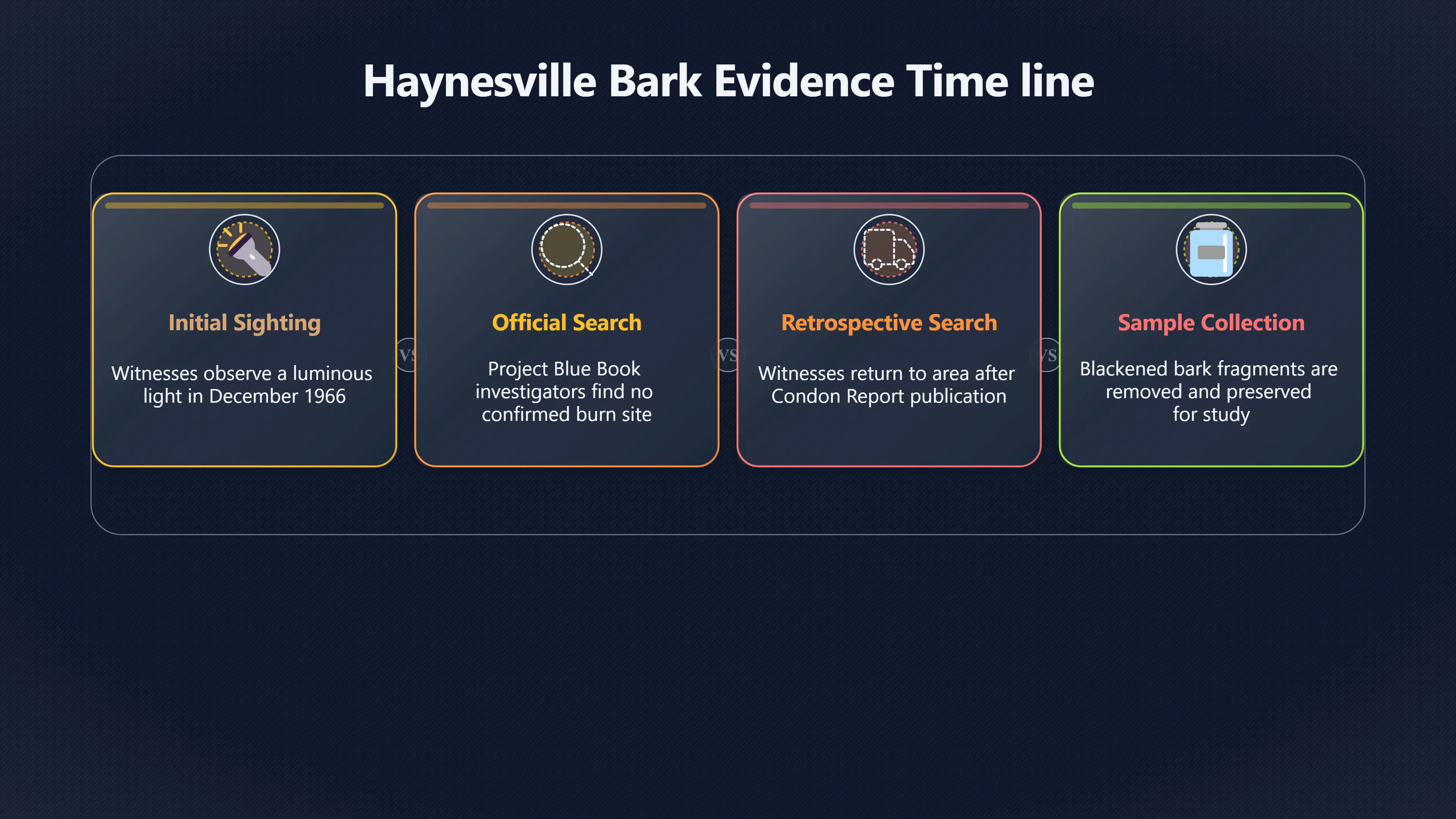
How the Clearing Was Identified After the Official Search
One of the most important facts in the Haynesville record is that investigators working close to the event did not initially find a damaged clearing.
The case was examined by personnel connected with Project Blue Book and by the University of Colorado UFO study, often known as the Condon investigation. Contemporary investigators attempted to reconstruct the observation area, but they did not identify a site containing obvious burn damage that could be tied directly to the reported light. This absence of physical traces became part of the original investigative record.
According to later accounts, the situation changed only after publication of the Condon Report. The principal witness, Louie Galloway, reportedly returned to the area with colleagues and conducted a more systematic search. During this later effort, a clearing was identified where trees around the perimeter allegedly displayed blackened bark facing towards the centre. Bark fragments were then removed and preserved for study.[ScienceDirect]sciencedirect.comThey are often noted to impact both human health and physical devices in…
This sequence creates an evidential problem. The alleged trace site was not documented on the night of the sighting, nor was it established during the earliest official fieldwork. Instead, it emerged through a retrospective reconstruction. Even if the clearing genuinely contained unusual bark damage, the gap between the event and the site’s identification makes it difficult to demonstrate that the damage was caused by the light observed in December 1966.[ScienceDirect]sciencedirect.comThey are often noted to impact both human health and physical devices in…
In practical terms, the key question is not whether bark samples existed. It is whether anyone can show that those samples came from the exact location illuminated by the phenomenon reported by the witnesses. The surviving record does not provide that level of certainty.
What a Reliable Chain of Custody Would Require
Physical evidence is strongest when its history can be traced continuously from discovery to analysis.
For the bark samples, a robust chain of custody would ideally include:
- Precise documentation of the location immediately after the event.
- Photographs showing the damaged trees before sampling.
- Independent confirmation that the site matched the witness observations.
- Recorded collection procedures identifying who removed each sample.
- Continuous records showing where the samples were stored and how they were handled.
- Laboratory examinations conducted on material whose origin was independently verified.
The Haynesville bark evidence does not meet this standard. The available accounts describe samples being collected after the site was identified retrospectively, but they do not provide the kind of uninterrupted documentation normally expected for high-confidence forensic evidence.[ScienceDirect]sciencedirect.comThey are often noted to impact both human health and physical devices in…
This limitation is acknowledged indirectly even in modern re-examinations. A 2025 aerospace study revisiting the case treated the bark as potentially valuable physical material and used it in energy-modelling discussions, yet also noted the uncertainty surrounding surviving samples and recommended renewed examination if preserved material remains available.[ScienceDirect]sciencedirect.comThey are often noted to impact both human health and physical devices in…
The result is a paradox. The bark is often presented as the strongest physical evidence in the case, but the evidential chain linking it to the sighting is weaker than many summaries imply.
Could the Blackening Have Had Other Causes?
Even if the bark damage was genuine, establishing its cause is another challenge.
Blackened bark can result from several natural or ordinary processes. Trees may be marked by previous fires, controlled burns, lightning effects, disease, fungal activity, environmental stress, mechanical damage, or localised heating from entirely terrestrial sources. In forest environments, evidence of past burning can persist long after the original cause has disappeared. Studies of charcoal and fire traces show that blackened plant material can survive for extended periods and may be difficult to connect confidently to a specific event without supporting documentation.[National Park Service]nps.govdff8 sedimentNational Park ServiceSoil charcoal shows fire history12 Nov 2015 — Results from fine-scale sampling of charcoal in Gum Swamp seemed to sh…
The 2025 analysis argued that the pattern of bark darkening was more consistent with exposure to intense light than direct flame and used thermal modelling to estimate the energy that would have been required. Those calculations are interesting because they attempt to quantify the phenomenon rather than merely describe it. However, the modelling starts from the assumption that the sampled bark was indeed affected by the same source observed by Galloway. If that assumption is uncertain, the resulting energy estimates inherit the same uncertainty.[ScienceDirect]sciencedirect.comThey are often noted to impact both human health and physical devices in…
This does not invalidate the calculations. It simply means that the physical interpretation cannot be stronger than the provenance of the samples on which it depends.
Why Provenance Matters More Than the Damage Itself
Many discussions of Haynesville focus on whether the bark looked burned. The more important question is whether investigators can demonstrate where that bark came from and when the damage occurred.
If a confirmed burn site had been photographed and sampled immediately after the sighting, Haynesville would rank among the stronger physical-trace cases in Louisiana UFO history. Instead, the evidential chain contains a critical break between the original observation and the later discovery of the clearing. That gap leaves open several possibilities:
- The clearing was the correct location and the bark was genuinely affected by the observed light.
- The clearing was related to the event but the damage pre-dated it.
- The clearing was unrelated and was identified only because investigators were searching for physical traces.
- The bark showed unusual effects, but those effects stemmed from an ordinary environmental cause.
The surviving record does not allow these possibilities to be separated with confidence.[ScienceDirect]sciencedirect.comThey are often noted to impact both human health and physical devices in…

Reading the evidence around Bark Provenance conservatively
The bark samples remain one of the most intriguing aspects of the Haynesville case, but they do not provide conclusive physical proof of the reported phenomenon.
The strongest evidence is that bark displaying unusual blackening was later collected from a clearing believed to be associated with the sighting. The strongest objection is that the clearing was identified only after earlier investigators had failed to locate a confirmed trace site, leaving the provenance of the samples uncertain.[ScienceDirect]sciencedirect.comThey are often noted to impact both human health and physical devices in…
For that reason, the bark should be treated as suggestive rather than definitive evidence. Within Louisiana’s UFO history, it strengthens the case that something unusual may have occurred near Haynesville, but it does not establish that the blackened bark was caused by the light witnessed in December 1966. The physical-trace claim remains an unresolved possibility rather than a demonstrated fact.[ScienceDirect]sciencedirect.comThey are often noted to impact both human health and physical devices in…
Amazon book picks
Further Reading
Books and field guides related to Did the Bark Really Come From the UFO Site?. Use these as the next step if you want deeper reading beyond the article.
The UFO Experience: A Scientific Inquiry
Discusses trace cases and standards for assessing reports.
UFOs: Generals, Pilots, and Government Officials Go on the Re...
Highlights the importance of credible documentation and evidence.
The UFO Enigma: A New Review of the Physical Evidence
Directly addresses evaluation of physical-trace claims and evidence quality.
The Demon-haunted World
Useful for understanding chain-of-evidence and extraordinary claims.
eBay marketplace picks
Marketplace Samples
Live-tested eBay searches with available results related to this page.
Selected fromUFO poster oneBay.co.uk.
Current eBay listing
FS02 VINTAGE UFO FLYING SAUCERS COMIC ADVERTISING A4 POSTER PRINT
Current eBay listing
VINTAGE UFO FLYING SAUCERS COMIC ADVERTISING A2 POSTER PRINT

Endnotes
1.
Source: sciencedirect.com
Link:https://www.sciencedirect.com/science/article/abs/pii/S0376042125000247
Source snippet
They are often noted to impact both human health and physical devices in...
2.
Source: nps.gov
Title: dff8 sediment
Link:https://www.nps.gov/grsm/learn/nature/dff8-sediment.htm
Source snippet
National Park ServiceSoil charcoal shows fire history12 Nov 2015 — Results from fine-scale sampling of charcoal in Gum Swamp seemed to sh...
3.
Source: youtube.com
Link:https://www.youtube.com/watch?v=Uz1cjc-mMGM
Source snippet
The Condon Report | NASA's Unexplained Files...
4.
Source: youtube.com
Title: The Condon Report | NASA’s Unexplained Files
Link:https://www.youtube.com/watch?v=_W7SqS6UhE4
Additional References
5.
Source: researchgate.net
Link:https://www.researchgate.net/publication/311511858_Holocene_fire_history_Can_evidence_of_peat_burning_be_found_in_the_palaeo-archive
Source snippet
(PDF) Holocene fire history: Can evidence of peat burning...12 Dec 2016 — In this study, modern peat samples from peatlands across the g...
6.
Source: forensic-architecture.org
Title: environmental racism in death alley louisiana
Link:https://forensic-architecture.org/investigation/environmental-racism-in-death-alley-louisiana
Source snippet
Environmental Racism In Death Alley, Louisiana28 Jun 2021 — The erasure and degradation of hundreds of known, suspected, and unmarked bur...
7.
Source: youtube.com
Link:https://www.youtube.com/watch?v=fTlbxzMQajk
Source snippet
The UnXplained: UNBELIEVABLE Evidence of Unidentified Aerial Phenomena (Season 1)...
8.
Source: youtube.com
Link:https://www.youtube.com/watch?v=OAifOXu_L-M
Source snippet
The Proof Is Out There: UFO Expert EXPOSES Never-Before-Seen Video (Season 1)...
9.
Source: youtube.com
Title: The Proof Is Out There: UFO Expert EXPOSES Never-Before-Seen Video (Season 1)
Link:https://www.youtube.com/watch?v=-D7X3yjh5kc
Source snippet
ON THE TRAIL OF UFOS: THE DISCLOSURE ERA | Official Trailer (2026)|DOCUMENTARY...
10.
Source: 3af.fr
Link:https://www.3af.fr/docs/2025110701_1328693110_2025-estimates-of-radiative-energy-values-in-ground-level-observations-of-an-0aunidentified-aerial-phenomenon-new-physical-data.pdf
Source snippet
Estimates of radiative energy values in ground-level...Given the time elapsed since the 1966 Haynesville incident, it is uncertain wheth...
11.
Source: ui.adsabs.harvard.edu
Link:https://ui.adsabs.harvard.edu/abs/2025PrAeS.15601098V/abstract
Source snippet
Samples of the burned and intact bark were obtained by our own team, and they were preserved until it became possible to properly...
12.
Source: medium.com
Link:https://medium.com/%40kyeq1/the-forgotten-uap-case-jacques-vall%C3%A9e-calls-one-of-the-most-important-in-history-5f5f44f2d88c
13.
Source: scholarship.claremont.edu
Link:https://scholarship.claremont.edu/cgi/viewcontent.cgi?article=1315&context=scripps_theses
14.
Source: appalachian.nccardinal.org
Link:https://appalachian.nccardinal.org/eg/opac/record/10431014