Within Haynesville
Do the Haynesville Energy Calculations Hold Up?
The later calculations estimate extreme energy output, but their result depends on uncertain distance, brightness, site location and sample history.
On this page
- What the 2025 model tried to calculate
- Which witness and site assumptions drive the result
- Why impressive numbers cannot validate uncertain evidence
Page outline Jump by section
Introduction
The short answer is that the 2025 Haynesville energy model is technically interesting but only as reliable as the assumptions fed into it. The paper attempted to estimate how much radiant energy would have been required to produce the extraordinary brightness reported by witness Louie Galloway and, if the later bark samples genuinely came from the correct site, how much energy might have been needed to affect vegetation. The resulting figures were extremely large and attracted attention because they appeared to imply a powerful physical event rather than a simple misperception. However, the calculations depend on several uncertain inputs: the distance to the light source, the true location of the event, the accuracy of brightness estimates made decades earlier, and the provenance of the bark samples themselves. As a result, the model can show what energy would be required under a particular set of assumptions, but it cannot demonstrate that those assumptions are correct.[ScienceDirect]sciencedirect.comHigh-energy events are not rare in the context of UFO/UAP reports. They are…Read more…
Within the wider debate over Haynesville’s alleged physical traces, this distinction is crucial. A sophisticated calculation can quantify a scenario, but it cannot rescue weak or uncertain evidence. The reliability of the model therefore depends less on mathematics than on the quality of the underlying historical data.
What the 2025 model tried to calculate
The 2025 aerospace paper revisited the Haynesville case nearly six decades after the original sighting. Its goal was not simply to retell the event but to estimate the radiative energy associated with the reported luminous phenomenon. Using witness descriptions, reconstructed geometry and later physical-trace claims, the authors attempted to calculate the energy levels that would have been required to create the observed effects.[ScienceDirect]sciencedirect.comHigh-energy events are not rare in the context of UFO/UAP reports. They are…Read more…
The basic logic is straightforward. If a light source was bright enough to illuminate a forest, overpower the apparent effect of vehicle headlights and cast shadows through trees in poor weather conditions, then physics can be used to estimate the minimum energy output needed to produce those observations. Likewise, if bark was genuinely altered by exposure to intense radiation, one can estimate the energy necessary to create such changes.[ScienceDirect]sciencedirect.comHigh-energy events are not rare in the context of UFO/UAP reports. They are…Read more…
In that sense, the model is a legitimate scientific exercise. The question is not whether the calculations themselves are possible, but whether the historical inputs are sufficiently secure to justify confidence in the final numbers.
Which witness and site assumptions drive the result
Several assumptions dominate the calculation. Small changes in these inputs can produce very large changes in the estimated energy requirement.
Distance to the source
Distance is perhaps the most important variable. Radiative intensity falls rapidly with increasing distance. If the light was twice as far away as assumed, the required energy output rises dramatically. Yet the Haynesville witness never measured the object’s distance directly. Estimates were reconstructed from bearings, road positions and later site investigations rather than from contemporaneous instrumentation.[ScienceDirect]sciencedirect.comHigh-energy events are not rare in the context of UFO/UAP reports. They are…Read more…
This means the model is not calculating the energy of a known source at a known location. It is calculating the energy of a hypothetical source placed at a reconstructed location.
Brightness estimates
The witness descriptions are vivid but qualitative. Statements that the light illuminated woodland, cast shadows or appeared brighter than vehicle headlights are valuable observations, yet they are not photometric measurements.
To convert such descriptions into energy values, researchers must translate human impressions into numerical estimates. That process inevitably introduces uncertainty. Weather conditions, dark adaptation, fog, rain and memory effects can all influence perceived brightness. The mathematical treatment may be rigorous, but the observational input remains approximate.[ScienceDirect]sciencedirect.comHigh-energy events are not rare in the context of UFO/UAP reports. They are…Read more…
The reconstructed site
A further complication is that the location associated with the later bark samples was not documented as a confirmed trace site immediately after the sighting. The original investigations in 1967 did not report finding the dramatic vegetation damage that later became associated with the case.
The 2025 study relied on a reconstructed location identified after the event through witness recollections and later field work. The paper itself acknowledges the importance of site reconstruction because the geometry of the event affects every subsequent calculation.[ScienceDirect]sciencedirect.comHigh-energy events are not rare in the context of UFO/UAP reports. They are…Read more…
If the selected clearing was not the exact location involved in the sighting, then any energy estimate derived from vegetation at that site becomes correspondingly less secure.
Why the bark evidence matters so much
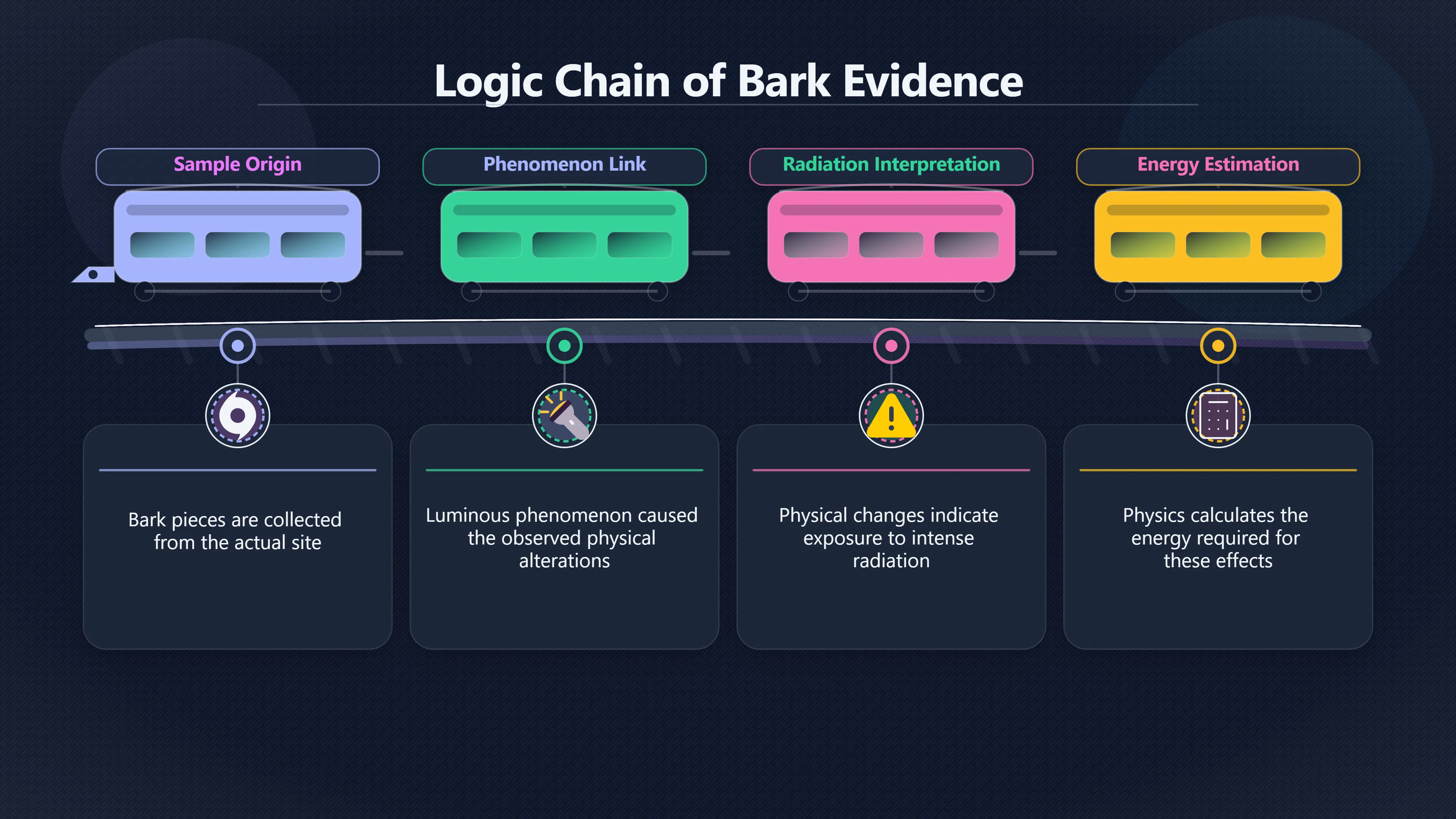
The most striking energy estimates emerge when the model is linked to the reported bark damage. This creates a chain of reasoning:

- The bark samples came from the actual event location.
- The observed alterations were caused by the luminous phenomenon.
- The physical changes can be interpreted as evidence of intense radiative exposure.
- Physics can then estimate the energy required to create those effects.
Each step may be plausible, but each introduces additional uncertainty.
The crucial point is that energy calculations do not independently verify the bark evidence. They assume the bark evidence is connected to the event and then calculate what would be required if that assumption is true. If the chain breaks at any point, the resulting energy figures lose much of their evidential value.[ScienceDirect]sciencedirect.comHigh-energy events are not rare in the context of UFO/UAP reports. They are…Read more…
This is a common misunderstanding in discussions of physical-trace cases. Large numbers can appear impressive, yet they remain conditional upon the authenticity and relevance of the physical traces being modelled.
Why impressive numbers cannot validate uncertain evidence
One reason the 2025 study attracted attention is that its estimates suggest an energy output far beyond ordinary vehicle lights, household lighting or many conventional explanations. Such figures naturally create the impression that something extraordinary must have occurred.[ScienceDirect]sciencedirect.comHigh-energy events are not rare in the context of UFO/UAP reports. They are…Read more…
However, there is a logical distinction between calculating the consequences of an assumption and proving the assumption itself.
For example, if one assumes a particular source produced a certain level of illumination, physics may show that the source would need to generate enormous energy. That result demonstrates the implications of the scenario. It does not demonstrate that the scenario actually happened.
The Haynesville model therefore has greater value as a sensitivity analysis than as proof. It shows that, under the study’s chosen assumptions, the reported observations imply a very energetic phenomenon. It does not independently establish the source distance, verify the trace location, authenticate the bark samples or confirm the witness-derived brightness estimates.[ScienceDirect]sciencedirect.comHigh-energy events are not rare in the context of UFO/UAP reports. They are…Read more…
How should the model be judged?
A balanced assessment places the 2025 work somewhere between a speculative exercise and a definitive measurement.
Its strengths include:
- An explicit attempt to quantify claims that had often been discussed only qualitatively.
- Clear use of physical principles rather than purely anecdotal argument.
- A willingness to revisit historical evidence with modern analytical methods.[ScienceDirect]sciencedirect.comHigh-energy events are not rare in the context of UFO/UAP reports. They are…Read more…
Its limitations are equally important:
- No direct instrumental measurements from the night of the event.
- Dependence on reconstructed geometry and estimated distances.
- Reliance on witness descriptions for brightness values.
- Dependence on a physical-trace record whose chain of documentation remains incomplete.
- Sensitivity to assumptions that cannot now be independently verified.[ScienceDirect]sciencedirect.comHigh-energy events are not rare in the context of UFO/UAP reports. They are…Read more…
For readers examining Haynesville’s physical-trace claims, the safest conclusion is that the energy model strengthens neither a sceptical nor a pro-UFO interpretation on its own. Instead, it clarifies the stakes. If the reconstructed site, witness estimates and bark evidence are all substantially correct, then the implied energy levels are remarkable. If any of those foundations are mistaken, the dramatic figures become far less meaningful.
The 2025 calculations therefore illuminate the uncertainties in the case as much as they illuminate the event itself. They show how extraordinary the reported phenomenon would have been under specific assumptions, but they do not remove the longstanding uncertainty surrounding those assumptions.[ScienceDirect]sciencedirect.comHigh-energy events are not rare in the context of UFO/UAP reports. They are…Read more…
Amazon book picks
Further Reading
Books and field guides related to Do the Haynesville Energy Calculations Hold Up?. Use these as the next step if you want deeper reading beyond the article.
UFOs: Generals, Pilots, and Government Officials Go on the Re...
Shows how evidence and testimony are weighed in notable cases.
The UFO Experience: A Scientific Inquiry
Scientific framework for assessing unusual sightings.
The UFO Enigma: A New Review of the Physical Evidence
Focuses on evaluating physical and technical evidence.
How to Lie with Statistics
Helpful for understanding the limits of models built on uncertain assumptions.
eBay marketplace picks
Marketplace Samples
Live-tested eBay searches with available results related to this page.
Selected fromUFO poster oneBay.co.uk.




Endnotes
1.
Source: sciencedirect.com
Link:https://www.sciencedirect.com/science/article/abs/pii/S0376042125000247
Source snippet
High-energy events are not rare in the context of UFO/UAP reports. They are...Read more...
Additional References
2.
Source: 3af.fr
Link:https://www.3af.fr/docs/2025110701_1328693110_2025-estimates-of-radiative-energy-values-in-ground-level-observations-of-an-0aunidentified-aerial-phenomenon-new-physical-data.pdf
Source snippet
Estimates of radiative energy values in ground-level...The observation took place on the evening of December 30, 1966, on an isolated hi...
Published: December 30, 1966
3.
Source: medium.com
Link:https://medium.com/%40kyeq1/the-forgotten-uap-case-jacques-vall%C3%A9e-calls-one-of-the-most-important-in-history-5f5f44f2d88c
Source snippet
long-running program to evaluate UFO reports. It did not...Read more...
4.
Source: pubmed.ncbi.nlm.nih.gov
Link:https://pubmed.ncbi.nlm.nih.gov/21086985/
Source snippet
impacts of natural gas development in the...by S Kemball-Cook · 2010 · Cited by 139 — The Haynesville Shale is a subsurface rock formati...
5.
Source: youtube.com
Link:https://www.youtube.com/watch?v=X-iiIF3b7BE
Source snippet
NASA Scientist Explains Why Anti-Gravity Research is Making No Progress | Kevin Knuth...
6.
Source: knuthlab.org
Title: knuth+etal 2025 new science UAP
Link:https://knuthlab.org/papers/knuth%2Betal—2025–new-science-UAP.pdf
Source snippet
knuth+etal---2025--new-science-UAP.pdfwho has worked to study the physical traces produced during UFO encounters. She received her B.S. i...
7.
Source: youtube.com
Link:https://www.youtube.com/watch?v=XG04I_vtQFA
Source snippet
NASA Physicist: The Government Has Known Aliens Are Here Since 1961 | Dr. Kevin Knuth...
8.
Source: www1.gly.bris.ac.uk
Title: Verdon Harris 2025 Haynesville
Link:https://www1.gly.bris.ac.uk/~gljpv/PDFS/Verdon_Harris_2025_Haynesville.pdf
Source snippet
All the events are located at depths shallower than 6 km. HF operations in the Haynesville in this area take place at depths of around 4...
9.
Source: youtube.com
Link:https://www.youtube.com/watch?v=T3xAfuvIaqE
Source snippet
Kevin Knuth's UFO Calculations vs. Reality...
10.
Source: youtube.com
Title: Kevin Knuth’s UFO Calculations vs. Reality
Link:https://www.youtube.com/watch?v=iZmnSR4al0A
Source snippet
NASA Scientist Studies UAPs & Their Physics + Disclosure Press Conference REACTION | Kevin Knuth...
11.
Source: searchanddiscovery.com
Title: ndx bryant
Link:https://www.searchanddiscovery.com/documents/2013/80284bryant/ndx_bryant.pdf
Source snippet
Petroleum system modeling has long been used to model generation, migration and entrapment of yet-to-be-discovered hydrocarbons in.Read more...