Within Project Identification
Why Distance Undermined Piedmont's Strangest Sightings
Project Identification's boldest speed and size claims remained fragile because its observers rarely secured reliable range measurements.
On this page
- How triangulation was meant to establish range
- Why timing, angles and station matching often failed
- How uncertain distance distorted speed, size and altitude claims
Page outline Jump by section
Introduction
One of the strongest claims associated with Missouri’s 1973 Piedmont sightings was that some lights appeared to move at extraordinary speeds, change direction abruptly, or cover large distances in very short periods. Yet those conclusions depended on a measurement that Project Identification often struggled to obtain: reliable distance.
Harley Rutledge and his colleagues understood that apparent motion alone proves very little. A light close to an observer can seem to race across the sky, while a distant object may appear nearly stationary. To determine true speed, size or altitude, investigators first needed to know how far away the object was. Their preferred solution was triangulation—observing the same target from different locations and comparing viewing angles. In practice, however, Piedmont’s most puzzling lights rarely cooperated with the requirements of accurate triangulation. As a result, some of the project’s boldest performance estimates remained dependent on uncertain range calculations rather than firmly established measurements.[Wikipedia]WikipediaHarley RutledgeHarley Rutledge
How Triangulation Was Meant to Establish Range
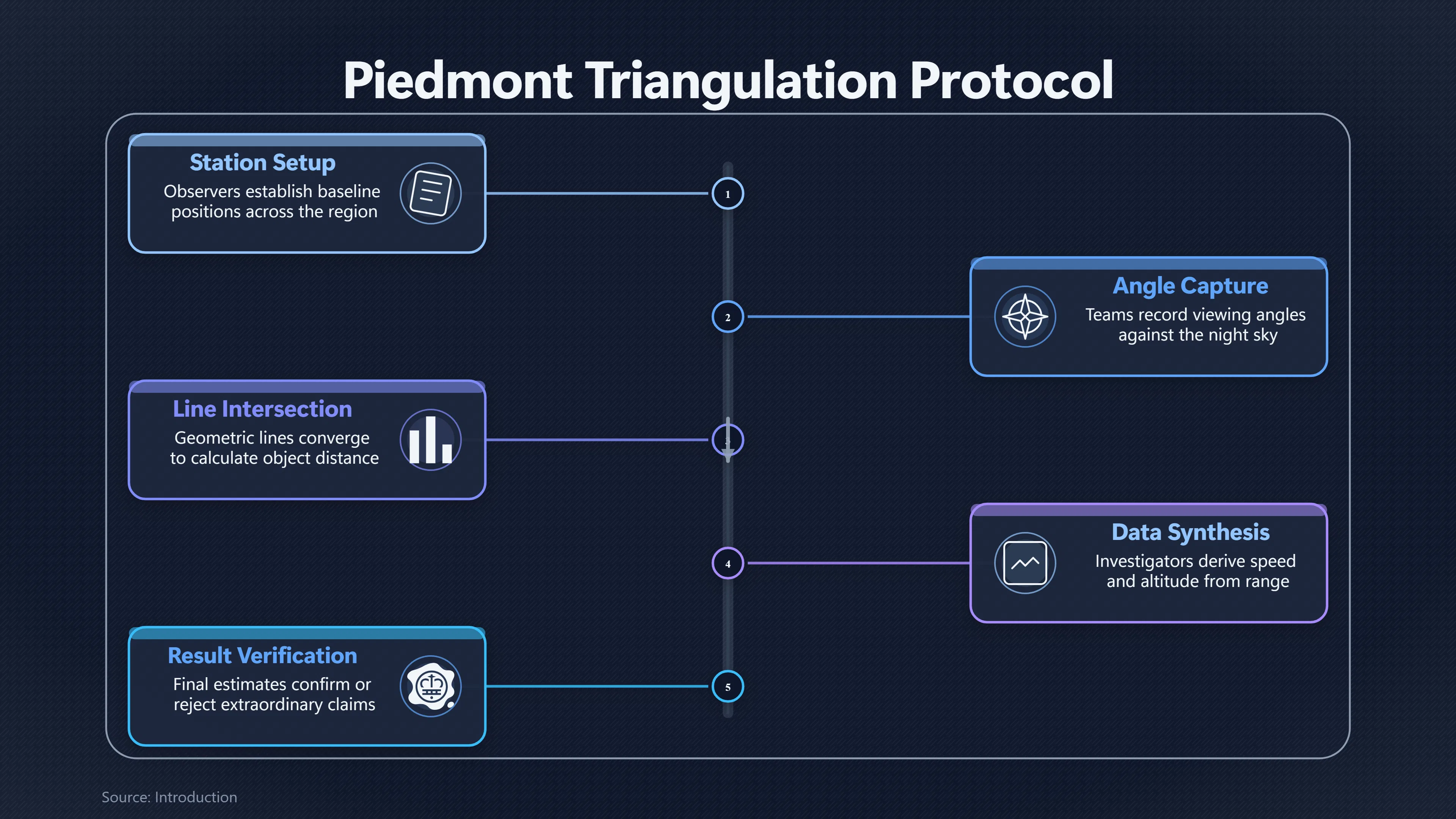
Triangulation is a straightforward geometric method. If two observers at known locations simultaneously measure the direction to the same object, the intersecting lines of sight can be used to calculate its position and distance. The method has long been used in surveying, navigation and astronomy because, in principle, knowing a baseline and two angles allows the remaining dimensions of a triangle to be calculated.[The Renaissance Mathematicus]thonyc.wordpress.comThe Renaissance MathematicusMapping the history of triangulationMay 25, 2012 — 25 May 2012 — This principle can be employed to measure ov…
For Project Identification, the idea was attractive. Multiple observing stations around the Piedmont area could watch the same light, record its angular position against the sky and compare notes. If the measurements matched, investigators could estimate the object’s distance and then derive its altitude, speed and physical size. Rutledge described the project as an attempt to obtain exactly these kinds of quantitative measurements rather than relying solely on witness impressions.[Wikipedia]WikipediaHarley RutledgeHarley Rutledge
The challenge was that triangulation only works when observers are unquestionably tracking the same object at the same moment and measuring it with sufficient precision.
Why Timing, Angles and Station Matching Often Failed
The Piedmont phenomenon did not resemble a laboratory target. Reports frequently involved isolated lights seen at night, sometimes appearing suddenly, changing brightness, vanishing, or moving against a largely featureless background. These conditions created several problems.
Were Both Stations Looking at the Same Light?
The most basic difficulty was identification. Multiple lights could be visible in different parts of the sky at once. Even when observers communicated by radio, there was no guarantee that Station A and Station B were measuring the identical target.
A small mismatch could destroy the calculation. If one observer tracked one light while another followed a different light that merely appeared nearby in the sky, the resulting geometry would be meaningless. This problem becomes especially severe at night when distant lights lack obvious structural details.[Wikipedia]WikipediaHarley RutledgeHarley Rutledge
Simultaneous Measurements Were Hard to Obtain
Triangulation depends on measurements taken at essentially the same time. Many Piedmont observations involved objects that appeared briefly or changed position before instruments could be aligned.
Even a modest timing error could create a large range error if the object was moving. A light measured by one station and then remeasured seconds later by another might no longer occupy the same position in space. Field investigators therefore faced a practical problem: the very sightings they most wanted to analyse were often the least stable observational targets.[Internet Archive]archive.orgInternet ArchiveProject Identification: the first scientific field study of UFO…8 Sept 2023 — Project Identification: the first scie…
Small Angular Errors Produced Large Distance Errors
Night-time angular measurements are difficult. A difference of only a fraction of a degree can dramatically alter a distance estimate, especially when the object is far away.
This is a general limitation of triangulation. When viewing lines are nearly parallel, tiny uncertainties in angle measurement expand into very large uncertainties in calculated range. In the Piedmont case, observers were often dealing with small points of light rather than large, sharply defined objects, making precise angle determination difficult.[The Renaissance Mathematicus]thonyc.wordpress.comThe Renaissance MathematicusMapping the history of triangulationMay 25, 2012 — 25 May 2012 — This principle can be employed to measure ov…
The Baseline Was Not Always Ideal
The distance between observing stations—the baseline—also affects accuracy. If the baseline is too short relative to the target’s distance, the parallax effect becomes very small and the calculation becomes highly sensitive to measurement errors.
Modern scientific sky-monitoring projects emphasise carefully designed camera networks and automated timing systems partly because obtaining accurate range estimates for distant aerial objects is so demanding. The same geometric limitations applied to Project Identification decades earlier.[ResearchGate]researchgate.netResearch Gate Project for a network of automatic stations for UFO monitoringSome engineering issues are also presented to stimulate a pragmatic problem solving aptitude.Read more…
How Uncertain Distance Distorted Speed, Size and Altitude Claims
The most important consequence of uncertain range was that every other physical estimate became uncertain as well.
Consider a light crossing a given angle of sky. If the object is assumed to be one mile away, its actual speed may be modest. If it is assumed to be ten miles away, the same apparent motion implies a much higher velocity. Without a secure distance measurement, apparent speed can be converted into radically different physical speeds.
The same problem affects size. A small nearby light and a large distant light can appear identical to an observer. Altitude estimates suffer from the same ambiguity. A single error in distance propagates through every subsequent calculation.[arXiv]arxiv.orgA New Method to Derive an Empirical Lower Limit on the Mass Density of a UFODecember 9, 2024…
This matters because some of the most dramatic interpretations of the Piedmont sightings relied on derived quantities rather than directly measured ones. Claims that a target moved at extraordinary speed, reached unusual altitudes or possessed a large physical size depended on first establishing where it actually was. When the distance estimate became uncertain, the confidence that could be placed in those secondary calculations dropped as well.[Wikipedia]WikipediaHarley RutledgeHarley Rutledge

What the Distance Problem Means for Project Identification
The failure to obtain consistently reliable range measurements does not mean that observers saw nothing unusual. Project Identification remains noteworthy because trained investigators spent years watching the skies over south-eastern Missouri, identified many conventional objects and attempted more rigorous measurements than most UFO investigations of the era.[Wikipedia]WikipediaHarley RutledgeHarley Rutledge
However, the distance problem helps explain why the project never produced decisive proof of extraordinary craft. The key question was not simply whether unusual lights were seen. It was whether investigators could determine where those lights were in three-dimensional space. In many of the most intriguing cases, that step remained unresolved.
As a result, the Piedmont observations often demonstrated the limits of field investigation as much as its possibilities. The project showed that observing unknown lights is relatively easy; proving their true distance, and therefore their true speed, size and altitude, is far harder. That gap between appearance and measurement remains one of the central reasons why the most striking Piedmont claims continue to be debated rather than settled.[Wikipedia]WikipediaHarley RutledgeHarley Rutledge
Amazon book picks
Further Reading
Books and field guides related to Why Distance Undermined Piedmont's Strangest Sightings. Use these as the next step if you want deeper reading beyond the article.
The Demon-Haunted World
Rating: 4.5/5 from 43 Google Books ratings
Highlights the importance of measurement quality.
Practical Astronomy with your Calculator
Covers positional measurements and observation methods.
eBay marketplace picks
Marketplace Samples
Live-tested eBay searches with available results related to this page.
Selected fromUFO poster oneBay.co.uk.




Endnotes
1.
Source: Wikipedia
Title: Harley Rutledge
Link:https://en.wikipedia.org/wiki/Harley_Rutledge
2.
Source: archive.org
Link:https://archive.org/details/projectidentific0000rutl
Source snippet
Internet ArchiveProject Identification: the first scientific [field study]({{ 'field-study/' | relative_url }}) of UFO...8 Sept 2023 — Project Identification: the first scie...
3.
Source: researchgate.net
Title: Research Gate Project for a network of automatic stations for UFO monitoring
Link:https://www.researchgate.net/publication/275829635_Project_for_a_network_of_automatic_stations_for_UFO_monitoring
Source snippet
Some engineering issues are also presented to stimulate a pragmatic problem solving aptitude.Read more...
4.
Source: arxiv.org
Link:https://arxiv.org/abs/2412.12142
Source snippet
A New Method to Derive an Empirical Lower Limit on the Mass Density of a UFODecember 9, 2024...
Published: December 9, 2024
5.
Source: arxiv.org
Link:https://arxiv.org/html/2502.06794v2
6.
Source: thonyc.wordpress.com
Link:https://thonyc.wordpress.com/2012/05/25/mapping-the-history-of-triangulation/
Source snippet
The Renaissance MathematicusMapping the history of triangulationMay 25, 2012 — 25 May 2012 — This principle can be employed to measure ov...
Published: May 25, 2012
Additional References
7.
Source: sos.mo.gov
Link:https://www.sos.mo.gov/symbol/ufo
Source snippet
UFO Capitals of MissouriHarley Rutledge investigated with his own team. He issued a public paper in 1973, which he later turned into a bo...
8.
Source: youtube.com
Link:https://www.youtube.com/watch?v=LHWxWNy6VO0
Source snippet
UFO Captured LIVE On Camera In Missouri “Planes Don't Stop In Midair” | Alien Highway...
9.
Source: vaticanobservatory.org
Link:https://www.vaticanobservatory.org/sacred-space-astronomy/mo-ufos-and-miracles/
Source snippet
MO UFOs... and Miracles - Vatican...11 Oct 2025 — Piedmont, Missouri about the 1973 UFO. Dr. Rutledge to calculate the objects' actual v...
10.
Source: youtube.com
Title: Missouri Mysteries, Chapter Two
Link:https://www.youtube.com/watch?v=8MS1s5YlhCM
Source snippet
How Piedmont became the UFO Capitol of Missouri | Living St. Louis...
11.
Source: youtube.com
Title: Piedmont, Mo. celebrates 50 years since UFO sightings
Link:https://www.youtube.com/watch?v=LxTE0-kPXMA
Source snippet
Investigators Visit The Site Of The 1973 Clearwater Lake UFO Sighting | Alien Highway...
12.
Source: books.google.com
Title: Rutledge Prentice-Hall, Length 265 pages Subjects
Link:https://books.google.com/books/about/Project_Identification.html?id=3claAAAAYAAJ
Source snippet
Identification: The First Scientific Field Study of UFO...Project Identification: The First Scientific Field Study of UFO Phenomena Fron...
13.
Source: youtube.com
Title: How Piedmont became the UFO Capitol of Missouri | Living St. Louis
Link:https://www.youtube.com/watch?v=JDTIqTJMBZ0
Source snippet
Piedmont, Mo. celebrates 50 years since UFO sightings...
14.
Source: facebook.com
Link:https://www.facebook.com/groups/1565114127094467/posts/2906047826334417/
15.
Source: amazon.com
Link:https://www.amazon.com/Project-Identification-First-Scientific-Phenomena/dp/0137307055?tag=searcht-20
16.
Source: amazon.com
Link:https://www.amazon.com/Project-Identification-first-scientific-phenomena/dp/0137307136?tag=searcht-20