Within Missouri
Did Project Identification Solve the Piedmont Mystery?
Harley Rutledge's team brought instruments and trained observers to Piedmont, but distance errors and incomplete records limited its conclusions.
On this page
- How Harley Rutledge organised the field study
- What the team observed and successfully identified
- Why the remaining cases did not prove extraordinary craft
Page outline Jump by section
Introduction
Project Identification did not solve the Piedmont mystery, but it did show why investigating unexplained lights in the field is harder than simply adding telescopes and trained observers. Beginning during Missouri’s 1973 sighting wave, physicist Harley Rutledge organised a team to watch the skies around Piedmont, Clearwater Lake and neighbouring areas using optical, photographic and electronic equipment. The project successfully identified many aircraft, stars, satellites and other ordinary objects. It also recorded a smaller group of observations that Rutledge considered unexplained.[mo.gov]sos.mo.govMissouri Secretary of StateState UFO Capitals of Missouri…
Those remaining cases matter because they came from observers who were actively looking, sometimes with instruments available. Yet they still did not establish the presence of extraordinary craft. Distances were often uncertain, different stations did not consistently obtain matching measurements, photographs lacked decisive detail, and much of the published evidence depended on Rutledge’s own interpretation rather than a complete, independently reusable dataset. Project Identification therefore strengthened the case that something genuinely difficult to identify was being seen over south-eastern Missouri, while weakening claims that the observations proved advanced or non-human vehicles.
How Harley Rutledge organised the field study
The Piedmont wave created an unusual opportunity. Rather than investigating a single report after the witnesses had gone home, Rutledge’s group attempted to observe the phenomenon while reports were still being made. The Missouri Secretary of State’s historical summary places the principal public wave between February and April 1973 and notes that several hundred calls reached police, sheriffs and newspapers. With the US Air Force’s Project Blue Book already closed, Rutledge’s university-based team became the most substantial organised investigation of the episode.[Missouri Secretary of State]sos.mo.govState UFO Capitals of Missouri…
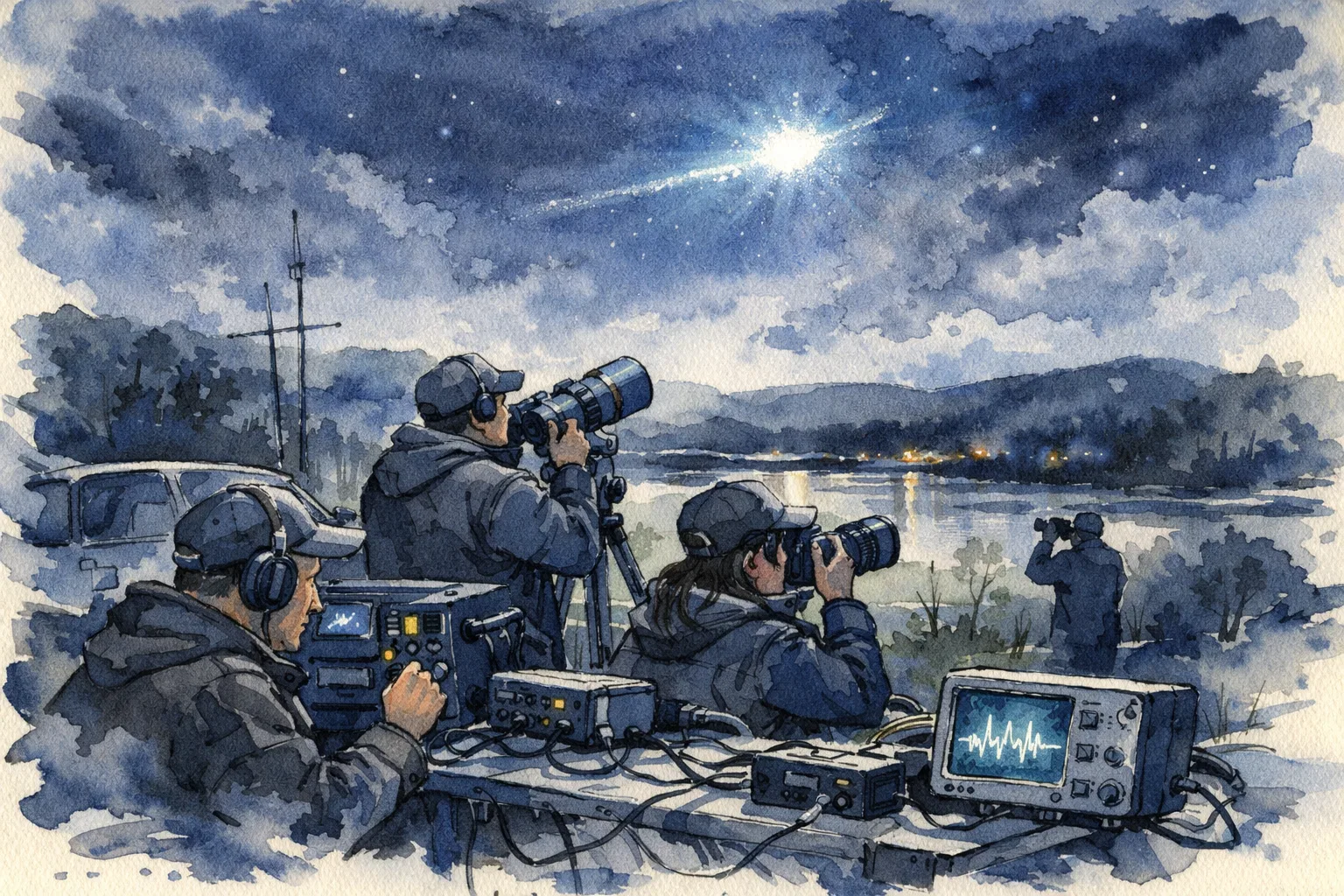
Rutledge was chairman of the physics department at Southeast Missouri State University and held a doctorate in physics. Contemporary accounts described him as initially sceptical and concerned both by the treatment of Piedmont witnesses and by the fear spreading within the community. He assembled volunteers with scientific, engineering, aviation and technical backgrounds rather than relying solely on UFO enthusiasts. The project began field operations in spring 1973 and continued in various forms for several years.[Wikipedia]WikipediaHarley RutledgeHarley Rutledge
The equipment was broad for a small civilian project. Rutledge’s published account refers to Questar and Celestron telescopes, binoculars, still cameras, radio equipment, audio detectors, a spectrum analyser and devices intended to detect electromagnetic or gravitational changes. Observers used viewing stations around the region and sometimes surveyed possible locations from a light aircraft. The project’s 1981 book included diagrams, photographs, statistical tables and descriptions of observation procedures.[Google Books]books.google.comBooks Project Identification: The First Scientific Field Study of UFO PhenomenaGoogle BooksProject Identification: The First Scientific Field Study of UFO Phenomena - Harley D. Rutledge - Google Books…
This was a meaningful improvement over ordinary witness collection. A trained observer could check a star chart, recognise aircraft lighting, compare an object through binoculars and a telescope, note its angular position and ask another station whether the same light was visible. The group could also remain on site long enough to learn the normal night sky. That experience is important because unfamiliarity, rather than dishonesty, explains many sincere UFO reports.
Project Identification nevertheless remained a volunteer field effort rather than a controlled observatory programme. Its equipment was not continuously aimed at every part of the sky, sightings often began before instruments were ready, and the observers could not command an unknown light to appear where cameras or measuring devices were positioned. The project was therefore reactive even when it was operating in real time.
What the team observed and successfully identified
One of Project Identification’s strongest achievements was demonstrating how many apparently unusual lights became ordinary once experienced observers followed them carefully. Rutledge repeatedly acknowledged that aircraft, astronomical objects and atmospheric effects accounted for a substantial portion of what people reported. His wider work also included teaching observers how to recognise identified objects in the sky.[Wikipedia]WikipediaHarley RutledgeHarley Rutledge
The Missouri landscape made some identifications difficult. Observers were working among hills, ridges, wooded horizons and scattered roads rather than on a flat, unobstructed range. A distant aircraft could disappear behind terrain, turn so that its landing light suddenly dimmed, or appear nearly stationary when flying towards an observer. Stars and planets close to the horizon could flicker, change colour and seem to move because of atmospheric turbulence and small involuntary movements of the eye.
These effects were not theoretical side issues. Rutledge’s book repeatedly discusses aircraft, airports, runways, satellites, stars and questions of angular position and distance, indicating that ordinary-source identification was central to the project rather than an afterthought. The project’s use of the term “pseudostar” for some distant points of light also shows the practical problem: before distance and motion were established, an object could resemble a star while behaving just differently enough to attract attention.[Google Books]books.google.comBooks Project Identification: The First Scientific Field Study of UFO PhenomenaGoogle BooksProject Identification: The First Scientific Field Study of UFO Phenomena - Harley D. Rutledge - Google Books…
The team also gained useful negative evidence. Some dramatic expectations were not confirmed. The available public record does not contain a clear radar track tied to a photographed object, a recovered physical trace, a close-range instrument package showing unusual propulsion, or a sequence of images from which the size and speed of a solid craft can be reliably calculated. Rutledge’s 265-page account instead centres mainly on visual lights, apparent movement, observational patterns and photographs of luminous sources.[Internet Archive]archive.orgOpen source on archive.org.
That distinction is essential. A light that remains unidentified after reasonable checking is an unresolved observation. It is not automatically a vehicle, and it says nothing by itself about origin. Project Identification was most successful when it treated identification as a process of elimination. Its conclusions became less secure when it moved from describing what observers saw to inferring intelligence or physical capabilities from apparent responses and movements.
Why distance was the central weakness
Nearly every dramatic claim about a light’s performance depends on knowing its distance. Apparent speed is not actual speed. A nearby object moving slowly and a distant object moving quickly can cross the same angle of sky in the same time. The same problem applies to size: a bright point cannot be described as a large craft unless its range or dimensions are independently established.
Project Identification sometimes attempted triangulation, in which observers at separated locations record the direction to an object at the same moment. In principle, the crossing sightlines can reveal distance. In practice, successful triangulation requires synchronised timing, accurately surveyed station positions, precise angular measurements and confidence that both observers are tracking the same object. Small directional errors become very large range errors when the target is distant or the sightlines meet at a shallow angle.
The surviving public descriptions do not show that these conditions were met consistently across the project’s most important unidentified cases. Many sightings were visual and brief. Stations were not always simultaneously staffed, and observers sometimes lacked a stable reference point against which to measure elevation and bearing. Even when more than one person saw a light, shared observation did not necessarily provide independent distance data.
This is why estimates of high speed, low altitude or large physical size must be treated carefully. If the distance was assumed from brightness, apparent closeness or the impression that a light passed in front of terrain, the later calculation inherited that assumption. A mistake in range could turn a modest aircraft-like movement into an apparently extraordinary manoeuvre.
The local terrain could also create false certainty. A light that seemed to be below a ridge line might actually have been seen through a gap, above a more distant ridge, or against a poorly perceived horizon. At night, observers lacked many of the visual cues used to judge depth in daylight. Telescopes magnified the light but did not automatically reveal how far away it was.
Why the instruments did not produce decisive proof
Project Identification is sometimes described as if every sighting were captured simultaneously by cameras, telescopes and electronic detectors. The published record does not support that impression. The equipment increased the chances of obtaining useful observations, but much of it had limited diagnostic value.
A telescope could show that a light changed colour or consisted of more than one luminous point, yet poor focus, atmospheric distortion and movement within the instrument could also alter its appearance. A photograph could establish that light reached the film, but without stars, terrain or calibrated reference objects in the same frame, it might provide little reliable information about distance, size or motion. Long exposures could convert camera shake or object movement into trails that looked more complex than the original source.
Electronic instruments presented a different problem. A coincident fluctuation is not meaningful unless the device, calibration, background level and timing are fully documented. The same applies to radio interference or magnetic changes. A signal must be repeatable or tightly correlated with a well-observed object before it can reasonably be attributed to that object. Project Identification reported instrument use, but no widely available record shows a repeatable physical signature that independently distinguishes its unidentified lights from aircraft, equipment noise or environmental variation.[Google Books]books.google.comBooks Project Identification: The First Scientific Field Study of UFO PhenomenaGoogle BooksProject Identification: The First Scientific Field Study of UFO Phenomena - Harley D. Rutledge - Google Books…
The photographs were similarly suggestive rather than conclusive. Rutledge’s book is illustrated, but no image from the project has become a recognised, high-resolution record of a structured craft with secure scale, location and chain of custody. A bright blob, streak or cluster can preserve part of an observation without resolving what produced it.
This does not make the equipment pointless. It helped rule out some candidates, trained the observers to describe what they saw and preserved more information than an unsupported memory would have done. The limitation is that instruments only answer questions they are configured to measure. A camera that records a light but not its range has documented the light, not solved its identity.
The disputed idea that the lights reacted to observers
Rutledge believed that some lights behaved in ways suggesting awareness of the team. His account describes apparent approaches, changes of direction and patterns that seemed to occur after observers signalled or repositioned themselves. One early aerial observation, which he regarded as important in forming the project, involved multiple amber and white lights whose movements he interpreted as responsive to his aircraft.[Professor Wham]professorwham.comProfessor WhamProject Identification and Harley D Rutledge Part 1January 13, 2023 — 13 Jan 2023 — However, the sighting that cinched the…
These reports are among the most memorable parts of Project Identification, but they are also among the hardest to test. When a light changes shortly after an observer flashes a lamp or speaks about it, the sequence may feel interactive. Establishing interaction scientifically requires more: a planned signal protocol, repeated trials, control periods, exact timing and a pre-agreed definition of what counts as a response.
Without those controls, coincidence and selective memory become serious alternatives. Aircraft routinely turn, change brightness and disappear as their orientation changes. A star may seem to brighten or move just as an observer performs an action. People also remember successful-looking sequences more readily than occasions when nothing happened.
The interpretation was further complicated by Rutledge’s growing personal involvement. He began as a sceptic but eventually reported numerous sightings of his own and defended the project strongly against critics. That does not invalidate his observations, but it increased the importance of independent replication and complete data release. A claim of responsive intelligence cannot rest mainly on the judgement of the investigator who experienced the response.
Incomplete records limited later reanalysis
The most important weakness of Project Identification is not that Rutledge failed to explain every sighting. No realistic field investigation should be expected to do so. The deeper problem is that later researchers cannot fully reconstruct and reanalyse the strongest cases from the published material alone.
Rutledge’s book provides narratives, diagrams, classifications and statistics, but it is not the equivalent of a modern open dataset containing every original log, exact time, observer position, weather condition, instrument setting, photograph, negative result and subsequent identification. The Internet Archive catalogue confirms that the published work runs to 265 pages with photographic plates, references and an index, yet access to a book is not the same as access to the underlying project archive.[Internet Archive]archive.orgOpen source on archive.org.
This matters because unexplained-case counts are highly sensitive to record quality. An entry may remain unidentified because the object was extraordinary, but also because the time was rounded, the direction was vague, a flight record was unavailable or the relevant observer notes were never preserved. “Unidentified” can describe the limits of the evidence as much as the qualities of the object.
The published classifications also depended on project-defined categories. Rutledge distinguished ordinary objects from more puzzling classes of sightings, but such categories do not create independent proof. To judge whether the residue was genuinely anomalous, an outside analyst would need to know exactly how each case was promoted from uncertain to unexplained and whether ordinary explanations were tested consistently.
A contemporary sceptical review by Robert Sheaffer argued that Rutledge had misinterpreted ordinary lights and described the project as an exercise in self-deception. Rutledge replied that the review contained errors and defended the number and qualifications of the observers involved. The exchange is useful because it exposes the central dispute: Rutledge stressed accumulated trained testimony, whereas his critic stressed the possibility that experienced observers can still make systematic mistakes when distance and identification are uncertain.[centerforinquiry.org]cdn.centerforinquiry.orgRutledge, chairman of the PhysicsProject Identification: The First Scientific Field Study of UFO PheProject Identification is the story of a UFO investigative group of th…
Neither side’s rhetoric settles the matter. The appropriate test is whether the observations can be independently reconstructed. Where original measurements are incomplete or ambiguous, later investigators cannot confidently confirm either an extraordinary interpretation or a specific conventional explanation.

Why the remaining cases did not prove extraordinary craft
Project Identification left a residue of sightings that Rutledge and his colleagues did not explain. That residue should not be dismissed as worthless. It shows that trained people conducting repeated observation can encounter lights whose identity is not immediately recoverable. It also preserves part of the experience that made the Piedmont wave so important in Missouri’s UFO history.
However, three evidential steps were never completed.
First, the project did not consistently establish distance. Without reliable range, claims about extreme speed, size or proximity remain uncertain. Second, the project did not obtain a decisive instrument package in which independent devices recorded the same object and produced measurements incompatible with aircraft, astronomical sources or optical effects. Third, the most unusual behavioural interpretations were not reproduced under controlled signalling conditions.
There was also no verified physical consequence requiring an exotic explanation. No project result yielded recovered material, a securely documented landing trace, a calibrated energy measurement or an aviation record showing a craft performing beyond known capabilities. The evidence remained predominantly observational.
Rutledge himself was more cautious than many later retellings. Although he argued that some events suggested intelligence, he did not claim to have proved an extraterrestrial origin and resisted being labelled an advocate of that conclusion. Accounts of his later position emphasise that he did not believe the available data justified a final answer about origin.[Wikipedia]WikipediaHarley RutledgeHarley Rutledge
The fairest assessment is therefore neither “nothing happened” nor “scientists proved alien craft”. Project Identification documented a mixture of identifiable objects, ambiguous lights and a smaller number of difficult observations. Its methods were stronger than casual witness interviews but weaker than the project’s ambitious title implied.
What Project Identification changed in Missouri’s UFO history
Project Identification matters because it transformed the Piedmont wave from local folklore into a documented problem of observation. The project showed that residents were not simply inventing stories: trained observers also saw things they could not always identify. At the same time, it demonstrated how quickly dramatic impressions could shrink when aircraft, stars and viewing conditions were examined carefully.
Its lasting lesson is methodological. Field investigation can improve UFO evidence, but only when the study is designed around the questions that later matter most: exact position, exact time, calibrated direction, verified distance, simultaneous recording, complete weather and aviation data, and preservation of both positive and negative results. More equipment is not enough if the crucial variables remain unknown.
Within Missouri’s UFO history, the project therefore occupies an unusual middle ground. It is stronger than a collection of retrospective anecdotes and weaker than a controlled scientific detection. It supports the conclusion that the Piedmont wave included sincere and sometimes genuinely unresolved observations. It does not support the stronger claim that extraordinary vehicles were scientifically demonstrated over Wayne County.
Project Identification did not fail because it left cases unexplained. It reached its limit because an unidentified light is often easiest to observe precisely where the facts needed to identify it — range, scale, structure and independent physical effects — are hardest to obtain.
Amazon book picks
Further Reading
Books and field guides related to Did Project Identification Solve the Piedmont Mystery?. Use these as the next step if you want deeper reading beyond the article.
UFOs: Generals, Pilots, and Government Officials Go on the Re...
Provides broader investigative context.
eBay marketplace picks
Marketplace Samples
Live-tested eBay searches with available results related to this page.
Selected fromUFO poster oneBay.co.uk.



Endnotes
1.
Source: sos.mo.gov
Title: Missouri Secretary of State
Link:https://www.sos.mo.gov/symbol/ufo
Source snippet
State UFO Capitals of Missouri...
2.
Source: archive.org
Link:https://archive.org/details/projectidentific0000rutl
3.
Source: books.google.com
Title: Books Project Identification: The First Scientific [Field Study]({{ ‘field-study/’ | relative_url }}) of UFO Phenomena
Link:https://books.google.com/books/about/Project_Identification.html?id=3claAAAAYAAJ
Source snippet
Google BooksProject Identification: The First Scientific Field Study of UFO Phenomena - Harley D. Rutledge - Google Books...
4.
Source: Wikipedia
Title: Harley Rutledge
Link:https://en.wikipedia.org/wiki/Harley_Rutledge
5.
Source: cdn.centerforinquiry.org
Title: Rutledge, chairman of the Physics
Link:https://cdn.centerforinquiry.org/wp-content/uploads/sites/29/1982/04/22165422/p70.pdf
Source snippet
Project Identification: The First Scientific Field Study of UFO PheProject Identification is the story of a UFO investigative group of th...
6.
Source: books.google.com
Title: Project Identification
Link:https://books.google.com/books/about/Project_Identification.html?id=T4NTAAAAMAAJ
7.
Source: books.google.rw
Link:https://books.google.rw/books?id=3claAAAAYAAJ&source=gbs_navlinks_s
8.
Source: books.google.rw
Link:https://books.google.rw/books/about/Project_Identification.html?id=T4NTAAAAMAAJ
9.
Source: Wikipedia
Title: Harley Davidson
Link:https://en.wikipedia.org/wiki/Harley-Davidson
10.
Source: Wikipedia
Link:https://en.wikipedia.org/wiki/Project
11.
Source: Wikipedia
Link:https://en.wikipedia.org/wiki/Ufology
12.
Source: professorwham.com
Link:https://www.professorwham.com/post/project-identification-and-harley-d-rutledge-part-1-challenges-opportunities-synchronicities
Source snippet
Professor WhamProject Identification and Harley D Rutledge Part 1January 13, 2023 — 13 Jan 2023 — However, the sighting that cinched the...
Published: January 13, 2023
13.
Source: skepticalinquirer.org
Link:https://skepticalinquirer.org/wp-content/uploads/sites/29/2019/03/Issue-03-4.pdf
14.
Source: dictionary.cambridge.org
Link:https://dictionary.cambridge.org/dictionary/english/project
Additional References
15.
Source: youtube.com
Link:https://www.youtube.com/watch?v=LHWxWNy6VO0
Source snippet
Why NOBODY Talks About The Real UFO Geography...
16.
Source: youtube.com
Title: This small Missouri town could become state’s ‘UFO Capital’
Link:https://www.youtube.com/watch?v=-Zx6ToyqoqQ
Source snippet
Investigators Visit The Site Of The 1973 Clearwater Lake UFO Sighting | Alien Highway...
17.
Source: youtube.com
Title: How Piedmont became the UFO Capitol of Missouri | Living St. Louis
Link:https://www.youtube.com/watch?v=JDTIqTJMBZ0
Source snippet
Piedmont, Mo. celebrates 50 years since UFO sightings...
18.
Source: youtube.com
Title: Piedmont, Mo. celebrates 50 years since UFO sightings
Link:https://www.youtube.com/watch?v=LxTE0-kPXMA
Source snippet
This small Missouri town could become state's 'UFO Capital'...
19.
Source: knowledgetrain.co.uk
Link:https://www.knowledgetrain.co.uk/project-management/projects?srsltid=AfmBOorcWWr8STUCPGpDMkm1T4MZa5nXBee_FEAvza5VL12OeRM1M5U5
20.
Source: researchgate.net
Link:https://www.researchgate.net/publication/228807929_Distance-based_and_probabilistic_record_linkage_for_re-identification_of_records_with_categorical_variables
21.
Source: facebook.com
Link:https://www.facebook.com/groups/1565114127094467/posts/2906047826334417/
22.
Source: reddit.com
Link:https://www.reddit.com/r/UFOs/comments/15ec4xd/great_ufo_book_recommendations/
23.
Source: harleyworldchesterfield.co.uk
Link:https://www.harleyworldchesterfield.co.uk/
24.
Source: facebook.com
Link:https://www.facebook.com/sdcfans/posts/new-book-i-was-amazed-while-doing-research-how-many-ufo-sightings-have-happened-/1328407246000628/