Within 1952 Flap
Did Radar and Pilots See the Same Objects?
Radar returns and pilot sightings sometimes overlapped, but gaps in timing, tracking and visual confirmation prevent a firm conclusion.
On this page
- The radar contacts reported over two July weekends
- Where pilot sightings appeared to match controller reports
- Missing measurements, failed visual checks and ordinary explanations
Page outline Jump by section
Introduction
The most debated part of the July 1952 Washington sightings is not that radar operators saw unusual returns or that pilots reported strange lights. It is whether those reports referred to the same physical objects. The events drew attention because multiple radar sites, commercial pilots, military personnel and air-traffic controllers appeared to observe unusual activity during the same periods. That combination gave the case a credibility that many UFO reports lacked. Yet the surviving evidence is less clear-cut than popular retellings often suggest. Radar contacts, visual observations and fighter interceptions overlapped at times, but the records also contain gaps, missed interceptions and contradictory observations that make firm conclusions difficult.[Wikipedia]Wikipedia1952 Washington, D.C. UFO incident1952 Washington, D.C. UFO incident

For Maryland’s role in the wider Washington UFO flap, the radar facilities and personnel at Andrews Air Force Base were especially important. Reports from Andrews were among the reasons the incidents became known as more than a single-airport radar anomaly. At the same time, later investigations found that some radar returns could have been influenced by atmospheric conditions, and not every radar target received visual confirmation.[Wikipedia]Wikipedia1952 Washington, D.C. UFO incident1952 Washington, D.C. UFO incident
Did Radar and Pilots See the Same Objects?
The strongest argument for an unexplained event comes from occasions when radar operators and pilots appeared to report unusual activity at roughly the same time. If independent observers using different methods detect the same target, confidence in the observation normally increases.
However, proving that radar and visual sightings involved the same object requires more than rough coincidence. Investigators ideally need continuous tracking, accurate positions, altitude information and clear timing records. Much of that information was either unavailable or incomplete during the July 1952 events. As a result, researchers continue to disagree over how much weight should be given to the apparent radar-visual matches.[Wikipedia]Wikipedia1952 Washington, D.C. UFO incident1952 Washington, D.C. UFO incident
The Radar Contacts Reported Over Two July Weekends
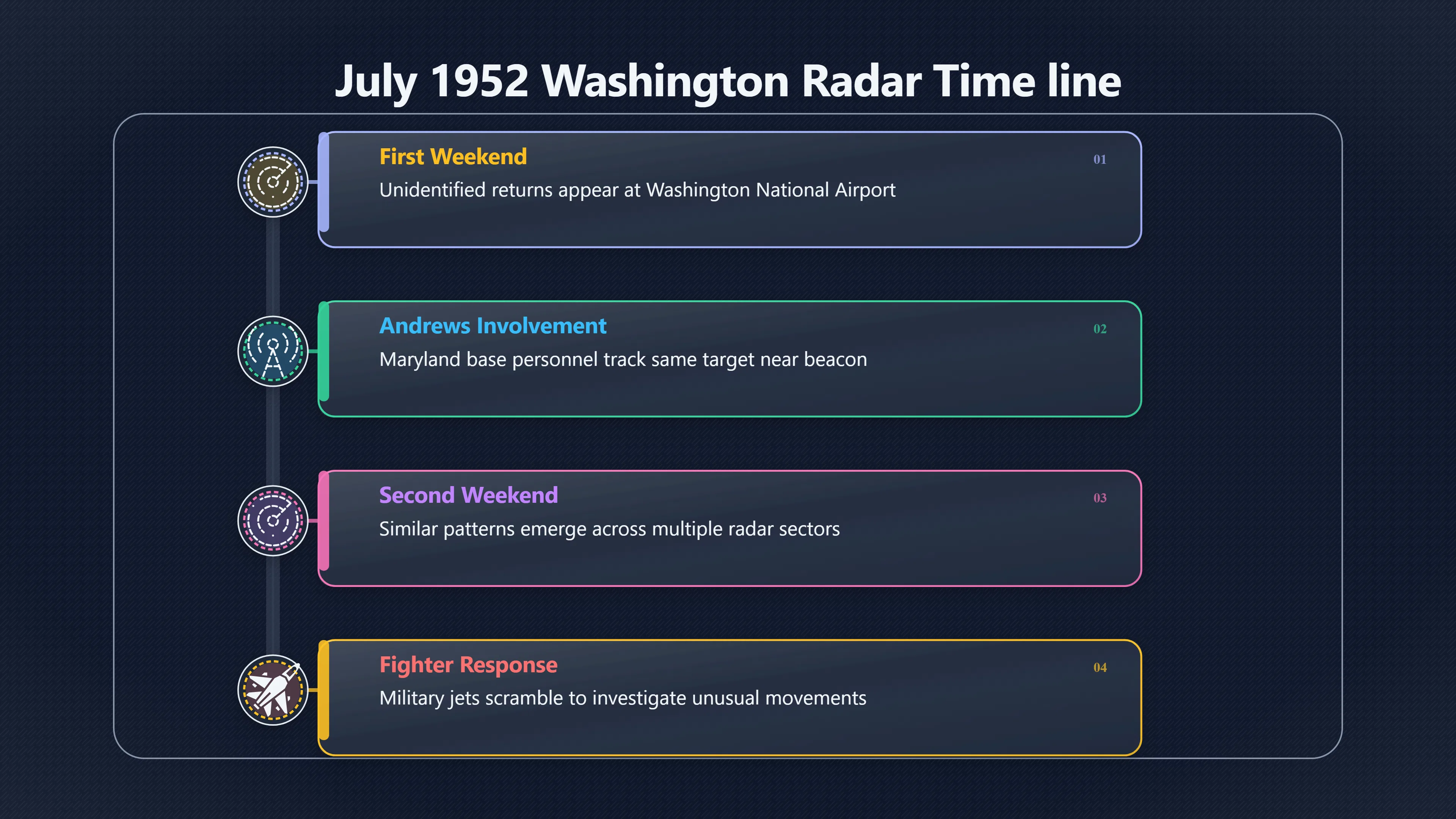
On the night of 19–20 July 1952, controllers at Washington National Airport reported several unidentified radar returns that did not appear to follow recognised air routes. Senior controller Harry Barnes believed the targets displayed movements unlike ordinary aircraft. Controllers checked the equipment and reported that it was functioning normally. A second radar installation at the airport also detected unusual returns, reducing the likelihood of a simple equipment malfunction.[Wikipedia]Wikipedia1952 Washington, D.C. UFO incident1952 Washington, D.C. UFO incident
The situation became more significant when Andrews Air Force Base in Maryland also became involved. Personnel there reported unusual observations, and at one stage radar operators at both Washington National and Andrews were said to be tracking the same target near a radio beacon. According to contemporary accounts, the target disappeared from all involved radar displays at roughly the same moment. Supporters of the case regard this as one of the strongest pieces of evidence because it suggests more than a single faulty radar return.[Wikipedia]Wikipedia1952 Washington, D.C. UFO incident1952 Washington, D.C. UFO incident
A week later, on 26–27 July, a similar pattern emerged. Radar operators at Washington National and Andrews again reported unidentified targets. The returns appeared across multiple sectors and, according to observers, sometimes changed direction or speed in unusual ways. These reports triggered renewed military concern and another fighter response.[Wikipedia]Wikipedia1952 Washington, D.C. UFO incident1952 Washington, D.C. UFO incident
Yet the radar evidence had important limitations. The displays used in 1952 were less sophisticated than modern systems. Radar operators could identify position but often had limited information about altitude and object characteristics. Intermittent returns were common, and atmospheric conditions could create false echoes that appeared as genuine targets. Later reviews concluded that radar data alone could not establish exactly what was present over the Washington area.[Wikipedia]Wikipedia1952 Washington, D.C. UFO incident1952 Washington, D.C. UFO incident
Where Pilot Sightings Appeared to Match Controller Reports
The most frequently cited radar-and-visual correlation involved Capital Airlines pilot S. C. “Casey” Pierman during the first weekend. While preparing for departure and later after take-off, Pierman reported seeing several bright white lights moving rapidly. Barnes later stated that some of the lights Pierman reported appeared to correspond with radar returns near his aircraft. When Pierman reported a light moving away at high speed, Barnes believed a corresponding radar target disappeared from the display.[Wikipedia]Wikipedia1952 Washington, D.C. UFO incident1952 Washington, D.C. UFO incident
This apparent agreement between an experienced airline pilot and radar operators remains one of the strongest elements of the case. It is often cited by researchers who argue that the Washington sightings cannot be dismissed as purely atmospheric effects or radar errors. If Barnes’s recollection was accurate, radar and visual observations may have reinforced one another in real time.[Wikipedia]Wikipedia1952 Washington, D.C. UFO incident1952 Washington, D.C. UFO incident
During the second weekend, additional reports emerged from airline crews and military personnel. A National Airlines crew reported unusual lights before radar operators began detecting new targets. At Andrews Air Force Base, military observers described bright lights that did not resemble ordinary meteors. Some civilian aircraft crews also reported glowing objects while radar operators were tracking unknown returns.[Wikipedia]Wikipedia1952 Washington, D.C. UFO incident1952 Washington, D.C. UFO incident
Even so, the matches were rarely exact. Most reports lacked precise measurements showing that a radar target and a visual object occupied the same point in space. Witnesses often described lights rather than structured craft, and lights seen at night can be difficult to identify accurately. The evidence therefore suggests correlation, but not definitive identification.[Wikipedia]Wikipedia1952 Washington, D.C. UFO incident1952 Washington, D.C. UFO incident

Why Fighter Interceptions Failed to Settle the Question
If radar operators were tracking solid objects, fighter aircraft should have provided the clearest test. Interceptors were scrambled on both weekends to investigate the reports.
The results were mixed. During the first weekend, many radar targets disappeared before the fighters arrived. Some later reappeared after the jets departed, a pattern that became central to later UFO narratives. However, the timing alone does not prove the targets reacted intelligently. The returns had been appearing and disappearing throughout the night, making coincidence a plausible explanation.[Wikipedia]Wikipedia1952 Washington, D.C. UFO incident1952 Washington, D.C. UFO incident
During the second weekend, one interceptor pilot reported seeing a bright light that seemed to move away as he approached, while another pilot reported nothing unusual. Other aircraft crews were directed towards radar targets but failed to obtain visual confirmation. These inconsistent results weakened the argument that a clearly identifiable object was being tracked continuously.[Wikipedia]Wikipedia1952 Washington, D.C. UFO incident1952 Washington, D.C. UFO incident
The inability of trained military pilots to obtain a decisive visual identification remains one of the key weaknesses in the case. Had radar and aircraft repeatedly tracked the same object at close range, the historical debate would likely look very different today.[Wikipedia]Wikipedia1952 Washington, D.C. UFO incident1952 Washington, D.C. UFO incident
Missing Measurements, Failed Visual Checks and Ordinary Explanations
The central problem for investigators is that the most dramatic claims rely on evidence that was never fully recorded. There were no detailed radar recordings that could be reanalysed, no photographs clearly linking radar targets to visual objects, and no recovered physical evidence. Much of the case depends on witness recollections and operational reports produced under fast-moving conditions.[Wikipedia]Wikipedia1952 Washington, D.C. UFO incident1952 Washington, D.C. UFO incident
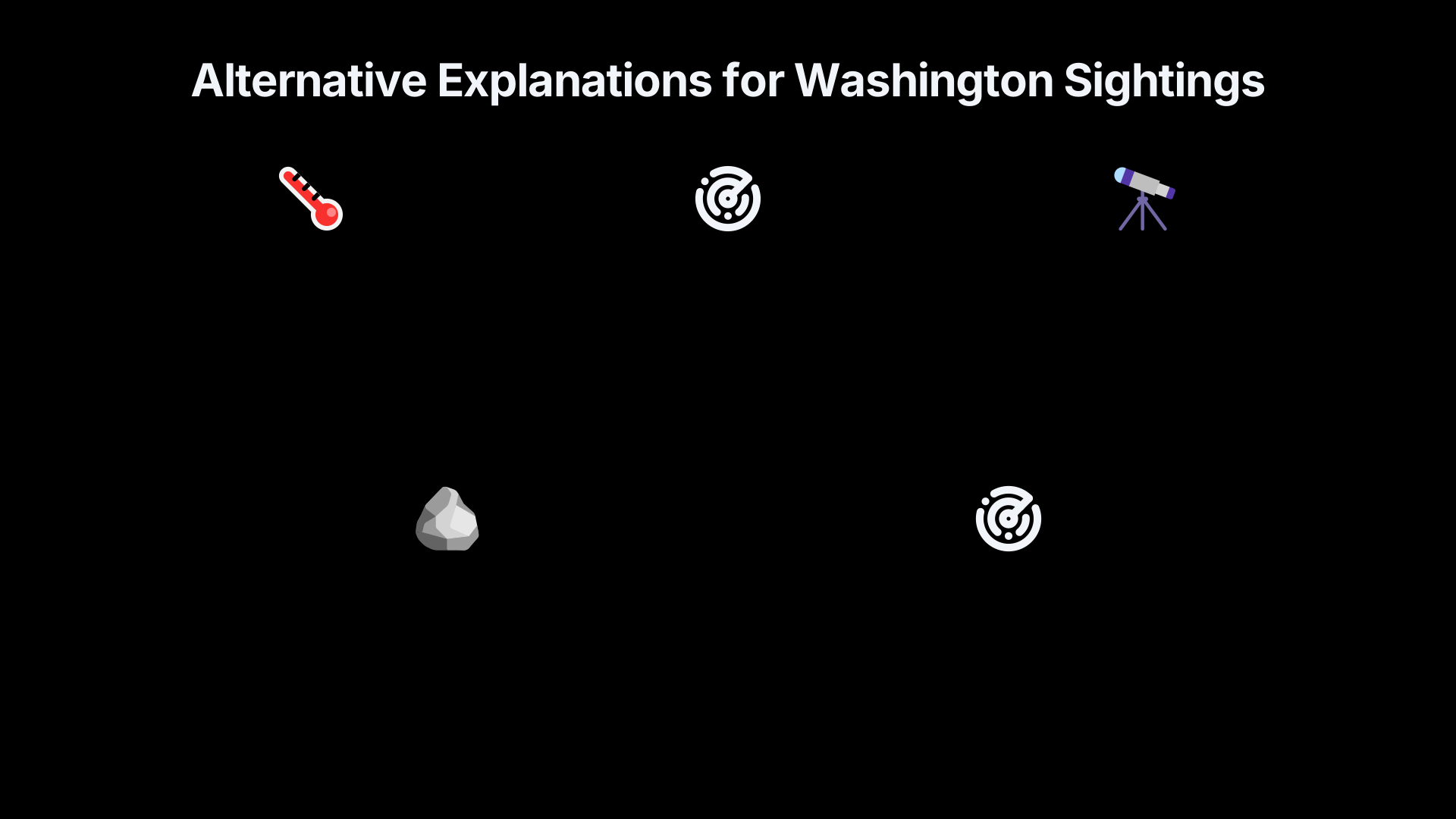
The Air Force’s public explanation focused on temperature inversions. A temperature inversion occurs when warm air sits above cooler air near the ground, allowing radar beams to bend and occasionally produce false or misleading returns. Investigators noted that inversion conditions were present during both weekends. The Civil Aeronautics Administration’s technical review concluded that such conditions were associated with nearly all reports of unidentified radar targets or visual objects during the incidents.[Wikipedia]Wikipedia1952 Washington, D.C. UFO incident1952 Washington, D.C. UFO incident
Several observations also pointed towards more ordinary causes. A B-25 crew directed towards radar targets reported seeing nothing unusual and discovered that one radar contact corresponded to a steamboat on the Potomac River. Air Force Captain Harold May initially believed he was watching an unusual aerial object, but later concluded he had been observing a star distorted by atmospheric conditions. Other crews likewise failed to locate targets that radar operators believed were nearby.[Wikipedia]Wikipedia1952 Washington, D.C. UFO incident1952 Washington, D.C. UFO incident
Critics of the inversion explanation note that some experienced controllers felt the radar returns looked stronger and more persistent than typical weather-related echoes. They argue that atmospheric effects may explain part of the incident without necessarily accounting for every report. Supporters of the official explanation counter that the combination of radar anomalies, stars, meteors, aircraft lights and human interpretation could produce exactly the kind of confusing situation reported in July 1952.[Wikipedia]Wikipedia1952 Washington, D.C. UFO incident1952 Washington, D.C. UFO incident
What the Evidence Supports Today
The radar and pilot evidence from the July 1952 sightings remains noteworthy because it involved multiple categories of witness: civilian controllers, military personnel, airline crews and radar operators at facilities including Andrews Air Force Base in Maryland. Few UFO cases combine so many forms of observation in one episode.[Wikipedia]Wikipedia1952 Washington, D.C. UFO incident1952 Washington, D.C. UFO incident
At the same time, the evidence falls short of demonstrating that radar operators and pilots were unquestionably observing the same unknown craft. Some sightings appeared to coincide with radar returns, but continuous tracking was lacking, visual confirmations were inconsistent, and several reported targets were never identified by pilots sent to intercept them. The strongest conclusion supported by the record is that an unusual series of radar contacts and visual reports occurred over two July weekends, creating a genuine operational mystery at the time. Whether all of those reports shared a single cause remains unresolved.[Wikipedia]Wikipedia1952 Washington, D.C. UFO incident1952 Washington, D.C. UFO incident
Amazon book picks
Further Reading
Books and field guides related to Did Radar and Pilots See the Same Objects?. Use these as the next step if you want deeper reading beyond the article.
The Report on Unidentified Flying Objects
Directly relevant to radar, pilots, and official investigations.
UFOs: Generals, Pilots, and Government Officials Go on the Re...
Focuses heavily on pilot and official testimony.
UFOs and Government: A Historical Inquiry
Explores how radar and military evidence were interpreted.
The UFO Experience: A Scientific Inquiry
Discusses evidentiary standards for correlating observations.
eBay marketplace picks
Marketplace Samples
Live-tested eBay searches with available results related to this page.
Selected fromradar poster oneBay.co.uk.


Endnotes
1.
Source: Wikipedia
Title: 1952 Washington, D.C. UFO incident
Link:https://en.wikipedia.org/wiki/1952_Washington%2C_D.C._UFO_incident
2.
Source: Wikipedia
Title: 1952 Washington, D.C., UFO incident
Link:https://en.wikipedia.org/wiki/1952_Washington%2C_D.C.%2C_UFO_incident
3.
Source: Wikipedia
Title: Robertson Panel
Link:https://en.wikipedia.org/wiki/Robertson_Panel
Additional References
4.
Source: cia.gov
Link:https://www.cia.gov/readingroom/docs/CIA-RDP79B00752A000300100010-4.pdf
Source snippet
REPORT OF MEETINGS OF SCIENTIFIC ADVISORY...U.F.O. reports. This problem was underlined by information received indicating ADC concer...
5.
Source: prologue.blogs.archives.gov
Link:https://prologue.blogs.archives.gov/2019/12/19/saucers-over-washington-the-history-of-project-blue-book/
Source snippet
Pieces of HistorySaucers Over Washington: the History of Project Blue BookDec 19, 2019 — The Federal Government established Project Blue...
6.
Source: wral.com
Title: a radar blip a flash of light how ufos exploded into public view
Link:https://www.wral.com/story/a-radar-blip-a-flash-of-light-how-ufos-exploded-into-public-view/17744754/
Source snippet
UFO sightings. A search of The Times' historical archives reveals a... Washington: UFOs Over the Capitol.” In January 1953, spurred by...
Published: January 1953
7.
Source: archives.gov
Title: project blue book 50th anniversary
Link:https://www.archives.gov/news/articles/project-blue-book-50th-anniversary
Source snippet
Public Interest in UFOs Persists 50 Years After Project Blue...5 Dec 2019 — Project Blue Book, from March 1952 to December 1969—the long...
Published: March 1952
8.
Source: enigmalabs.io
Title: Enigma Labs | Report a UFO sighting Washington D.C
Link:https://enigmalabs.io/library/ca7fafd2-c59e-4b29-a1ec-5dbb92d02fd8
Source snippet
Washington D.C. IncidentBarnes had two controllers check Nugent's radar. They found that it was working normally. Barnes then called Nati...
9.
Source: youtube.com
Link:https://www.youtube.com/watch?v=Jj3DhKSaw0w
Source snippet
1952 - The Invasion of Washington | Full Documentary...
10.
Source: youtube.com
Link:https://www.youtube.com/watch?v=4-MbGYAv7Cg
Source snippet
UFO Report 1952 Major Samford Donald Keyhoe, 1952...
11.
Source: youtube.com
Link:https://www.youtube.com/watch?v=MnYqf-YBFEA
Source snippet
UFOs Over the White House | The 1952 Washington UAP | Full UFO Government Conspiracy Documentary...
12.
Source: cia.gov
Link:https://www.cia.gov/readingroom/document/cia-rdp81r00560r000100010001-0
13.
Source: facebook.com
Link:https://www.facebook.com/HISTORY/posts/during-the-cold-war-as-project-blue-book-investigated-potential-ufo-threats-a-sh/1473622884330683/