Within Alaska
Why Alaska's Skies Create Convincing UFO Mistakes
Darkness, weather, celestial objects and radar artefacts can create convincing UFO reports even when pilots and controllers act carefully.
On this page
- How darkness and distance distort size and motion
- Celestial lights, snow reflections and atmospheric effects
- Radar duplicates, weather returns and correlation errors
Page outline Jump by section
Introduction
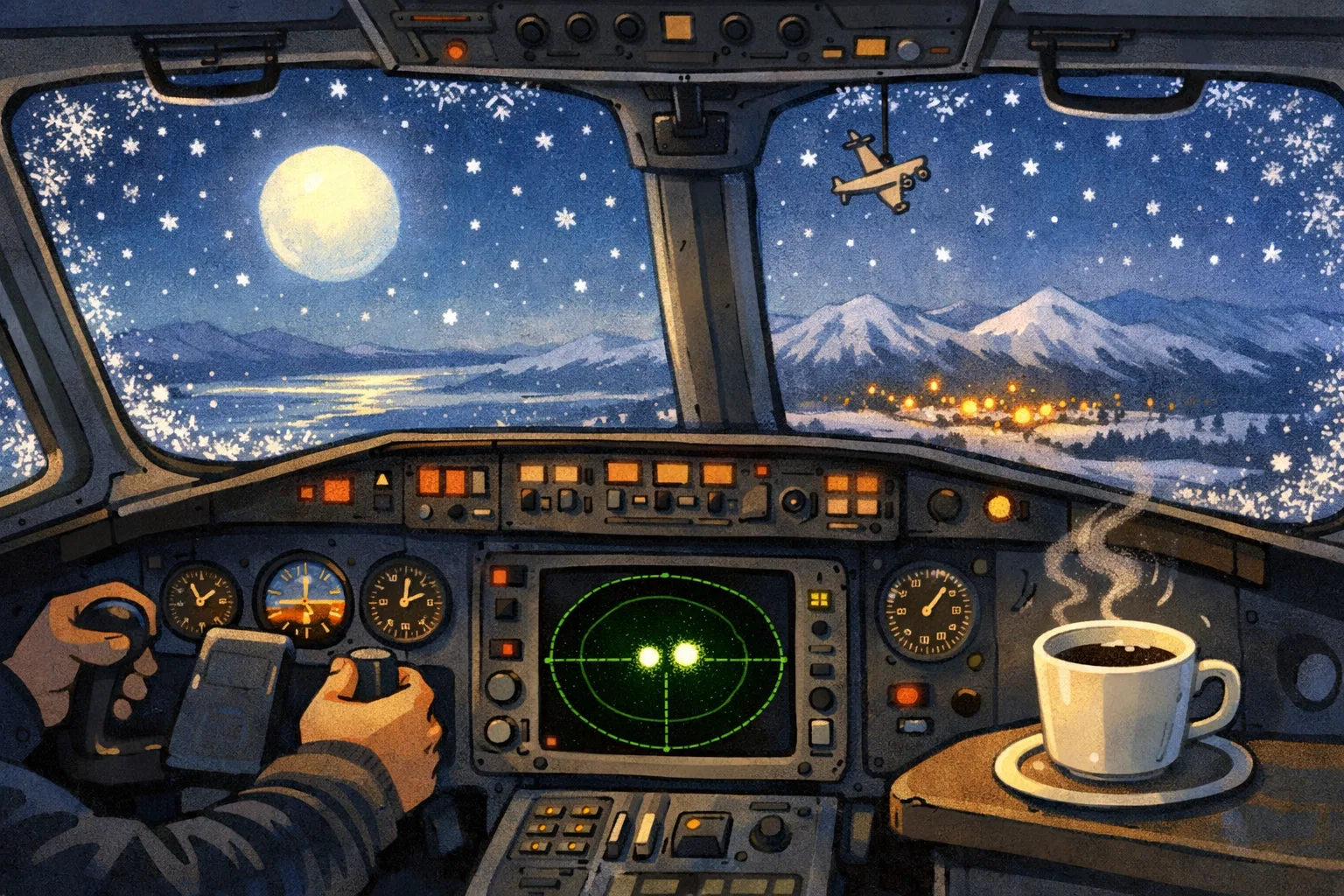
Experienced pilots and air-traffic controllers can make convincing UFO reports over Alaska without being careless, untrained or dishonest. The difficulty lies in the environment: long periods of darkness, vast stretches with almost no ground lighting, snow-covered terrain, ice crystals, temperature inversions and limited radar coverage can remove the normal clues used to judge distance, size and motion. A stationary planet may seem to pace an aircraft; village lights can appear suspended in the sky; an ice-crystal reflection can look like a luminous structure; and one aircraft can briefly generate two radar symbols.
This matters because professional testimony is often treated as though it rules out ordinary explanations. In reality, aviation training recognises that skilled crews remain vulnerable when visual information is sparse or ambiguous. Alaska does not make witnesses unreliable. It makes some observations unusually difficult to interpret, even when the witnesses respond exactly as they should: checking instruments, contacting controllers and asking other aircraft to look.[FAA]faa.govSpatial DSpatial D…
How darkness and distance distort size and motion
Human vision estimates an object’s distance by combining several clues: its apparent size, movement against the background, overlap with other objects, surface detail and the way the view changes as the observer moves. Much of that information disappears during a night flight over Alaska’s interior. Mountains, tundra and frozen rivers may merge into darkness, while settlements are separated by enormous unlit areas. A witness may see a bright point but have no dependable way to decide whether it is a small nearby light or a powerful source many kilometres away.
This uncertainty also corrupts estimates of size. A pilot who assumes that a light is close will infer that it is relatively small; if the same light is assumed to be distant, it may seem enormous. Reports of an object “as large as an aircraft carrier” therefore sound more precise than they really are unless investigators can establish its range independently. Apparent dimensions calculated from an assumed distance merely repeat the original assumption.
Motion is equally deceptive. The Federal Aviation Administration describes the autokinetic illusion, in which a stationary light viewed against a completely dark, featureless background appears to move. Fixating on a star, planet or isolated ground light can even create the impression that it is approaching or crossing the aircraft’s path. The effect is not a sign of poor eyesight. It occurs because the eye makes tiny involuntary movements while the brain lacks a fixed background against which to correct them.[FAA]faa.govSpatial DSpatial D…
An aircraft’s own movement can make the illusion more persuasive. During a turn, a distant celestial object may shift across the windscreen. Once the aircraft levels out, the light may appear to resume a steady position beside or ahead of it. A pilot can reasonably interpret this sequence as an object manoeuvring in response, even though the apparent movement was produced by the aircraft’s changing heading and the absence of useful depth cues.
Alaska also produces the conditions associated with false horizons and “black-hole” flying. The FAA warns that stars can become confused with isolated ground lights and that sloping cloud layers or patterns of lights over featureless terrain can be mistaken for the true horizon. These illusions are serious enough to affect aircraft control, which demonstrates why training and experience cannot simply eliminate them. Pilots are taught to rely on instruments precisely because perception remains fallible.[FAA]faa.govSpatial DSpatial D…

Celestial lights, snow and Arctic atmosphere
Bright planets are recurrent UFO candidates because they can remain visible for long periods, appear to follow an aircraft and look unusually intense near the horizon. Atmospheric turbulence can make them shimmer, change colour or seem to dart slightly. Thin cloud can alternately dim and reveal them, creating an impression of pulsation or deliberate signalling. Without a recognisable horizon, even an experienced observer may not immediately identify a planet appearing in an unfamiliar direction from a polar route.
Snow and ice add further ambiguity. A distant light source may be reflected or scattered by layers of ice crystals, while snow-covered ground can brighten the lower sky and blur the distinction between terrestrial and aerial lights. A cluster of lights from a small community may therefore appear higher, more diffuse or farther away than it really is.
One of Alaska’s most striking examples is the light pillar. Flat ice crystals suspended in cold air reflect light towards the observer, producing what looks like a vertical luminous column above a streetlight, vehicle, building or flight-line lamp. Joint Base Elmendorf-Richardson has published an explanation after such pillars appeared over the installation, noting that the apparent columns are not physical beams located directly above the lamps. They are collective reflections from crystals between the source and the observer.[jber.jb.mil]jber.jb.milLight pillars: an optical illusion > Joint Base Elmendorf-Richardson > ArticlesLight pillars: an optical illusion > Joint Base Elmendorf-Richardson > Articles
The phenomenon is particularly relevant to Alaska because “diamond dust” — tiny ice crystals falling through very cold air — is common enough to produce pillars from outdoor lights and sometimes from the Sun. The University of Alaska Fairbanks’ Geophysical Institute also describes sundogs and halos created when plate-like or column-shaped crystals refract light. These effects can produce extra bright spots, arcs, rings or luminous extensions around a source. Seen briefly from a moving cockpit, an incomplete atmospheric display may not resemble the neat textbook photographs used to explain it afterwards.[gi.alaska.edu]gi.alaska.eduSundogs, light pillars enliven the dog days | Geophysical InstituteSundogs, light pillars enliven the dog days | Geophysical Institute
A particularly instructive Alaska case occurred on 11 January 1987. Japan Air Lines captain Kenju Terauchi reported irregular lights and a large dark mass north of Nenana. The flight was operating near a reported temperature inversion. During the FAA interview, Terauchi himself suggested that lights from Arctic Village had been altered or obscured by ice crystals. The FAA agreed that this was the most likely explanation. The episode is valuable because the reinterpretation did not come from an outsider dismissing the witness; it came from the pilot after the route, village positions and atmospheric conditions were considered together.[documents.theblackvault.com]documents.theblackvault.comOpen source on theblackvault.com.
Temperature inversions can strengthen such effects by bending light through layers of air with different densities. They do not routinely create spectacular mirages, but they can modify the apparent height, shape and visibility of distant sources. In an area where settlements are isolated and a pilot may not expect to see their lights from a particular angle, that modest distortion can be enough to turn a familiar source into an unfamiliar one.
Why radar does not automatically settle the question
Radar evidence is often described as independent confirmation of a visual sighting, but that conclusion depends on whether the radar return can be shown to represent the same object. Radar systems do not display an unfiltered picture of the sky. They process reflected energy, transponder replies and computer-generated tracks. Terrain, precipitation, atmospheric refraction, ground reflections and imperfect correlation between different signals can all create misleading returns.
Weather radar is especially easy to overinterpret. It is designed primarily to show precipitation intensity, not to identify solid aircraft. Ground returns and mountain clutter may appear when the antenna beam intersects terrain. Changing the tilt or range setting can make a patch appear, move or vanish. A return that advances several miles between sweeps may look like an object travelling at extraordinary speed, although the apparent movement can result from changing geometry, intermittent detection or different parts of an extended clutter pattern being displayed.
The 29 January 1987 Alaska Airlines Flight 53 report illustrates the limitation. Both pilots saw a target on their airborne weather radar west of McGrath and estimated that it moved roughly five miles on each sweep. They looked outside but saw nothing. After the crew changed the radar range, the return appeared briefly again and was then lost in clutter from the Alaska Range. The area was outside FAA radar coverage, so there was no independent ground track with which to compare it. The FAA recorded the incident but reached no conclusion. It remains unidentified in the narrow sense that the exact radar source was not established, not in the stronger sense that a solid, high-speed craft was confirmed.[documents.theblackvault.com]documents.theblackvault.comOpen source on theblackvault.com.
Ground radar can also display duplicate information from one aircraft. During the investigation of Japan Air Lines Flight 1628’s better-known November 1986 encounter, Anchorage controllers saw returns that initially raised the possibility of nearby traffic. FAA specialists later reviewed the recorded data using equivalent equipment and concluded that the apparent second target was a split return from the JAL Boeing 747. The aircraft’s primary radar echo and its transponder response had failed to align precisely, creating the impression of two targets. The FAA described this as an “uncorrelated primary and beacon target return” and stated that it was not unusual.[documents.theblackvault.com]documents.theblackvault.comOpen source on theblackvault.com.
That finding did not prove that every light reported by the crew had the same explanation. It did, however, weaken the often-repeated claim that radar independently verified a second craft travelling alongside the aircraft. A diverted United Airlines crew established visual contact with the JAL jet but reported seeing nothing else. The case therefore contains sincere testimony and some ambiguous radar indications, but not an unbroken chain of corroboration across separate sensors.[documents.theblackvault.com]documents.theblackvault.comOpen source on theblackvault.com.
Weather radars face another recognised problem called anomalous propagation. Under certain atmospheric conditions, radar energy bends unusually and strikes terrain or objects that would normally lie below the beam. The resulting echoes may appear in unexpected places and can contaminate genuine weather information. Because the effect depends on changing atmospheric layers, false returns may emerge, shift or disappear in ways that look more purposeful than ordinary static clutter.[noaa.gov]noaa.govanomalous propagationanomalous propagation
Correlation errors turn ambiguity into a stronger story
The most convincing mistakes often arise not from one dramatic failure but from several weak signals being linked together. A pilot sees an unexplained light. A controller notices a brief uncorrelated return. An onboard weather radar shows a patch. Because the reports occur at roughly the same time, they are treated as three observations of one object. Yet each may have a separate cause: a planet or village light outside, a split aircraft return on ground radar and mountain clutter on the weather display.
This is the central investigative risk in Alaska cases. Time coincidence is not enough. Investigators need to compare bearing, elevation, range, duration and movement. A visual light reported off the left side of an aircraft is not confirmed by a radar return behind it. A radar contact several kilometres away may be unrelated unless its position and timing match the witness account within the accuracy of both systems.
Witness discussion can also narrow later recollections into a shared narrative. Controllers may ask whether a crew sees “traffic”; pilots may hear that radar has shown something nearby; later interviews then combine the visual and radar information into a single story. This need not involve exaggeration or bad faith. Memory is reconstructive, and knowledge acquired after an event can influence how its sequence is recalled.
The safest classification is therefore evidence-specific. A case may contain an unexplained visual observation while its radar component is plausibly explained. Another may contain an unresolved radar return with no visible object. Calling the whole incident either “confirmed” or “debunked” loses the distinction that matters.
What experienced witnesses contribute — and what they cannot supply
Professional witnesses remain valuable. Pilots can describe cockpit geometry, headings, weather-radar settings and aircraft behaviour more accurately than most casual observers. Controllers can preserve communications, identify known traffic and recognise common display effects. Their reports deserve careful investigation, especially when recorded promptly.
Their experience does not provide automatic knowledge of an object’s distance, size or physical nature. A pilot is trained to operate an aircraft safely, not to identify every astronomical or atmospheric display under every combination of Arctic darkness, ice and unfamiliar terrain. A controller is trained to separate and route traffic, but a brief primary return may not contain enough information to determine what produced it.
The strongest Alaska investigations therefore separate observation from interpretation. They ask what the witness actually saw or recorded before considering what it seemed to be. They compare the report with aircraft headings, settlements, celestial positions, cloud and inversion data, radar coverage and equipment behaviour. They also look for genuinely independent confirmation rather than assuming that simultaneous ambiguity equals corroboration.
That approach does not dismiss Alaska’s witnesses. It explains why some of the state’s most credible observers can produce reports that are both sincere and mistaken — and why a small residue may remain unresolved even after ordinary mechanisms have accounted for the most dramatic claims.
Amazon book picks
Further Reading
Books and field guides related to Why Alaska's Skies Create Convincing UFO Mistakes. Use these as the next step if you want deeper reading beyond the article.
The UFO Experience: A Scientific Inquiry
Discusses classification and misidentification of aerial phenomena.
UFOs: Generals, Pilots, and Government Officials Go on the Re...
Provides context for evaluating aviation-based UFO reports.
The Demon-haunted World
Explains perception errors, evidence standards, and extraordinary claims.
Why People Believe Weird Things
Helps explain how ordinary events become extraordinary interpretations.
eBay marketplace picks
Marketplace Samples
Live-tested eBay searches with available results related to this page.
Selected fromAlaska wall art oneBay.co.uk.


Endnotes
1.
Source: faa.gov
Title: Spatial D
Link:https://www.faa.gov/pilots/safety/pilotsafetybrochures/media/spatiald_visillus.pdf
Source snippet
Spatial D...
2.
Source: jber.jb.mil
Title: Light pillars: an optical illusion > Joint Base Elmendorf-Richardson > Articles
Link:https://www.jber.jb.mil/News/News-Articles/Article/771234/light-pillars-an-optical-illusion/
3.
Source: gi.alaska.edu
Title: Sundogs, light pillars enliven the dog days | Geophysical Institute
Link:https://www.gi.alaska.edu/alaska-science-forum/sundogs-light-pillars-enliven-dog-days
4.
Source: weather.gov
Link:https://www.weather.gov/arx/why_halos_sundogs_pillars
Source snippet
National Weather ServiceWhat Causes Halos, Sundogs and Sun Pillars?Sundogs are colored spots of light that develop due to the refraction...
5.
Source: documents.theblackvault.com
Link:https://documents.theblackvault.com/documents/ufos/jal1628/733667-001-024.pdf
6.
Source: noaa.gov
Title: anomalous propagation
Link:https://www.noaa.gov/jetstream/anomalous-propagation
7.
Source: faa.gov
Link:https://www.faa.gov/sites/faa.gov/files/regulations_policies/handbooks_manuals/aviation/phak/19_phak_ch17.pdf
8.
Source: faa.gov
Link:https://www.faa.gov/documentLibrary/media/Advisory_Circular/AC-0045F.pdf
9.
Source: faa.gov
Title: Section 1. Decode A. EXPLANATION OF CODES. GEN
Link:https://www.faa.gov/air_traffic/publications/atpubs/cnt_html/chap2_section_1.html
10.
Source: documents.theblackvault.com
Link:https://documents.theblackvault.com/documents/ufos/jal1628/733667-001-003.pdf
11.
Source: theblackvault.com
Title: the vault files 1986 alaska jal flight 1628
Link:https://www.theblackvault.com/casefiles/the-vault-files-1986-alaska-jal-flight-1628/
Additional References
12.
Source: aopa.org
Link:https://www.aopa.org/training-and-safety/online-learning/safety-spotlights/spatial-disorientation/tricked-by-illusions
Source snippet
Tricked by IllusionsAutokinesis: At night, a stationary dim light against a dark background will appear to move if a pilot visually f...
13.
Source: upi.com
Title: Controller confirms UFO sighting
Link:https://www.upi.com/Archives/1986/12/30/Controller-confirms-UFO-sighting/4431536302800/
Source snippet
Controller confirms UFO sighting - UPI Archives30 Dec 1986 — All three crewmen on JAL Flight 1628 told Federal Aviation Administration...
14.
Source: youtube.com
Title: Spatial Disorientation Explained: Deadly Flight Illusions Every Pilot Must Know
Link:https://www.youtube.com/watch?v=6BD9fyyIJzY
Source snippet
How 'Spatial Disorientation' Can Be Fatal To Pilots In Flight | NBC News NOW...
15.
Source: youtube.com
Title: How ‘Spatial Disorientation’ Can Be Fatal To Pilots In Flight | NBC News NOW
Link:https://www.youtube.com/watch?v=Vi9Oaon_7d4
Source snippet
How to Recognize and Overcome Spatial Disorientation...
16.
Source: faasafety.gov
Link:https://www.faasafety.gov/files/events/SO/SO15/2024/SO15134204/YourSensesInTheShadows.pdf
17.
Source: flightsafety.org
Title: in the dark
Link:https://flightsafety.org/asw-article/in-the-dark/
Source snippet
Flight Safety FoundationIn the Dark20 Jan 2017 — Pilots are vulnerable to visual illusions in conditions of visual ambiguity. In such con...
18.
Source: youtube.com
Title: How to Recognize and Overcome Spatial Disorientation
Link:https://www.youtube.com/watch?v=YatlPrTZUNs
Source snippet
FROM THE ARCHIVES | Spatial Disorientation (2001)...
19.
Source: timeanddate.com
Link:https://www.timeanddate.com/astronomy/optical-phenomenon.html
20.
Source: flyaeroguard.com
Link:https://www.flyaeroguard.com/learning-center/visual-illusions/
21.
Source: reddit.com
Link:https://www.reddit.com/r/ATC/comments/noxllb/have_you_ever_had_false_targets_show_on_radar/