Within Indiana UFOs
What Project Blue Book Actually Says About Indiana
Air Force records show how Indiana sightings were logged, assessed and sometimes left unresolved without implying alien technology.
On this page
- How Indiana reports entered the official system
- What identified and unidentified classifications meant
- Why an unresolved case is not proof of extraterrestrials
Page outline Jump by section
Introduction
Project Blue Book’s Indiana files do not reveal a hidden Air Force finding that alien craft visited the state. They show something more useful: how reports moved through an official system, what investigators tried to check, and why some cases remained unresolved. Indiana sightings were recorded alongside witness statements, weather information, aircraft and balloon enquiries, intelligence notes and provisional conclusions. Some received ordinary explanations; others were left unidentified because the available evidence did not support a dependable answer.
That distinction matters. In Blue Book terminology, “unidentified” described the result of an investigation, not the nature of the object. It meant that investigators could not match a report confidently to a known aircraft, balloon, astronomical object or other conventional cause. The Air Force’s final conclusion remained that neither Indiana’s unresolved reports nor the wider national collection provided evidence of extraterrestrial vehicles, scientific breakthroughs beyond contemporary knowledge or a threat to national security.[National Archives]archives.govNational Archives Project BLUE BOOKNational ArchivesProject BLUE BOOK - Unidentified Flying Objects | National Archives
How Indiana reports entered the official system
The surviving Blue Book archive is not a single book or a polished state-by-state catalogue. It is a large administrative collection inherited from Project Sign, Project Grudge and Project Blue Book, the successive Air Force investigations operating from the late 1940s until 1969. The National Archives holds about 37 cubic feet of chronological case files, together with administrative material and Office of Special Investigations records. Its finding aids index sightings by date and location, which is how Indiana reports can be traced within a predominantly national filing system.[National Archives]archives.govNational Archives Project BLUE BOOKNational ArchivesProject BLUE BOOK - Unidentified Flying Objects | National Archives
A report might reach the Air Force through a military installation, civil aviation official, police officer, pilot, newspaper clipping or letter from a member of the public. Local personnel could collect a description and forward it for technical assessment at Wright-Patterson Air Force Base in neighbouring Ohio. The forms sought details such as:
- the time, place and duration of the observation;
- the object’s apparent shape, colour, size and direction;
- weather, visibility and cloud conditions;
- whether radar, photographs or physical traces existed;
- the witness’s occupation, experience and reliability;
- possible aircraft, balloon, meteorological or astronomical matches.
The Air Force Office of Special Investigations says its agents were expected to examine both the reported object and the credibility of the observer. The original defence concern was not primarily visitors from space. During the early Cold War, an unfamiliar object might conceivably have been a Soviet aircraft, surveillance device or other technological threat.[osi.af.mil]osi.af.milOpen source on af.mil.
The quality of that process varied. A well-connected military or aviation case could generate interviews and checks with airfields, weather stations and radar operators. A brief civilian sighting submitted late might produce little more than a questionnaire and a short evaluation. Consequently, the thickness of a file does not necessarily indicate how extraordinary the sighting was, while a thin file may say more about limited information than about the event itself.
What the Indiana files actually contain
Indiana’s records range from short descriptions to cases involving aviation professionals and apparently related observations. They are valuable less as proof of unusual technology than as examples of how officials converted uncertain testimony into administrative evidence.
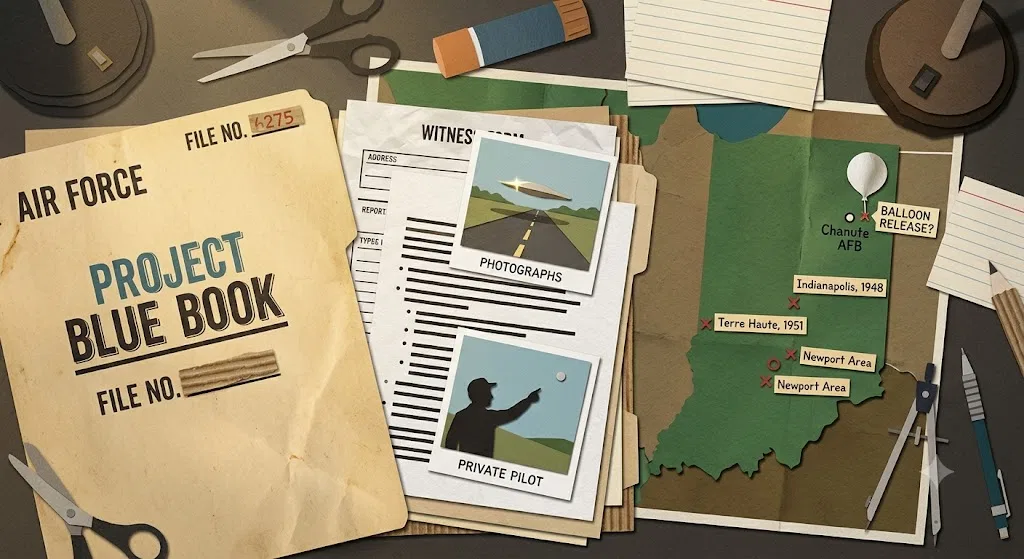
The Indianapolis daylight case of 1948
One of Indiana’s best-known official “unknowns” occurred near Indianapolis on 29 July 1948, during the Project Sign period. Two rug-cleaning company employees reportedly saw a shiny, elongated object cross the road ahead of their vehicle at low altitude. They estimated that it was six to eight feet long and about two feet wide, and said it appeared to turn or glide down towards woodland. The sighting lasted only several seconds. The case was later retained in Blue Book-derived listings as case 185, classified as unknown.[ufologie.patrickgross.org]ufologie.patrickgross.orgProject Blue Book lists this sighting as an “unknown.”. CaseUFOs at close sight: Blue Book unexplained case 18526 Feb 2005 — Indianapolis, Indiana, July 29, 1948: Blue Book case number: 185…
Its official status makes it noteworthy, but the same record illustrates the limitations of the label. The report described a structured object in daylight rather than an indistinct night-time light, yet there was no photograph, radar record, recovered material or confirmed landing site. Distance, height and dimensions were estimates made during a fleeting encounter. Investigators evidently found no conventional identification persuasive enough to close the case, but they also acquired no independent evidence establishing what had been seen.
The correct reading is therefore narrow: the Air Force did not solve the report from the information available. “Unknown” did not mean that investigators had ruled out every ordinary possibility, still less that they had identified an extraterrestrial machine.
The Terre Haute reports of October 1951
A more revealing example appears in an early Project Grudge status report later incorporated into the Blue Book archive. At 1.42 pm on 9 October 1951, a Civil Aeronautics Administration chief aircraft communicator at Hulman Municipal Airport, east of Terre Haute, reported a silver object passing directly overhead. He said it travelled from overhead to the south-eastern horizon in about 15 seconds, without audible sound or a vapour trail. The weather was recorded as clear, with bright sunshine and no haze.[Wikimedia Commons]upload.wikimedia.orgWikimedia Commons…
Three minutes later, a private pilot flying from Greencastle towards Paris, Illinois, reported a silver object at about 5,000 feet. It initially appeared stationary relative to the approaching aeroplane and then moved north-east, south of the Newport area. The report specifically considered whether a weather balloon released from Chanute Air Force Base might account for it, but judged that explanation doubtful because the expected ascent and drift did not fit well.[Wikimedia Commons]upload.wikimedia.orgWikimedia Commons…
These reports are interesting because they involved aviation witnesses, occurred within minutes of each other and prompted comparison with balloon activity. Yet the archive does not establish conclusively that both witnesses saw the same object. Their locations, lines of sight and estimates were not precise enough to reconstruct a reliable track. The contemporary status note was cautious: further details would be sought, but investigators doubted that more information would produce an identification.[Wikimedia Commons]upload.wikimedia.orgWikimedia Commons…
That wording captures an important feature of Blue Book. An investigation could end not with a dramatic finding but with diminishing prospects of resolution. Missing measurements, uncertain geometry and the passage of time could make a case permanently inconclusive even where the observer appeared credible.
Routine files mattered too
Other Indiana material demonstrates the programme’s bureaucratic scale. A surviving 14-page Indianapolis file from November 1966 contains standard Blue Book paperwork concerning a ground-visual observation, including spaces for the number of objects, length and type of observation, photographs, physical evidence, analysis and conclusion. Its existence shows that a report could create a sizeable documentary packet without becoming one of Blue Book’s celebrated national cases.[Wikimedia Commons]commons.wikimedia.orgCommons File:Project Blue Book reportWikimedia CommonsFile:Project Blue Book report - 1966-11-8271349-Indianapolis-Indiana.pdf - Wikimedia Commons…
This is a useful corrective to two opposite misconceptions. Blue Book did not ignore every civilian report, but neither did the opening of a file signify official endorsement of an extraordinary claim. Filing, interviewing and checking were stages in classification, not confirmation.

What “identified” and “unidentified” meant
Blue Book’s categories are often treated as if they formed a scale from mundane to alien. They did not. They described how successfully the Air Force believed it could account for a report.
Identified cases were matched, firmly or provisionally, with a conventional source. Common categories included balloons, aircraft, astronomical bodies, meteors, clouds, atmospheric effects, searchlights, birds, debris and deliberate hoaxes. An identification could sometimes be highly specific, such as a balloon launched at a documented time. In other cases, the conclusion was less secure and rested on the explanation judged most compatible with the report.
Unidentified cases contained enough information to be assessed but lacked a satisfactory conventional match. This could happen because the reported appearance or motion did not agree with checked aircraft or balloon activity. It could also happen because estimates of speed, distance and direction were too uncertain to test decisively.
Insufficient-information cases lacked the basic data needed for meaningful analysis. A distant light reported without an exact time, direction, duration or location could not sensibly be compared with astronomical or aviation records. Such a report might remain mysterious to the witness while being unsuitable for an official “unidentified” classification.
This distinction was formalised most clearly in Project Blue Book Special Report No. 14, a statistical study prepared with the Battelle Memorial Institute. Analysts compared reports using characteristics including colour, duration, brightness, shape, speed and number of objects, while also rating the quality of the available information. The study’s framework recognised that an unresolved, information-rich case differed from one that was merely too vague to analyse.[Wikipedia]WikipediaProject Blue BookProject Blue Book
The categories were nevertheless dependent on judgement. Apparent speed could be greatly exaggerated when an observer did not know an object’s distance. A stationary planet could seem to move when viewed from a moving car, and a balloon’s shape could change with lighting and angle. Conversely, a proposed solution might be recorded even when some details did not fit perfectly. Blue Book’s classifications should therefore be read as historical assessments, not laboratory measurements.
Why the official conclusions were broader than individual cases
When Project Blue Book ended, the Air Force reported that it had received 12,618 sightings nationwide and classified 701 as unidentified. Its final position contained three distinct findings:
- no investigated report had indicated a threat to United States national security;
- no evidence showed that unidentified sightings represented technology beyond contemporary scientific knowledge;
- no evidence showed that unidentified sightings were extraterrestrial vehicles. National Archives
Those conclusions did not claim that every one of the 701 cases had eventually been explained. Instead, they separated unresolved observations from larger claims about their origin. A file could remain unidentified because investigators lacked enough discriminating evidence, while the collection as a whole still failed to demonstrate hostile intent, revolutionary engineering or alien visitation.
The decision to close Blue Book also reflected an institutional judgement about value and responsibility. The Air Force cited its own experience, the University of Colorado’s scientific study and a National Academy of Sciences review. Officials concluded that continuing the programme was not justified by either defence needs or the expected scientific return. The records were transferred to the National Archives rather than destroyed, leaving the underlying files open to public examination. National Archives
For Indiana, this means that the final national conclusions apply without erasing local uncertainty. The Indianapolis case of 1948 and the Terre Haute reports of 1951 can remain historically unresolved while still providing no verified evidence for extraterrestrial craft.
Where criticism of Blue Book is justified
A balanced reading should not treat every Air Force conclusion as beyond challenge. Blue Book operated with limited staff, uneven reporting and competing duties. Its scientific consultant, astronomer J. Allen Hynek, eventually criticised the programme’s resources, data collection and tendency to receive incomplete information from local bases. Critics also argued that the Air Force became increasingly concerned with reducing public alarm and closing cases rather than pursuing the most difficult reports in depth. Wikipedia
The Indiana archive itself supports a modest version of that criticism. The 1951 Terre Haute document promises further enquiries but already anticipates that identification will probably be impossible. That may have been a realistic assessment, not a dismissal; nevertheless, it shows how easily an investigation could stall once immediate checks produced no answer. Wikimedia Commons
Blue Book records also contain provisional language such as “probably”, “possibly” and “doubtful”. These words matter. They indicate that many conclusions were assessments of likelihood rather than definitive demonstrations. Researchers should therefore distinguish between:
- a verified identification supported by matching times, positions and physical characteristics;
- a plausible explanation that fits most but not all details;
- an unresolved case with reasonably substantial testimony;
- a report that cannot be evaluated because crucial information is missing.
Criticism of weak methods does not, however, validate the extraterrestrial interpretation. Showing that an investigation was incomplete establishes only that the official answer may be uncertain. A positive claim about an exotic vehicle would still require independent evidence capable of being checked: reliable imagery, calibrated radar, physical material, multiple consistent viewing positions or similarly strong documentation. Indiana’s Blue Book files do not provide that standard of proof.
Why an unresolved case is not proof of extraterrestrials
An unexplained observation leaves a gap between what a witness described and what investigators could establish. It does not automatically fill that gap with the most extraordinary possibility.
Several ordinary reasons can preserve a case as unresolved:
- The observation was too brief. A few seconds may allow a vivid impression but little reliable measurement.
- Distance was unknown. Without distance, apparent size and speed cannot be calculated securely.
- Records were incomplete. Civilian, military and meteorological activity was not always documented or checked comprehensively.
- Witness accounts changed in transmission. Newspaper summaries, telephone reports and later recollections could lose precision.
- The investigation began too late. Weather conditions, transient aircraft and balloon tracks became harder to reconstruct after days or weeks.
- The surviving archive may be incomplete. Later researchers sometimes have the initial report but not every follow-up communication.
The 1948 Indianapolis report remains striking because it involved a daylight object described at apparently close range. The Terre Haute reports remain interesting because experienced aviation observers reported silver objects under clear conditions. Yet neither case produced measurements or physical evidence capable of distinguishing decisively between an unusual conventional object, perceptual error and something genuinely novel. ufologie.patrickgross.org
That is the central lesson of Project Blue Book’s Indiana files. They preserve genuine reports, official enquiries and a small residue of uncertainty. They do not show that every sighting was trivial, nor do they show that the Air Force secretly confirmed alien technology. Their strongest conclusion is narrower and more durable: witnesses sometimes saw things they could not identify, investigators sometimes failed to resolve them, and uncertainty remained uncertainty.
Amazon book picks
Further Reading
Books and field guides related to What Project Blue Book Actually Says About Indiana. Use these as the next step if you want deeper reading beyond the article.
The Report on Unidentified Flying Objects
Explains how Air Force UFO investigations worked and what unidentified classifications meant.
The UFO Experience: A Scientific Inquiry
Provides context for evaluating sightings and unidentified cases.
UFOs and Government: A Historical Inquiry
Covers official investigations including the Blue Book era.
UFOs: Generals, Pilots, and Government Officials Go on the Re...
Examines how official sources evaluate unexplained aerial reports.
eBay marketplace picks
Marketplace Samples
Live-tested eBay searches with available results related to this page.
Selected fromProject Blue Book poster oneBay.co.uk.

Endnotes
2.
Source: af.mil
Title: There was no evidence indicating that sightings categorized as “
Link:https://www.af.mil/About-Us/Fact-Sheets/Display/Article/104590/unidentified-flying-objects-and-air-force-project-blue-book/
Source snippet
Air ForceUnidentified Flying Objects and Air Force Project Blue BookOf a total of 12,618 sightings reported to Project Blue Book, 701 rem...
3.
Source: osi.af.mil
Link:https://www.osi.af.mil/News/Features/Display/Article/2302429/project-blue-book-part-1-ufo-reports/
4.
Source: ufologie.patrickgross.org
Title: Project Blue Book lists this sighting as an “unknown.”. Case
Link:https://www.ufologie.patrickgross.org/bb/185.htm
Source snippet
UFOs at close sight: Blue Book unexplained case 18526 Feb 2005 — Indianapolis, Indiana, July 29, 1948: Blue Book case number: 185...
Published: July 29, 1948
5.
Source: upload.wikimedia.org
Link:https://upload.wikimedia.org/wikipedia/commons/3/3b/Project_Blue_Book%2C_BBA-PBSR1-300.pdf
Source snippet
Wikimedia Commons...
6.
Source: commons.wikimedia.org
Title: Commons File:Project Blue Book report
Link:https://commons.wikimedia.org/wiki/File%3AProject_Blue_Book_report_-_1966-11-8271349-Indianapolis-Indiana.pdf
Source snippet
Wikimedia CommonsFile:Project Blue Book report - 1966-11-8271349-Indianapolis-Indiana.pdf - Wikimedia Commons...
7.
Source: upload.wikimedia.org
Title: Project Blue Book report 1966 11 8271349 Indianapolis Indiana
Link:https://upload.wikimedia.org/wikipedia/commons/4/4d/Project_Blue_Book_report_-_1966-11-8271349-Indianapolis-Indiana.pdf
Source snippet
Wikimedia Commons1966-11-8271349-Indianapolis-Indiana...
8.
Source: Wikipedia
Title: Project Blue Book
Link:https://en.wikipedia.org/wiki/Project_Blue_Book
9.
Source: archives.gov
Title: project blue book 50th anniversary
Link:https://www.archives.gov/news/articles/project-blue-book-50th-anniversary
Source snippet
National ArchivesPublic Interest in UFOs Persists 50 Years After Project Blue...5 Dec 2019 — Project Blue Book, from March 1952 to Decem...
Published: March 1952
10.
Source: time.com
Link:https://time.com/5492638/project-blue-book-tv-show-review/
11.
Source: archives.gov
Link:https://www.archives.gov/citizen-archivist/missions
12.
Source: archives.gov
Title: nara documents2
Link:https://www.archives.gov/research/foreign-policy/cold-war/1961-berlin-crisis/nara-documents2
13.
Source: archives.gov
Link:https://www.archives.gov/research/topics/uaps/moving-images-and-sound
14.
Source: archives.gov
Title: Federal Records Guide: Alphabetical Index
Link:https://www.archives.gov/research/guide-fed-records/index-alpha/a.html
15.
Source: archives.gov
Title: Project BLUE BOOK
Link:https://www.archives.gov/foia/ufos.html
16.
Source: archives.gov
Title: listdigitizedpartnerdata.xlsx
Link:https://www.archives.gov/files/digitization/listdigitizedpartnerdata-.xlsx
17.
Source: archives.gov
Link:https://www.archives.gov/research/topics/uaps/photographs
18.
Source: archives.gov
Link:https://www.archives.gov/research/topics/uaps/textual-and-microfilm
19.
Source: archives.gov
Title: still pictures guide
Link:https://www.archives.gov/research/guides/still-pictures-guide
20.
Source: prologue.blogs.archives.gov
Title: saucers over washington the history of project blue book
Link:https://prologue.blogs.archives.gov/2019/12/19/saucers-over-washington-the-history-of-project-blue-book/
21.
Source: archives.gov
Title: uap bulk download
Link:https://www.archives.gov/research/catalog/catalog-bulk-downloads/uap-bulk-download
22.
Source: archives.gov
Link:https://www.archives.gov/preservation/technical/imaging-storage-appendix.html
23.
Source: archives.gov
Title: rg collections
Link:https://www.archives.gov/research/topics/uaps/rg-collections
24.
Source: archives.gov
Link:https://www.archives.gov/research/guide-fed-records/groups/220.html/1000
25.
Source: archives.gov
Title: Record Groups 103
Link:https://www.archives.gov/atlanta/holdings/rg-100-164.html
26.
Source: archives.gov
Link:https://www.archives.gov/research/alic/periodicals/nara-citations/genealogy.html
27.
Source: archives.gov
Title: Federal Records Guide: Alphabetical Index
Link:https://www.archives.gov/research/guide-fed-records/index-alpha/s.html
28.
Source: af.mil
Link:https://www.af.mil/The-Roswell-Report/
29.
Source: osi.af.mil
Title: mil Features
Link:https://www.osi.af.mil/News/Features/?Page=9
30.
Source: af.mil
Title: SAFLLMI Const Resp Guide Web 19Mar2015 v4
Link:https://www.af.mil/Portals/1/documents/aboutus/SAFLLMI_Const_Resp_Guide_Web_19Mar2015_v4.pdf
31.
Source: af.mil
Title: DAF CRG
Link:https://www.af.mil/Portals/1/documents/2025SAF/DAF_CRG.pdf
32.
Source: commons.wikimedia.org
Title: File:Project Blue Book report 1948 07 6387196 Indianapolis Indiana 152
Link:https://commons.wikimedia.org/wiki/File%3AProject_Blue_Book_report_-_1948-07-6387196-Indianapolis-Indiana-152-.pdf
33.
Source: upload.wikimedia.org
Title: Rodgers Unidentified Flying Objects
Link:https://upload.wikimedia.org/wikipedia/commons/a/ad/Rodgers_-_Unidentified_Flying_Objects.pdf
34.
Source: upload.wikimedia.org
Title: Project Blue Book, BBA PBSR8 300
Link:https://upload.wikimedia.org/wikipedia/commons/5/5c/Project_Blue_Book%2C_BBA-PBSR8-300.pdf
35.
Source: war.gov
Link:https://www.war.gov/medialink/ufo/071026/release_04/documents/DOW-UAP-D092_DAF-Committee-to-Review-Project-Bluebook_1966-1967.pdf
36.
Source: archive.org
Link:https://archive.org/stream/TheHynekUFOReport/The_Hynek_UFO_Report_djvu.txt
37.
Source: Wikipedia
Title: Mantell UFO incident
Link:https://en.wikipedia.org/wiki/Mantell_UFO_incident
38.
Source: tastedive.com
Title: Project Blue Book
Link:https://tastedive.com/shows/like/Project-Blue-Book
39.
Source: history.com
Title: Project Blue Book
Link:https://www.history.com/articles/project-blue-book
40.
Source: geekchocolate.co.uk
Title: project blue book
Link:https://geekchocolate.co.uk/project-blue-book/
Additional References
41.
Source: youtube.com
Title: 10 Cases From Project Blue Book: The CIA’s Hunt For UFOs
Link:https://www.youtube.com/watch?v=OoKm417zKOA
Source snippet
17th December 1969: Project Blue Book, the United States' study of UFOs, officially terminated...
Published: December 1969
42.
Source: cia.gov
Link:https://www.cia.gov/readingroom/docs/CIA-RDP81R00560R000100060001-5.pdf
43.
Source: youtube.com
Link:https://www.youtube.com/watch?v=kvkpX-ucTSc
Source snippet
The Unknowns: Mystifying UFO Cases...
Published: December 1969
44.
Source: reddit.com
Link:https://www.reddit.com/r/UFOs/comments/1nscs8i/youve_been_lied_to_australian_intel_report/
45.
Source: facebook.com
Link:https://www.facebook.com/therealbryancallen/posts/decoding-the-mystery-of-unidentified-anomalous-phenomenauap-ufo-unexplained-hist/1559896458831757/
46.
Source: facebook.com
Link:https://www.facebook.com/HISTORY/posts/during-the-cold-war-as-project-blue-book-investigated-potential-ufo-threats-a-sh/1473622884330683/
47.
Source: nationalacademies.org
Link:https://www.nationalacademies.org/read/13462/chapter/24
48.
Source: reddit.com
Link:https://www.reddit.com/r/skeptic/comments/1343gou/j_allen_hynek/
49.
Source: fold3.com
Link:https://www.fold3.com/collection/non-military
50.
Source: academia.edu
Link:https://www.academia.edu/49680297/Project_Blue_Book_Special_Report_14