Within New Mexico
How Military Secrecy Shaped New Mexico UFO Lore
New Mexico's bases, laboratories and classified programmes made strange sightings more likely and straightforward public explanations far less likely.
On this page
- Bases, laboratories and experimental programmes
- Kirtland investigators and early Air Force casework
- How secrecy created suspicion and lasting myths
Page outline Jump by section
Introduction
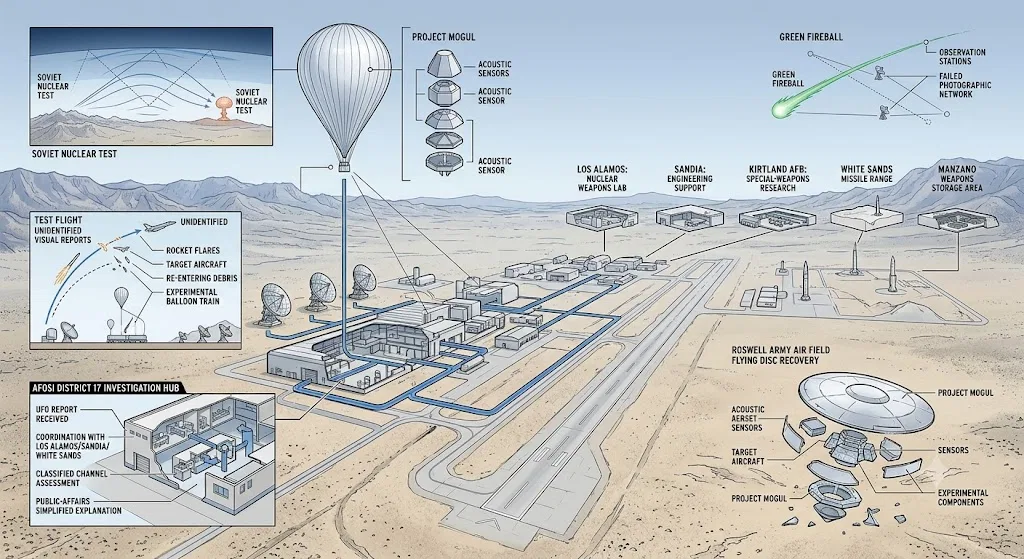
Military secrecy did not prove that extraterrestrial craft visited New Mexico, but it decisively shaped how the state’s UFO stories developed. New Mexico contained an exceptional concentration of nuclear laboratories, weapons-storage sites, missile ranges, radar networks and experimental aviation programmes. Consequently, residents and military personnel sometimes saw unfamiliar objects in places where genuine national-security activity was taking place—and where officials could not give a full public explanation.
This produced a recurring pattern. A sighting prompted real military interest because it might involve Soviet surveillance, an unidentified aircraft or a threat to a sensitive installation. Investigators then worked through classified channels, released a simplified explanation or said little at all. Years later, declassified records showed that secrecy had existed, but not necessarily for the reason UFO believers suspected. Roswell’s Project Mogul connection is the clearest example; the green-fireball investigations around Los Alamos and the Air Force’s casework at Kirtland show that the pattern extended much further.[gao.gov]gao.govnsiadNSIAD-95-187 Government RecordsJul 28, 1995 — At the time of the Roswell crash, project. MOGUL was a highly classified U.S. effort to…
Why New Mexico generated both sightings and secrecy
New Mexico’s strategic landscape made unusual aerial reports more likely than they would have been in an ordinary rural state. Los Alamos developed nuclear weapons; Sandia worked on their engineering and support systems; Kirtland Air Force Base became a centre for special-weapons research, testing and regional air defence; and White Sands provided an immense controlled range for rockets, missiles and experimental vehicles. White Sands says that more than 42,000 rocket and missile tests have been conducted there, while Kirtland’s official history records its central Cold War role in nuclear-weapons development and flight testing.[af.mil]kirtland.af.milBase HistoryB - Air ForceKirtland became the home of Air Force Special Weapons Command in December 1949 to provide operational synchronici…
This environment created several ordinary routes to an extraordinary-looking sighting. High-altitude balloons could travel far from their launch sites. Rockets, flares, target aircraft and re-entering debris could produce unfamiliar lights or movements. Radar operators might detect test vehicles or atmospheric effects that civilian witnesses knew nothing about. Security patrols also watched the skies and restricted areas more closely than people elsewhere, increasing the chance that a strange observation would be formally reported.
The same environment made straightforward explanations difficult. Officials responsible for a secret programme might be unable to identify it even to another government investigator without the correct clearance. Public-affairs officers could describe an object’s harmless appearance while concealing its intelligence purpose. Investigative files might omit details, use vague language or remain classified long after the incident. Such practices were understandable from a Cold War security perspective, but they created exactly the documentary gaps from which cover-up claims later grew.
There is also an important observation bias. New Mexico did not merely contain more unusual military activity; it contained more people professionally employed to notice unusual activity. Pilots, radar operators, guards, engineers, scientists and intelligence officers were watching controlled airspace and strategic installations. A high number of reports near bases therefore does not by itself show that UFOs were attracted to nuclear facilities. It may show that sensitive sites combined unfamiliar technology with unusually intensive surveillance. Historians and contemporary investigators continue to regard this mixture of restricted activity and concentrated observation as central to New Mexico’s UFO reputation.[The Guardian]theguardian.comConcurrently, there has been a recent panic in New Jersey over drones. This renewed interest is supported by the newly established Nation…
Kirtland became a hub for early Air Force investigations
New Mexico was not simply a setting for sightings; it was part of the machinery used to investigate them. The Air Force Office of Special Investigations, or AFOSI, has confirmed that its detachments recorded UFO reports from 1948 into the late 1960s. Although reports could originate across the country, AFOSI says that most early investigations were handled by District 17 at Kirtland Air Force Base.[osi.af.mil]osi.af.milProject Blue Book Part 1 (UFO Reports) - AFOSI - Air Force6 Aug 2020 — Although all detachments received and documented UFO reports, most…
This placed Kirtland at the operational centre of the Air Force’s first organised UFO programmes. Project Sign began in 1948 amid concern that unexplained craft might represent an advanced foreign capability. Its successor, Project Grudge, adopted a more sceptical approach, and Project Blue Book later became the best-known public investigation. The National Archives records that Sign evaluated 243 reports and Grudge evaluated 244; Grudge’s 1949 conclusion was that reports generally arose from mistaken natural phenomena, conventional aircraft, fabrications or hoaxes.[National Archives]archives.govNational Archives Public Interest in UFOs Persists 50 Years After Project BlueNational Archives Public Interest in UFOs Persists 50 Years After Project Blue
The original concern was primarily national security rather than extraterrestrial visitation. In the early Cold War, an object described as fast, high-flying or able to penetrate restricted airspace might have been a Soviet reconnaissance platform. Investigators therefore collected witness statements, checked aircraft movements, consulted weather data and contacted technical specialists. A case could be worth examining even when its eventual explanation was mundane because the initial report might expose an intelligence gap or a weakness in air defence.
Kirtland was a logical place for that work. It supported nuclear-weapons activity, flight testing and a regional air-defence network capable of directing interceptors through radar and command facilities. Its investigators could draw on military expertise while remaining close to Los Alamos, Sandia and the state’s test ranges. The result was a dense overlap between the institutions generating unusual aerial activity and those responsible for assessing reports of it.[kirtland.af.mil]kirtland.af.milBase HistoryB - Air ForceKirtland became the home of Air Force Special Weapons Command in December 1949 to provide operational synchronici…
Yet official investigation did not mean official endorsement. Blue Book and its predecessors classified many reports as balloons, aircraft, astronomical objects or insufficiently documented observations. A residue remained unidentified, but “unidentified” usually meant that the available information was inadequate for a firm conclusion—not that investigators had established an exotic origin. This distinction is essential when reading New Mexico case files. A serious investigation shows that officials considered a report worth checking; it does not show that the reported object was extraordinary.
The green fireballs tested the limits of official inquiry
The reports known as the New Mexico green fireballs offer one of the clearest examples of genuine government concern without a conclusive exotic finding. Beginning in the late 1940s, pilots, scientists and military personnel reported brilliant green lights or fireball-like objects, often in the broad region containing Los Alamos, Sandia and other sensitive facilities. Their colour, apparent brightness and repeated presence near atomic installations made them difficult to dismiss casually.
Officials considered several possibilities. The objects might have been unusual meteors, atmospheric phenomena, flares or observations distorted by distance and expectation. More troubling alternatives included foreign reconnaissance or some form of deliberate activity near nuclear sites. The importance of the locations, rather than firm evidence of advanced craft, explains why the reports reached intelligence and scientific authorities.
A 1949 conference at Los Alamos brought together military representatives and scientists to consider the phenomenon. This led to Project Twinkle, an attempt to observe and photograph future events using instrumented stations. Los Alamos National Laboratory’s account of the surviving records says that the proposed network was never fully implemented and that the project ended after roughly two years, with officials favouring a natural explanation.[Los Alamos National Laboratory]lanl.gov1124 foia requests at the national security research centerLos Alamos National LaboratoryFOIA requests at the National Security Research Center18 Nov 2024 — Project Twinkle was never fully impleme…
Twinkle’s limitations matter as much as its existence. The programme did not establish a comprehensive network capable of continuously tracking the lights across New Mexico. Equipment, staffing and placement were inadequate for the ambition of the project. The absence of decisive photographs or measurements therefore cannot demonstrate that nothing unusual occurred, but neither can the failure to obtain good data be turned into evidence of suppression.
The fireballs remain historically significant because they show officials behaving neither as complete believers nor as simple debunkers. They treated the reports as a potential security and scientific problem, consulted specialists and attempted instrumental observation. The resulting evidence was too weak to demonstrate a hostile technology or an extraterrestrial presence. Later disclosure strengthened the conclusion that an investigation had occurred, while weakening claims that the investigation had secretly confirmed alien craft.
Roswell shows how a real cover story became a larger myth
The 1947 Roswell incident is the most influential example of military secrecy altering the meaning of an event. Personnel from Roswell Army Air Field recovered scattered material from a ranch north-west of the city. On 8 July, the base announced that it had obtained a “flying disc”, only for senior officers to identify the debris publicly as a weather balloon shortly afterwards.
The weather-balloon description was incomplete. Air Force and Government Accountability Office research in the 1990s connected the debris to Project Mogul, a classified effort using high-altitude balloon trains and acoustic equipment to detect evidence of Soviet nuclear tests. The programme’s intelligence purpose could not have been disclosed in 1947, so officials substituted an ordinary meteorological explanation.[gao.gov]gao.govnsiadNSIAD-95-187 Government RecordsJul 28, 1995 — At the time of the Roswell crash, project. MOGUL was a highly classified U.S. effort to…
This distinction is often lost in arguments over Roswell. There was a cover story in the limited sense that the military concealed the purpose of a secret American programme. That fact does not establish the later claim that officials hid an alien spacecraft. It explains why witnesses and researchers who discovered inconsistencies in the weather-balloon account believed that a deeper secret remained.
The timing of the later testimony also raises difficulties. The elaborate Roswell narrative—multiple crash sites, bodies, unusual metal and large recovery operations—developed mainly from interviews conducted decades after 1947. Memories differed over dates, places and who had been present. The Air Force’s later “Case Closed” report argued that some body stories probably incorporated memories of military accidents and anthropomorphic test dummies from later years, although critics have challenged whether that explanation accounts for every recollection.[U.S. Department of War]media.defense.govOpen source on defense.gov.(https://media.defense.gov/2010/Oct/27/2001330219/-1/-1/0/AFD-101027-030.pdf)
The records therefore support a more limited but historically important conclusion. Roswell involved classified military activity and a misleading public explanation. Later investigations strengthened the documentary case for Project Mogul, but the initial secrecy made official correction less persuasive to many readers. Once the government admitted that its first explanation had not been candid, every later gap could be interpreted as another layer of concealment.
The Government Accountability Office’s search also revealed why archival absence cannot settle every detail. Some relevant Roswell Army Air Field administrative records had been destroyed under records-management procedures, and the precise authority for certain destruction could not be established. Missing files are not evidence that alien material was removed, but in a case already defined by secrecy, they inevitably encouraged suspicion.[GAO]gao.govnsiadNSIAD-95-187 Government RecordsJul 28, 1995 — At the time of the Roswell crash, project. MOGUL was a highly classified U.S. effort to…
When secrecy produced disinformation claims
The interaction between UFO belief and military secrecy became more complicated around Kirtland in the late 1970s and 1980s. Albuquerque businessman Paul Bennewitz reported strange lights and electronic signals near Kirtland and the Manzano weapons-storage area. He came to believe that he had uncovered alien operations linked to an underground base near Dulce in northern New Mexico.
Some elements of the episode are documented: Bennewitz contacted military officials, briefed personnel at Kirtland and circulated increasingly elaborate claims. The controversial part concerns what happened next. Former AFOSI officer Richard Doty later said that false documents and invented information were fed to UFO researchers, including Bennewitz, as part of efforts connected with protecting classified activities. Authors and journalists have interpreted the affair as an example of counter-intelligence exploiting UFO belief, but much of the detailed narrative relies on retrospective testimony and disputed accounts rather than a complete official record.[Cat Directory]catdir.loc.govOpen source on loc.gov.
The safest conclusion is narrower than either extreme. There is no persuasive public evidence for Bennewitz’s claimed alien base or extraterrestrial communications. There is, however, credible reason to treat the episode as a warning about the unstable boundary between secrecy, rumour and deliberate deception. Intelligence personnel protecting sensitive tests may allow an incorrect explanation to circulate, discourage inquiry or manipulate a source without endorsing the source’s beliefs.
The human consequences were serious. Bennewitz’s convictions became increasingly expansive and damaging to his wellbeing. His story later fed the Dulce underground-base legend, alleged alien-government treaties and other claims that spread far beyond the original observations near Kirtland. What may have begun with misidentified lights, classified activity or both became a mythology that could absorb almost any contradiction: official denial became proof of concealment, while implausible information could be accepted because it appeared to come from an intelligence source.
This makes the Bennewitz affair different from Roswell. Project Mogul provides a well-supported classified programme capable of explaining the recovered debris. In the Bennewitz case, the public evidence does not reveal one comparably neat underlying project. Its importance lies instead in showing how people associated with the national-security system could lend authority to weak or false UFO claims, intentionally or otherwise.

Why investigations often appeared contradictory
Official UFO work was divided among organisations with different responsibilities and levels of access. A local AFOSI detachment might investigate a report as a security matter. Blue Book staff might classify the same event for statistical purposes. A laboratory could assess a possible meteor or radar effect. The CIA might be concerned about foreign exploitation of public alarm, while the military unit operating a secret aircraft remained outside the reporting chain.
This fragmentation helps explain why government records can appear inconsistent without requiring a single central cover-up. One office might honestly report that it could not identify an object because it had not been informed about another office’s classified project. A public conclusion might also differ from a classified assessment because officials were protecting technical capabilities, intelligence sources or the location of weapons.
The CIA-sponsored Robertson Panel of 1953 illustrates another source of mistrust. The panel concluded that UFO reports did not demonstrate a direct national-security threat, but it worried that large numbers of reports could clog military communications or be exploited by an adversary. It recommended public education to reduce false sightings and improve recognition of balloons, aircraft reflections, meteors and other common causes.[CIA]cia.govOpen source on cia.gov.
To sceptics, this was a practical response to poor-quality reports during a tense period. To later UFO researchers, official efforts to reduce public interest looked like a policy of ridicule or suppression. Both readings contain part of the history. Authorities had legitimate reasons to prevent air-defence systems being overwhelmed, but campaigns intended to discourage unreliable reporting could also discourage competent witnesses and damage trust.
Classified aircraft added another complication nationally. Declassified CIA histories acknowledge that flights by advanced reconnaissance aircraft generated UFO reports and that investigators could not publicly disclose the real cause at the time. Although this does not explain every New Mexico case, the state’s concentration of testing and weapons work made the same mechanism especially relevant there.[CIA]cia.govOpen source on cia.gov.
What later official reviews have clarified
The closure of Project Blue Book in 1969 did not end either sightings or government interest. It ended the Air Force’s centralised public-facing collection programme after official reviews concluded that UFO reports had not shown a national-security threat, technology beyond contemporary scientific knowledge or evidence of extraterrestrial vehicles. Blue Book’s surviving files were eventually transferred to the National Archives, making thousands of reports available for independent scrutiny.[National Archives]archives.govNational Archives Project BLUE BOOKNational Archives Project BLUE BOOK
Later reviews have clarified several New Mexico stories without resolving every sighting. Roswell is now strongly linked to Project Mogul. Project Twinkle’s documentation confirms that the green fireballs received organised scientific attention but produced no convincing evidence of exotic craft. AFOSI’s history confirms Kirtland’s major role in early casework. These disclosures demonstrate that officials sometimes took UFO reports seriously and that classified programmes sometimes lay behind misleading explanations.
They do not support the stronger claim that the government established an extraterrestrial presence in New Mexico. The Pentagon’s All-domain Anomaly Resolution Office, or AARO, reviewed the historical record again in 2024 and reported that it had found no verified evidence that the United States possessed extraterrestrial technology or operated a hidden reverse-engineering programme. Its report also argued that some alleged secret UFO programmes were misunderstandings of authentic classified national-security work.[aaro.mil]aaro.milAAR O_Historical_Record_ReporAAR O_Historical_Record_Repor
AARO’s conclusions have not satisfied all witnesses, researchers or members of Congress. Critics question whether the office had access to every compartmented programme and whether its historical review treated some testimony too dismissively. Those are legitimate questions about the completeness of an investigation, but they are not positive evidence for an alien programme. The public record still supports a mixed picture: many explained reports, some cases too poorly documented to resolve, a smaller number of genuinely puzzling observations and no verified New Mexico case demonstrating non-human technology.
How secrecy created lasting suspicion
New Mexico’s UFO lore endured because the government was sometimes secretive for demonstrable reasons. Project Mogul was real. Nuclear installations and weapons stores were real. Missile launches, balloon research, radar operations and experimental aircraft were real. Early UFO inquiries were also real, including work conducted through Kirtland and scientific discussion at Los Alamos.
These facts gave later legends a durable foundation. A person did not need to believe every alien claim to recognise that official statements had occasionally been incomplete. The difficulty was determining what the secrecy protected. In the best-documented cases, it protected American surveillance, nuclear or testing programmes—not recovered extraterrestrial craft.
Three distinctions help make sense of the state’s military UFO history:
- Secret does not mean extraterrestrial. Classification establishes that information was withheld, not what the hidden information contained.
- Investigated does not mean confirmed. Military interest often reflected concern about airspace, intelligence collection or installation security.
- Unresolved does not mean inexplicable. A case may remain unidentified because records are missing, observations were brief or investigators lacked sufficient data.
The most important legacy of military secrecy in New Mexico is therefore not evidence of a single enormous UFO cover-up. It is a long-running crisis of interpretation. Officials sometimes concealed ordinary but sensitive technology; investigators sometimes lacked access to the truth; witnesses sometimes encountered genuinely unfamiliar phenomena; and later storytellers combined those fragments into much larger claims.
That history leaves room for uncertainty without treating all explanations as equally likely. New Mexico contains several cases worthy of continued archival and technical study, particularly where military witnesses, radar records or physical evidence survive. Yet the strongest documented lesson is more earthly: secrecy can protect national security in the short term while creating myths that remain almost impossible to extinguish.
Amazon book picks
Further Reading
Books and field guides related to How Military Secrecy Shaped New Mexico UFO Lore. Use these as the next step if you want deeper reading beyond the article.
The Report on Unidentified Flying Objects
Explains official Air Force responses to sightings.
Area 51: An Uncensored History of America's Top Secret Milita...
Explores Cold War secrecy and classified aviation relevant to UFO lore.
UFOs: Generals, Pilots, and Government Officials Go on the Re...
Examines credible military reporting without relying on conspiracy.
eBay marketplace picks
Marketplace Samples
Live-tested eBay searches with available results related to this page.
Selected fromUFO wall sign oneBay.co.uk.


Endnotes
1.
Source: gao.gov
Title: nsiad 95 187
Link:https://www.gao.gov/assets/nsiad-95-187.pdf
Source snippet
NSIAD-95-187 Government RecordsJul 28, 1995 — At the time of the Roswell crash, project. MOGUL was a highly classified U.S. effort to...
2.
Source: osi.af.mil
Link:https://www.osi.af.mil/News/Features/Display/Article/2302429/project-blue-book-part-1-ufo-reports/
Source snippet
Project Blue Book Part 1 (UFO Reports) - AFOSI - Air Force6 Aug 2020 — Although all detachments received and documented UFO reports, most...
3.
Source: kirtland.af.mil
Title: Base History
Link:https://www.kirtland.af.mil/About-Us/Kirtland-AFB-History/Base-History/
Source snippet
B - Air ForceKirtland became the home of Air Force Special Weapons Command in December 1949 to provide operational synchronici...
Published: December 1949
4.
Source: home.army.mil
Title: IMCOMAbout:: White Sands Missile Range
Link:https://home.army.mil/wsmr/about
Source snippet
After 76 years and more than 42,000 rocket and missile tests, however, White Sands Missile Range...
5.
Source: kirtland.af.mil
Link:https://www.kirtland.af.mil/Units/377th-Air-Base-Wing/
Source snippet
Kirtland Air Force Base > Units > 377th Air Base WingIn December 1949, Kirtland AFB became the headquarters for the Air Force's newly for...
Published: December 1949
6.
Source: kirtland.af.mil
Link:https://www.kirtland.af.mil/Units/
7.
Source: archives.gov
Title: National Archives Public Interest in UFOs Persists 50 Years After Project Blue
Link:https://www.archives.gov/news/articles/project-blue-book-50th-anniversary
8.
Source: archives.gov
Title: National Archives Project BLUE BOOK
Link:https://www.archives.gov/research/military/air-force/ufos
9.
Source: cia.gov
Link:https://www.cia.gov/readingroom/docs/CIA-RDP79B00752A000300100010-4.pdf
10.
Source: cia.gov
Link:https://www.cia.gov/readingroom/document/cia-rdp81r00560r000100030027-0
11.
Source: cia.gov
Title: how to investigate a flying saucer
Link:https://www.cia.gov/stories/story/how-to-investigate-a-flying-saucer/
12.
Source: cia.gov
Link:https://www.cia.gov/readingroom/docs/DOC_0000838057.pdf
13.
Source: cia.gov
Link:https://www.cia.gov/readingroom/docs/DOC_0000838058.pdf
14.
Source: aaro.mil
Title: AAR O_Historical_Record_Repor
Link:https://www.aaro.mil/Portals/136/PDFs/AARO_Historical_Record_Report_Vol_1_2024.pdf
15.
Source: cia.gov
Title: cia rdp81r00560r000100010001 0
Link:https://www.cia.gov/readingroom/document/cia-rdp81r00560r000100010001-0
16.
Source: cia.gov
Link:https://www.cia.gov/readingroom/document/cia-rdp79b00752a000300100010-4
17.
Source: cia.gov
Link:https://www.cia.gov/readingroom/collection/ufos-fact-or-fiction
18.
Source: cia.gov
Link:https://www.cia.gov/readingroom/document/07083374
19.
Source: cia.gov
Link:https://www.cia.gov/readingroom/home
20.
Source: army.mil
Title: the evolution of white sands missile range a look back at the 1950s and 1960s
Link:https://www.army.mil/article/288098/the_evolution_of_white_sands_missile_range_a_look_back_at_the_1950s_and_1960s
21.
Source: home.army.mil
Title: mil White Sands Missile Range
Link:https://home.army.mil/wsmr/
22.
Source: history.army.mil
Title: White Sands Missile Range Museum
Link:https://history.army.mil/Army-Museum-Enterprise/Find-an-Army-Museum/White-Sands-Missile-Range-Museum/
23.
Source: home.army.mil
Title: mil My WSMR:: White Sands Missile Range
Link:https://home.army.mil/wsmr/my-wsmr
24.
Source: home.army.mil
Link:https://home.army.mil/wsmr/contact/public-affairs-office/trinity-site-open-house
25.
Source: army.mil
Title: the evolution of white sands missile range a look back at the 1990s and 2000s
Link:https://www.army.mil/article/288139/the_evolution_of_white_sands_missile_range_a_look_back_at_the_1990s_and_2000s
26.
Source: home.army.mil
Title: mil Units/Tenants:: White Sands Missile Range
Link:https://home.army.mil/wsmr/unitstenants
27.
Source: army.mil
Title: ranchers explore the space legacy of white sands missile range
Link:https://www.army.mil/article/292229/ranchers_explore_the_space_legacy_of_white_sands_missile_range
28.
Source: army.mil
Link:https://www.army.mil/article/282845/white_sands_missile_range_new_mexico_land_conservancy_and_state_land_office_unite_to_safeguard_60000_acres_of_land
29.
Source: osi.af.mil
Title: AFD 140801 003
Link:https://www.osi.af.mil/Portals/29/documents/AFD-140801-003.pdf?ver=2016-07-27-162415-913
30.
Source: kirtland.af.mil
Title: sandia labs documentary gives detailed history of nuclear weapons
Link:https://www.kirtland.af.mil/News/Article-Display/Article/817375/sandia-labs-documentary-gives-detailed-history-of-nuclear-weapons/
31.
Source: kirtland.af.mil
Link:https://www.kirtland.af.mil/About-Us/Fact-Sheets/Display/Article/825944/kirtland-air-force-base-and-the-377th-air-base-wing/
32.
Source: kirtland.af.mil
Title: joseph m oder
Link:https://www.kirtland.af.mil/About-Us/Biographies/Display/Article/848381/joseph-m-oder/
33.
Source: kirtland.af.mil
Title: national atomic museum has new name new home
Link:https://www.kirtland.af.mil/News/Article-Display/Article/390159/national-atomic-museum-has-new-name-new-home/
34.
Source: kirtland.af.mil
Link:https://www.kirtland.af.mil/Portals/52/KAFB%20and%20377ABW%20Fact%20Sheet%20-%20October%202020.pdf
35.
Source: kirtland.af.mil
Link:https://www.kirtland.af.mil/Portals/52/KAFB%20Historic%20Landmark%20Booklet%20Sep%202021.pdf
36.
Source: archives.gov
Link:https://www.archives.gov/research/alic/periodicals/nara-citations/genealogy.html
37.
Source: archives.gov
Title: Federal Records Guide: Alphabetical Index
Link:https://www.archives.gov/research/guide-fed-records/index-alpha/s.html
38.
Source: archives.gov
Link:https://www.archives.gov/research/alic/periodicals/nara-citations/old-army.html
39.
Source: archives.gov
Link:https://www.archives.gov/research/alic/periodicals/nara-citations/foreign-affairs.html
40.
Source: lanl.gov
Title: 1124 foia requests at the national security research center
Link:https://www.lanl.gov/media/publications/the-vault/1124-foia-requests-at-the-national-security-research-center
Source snippet
Los Alamos National LaboratoryFOIA requests at the National Security Research Center18 Nov 2024 — Project Twinkle was never fully impleme...
41.
Source: theguardian.com
Link:https://www.theguardian.com/world/2024/dec/16/ufos-drones-new-mexico-archive
Source snippet
Concurrently, there has been a recent panic in New Jersey over drones. This renewed interest is supported by the newly established Nation...
42.
Source: dafhistory.af.mil
Title: AFD 101201 038
Link:https://www.dafhistory.af.mil/Portals/16/documents/AFD-101201-038.pdf
43.
Source: media.defense.gov
Link:https://media.defense.gov/2010/Oct/27/2001330219/-1/-1/0/AFD-101027-030.pdf
44.
Source: catdir.loc.gov
Link:https://catdir.loc.gov/catdir/enhancements/fy0641/2005297375-s.html
45.
Source: Wikipedia
Title: Roswell incident
Link:https://en.wikipedia.org/wiki/Roswell_incident
46.
Source: Wikipedia
Title: Paul Bennewitz
Link:https://en.wikipedia.org/wiki/Paul_Bennewitz
47.
Source: Wikipedia
Title: Green fireballs
Link:https://en.wikipedia.org/wiki/Green_fireballs
48.
Source: roswellroadmusic.com
Link:https://www.roswellroadmusic.com/
Additional References
49.
Source: youtube.com
Title: Paul Bennewitz & Alien Invasion (Dulce Base, Project Beta)
Link:https://www.youtube.com/watch?v=O_FCSff37ZI
Source snippet
Richard Doty's Shocking UFO Revelations! (Paul Bennewitz) - Jimmy Akin's Mysterious World...
50.
Source: youtube.com
Title: Richard Doty’s Shocking UFO Revelations! (Paul Bennewitz)
Link:https://www.youtube.com/watch?v=PuMuD4i_6ZY
Source snippet
Mysterious 'green fireballs,' Space Shuttle photos among newly released UFO files...
51.
Source: youtube.com
Link:https://www.youtube.com/watch?v=FB6FMi7Lpfg
Source snippet
The Roswell Incident Mystery Finally Solved...
52.
Source: youtube.com
Title: The Roswell Incident Mystery Finally Solved
Link:https://www.youtube.com/watch?v=Pz0vYcc4KiI
Source snippet
Paul Bennewitz & Alien Invasion (Dulce Base, Project Beta) - Jimmy Akin's Mysterious World...
53.
Source: sacred-texts.com
Link:https://sacred-texts.com/ufo/rufo/rufo06.htm
54.
Source: instagram.com
Link:https://www.instagram.com/p/DYdD7g1miLR/
55.
Source: rottentomatoes.com
Link:https://www.rottentomatoes.com/tv/roswell
56.
Source: e-flux.com
Link:https://www.e-flux.com/journal/147/623330/society-of-the-psyop-part-1-ufos-and-the-future-of-media
57.
Source: facebook.com
Link:https://www.facebook.com/Abovethenormnews/posts/-secret-los-alamos-uap-file-released-a-newly-released-1949-document-records-seni/1015463144620679/
58.
Source: facebook.com
Title: newly declassified 1949 los alamos records detail scientists baffling encounters
Link:https://www.facebook.com/Newsweek/posts/newly-declassified-1949-los-alamos-records-detail-scientists-baffling-encounters/1387807969886310/