Within West Virginia UFOs
What Did Point Pleasant Witnesses Actually See?
The 1966-67 Mothman wave rests mainly on sincere eyewitness reports, with little physical or sensor evidence to confirm an unknown creature.
On this page
- The first TNT area encounter and later reports
- What contemporary records say about the witnesses
- Why physical and sensor evidence remains weak
Page outline Jump by section
Introduction
The Point Pleasant Mothman case began with a frightening report by four young adults on 15 November 1966 and grew into a year-long wave of stories about a tall, winged figure with striking red eyes. The witnesses appear to have been genuinely alarmed, they reported the encounter promptly, and a sheriff’s deputy accompanied them back to the location. Those features make the first incident more substantial than a purely anonymous legend.
The limits are equally important. No clear photograph, film, body, feather, footprint, radar return or recoverable material established that an unknown creature was present. Later reports varied in detail and quality, while newspaper publicity, repeated visits to the site and paranormal interpretation made independent testimony increasingly difficult to separate from an emerging local legend. The most defensible conclusion is that some witnesses saw something they could not identify, probably under poor viewing conditions, but the surviving evidence does not demonstrate a previously unknown animal, an extraterrestrial visitor or a supernatural being.[shu.ac.uk]shura.shu.ac.ukOpen source on shu.ac.uk.
The first TNT area encounter
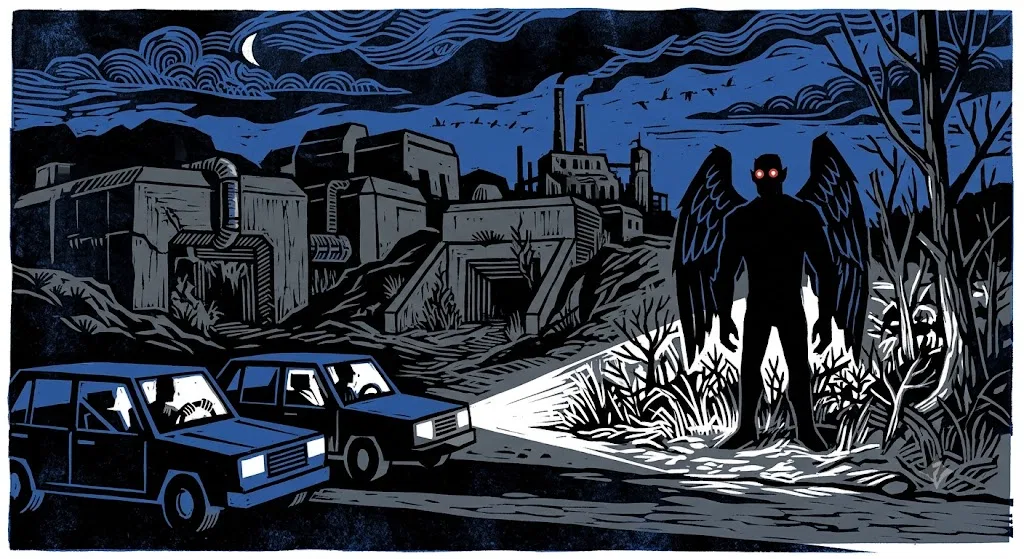
On the night of 15 November, Roger and Linda Scarberry and Steve and Mary Mallette were driving through the former West Virginia Ordnance Works north of Point Pleasant. Locally called the TNT area, the abandoned Second World War explosives complex contained disused buildings, concrete storage bunkers, ponds, woodland and the surrounding McClintic Wildlife Management Area. It was an ideal setting for an unsettling night-time encounter: isolated, visually confusing and rich in birds and other wildlife.[SHURA]shura.shu.ac.ukOpen source on shu.ac.uk.
The couples said they saw a large, man-like or bird-like figure near the old power plant. Early accounts described it as roughly six or seven feet tall, with wings and two prominent red eyes. They reported that it rose into the air and appeared to follow their car as they drove towards Point Pleasant, supposedly keeping pace even at high speed. Contemporary reporting emphasised the witnesses’ fear rather than treating the episode as a casual joke.[shu.ac.uk]shura.shu.ac.ukOpen source on shu.ac.uk.
The four went to the Mason County Sheriff’s Office, where they spoke to Deputy Millard Halstead. Halstead returned to the TNT area with them but found nothing unusual. That immediate contact with law enforcement is one of the strongest features of the case because it shows that an identifiable group made a prompt report and were sufficiently concerned to revisit the scene. It is not, however, equivalent to physical confirmation. The deputy did not see the reported figure, and the publicly discussed record consists chiefly of newspaper accounts, later interviews and reconstructions rather than a detailed surviving forensic case file.[SHURA]shura.shu.ac.ukOpen source on shu.ac.uk.
What the four-witness account adds
Four people in one car are better than a lone anonymous claimant, but they do not provide four fully independent observations. They shared the same setting, danger response and conversation, and may have reinforced one another’s interpretation while the event was unfolding. Once one person identified a roadside form as a threatening figure, the others were viewing it through the same emotional frame.
The apparent pursuit is especially difficult to assess. A flying bird illuminated intermittently by headlights can seem to remain beside or behind a moving vehicle, particularly on a road with bends and limited reference points. Estimates that the creature matched a car travelling at extremely high speed came from frightened occupants rather than from timed measurements, radar or a second observer positioned outside the car. The reported speed therefore expresses how the encounter felt, not a securely measured flight performance.[SHURA]shura.shu.ac.ukOpen source on shu.ac.uk.
Descriptions also became more definite in later retellings. The familiar image of a muscular humanoid with a ten-foot wingspan is partly a synthesis of several accounts rather than a precisely documented view shared in every detail by all four original witnesses. Contemporary language was less settled: reports used terms such as “bird-like”, “man-like thing”, “creature” and “something”, revealing uncertainty at the heart of the experience.[shu.ac.uk]shura.shu.ac.ukOpen source on shu.ac.uk.
What contemporary records say about the witnesses
The earliest newspaper coverage matters because it predates John Keel’s influential book, the Silver Bridge mythology and decades of films, festivals and internet retellings. The Point Pleasant story was already spreading nationally within days. A syndicated version appeared in newspapers across North America and even in Pacific Stars and Stripes, giving the encounter a much larger audience almost immediately.[SHURA]shura.shu.ac.ukOpen source on shu.ac.uk.
The contemporary coverage supports several basic points:
- the Scarberrys and Mallettes were named local witnesses rather than anonymous callers;
- they approached the sheriff’s office soon after the experience;
- law-enforcement personnel took the report seriously enough to return to the site;
- the witnesses appeared frightened and maintained that they had seen something unusual;
- officials did not find a creature, landing trace or other confirming object.
This supports sincerity more strongly than accuracy. A witness can be honest about an experience while being mistaken about distance, size, shape or speed. Fear, darkness, car movement and an unfamiliar animal can produce a confident but incorrect interpretation without deception.
Deputy Halstead was later quoted as believing that the young people had seen something, while withholding judgement about what it was. That is a sensible distinction. His confidence in their distress and good faith did not establish the nature of the stimulus. Contemporary officials also considered ordinary birds from the beginning, showing that a conventional explanation was not invented only decades later by sceptics.[shu.ac.uk]shura.shu.ac.ukOpen source on shu.ac.uk.
How the sighting wave developed
Further reports followed quickly after the first story appeared. Two volunteer firemen reportedly described a large bird with red eyes. Contractor Newell Partridge said that he had seen reflective eyes in a field near his home shortly before the couples’ encounter. Other Point Pleasant-area residents later described winged shapes, red lights or frightening figures, and Linda Scarberry said she experienced additional sightings. West Virginia’s state encyclopedia summarises the recognised wave as 26 reports over roughly a year, although broader popular claims of more than 100 witnesses largely derive from John Keel’s own collection and are not supported by 100 equally detailed, independent contemporary records.[wvencyclopedia.org]wvencyclopedia.orgWest Virginia EncyclopediaMothman22 Feb 2024 — Persistent sightings began in November 1966, and totaled 26 over a one-year span. The repo…
The reports should not be treated as one uniform body of evidence. They included close and distant views, daylight and night-time observations, single witnesses and groups, and descriptions ranging from an oversized bird to a humanoid figure. Some were reported promptly; others entered the literature through interviews conducted much later. A tally alone can therefore mislead. Twenty-six uncertain accounts do not necessarily provide 26 confirmations of the same object.
The location also became a destination for curious visitors almost at once. People drove into the TNT area hoping to see the creature, a practice folklorists call a “legend trip”. This created poor conditions for clean evidence gathering. Later observers arrived primed to interpret ordinary lights, birds and sounds as part of the Mothman wave, while pranksters gained an audience. The growth of reports after intense publicity may reflect a mixture of genuine misidentification, expectation, repetition and occasional hoaxing rather than repeated encounters with one extraordinary being.[journalofscientificexploration.org]journalofscientificexploration.orgJournal of Scientific Exploration DALY WORKING GALLEY.inddJournal of Scientific Exploration DALY WORKING GALLEY.indd
Why the red eyes are less decisive than they seem
Glowing red eyes became the defining feature of Mothman, but “glowing” does not necessarily mean that the eyes produced light. Many nocturnal animals show eyeshine when light enters the eye and reflects back towards the observer. Headlights or torches can make two points of reflected light appear intensely bright while concealing the rest of the animal.
An owl is therefore a serious candidate for at least some reports. The TNT area was surrounded by a wildlife management area and bird habitat. Sceptical investigator Joe Nickell noted that a snowy owl shot locally during the scare had a wingspan approaching five feet and was described in newspapers as a “giant owl”. A large owl launching from a low perch can briefly present a broad, apparently headless or humanoid silhouette, especially when its body is hidden by darkness and its eyes dominate the view.[SHURA]shura.shu.ac.ukOpen source on shu.ac.uk.
Owls do not reproduce every detail of the first account. They are not six-foot standing humanoids, and a five-foot wingspan is smaller than the most dramatic estimates. Yet eyewitness size estimates made at night, through a windscreen and under stress are not dependable enough to rule out a bird merely because the reported dimensions were larger.
Red colouring around the eyes also led to the sandhill crane explanation. Within days, West Virginia University wildlife specialist Robert L. Smith told the local press that the descriptions might fit a crane: a tall bird with a broad wingspan and reddish facial skin. The important point is not that a specific crane was captured and identified—it was not—but that a large unfamiliar bird was considered biologically plausible at the time.[IUScholarWorks]scholarworks.iu.eduScholar WorksScholarWorks…
The crane theory has weaknesses. Sandhill cranes were unusual in the area, and the dimensions attributed to them in some 1966 newspaper reports were imprecise. A crane normally flies with visible wingbeats rather than gliding indefinitely without movement, and its long neck and legs should be noticeable during a clear view. More recent sceptical analysis has therefore argued that great blue herons or large owls may fit some West Virginia reports better than a single wandering crane. The safest conclusion is not that one species explains every sighting, but that local and migratory birds provide several credible sources of mistaken identification.[IUScholarWorks]scholarworks.iu.eduScholar WorksScholarWorks…
Why physical and sensor evidence remains weak
The central weakness of the Mothman case is not a lack of stories but a lack of independent traces. No accepted photograph from the 1966–67 wave shows the reported figure clearly. There is no authenticated film, biological specimen, feather, blood sample, track cast or damaged object that can be linked to an unknown flying animal. Searches of the TNT area did not produce a body or nesting site.
Nor is there strong sensor evidence. The case did not generate a verified radar track, aviation incident record or instrument reading matching the creature’s alleged movements. Reports of disturbed televisions, telephones or radios were anecdotal and occurred amid a wider mixture of UFO stories and paranormal claims. They were not recorded under controlled conditions, tied to a measured external source or independently reproduced.[SHURA]shura.shu.ac.ukOpen source on shu.ac.uk.
The absence of traces does not prove that every witness imagined the event. A fleeting sighting of a bird would normally leave no recoverable evidence. It does, however, weigh heavily against claims that a large unknown species repeatedly occupied the same limited area for more than a year. A breeding population of giant flying creatures should be expected to leave more than memories: remains, droppings, feeding signs, repeated daylight observations or clear photographs.
The abandoned industrial setting sometimes encourages claims that Mothman was linked to secret military activity. The TNT area had indeed been part of a wartime explosives facility, but by 1966 it was largely disused and embedded in a wildlife area. No reliable document connects the sightings to an active experiment, military aircraft programme or weapons test. The site’s history made the story more atmospheric; it did not provide evidence for a government-created creature or covert aerospace event.[SHURA]shura.shu.ac.ukOpen source on shu.ac.uk.
Did later investigation strengthen the case?
John Keel’s fieldwork preserved names, narratives and local detail that might otherwise have disappeared. He visited Point Pleasant in December 1966, interviewed witnesses, met Deputy Halstead and worked closely with local reporter Mary Hyre. His records remain important to the history of the case.[SHURA]shura.shu.ac.ukOpen source on shu.ac.uk.
At the same time, Keel widened the subject far beyond the original winged-creature reports. His later account incorporated UFO lights, mysterious telephone calls, “men in black”, prophecies, poltergeist-like incidents and the collapse of the Silver Bridge. These connections relied primarily on anecdote and interpretation rather than demonstrated physical links. As Keel became personally immersed in the events, the boundary between reporter, participant and theorist became less clear.[SHURA]shura.shu.ac.ukOpen source on shu.ac.uk.
Later popular culture weakened evidential clarity further. The 2002 film portrayed Mothman as an omen of disaster and helped spread claims that similar beings appeared before events elsewhere. Folklore research has shown that some supposed international precedents, including stories attached to Chernobyl, entered circulation through later media rather than through reliable pre-disaster documentation. The film also implied that the Silver Bridge collapse remained unexplained, although engineering investigation traced it to the failure of an eyebar in the suspension chain.[SHURA]shura.shu.ac.ukOpen source on shu.ac.uk.
This does not discredit the Scarberry-Mallette witnesses. It shows why later material cannot automatically be used to corroborate them. Each new layer—Keel’s paranormal theory, the bridge-omen narrative, the film and modern internet sightings—changed the meaning of the original encounter without adding decisive physical evidence to it.
What did Point Pleasant witnesses probably see?
No single explanation can be demonstrated for every report. The initial witnesses may have encountered a large bird at close range, misjudged through darkness, motion and fear. Other people may have seen owls, herons, cranes, distant aircraft lights or unrelated objects after the story primed the community to notice anything unusual. Some later reports may have been embellishments or pranks. These possibilities can coexist.
The evidence supports three graded conclusions:
Well supported: Four identifiable local residents had a frightening experience near the TNT area, reported it promptly and persuaded a deputy that they were sincerely alarmed.
Plausible but unproved: At least some reports began with real animals or lights that observers could not identify under difficult conditions. Large birds and eyeshine explain several recurring features without requiring an unknown creature.
Not established: That one six- or seven-foot winged humanoid repeatedly appeared around Point Pleasant, flew at motorway speeds, caused electrical disturbances, arrived with UFOs or warned of the Silver Bridge collapse.
Within West Virginia’s UFO history, Mothman matters because it shows how a credible report of an ambiguous event can expand into a much broader phenomenon. Witness sincerity gave the story its foundation; the evocative TNT landscape, rapid press coverage and later paranormal interpretation gave it permanence. What remains unresolved is the exact stimulus behind the strongest observations. What remains unsupported is the extraordinary identity later assigned to it.
Amazon book picks
Further Reading
Books and field guides related to What Did Point Pleasant Witnesses Actually See?. Use these as the next step if you want deeper reading beyond the article.
The Mothman Prophecies
Rating: 4.5/5 from 6 Google Books ratings
Primary book associated with the Point Pleasant sightings.
eBay marketplace picks
Marketplace Samples
Live-tested eBay searches with available results related to this page.
Selected fromMothman t shirt oneBay.co.uk.


Endnotes
1.
Source: shura.shu.ac.uk
Link:https://shura.shu.ac.uk/24606/3/Clarke_Mothman_Of_West%28AM%29.pdf
2.
Source: newspapers.com
Title: Point Pleasant
Link:https://www.newspapers.com/article/115993346/point-pleasant-nov-17-1966-sighting/
Source snippet
Nov 17 1966 SightingClipping found in Beckley Post-Herald published in Beckley, West Virginia on 11/17/1966... 'Moth Man' Sighted POINT...
3.
Source: history.com
Title: a year in history
Link:https://www.history.com/a-year-in-history/1966
4.
Source: wvencyclopedia.org
Link:https://www.wvencyclopedia.org/entries/1369
Source snippet
West Virginia EncyclopediaMothman22 Feb 2024 — Persistent sightings began in November 1966, and totaled 26 over a one-year span. The repo...
Published: November 1966
5.
Source: scholarworks.iu.edu
Title: Scholar Works
Link:https://scholarworks.iu.edu/journals/index.php/cl/article/download/41747/44362/128005
Source snippet
ScholarWorks...
6.
Source: folklife.si.edu
Link:https://folklife.si.edu/magazine/mothman-point-pleasant-west-virginia
Source snippet
Smithsonian FolklifeAn Ode to a Hometown Creature: Mothman of Point...6 Jun 2021 — a bipedal, humanoid, mothlike creature with glowing eyes...
7.
Source: journalofscientificexploration.org
Title: Journal of Scientific Exploration DALY WORKING GALLEY.indd
Link:https://journalofscientificexploration.org/index.php/jse/article/view/2599/1841
8.
Source: Wikipedia
Link:https://en.wikipedia.org/wiki/Mothman
Source snippet
MothmanIn American folklore, Mothman is the name given to a humanoid creature that was reportedly seen around Point Pleasant, West Vir...
9.
Source: cryptidz.fandom.com
Link:https://cryptidz.fandom.com/wiki/Mothman
10.
Source: absolutehorror.fandom.com
Link:https://absolutehorror.fandom.com/wiki/Mothman
11.
Source: cryptozoologycryptids.fandom.com
Link:https://cryptozoologycryptids.fandom.com/wiki/Mothman
12.
Source: fallout.fandom.com
Link:https://fallout.fandom.com/wiki/Mothman
13.
Source: darrahsteffenwrites.wordpress.com
Title: the mothman
Link:https://darrahsteffenwrites.wordpress.com/2022/01/24/the-mothman/
14.
Source: 2020.soulofathens.com
Link:https://2020.soulofathens.com/lore-of-appalachia/mothman.html
15.
Source: journal.equinoxpub.com
Link:https://journal.equinoxpub.com/FIR/article/view/14342
16.
Source: janeway.uncpress.org
Link:https://janeway.uncpress.org/capstone/article/2453/galley/2954/download/
17.
Source: ebsco.com
Link:https://www.ebsco.com/research-starters/social-sciences-and-humanities/mothman
Additional References
18.
Source: youtube.com
Link:https://www.youtube.com/watch?v=Ta2TSlrpFRQ
Source snippet
Mothman Mystery: Eyewitnesses, Fear and the Unexplained | Full Documentary...
19.
Source: dtc-wsuv.org
Link:https://dtc-wsuv.org/rsegura22/miniproject-1/
20.
Source: facebook.com
Link:https://www.facebook.com/PBSDigitalStudios/videos/mothman-americas-notorious-winged-monster/663936454136838/
21.
Source: instagram.com
Link:https://www.instagram.com/reel/DWrA52tiX2y/?hl=en
22.
Source: facebook.com
Link:https://www.facebook.com/NatGeoTV/videos/legends-of-the-mothman-have-circulated-in-west-virginia-for-decades-with-the-cry/1298489072190578/
23.
Source: mothmanmuseum.com
Link:https://www.mothmanmuseum.com/
24.
Source: reddit.com
Link:https://www.reddit.com/r/Cryptozoology/comments/a7ufxz/mothmanso_what_was_it/
25.
Source: jstor.org
Link:https://www.jstor.org/stable/j.ctv296mnsz
26.
Source: facebook.com
Link:https://www.facebook.com/TheFolklorePodcast/posts/today-november-16th-is-the-anniversary-of-the-first-newspaper-report-detailing-a/1328382092636041/
27.
Source: facebook.com
Link:https://www.facebook.com/FOX28COLUMBUS/posts/two-young-couples-in-the-small-town-of-point-pleasant-west-virginia-saw-somethin/1406742961488965/