Within South Dakota UFOs
What Did Blue Book Find in South Dakota?
Blue Book logged dozens of South Dakota reports, but most were explained, poorly documented or left without enough information for a firm judgement.
On this page
- The scale and geography of the case files
- How reports were classified
- Why the archive remains difficult to interpret
Page outline Jump by section
Introduction
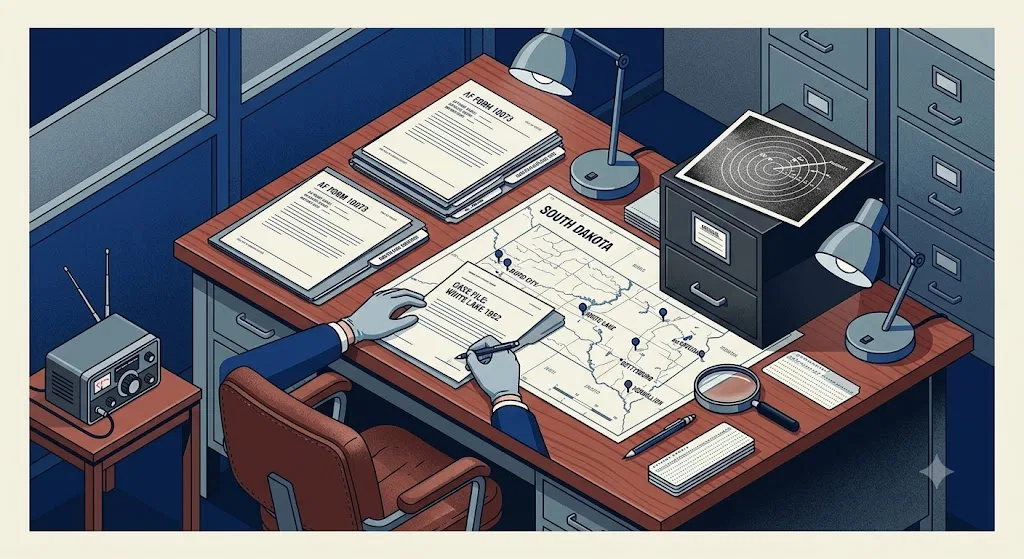
Project Blue Book’s South Dakota record is sizeable but far less dramatic than the phrase “official UFO files” may suggest. Historian Leland H. Larsen identified 35 South Dakota sighting studies in the surviving Air Force material. Most ended as aircraft, balloons, meteors, stars or other conventional objects; several were filed as “insufficient data”; and Larsen found only one case officially marked “unidentified”. The files therefore document a real pattern of unusual reports across the state, but they do not provide official confirmation of an extraordinary aircraft.[South Dakota Historical Society Press]sdhspress.comSouth Dakota Historical Society Press
What makes the record important is not simply its unexplained remainder. Blue Book was South Dakota’s principal official reporting system during the 1950s and 1960s, drawing in accounts from civilians, airmen, airline crews, radar stations and the Ground Observer Corps. Yet its investigations varied sharply in quality. Some cases received technical attention; others survived as little more than a summary card and a short military message. The archive is consequently useful as a history of what people reported and how the Air Force governed uncertainty, but much less reliable as a clean scientific dataset.[South Dakota Historical Society Press]sdhspress.comSouth Dakota Historical Society Press
The scale and geography of the case files
The 35 South Dakota cases examined by Larsen formed part of a wider group of roughly 250 Blue Book reports from Kansas, Nebraska and the Dakotas. Across that regional sample, he counted 70 astronomical explanations, 40 “insufficient data” decisions and 11 officially unidentified reports. South Dakota contributed only one of those formal unknowns, although several other state cases could not be firmly resolved.[South Dakota Historical Society Press]sdhspress.comSouth Dakota Historical Society Press
The state files were not confined to one supposed hotspot. Reports came from the Black Hills and Rapid City area, but also from eastern, central and reservation communities. Named locations in the surviving cases include White Lake, Hecla, Gettysburg, Watertown, Vermillion, Pine Ridge, Watauga, Lead, Deadwood and areas near Garretson. This spread is best understood as the reach of the reporting network rather than evidence of a single phenomenon travelling repeatedly across South Dakota. Military bases, air routes, local police, civilian observers and Ground Observer Corps posts all provided possible routes into the federal system.[South Dakota Historical Society Press]sdhspress.comSouth Dakota Historical Society Press
Rapid City and Ellsworth Air Force Base appear repeatedly because the area combined aircraft operations, military intelligence personnel and air-defence facilities. Reports from trained observers could move quickly through official channels, even when the eventual explanation was ordinary. In July 1954, for example, an Ellsworth air controller noticed a large, star-like object apparently moving near the ground, prompting fighters to be sent up. The object was ultimately identified as a fixed beacon viewed through haze. The episode shows why the archive cannot be read merely as a tally of strange objects: a single mistaken perception could trigger a genuine military response and generate a substantial-looking file.[South Dakota Historical Society Press]sdhspress.comSouth Dakota Historical Society Press
South Dakota’s record also extends beyond Blue Book’s formal 1952–69 lifespan because the archive absorbed material from its predecessor programmes, Project Sign and Project Grudge. Larsen therefore included an August 1947 report from an Air Force intelligence officer at Weaver, who described 12 yellow and white objects in a tight diamond formation. An Air Force consultant attributed them to migrating birds. Whether that explanation was correct cannot now be demonstrated from the thin surviving description, but the case illustrates how early reports were retrospectively incorporated into the Blue Book record.[South Dakota Historical Society Press]sdhspress.comSouth Dakota Historical Society Press
How the Air Force classified South Dakota reports
Blue Book placed reports under three broad headings: identified, insufficient data and unidentified. “Identified” did not always mean that an object had been positively matched to a particular aircraft, balloon or star. It could also mean that an evaluator considered one conventional explanation sufficiently likely. “Insufficient data” meant that essential information was missing, while “unidentified” was reserved for cases that could not be fitted convincingly to a known object or phenomenon.[esd.whs.mil]esd.whs.milProject Blue BookSeptember 25, 2012 — The Air Force groups its evaluations of UFO reports under three general headings: (1) identified, (2) insufficient d…
That distinction is essential when reading the South Dakota files. An unidentified case was not an Air Force finding that an exotic craft had been observed. Nationally, Blue Book recorded 12,618 reports and left 701 unidentified, but the Air Force maintained that none demonstrated a national-security threat, technology beyond contemporary scientific knowledge or an extraterrestrial vehicle. An “unknown” was therefore an unresolved report within the programme’s classification system, not a conclusion about the object’s origin.[National Archives]archives.govNational Archives Project BLUE BOOKNational ArchivesProject BLUE BOOK - Unidentified Flying Objects | National Archives…
Ordinary explanations dominated
Several South Dakota cases show the kinds of objects that entered the system:
- A large sphere above Hecla on 30 June 1948 was traced to a research balloon launched from Camp Ripley in Minnesota.
- A white ball reported over Rapid City in December 1957 was associated with a meteor display.
- A star seen through atmospheric conditions accounted for a September 1958 Rapid City report.
- Contrails from two B-52 bombers explained an October 1961 observation by five airmen near Gettysburg.
- Blinking aircraft lights were blamed for a May 1966 report from the University of South Dakota at Vermillion.
- A passenger aeroplane explained the coloured flashing lights reported by a teenager on the Pine Ridge Reservation in May 1969, the last upper Great Plains case discussed by Larsen.[South Dakota Historical Society Press]sdhspress.comSouth Dakota Historical Society Press
These examples do not show that every explanation was correct. They do show that Blue Book received a great deal of material produced by familiar but easily misperceived objects. Distance, haze, darkness and the absence of a fixed visual reference can make stars appear to move, aircraft lights seem stationary and distant objects look far larger or faster than they are.
Meteors were another frequent answer, sometimes on strong grounds and sometimes on weaker ones. A brilliant blue light that illuminated the flight decks of several airliners over South Dakota in February 1965 was classified as a meteor. A green object reported over Watertown the following month received the same explanation, although the witness argued that its apparent speed, angle and duration were inconsistent with a meteor. The disagreement cannot now be settled from the summary alone, but it demonstrates the difference between a plausible identification and a verified one.[South Dakota Historical Society Press]sdhspress.comSouth Dakota Historical Society Press
“Insufficient data” was not the same as mysterious
Several reports remained unresolved because the files lacked basic observational information. On 2 September 1952, two B-36 flight engineers at Ellsworth described lights moving slowly in a circular pattern. The evaluator found that too little was known to identify them. In March 1957, two airmen near Rapid City reported coloured rays forming a slowly moving circular pattern; a note suggested the aurora, but the final decision was insufficient information.[South Dakota Historical Society Press]sdhspress.comSouth Dakota Historical Society Press
A June 1960 report near Lead followed the same pattern. An airman said that he watched a large, multicoloured, flashing object for about half an hour. The consultant considered an astronomical object distorted by atmospheric conditions likely, but the report lacked its elevation and compass direction. Without those measurements, the evaluator could not test the proposed identification against the positions of stars or planets.[South Dakota Historical Society Press]sdhspress.comSouth Dakota Historical Society Press
Such cases can sound impressive when retold without the classification details. In reality, “insufficient data” often means precisely what it says: the record does not contain enough information to establish either an ordinary explanation or an extraordinary one. It is evidence of an incomplete investigation, not evidence that the reported object resisted a thorough technical analysis.
South Dakota’s single official unknown
Larsen’s review found that Blue Book formally classified only one South Dakota report as unidentified: Case 2089 at White Lake in 1952. A Ground Observer Corps member described a stick- or cigar-like object that periodically emitted smoke or vapour. It reportedly remained visible for about 30 minutes before departing rapidly towards the west. The file was marked “Secret”, reflecting the possible defence significance attached to an unknown aerial object during the early Cold War.[South Dakota Historical Society Press]sdhspress.comSouth Dakota Historical Society Press
Even this basic entry reveals an archival problem. Larsen dated the White Lake sighting to 14 August 1952, but later lists derived from Blue Book’s index give 14 September 1952 for the same case number. The September date appears in several independent case compilations, suggesting that Larsen may have misread or mistyped the month, although consulting the complete original file would be necessary to establish the chronology beyond doubt.[nicap.org]nicap.orgComplete List of Project Blue Book's Unsolved Cases 1870 August 9, 1952 Lake Charles AFB, Louisiana… 2089 September 14, 1952 Whit…
The description was unusual enough to resist Blue Book’s standard explanations, but the evidence remains limited. There is no publicly established photograph, radar track, recovered material or independent set of measurements associated with the case. Larsen suggested that the witness might conceivably have seen a missile that had strayed from its course, but treated that only as a possibility. The honest conclusion is narrower: an observer made a detailed report, the Air Force could not identify the object from the information available, and the surviving record does not determine what it was.[South Dakota Historical Society Press]sdhspress.comSouth Dakota Historical Society Press
The “Secret” marking should also be interpreted carefully. During the Cold War, secrecy could reflect concern about unidentified aircraft, reporting procedures, radar capabilities or intelligence sources. It does not by itself indicate that officials possessed evidence of an extraordinary vehicle. Blue Book existed partly because unexplained aerial reports might represent hostile aircraft, missiles or surveillance systems; classification was therefore a normal feature of military handling.[Pieces of History]prologue.blogs.archives.govPieces of History Saucers Over Washington: the History of Project Blue BookPieces of History Saucers Over Washington: the History of Project Blue Book
Why some official explanations remain debatable
Larsen’s central criticism was not that every South Dakota identification was wrong, but that the evidential standard varied from case to case. He found that a file frequently consisted only of a Project 10073 record card and a one-page telex. Witnesses were rarely asked to complete the longer eight-page technical form covering direction, elevation, apparent size, weather and other details needed for serious analysis.[South Dakota Historical Society Press]sdhspress.comSouth Dakota Historical Society Press
That weakness can be seen in several identified cases. In August 1958, witnesses at Rapid City described a round or disc-shaped object moving straight and level before disappearing southwards. Blue Book called it an aircraft turning in sunlight, although the available summary offers little information with which to test that conclusion. Near Deadwood in January 1959, a forest ranger reported a flickering object that seemed to tumble; the assessor suggested that clouds had created an illusion of motion and closed the case.[South Dakota Historical Society Press]sdhspress.comSouth Dakota Historical Society Press
At Watauga in July 1966, a retired Navy ordnance chief briefly observed round white lights moving vertically and sideways. Blue Book concluded that they were stars or planets. That answer is possible, particularly where atmospheric turbulence creates apparent movement, but Larsen noted that the recorded data scarcely demonstrated it. In other words, a reasonable hypothesis was sometimes entered as a settled classification.[South Dakota Historical Society Press]sdhspress.comSouth Dakota Historical Society Press
The reverse problem also occurred. Blue Book sometimes labelled reports insufficient even when a conventional explanation seemed likely, because the file lacked the information required to confirm it. The resulting categories therefore mix two separate questions:
- What did the witness probably see?
- Was enough information collected to demonstrate that identification?
Blue Book often answered the first through informed judgement while failing to document the second. That makes its final labels useful as investigative opinions, but unsafe to treat as precise scientific findings.

Why the archive remains difficult to interpret
The original Blue Book collection is extensive rather than tidy. The National Archives holds roughly two cubic feet of administrative files, 37 cubic feet of chronologically arranged case files and three cubic feet of Office of Special Investigations material. Access was organised through 94 rolls of microfilm, with photographs gathered separately on the final rolls. Witness names were removed from the publicly available textual records, protecting privacy but also limiting later efforts to assess testimony or locate follow-up interviews.[National Archives]archives.govNational Archives Project BLUE BOOKNational ArchivesProject BLUE BOOK - Unidentified Flying Objects | National Archives…
The record is also distributed across several related series, including administrative files, sanitised case files, unsanitised 1953–60 material, Air Force intelligence reports, artefacts, photographs, films and sound recordings. A location entry in the main index may therefore be only the starting point. Reconstructing a South Dakota incident can require comparison between the summary card, messages from a local base, weather and astronomical information, photographs and later administrative correspondence.[National Archives]archives.govOpen source on archives.gov.
Blue Book’s changing staff and priorities further complicate comparison. The project’s resources were limited, and investigations were initially conducted by intelligence officers at the nearest air base before being evaluated at Wright-Patterson Air Force Base. A 1966 advisory review described the programme as organised but noted that its central staff consisted of only one officer, one sergeant and a secretary. The same label could consequently emerge from very different levels of fieldwork.[South Dakota Historical Society Press]sdhspress.comSouth Dakota Historical Society Press
Later critics, including Blue Book’s long-serving astronomical consultant J. Allen Hynek, argued that the programme became a low-priority administrative and public-relations exercise rather than a sustained scientific investigation. Larsen reached a similarly critical view of the Great Plains files. That criticism is relevant, but it does not automatically convert weakly investigated reports into strong UFO cases. Poor analysis reduces confidence in both identifications and claims of anomaly; it widens uncertainty in both directions.[South Dakota Historical Society Press]sdhspress.comSouth Dakota Historical Society Press
What the South Dakota record actually establishes
South Dakota’s Blue Book files support three conclusions more firmly than any claim about extraordinary craft.
First, residents and military personnel reported a genuine variety of puzzling aerial observations over more than two decades. The witnesses included trained airmen and aviation professionals as well as civilians, but professional experience did not eliminate mistakes involving lights, distance, weather or astronomical objects.
Second, most cases were judged conventionally explainable. Balloons, aircraft, contrails, beacons, meteors and stars account for much of the surviving record. Some explanations are persuasive because they match a known object or event; others are merely plausible assessments recorded in files too thin for independent confirmation.[South Dakota Historical Society Press]sdhspress.comSouth Dakota Historical Society Press
Third, the difference between “unidentified” and “unresolved” is crucial. White Lake was South Dakota’s only formal Blue Book unknown in Larsen’s review, but several additional cases were left with insufficient information, and some official identifications remain debatable. None of those categories establishes an exotic origin. They instead reveal the limits of a reporting system designed partly for air defence, partly for intelligence screening and increasingly for administrative closure.[South Dakota Historical Society Press]sdhspress.comSouth Dakota Historical Society Press
The value of the archive lies in that tension. It weakens claims that South Dakota’s skies produced a large body of officially confirmed anomalies, because the overwhelming majority of reports were explained or poorly supported. At the same time, it prevents an equally simple dismissal. A handful of reports were never satisfactorily reconstructed, and the quality of investigation was sometimes too weak to justify Blue Book’s confidence. The state’s official record is therefore best read neither as proof nor as debunking, but as an uneven Cold War dataset in which ordinary objects, sincere mistakes and a small residue of unresolved observations were processed through the same bureaucracy.
eBay marketplace picks
Marketplace Samples
Live-tested eBay searches with available results related to this page.
Selected fromUFO metal sign oneBay.co.uk.




Endnotes
1.
Source: sdhspress.com
Title: South Dakota Historical Society Press
Link:https://www.sdhspress.com/journal/south-dakota-history-12-1/united-states-air-force-efforts-to-investigate-ufos-great-plains-encounters/vol-12-no-1-united-states-air-force-efforts-to-investigate-ufos.pdf
2.
Source: archives.gov
Title: National Archives Project BLUE BOOK
Link:https://www.archives.gov/research/military/air-force/ufos
Source snippet
National ArchivesProject BLUE BOOK - Unidentified Flying Objects | National Archives...
3.
Source: archives.gov
Link:https://www.archives.gov/news/articles/project-blue-book-50th-anniversary
Source snippet
After an extensive interagency partnership between the two entities to redact personally identifiable information from Blue Book case fil...
4.
Source: esd.whs.mil
Title: Project Blue Book
Link:https://www.esd.whs.mil/Portals/54/Documents/FOID/Reading%20Room/UFOsandUAPs/proj_b1.pdf?ver=2017-05-22-113513-837
Source snippet
September 25, 2012 — The Air Force groups its evaluations of UFO reports under three general headings: (1) identified, (2) insufficient d...
Published: September 25, 2012
5.
Source: nicap.org
Link:https://www.nicap.org/bluebook/bluelist.htm
Source snippet
Complete List of Project Blue Book's Unsolved Cases 1870 August 9, 1952 Lake Charles AFB, Louisiana... 2089 September 14, 1952 Whit...
Published: August 9, 1952
6.
Source: theblackvault.com
Title: Project Blue Book Unknown Case Files, Complete List
Link:https://www.theblackvault.com/casefiles/project-blue-book-unknown-case-files-complete-list/
Source snippet
3:35 p.m.... Three blue-white lights hovered then... 14, 1952; White Lake, South Dakota. 7 p.m...
7.
Source: prologue.blogs.archives.gov
Title: Pieces of History Saucers Over Washington: the History of Project Blue Book
Link:https://prologue.blogs.archives.gov/2019/12/19/saucers-over-washington-the-history-of-project-blue-book/
8.
Source: archives.gov
Link:https://www.archives.gov/research/topics/uaps/rg-collections
9.
Source: archives.gov
Link:https://www.archives.gov/research/catalog/catalog-bulk-downloads/uap-bulk-download
10.
Source: dn721804.ca.archive.org
Title: Bad UFOs critical thinking about UFO claims
Link:https://dn721804.ca.archive.org/0/items/bad-ufos/Bad%20UFOs%20-%20critical%20thinking%20about%20UFO%20claims.pdf
11.
Source: archive.org
Title: Brad Sparks Comprehensive Catalog of 1,600 Project Blue Book UFO Unknowns
Link:https://archive.org/download/BernardSieglerTechnicsAndTime1TheFaultOfEpimetheus/Brad%20Sparks%20-%20Comprehensive%20Catalog%20of%201%2C600%20Project%20Blue%20Book%20UFO%20Unknowns.pdf
12.
Source: nicap.org
Title: The Project Bluebook “Unknowns”
Link:https://www.nicap.org/bluebook/unknowns.htm
13.
Source: history.navy.mil
Link:https://www.history.navy.mil/research/library/online-reading-room/title-list-alphabetically/u/u2s-ufos-and-operation-blue-book.html
14.
Source: sdhspress.com
Link:https://www.sdhspress.com/journal/south-dakota-history-51-4/volume-51-index/5104_vol-51-index.pdf
15.
Source: sdhspress.com
Title: vol 35 no 3 a splendid service
Link:https://www.sdhspress.com/journal/south-dakota-history-35-3/a-splendid-service-the-south-dakota-free-library-commission-in-the-1930s/vol-35-no-3-a-splendid-service.pdf
16.
Source: sdhspress.com
Title: cumulative index web copy
Link:https://www.sdhspress.com/journal/south-dakota-history-41-1/cumulative-index/cumulative-index-web-copy.pdf
17.
Source: sdhspress.com
Title: vol 09 no 2 war balloons over the prairie
Link:https://www.sdhspress.com/journal/south-dakota-history-9-2/war-balloons-over-the-prairie-the-japanese-invasion-of-south-dakota/vol-09-no-2-war-balloons-over-the-prairie.pdf
18.
Source: sdhspress.com
Title: 4604 mcintyre
Link:https://www.sdhspress.com/journal/south-dakota-history-46-4/fraternity-charity-and-loyalty-the-grand-army-of-the-republic-and-the-dakota-soldiers-home/4604_mcintyre.pdf
19.
Source: sdhspress.com
Link:https://www.sdhspress.com/journal/south-dakota-history-44-1/yankton-portrait-of-a-river-city/yankton-portrait-of-a-city_4401_text_final.pdf
20.
Source: history.sd.gov
Link:https://history.sd.gov/archives/
21.
Source: Wikipedia
Title: Project Blue Book
Link:https://en.wikipedia.org/wiki/Project_Blue_Book
22.
Source: satyori.com
Title: project blue book
Link:https://satyori.com/suppressed-history/project-blue-book/
23.
Source: vocal.media
Title: Project Blue Book | Futurism
Link:https://vocal.media/futurism/project-blue-book
24.
Source: geekchocolate.co.uk
Title: project blue book
Link:https://geekchocolate.co.uk/project-blue-book/
Additional References
25.
Source: sdhsf.org
Title: august 2021 is it an airplane star or flying saucer
Link:https://www.sdhsf.org/news_events/history_articles.html/title/august-2021-is-it-an-airplane-star-or-flying-saucer-
Source snippet
Monthly History Article | Read about South Dakota History## August 2021-Is it an airplane, star or flying saucer?... South Dakota is kno...
Published: august 2021
26.
Source: youtube.com
Title: The UFO Experience: Evidence Behind Close… by J. Allen Hynek · Audiobook preview
Link:https://www.youtube.com/watch?v=CI-fYo3V94M
Source snippet
Ep. 6: Blue Book: The Rise | Ruppelt, Battelle, and the Washington UFO Wave of 1952...
27.
Source: youtube.com
Title: The Report on Unidentified Flying Objects By Edward Ruppelt. FULL Audiobook
Link:https://www.youtube.com/watch?v=DNh7iHsx6g8
Source snippet
The UFO Experience: Evidence Behind Close… by J. Allen Hynek · Audiobook preview...
28.
Source: youtube.com
Link:https://www.youtube.com/watch?v=xBytbIzJMiU
Source snippet
BD-0120 Lt Col Robert J Friend Project Blue Book...
29.
Source: nsa.gov
Link:https://www.nsa.gov/portals/75/documents/news-features/declassified-documents/ufo/usaf_fact_sheet_95_03.pdf
30.
Source: sdhsf.org
Link:https://www.sdhsf.org/news_events/history_articles.html/title/april-2019-lucky-lindy-visits-south-dakota
31.
Source: sdhsf.org
Link:https://www.sdhsf.org/news_events/history_articles.html/title/october-2021-the-march-king-conquers-south-dakota
32.
Source: medium.com
Link:https://medium.com/illumination/project-blue-book-unidentified-unexplained-or-misunderstood-0a9524ba3664
33.
Source: theprojectbluebookarchive.org
Link:https://theprojectbluebookarchive.org/
34.
Source: theprojectbluebookarchive.org
Link:https://theprojectbluebookarchive.org/archive/