Within Birds
Which Giant Bird Best Fits Mothman Reports?
Great blue herons may fit some Point Pleasant reports better than rare sandhill cranes, especially where glowing eyes were not described.
On this page
- Why sandhill cranes became the leading bird theory
- Why great blue herons better match the local habitat
- Which witness details each species fails to explain
Page outline Jump by section
Introduction
Among the natural explanations proposed for the Point Pleasant Mothman reports of 1966–67, the sandhill crane has become the best-known candidate. Yet it is not the only large bird that deserves consideration. Some researchers have argued that great blue herons fit parts of the witness testimony better, particularly in reports that lack the famous glowing red eyes. The debate matters because it shows that there is no single “bird explanation” for every Mothman sighting. Different reports describe different sizes, shapes and behaviours, and the most plausible species may vary from case to case.
Rather than asking whether Mothman was “really” a crane or a heron, the better historical question is which bird most closely matches particular eyewitness descriptions under the lighting and environmental conditions reported around Point Pleasant. The evidence suggests that sandhill cranes explain some features well, while great blue herons may better match the local habitat and several physical descriptions. Neither species accounts for every reported detail.[Skeptical Inquirer]skepticalinquirer.orgOpen source on skepticalinquirer.org.
Why sandhill cranes became the leading bird theory
The sandhill crane entered the Mothman story almost immediately after the first newspaper reports. In December 1966, West Virginia University wildlife biologist Robert L. Smith suggested that witnesses might have encountered a wandering sandhill crane rather than an unknown creature. The proposal gained attention because the species possesses several striking characteristics:
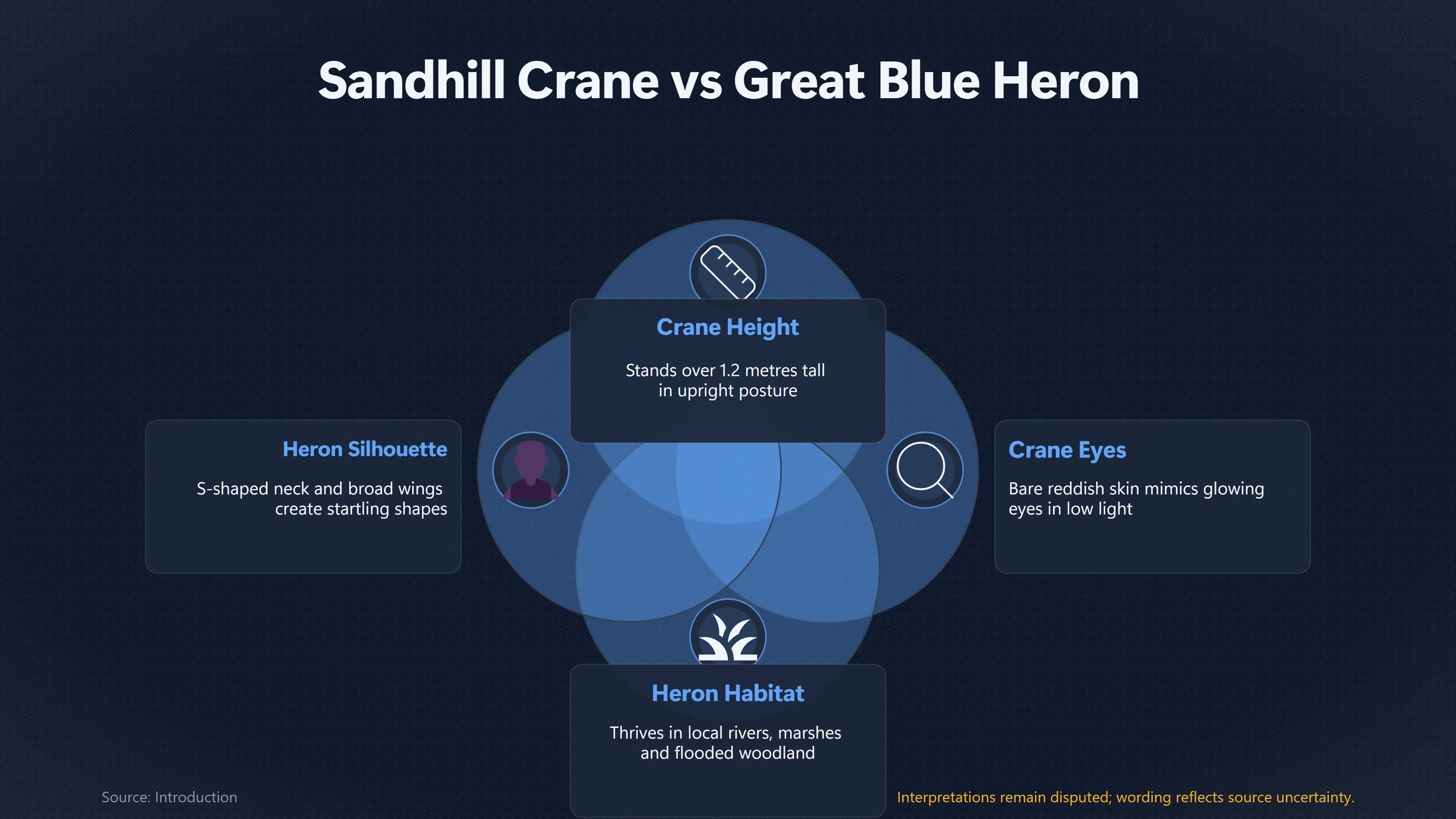
- It can stand over 1.2 metres (about 4 feet) tall.
- Its wingspan approaches 2 metres (over 6 feet).
- It has bare reddish skin around the eyes that could be mistaken for unusually coloured eyes in poor light.
- An unexpected encounter at night could make the bird appear larger than it really is.[Skeptical Inquirer]skepticalinquirer.orgOpen source on skepticalinquirer.org.
The crane theory also appealed because it required no supernatural explanation. Witnesses around the abandoned TNT area were often viewing unfamiliar shapes at night, sometimes from moving vehicles, where estimating height and distance is notoriously unreliable.
However, the theory has always faced an important limitation. Sandhill cranes were uncommon visitors to West Virginia in the mid-1960s. Although they are now recorded occasionally within the state, historical records suggest they were rare strays rather than regular residents. Modern migration studies likewise show that the principal migration routes lie well west of West Virginia, although individual birds can wander outside the normal range.[Skeptical Inquirer]skepticalinquirer.orgOpen source on skepticalinquirer.org.
Why great blue herons better match the local habitat
Some later sceptical researchers have argued that the great blue heron deserves more attention than the crane because it is a familiar bird in the wetlands surrounding Point Pleasant.
The landscape around the former TNT area contains rivers, marshes, ponds and flooded woodland—exactly the habitats favoured by great blue herons. Unlike a wandering crane, a heron would not require an unusual migration event to explain repeated encounters over many months. A local population could produce multiple sightings in suitable habitat.[Skeptical Inquirer]skepticalinquirer.orgOpen source on skepticalinquirer.org.
Great blue herons also possess several features that can look startling under poor viewing conditions:
- Their long legs can create the impression of an unusually tall animal when standing upright.
- They often fold their neck into an S-shape, making the head appear to sit directly on the shoulders and reducing the obvious long-necked profile many people expect.
- Their broad wings appear unexpectedly large during take-off.
- Their grey-blue plumage can become a dark silhouette at dusk or in headlights.
These characteristics arguably fit reports describing a tall, dark figure standing near roads or water more naturally than the crane does, particularly where witnesses never mentioned brilliant red eyes.
Which witness details each species fails to explain
Neither bird matches every element of the Mothman reports. The comparison is strongest when individual reports are separated rather than treated as one single event.
Reported featureSandhill craneGreat blue heronExceptional heightStrong matchModerate matchLarge wingsStrong matchStrong matchWetland habitatPossible but uncommon locallyVery strong matchRed colouring around eyesStrong matchWeak matchRegular presence near Point PleasantWeak in 1966StrongMultiple sightings over many monthsRequires repeated rare visitorsEasier to explain through resident birds
The famous glowing red eyes illustrate the problem well. Although the crane’s bare red facial skin has often been cited as the key explanation, later reviews of the original reports suggest that vivid glowing eyes were not described consistently across the entire wave. Some accounts omitted them altogether, while others appeared only in later retellings. If glowing eyes were absent in a particular report, the crane’s main identifying advantage becomes much less significant.[Skeptical Inquirer]skepticalinquirer.orgOpen source on skepticalinquirer.org.
Conversely, the heron struggles to explain reports describing intensely luminous red eyes. Great blue herons lack the conspicuous red facial patches that inspired the original crane hypothesis, although reflected light from animal eyes can sometimes appear bright under artificial illumination.
Why no single bird explains every Mothman report
The historical record is more varied than popular retellings often suggest. Witnesses reported different colours, different flight behaviour, different heights and different viewing distances over more than a year of sightings. Some descriptions resemble large birds more closely than others.
Researchers such as Joe Nickell have therefore argued that several ordinary animals—including barred owls as well as larger birds—may account for different encounters rather than assuming every witness saw the same thing. More recent comparative analyses similarly conclude that some reports are better matched by cranes, others by herons, and still others by owls depending on the original description and viewing conditions.[Skeptical Inquirer]skepticalinquirer.orgSkeptical Inquirer Mothman Revisited: Investigating on Site | Skeptical InquirerSkeptical Inquirer Mothman Revisited: Investigating on Site | Skeptical Inquirer
This approach also fits the circumstances of the sightings. The TNT area combined abandoned industrial structures, woodland, wetlands and open water, creating habitat for a variety of large birds. Different witnesses visiting different locations on different nights need not have encountered the same species.

What the comparison means for West Virginia UFO lore
Within the wider history of West Virginia’s unexplained sightings, the heron-versus-crane debate demonstrates why careful case-by-case analysis matters. The goal is not to dismiss witnesses but to compare each report with realistic local wildlife before reaching more extraordinary conclusions.
The sandhill crane remains the most famous natural explanation because of its impressive size and reddish facial markings. Yet the great blue heron arguably fits the Point Pleasant environment better and may provide a stronger explanation for sightings in which glowing eyes played little or no role. Taken together, the evidence suggests that bird misidentification is best viewed as a collection of species-specific explanations rather than a single solution to every Mothman report.
Amazon book picks
Further Reading
Books and field guides related to Which Giant Bird Best Fits Mothman Reports?. Use these as the next step if you want deeper reading beyond the article.
The Sibley Guide to Birds
Lets readers compare sandhill cranes, herons and other large birds.
The Mothman Prophecies
Rating: 4.5/5 from 6 Google Books ratings
Provides the original account that later bird-identification theories seek to explain.
National Geographic Field Guide to the Birds of North America
Covers the species most often suggested in Mothman explanations.
eBay marketplace picks
Marketplace Samples
Live-tested eBay searches with available results related to this page.
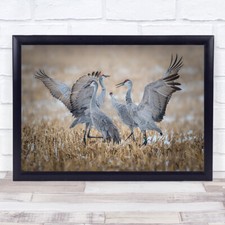
Selected fromsandhill crane print oneBay.co.uk.

Endnotes
1.
Source: skepticalinquirer.org
Link:https://skepticalinquirer.org/2022/06/the-mothman-and-the-crane-a-contemporary-perspective/
2.
Source: skepticalinquirer.org
Title: Skeptical Inquirer Mothman Revisited: Investigating on Site | Skeptical Inquirer
Link:https://skepticalinquirer.org/newsletter/mothman-revisitedinvestigating-on-site/
3.
Source: Wikipedia
Title: Sandhill crane
Link:https://en.wikipedia.org/wiki/Sandhill_crane
4.
Source: Wikipedia
Link:https://en.wikipedia.org/wiki/Mothman
5.
Source: skepticalinquirer.org
Link:https://skepticalinquirer.org/2020/05/investigating-mothmans-red-eyeshine/
6.
Source: unsolvedmysteries.fandom.com
Link:https://unsolvedmysteries.fandom.com/wiki/Mothman
7.
Source: science.howstuffworks.com
Link:https://science.howstuffworks.com/science-vs-myth/strange-creatures/mothman.htm
8.
Source: a.osmarks.net
Link:https://a.osmarks.net/content/rationalwiki_en_all_maxi_2021-03/A/Mothman
9.
Source: erenow.org
Link:https://erenow.org/common/american-myths-legends-tall-tales-3-volumes-encyclopedia-american-[folklore
Additional References
10.
Source: sidequestsofreality.com
Link:https://www.sidequestsofreality.com/p/case-study-the-mothman-of-point-pleasant
Source snippet
More than a hundred people in Mason County and the surrounding area reported encounters. Two volunteer firefighters saw it. Local law enf...
11.
Source: connectparanormal.net
Title: Mothman vs Sandhill Cranes: Myth or Reality?
Link:https://connectparanormal.net/2025/01/05/mothman-vs-sandhill-cranes-myth-or-reality/
Source snippet
Connect Paranormal BlogJanuary 5, 2025 — Image: Mothman MOTHMAN VS SANDHILL CRANES: MYTH OR REALITY? In the late 1960s, Point Pleasant, W...
Published: January 5, 2025
12.
Source: discoveryuk.com
Title: The Point Pleasant Mothman: Myth or Reality?
Link:https://www.discoveryuk.com/mysteries/the-point-pleasant-mothman-myth-or-reality/
Source snippet
Discovery UKDecember 14, 2023 — It was even known as the African unicorn. A YEAR IN THE LIFE… ImageImage Route 62 was claimed to be a Mot...
Published: December 14, 2023
13.
Source: wvencprod.wvnet.edu
Link:https://wvencprod.wvnet.edu/entries/1369
Source snippet
wvnet.edue-WV - MothmanFebruary 22, 2024 — MOTHMAN Folklife and Culture Folklore Mothman is one of several legendary West Virginia monste...
Published: February 22, 2024
14.
Source: wonderfulmuseums.com
Link:https://www.wonderfulmuseums.com/museum/mothman-museum-west-virginia/
Source snippet
Mothman Museum West Virginia: Deep Dive into the Cryptid's Haunting Legacy and the Point Pleasant Phenomenon - Wonderful MuseumsNovember...
15.
Source: kidelight.com
Link:https://www.kidelight.com/2026/03/mothman-winged-harbinger-of-doom-who.html
16.
Source: smithsonianmag.com
Link:https://www.smithsonianmag.com/blogs/smithsonian-center-folklife-cultural-heritage/2021/10/21/mothman-point-pleasant-west-virginia/
17.
Source: youtube.com
Title: Happy Hour #10: The Mothman Recipes
Link:https://www.youtube.com/watch?v=fes-mPtNK-A
Source snippet
Mothman Biology Explained | The Science of the Mothman...
18.
Source: denofgeek.com
Title: The Enduring Legacy of The Mothman Prophecies | Den of Geek
Link:https://www.denofgeek.com/movies/the-mothman-prophecies-anniversary-legacy/
19.
Source: pbs.org
Title: mothman americas notorious winged monster asl wdhz24
Link:https://www.pbs.org/video/mothman-americas-notorious-winged-monster-asl-wdhz24/