Within New Mexico UFOs
Why Did Green Fireballs Alarm New Mexico?
Bright green fireballs near Los Alamos and Sandia triggered serious security concern, yet official monitoring never produced a decisive explanation.
On this page
- The sightings around sensitive installations
- Why the Air Force launched Project Twinkle
- Meteors, weapons tests and unresolved reports
Page outline Jump by section
Introduction
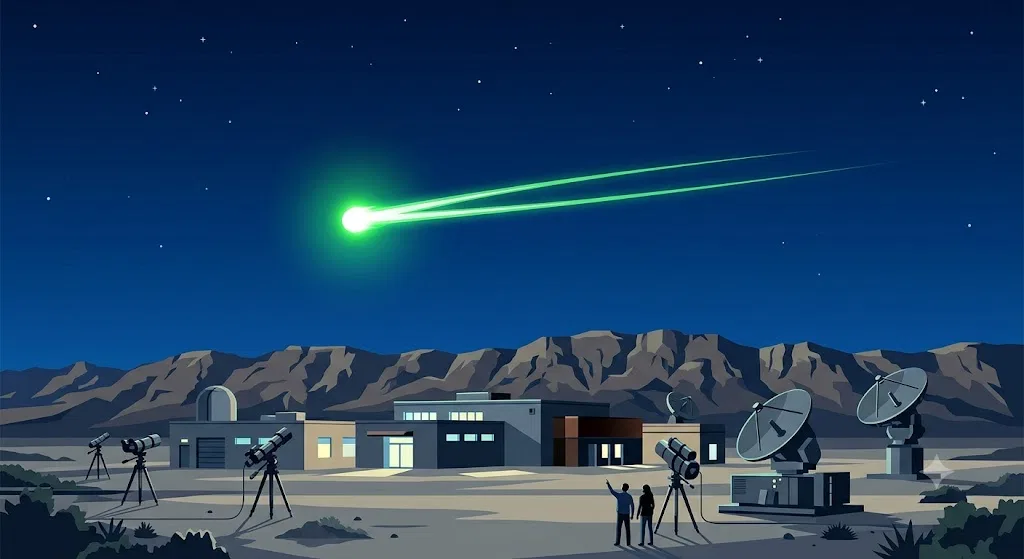
From late 1948, witnesses across northern and central New Mexico reported brilliant green objects crossing the night sky, sometimes on apparently shallow paths and often near Los Alamos, Sandia and other sensitive military or nuclear facilities. The reports mattered because they came from pilots, scientists and security personnel as well as members of the public. Officials could not safely assume that unexplained lights near the country’s atomic-weapons centres were harmless.
The resulting investigation, eventually known as Project Twinkle, was an unusually serious attempt to replace eyewitness descriptions with photographs, spectra and measured trajectories. It did not prove that exotic craft were present, but neither did it capture enough useful data to settle every original report. Its practical failure is the key to the mystery: official monitoring produced mostly negative or inconclusive results, while shortages of equipment, staff and timely communication weakened the experiment. The most reasonable overall reading is that many sightings were meteors or other ordinary objects, but the strongest early cases were never reconstructed with sufficient precision for a decisive identification.
The sightings around sensitive installations
The first recognised cluster developed around Albuquerque in November and December 1948. Early reports described green streaks or flare-like lights, which Air Force officers initially regarded as possible conventional flares. Concern rose when similar objects were reported repeatedly and by observers accustomed to aircraft, weapons activity and the New Mexico sky. According to Edward Ruppelt, later head of the Air Force’s UFO investigation, the reports appeared unusually concentrated in New Mexico rather than forming part of a comparable nationwide pattern.[Project Gutenberg]gutenberg.orgOpen source on gutenberg.org.
A particularly important sequence occurred on 5 December 1948. Civilian and military aircrews reported intensely bright green objects, and investigators collected observations from numerous locations in an attempt to reconstruct their paths. Lincoln LaPaz, director of the University of New Mexico’s Institute of Meteoritics, helped search an estimated fall area but found no recoverable fragments. That absence did not demonstrate that the objects were artificial: most meteors leave no meteorites, and a trajectory calculated from unaided eyewitness estimates can be substantially wrong. It nevertheless contributed to LaPaz’s growing doubt that the reports described ordinary meteor falls.[Project Gutenberg]gutenberg.orgOpen source on gutenberg.org.
On 8 December, two Air Force officers flying east of Las Vegas, New Mexico, reported an intense green, flare-like object that appeared above their aircraft, moved rapidly on a nearly level path and faded after about two seconds. The brief duration and high apparent speed were compatible with a meteor, but the witnesses considered its size, brightness and trajectory unusual for either a normal flare or the meteors familiar to them.[Project Gutenberg]gutenberg.orgOpen source on gutenberg.org.
The geographical setting turned an astronomical puzzle into a security problem. Los Alamos was central to nuclear-weapons research, Sandia was closely involved in weapons engineering, and Kirtland Air Force Base, White Sands and Holloman supported aviation, rocketry and missile testing. A foreign reconnaissance device, an unfamiliar American project, a weapons effect or even a misidentified natural event could all have demanded different responses. The crucial official position was therefore not that extraterrestrial visitors had been detected, but that trained people had genuinely seen something and that the available reports were too imprecise to identify it. A November 1949 Air Force memorandum stated that independent trained observers had made sightings, while also saying that the collected information was not quantitative enough for profitable scientific analysis.[documents2.theblackvault.com]documents2.theblackvault.comProjectTwinkle November1951ProjectTwinkle November1951
Los Alamos scientists and military representatives discussed the reports at conferences in 1949. Surviving records show participation by figures including laboratory director Norris Bradbury, physicists Frederick Reines and Edward Teller, LaPaz, and representatives of the military, Federal Bureau of Investigation and Atomic Energy Commission. The participants considered several natural and artificial possibilities, but did not establish a single cause. They rejected an immediate leap to an extraterrestrial conclusion and focused instead on obtaining photographs, triangulated paths and spectra.[Los Alamos National Laboratory]lanl.govOpen source on lanl.gov.
Why the Air Force launched Project Twinkle
Project Twinkle emerged from a basic evidential problem: eyewitnesses could describe colour, direction and apparent size, but those impressions could not reliably establish an object’s altitude, speed or distance. A bright meteor hundreds of kilometres away can look close, enormous and nearly horizontal. Conversely, an actual object near an installation might be impossible to distinguish from a distant fireball without simultaneous measurements from separated observation points.
The proposed answer was an instrument network. Two or more photographic theodolites—cameras that recorded the direction and elevation at which an object appeared—could photograph the same event and permit triangulation. Spectrum gratings could separate the light into wavelengths, potentially showing whether it resembled a meteor, flare or another luminous process. Radio-frequency equipment was also considered as a way to detect associated electromagnetic emissions. In principle, this combination could have transformed a vivid sighting into measurable altitude, velocity, path and composition.[documents2.theblackvault.com]documents2.theblackvault.comProjectTwinkle November1951ProjectTwinkle November1951
The full scheme was never realised as originally imagined. LaPaz was invited to propose a study but withdrew because of academic-arrangement difficulties. In February 1950, after further reports near Holloman Air Force Base and Vaughn, Holloman established a small observation post staffed by two people. A subsequent programme called for Askania photographic-theodolite triangulation, spectrum photography and radio-frequency measurements. Because Vaughn had generated an unusual number of reports, two camera stations were placed there for a six-month watch.[project1947.com]project1947.comProject 1947PROJECT 1947: Project Twinkle: Final Report…
Several weaknesses limited the project from the beginning:
- The network was too small. The planned multi-station coverage was reduced, making it harder to place cameras where unpredictable events would occur.
- Some observation arrangements favoured daylight. The initial Holloman post operated between sunrise and sunset, although the famous green-fireball reports were largely nocturnal.
- The specialist cameras did not work as a unified system. Events were photographed on 27 April and 24 May 1950, but not simultaneously by both stations, so no useful triangulation resulted.
- Investigators were not always alerted. During activity over Holloman on 30 August, neither project nor contractor personnel were notified in time. After a V-2 launch on 31 August, film was used but the geometry was again inadequate for triangulation.
- Staff and equipment were diverted. The diffraction-grating cameras operated only intermittently after military personnel were withdrawn amid Korean War demands. The proposed radio-monitoring element was not activated because its estimated annual cost was judged unjustified by the declining number of events.[documents2.theblackvault.com]documents2.theblackvault.comProjectTwinkle November1951ProjectTwinkle November1951
This history complicates the claim that Project Twinkle conducted a comprehensive search and found nothing. It conducted a real observation programme, and its photographic theodolites maintained extended watches, but it did not consistently deploy all the instruments needed to test the original reports. A negative result from such a system is informative—it suggests that persistent, readily detectable objects were not routinely operating over the monitored area—but it is weaker than a negative result from the fully staffed, three-station, spectroscopic network originally envisaged.
What Project Twinkle actually found
The project recorded activity, but almost none of it generated decisive measurements. The April and May 1950 photographs lacked paired observations. The August events around Holloman and missile launches were missed or inadequately triangulated. During the extended watch from late 1950 to March 1951, the Askania cameras made no relevant sightings, Northrop test pilots reported nothing, and other reports were judged sketchy or scientifically unusable. The final summary described both main observation periods as negative.[documents2.theblackvault.com]documents2.theblackvault.comProjectTwinkle November1951ProjectTwinkle November1951
The surviving files also show that investigators did identify several later reports as ordinary objects. A large object reported in November 1950 was traced to a General Mills balloon. A February 1951 sighting near Holloman was another balloon connected with Project Moby Dick. A green flare or rocket reported near Rodeo was considered a meteor, and a bright object seen by Los Alamos personnel and Kirtland pilots in March was also reported by the pilots as a meteor. Other observations were attributed to planets, clouds, aircraft or birds.[documents2.theblackvault.com]documents2.theblackvault.comProjectTwinkle November1951ProjectTwinkle November1951
Yet the final assessment was more cautious than a simple declaration that every green fireball had been explained. A project scientist wrote that the overall year of vigilance did not permit a conclusive opinion about the aerial phenomena. A review of meteor photographs covering 35 nights associated with reports found no unusual sky phenomena, but the report still entertained an increased meteoric population or other natural factors and acknowledged that the findings were inconclusive. It recommended no further dedicated spending, partly because of the fruitless results and uncertainty that genuinely unexplainable objects existed, while suggesting that new meteor cameras near Las Cruces could be checked for relevant evidence.[documents2.theblackvault.com]documents2.theblackvault.comProjectTwinkle November1951ProjectTwinkle November1951
The disappearance of the main wave also influenced official thinking. Reports around Holloman declined markedly after September 1950, and popular sensitivity to unusual lights appeared to fade. One memorandum observed that the fireballs seemed to cease when systematic watching began. That could be read suspiciously, as though the objects were avoiding observation, but it has simpler possible meanings: the initial cluster may have been temporary, reporting enthusiasm may have subsided, observers may have become better at recognising ordinary phenomena, or the cameras may simply have been aimed at the wrong place when rare events occurred.[documents2.theblackvault.com]documents2.theblackvault.comProjectTwinkle November1951ProjectTwinkle November1951
Meteors, weapons tests and unresolved reports
The natural-meteor explanation remains the strongest general explanation because bright meteors can be intensely green, silent and apparently enormous. Their colour depends on both atmospheric emissions and material vaporised from the meteoroid. Modern meteor guidance notes that nickel can contribute green light, while velocity and other elements affect the colour seen by witnesses. Bright meteor trails can also show green atmospheric oxygen emission. Green colour alone is therefore not anomalous.[amsmeteors.org]amsmeteors.orgAmerican Meteor Society Fireball FAQsFor example, sodium produces a bright yellow color, nickel shows as green, and magnesium as blue-white…
Several features that troubled LaPaz are less decisive than they appeared in 1949:
Apparently level flight. A meteor entering at a shallow angle, or seen far from and almost side-on to the observer, may seem to move horizontally. Without measured range, a witness cannot reliably convert an apparent path into a physical trajectory.
No recovered fragments. Most incoming material burns up or falls as small pieces over a broad and uncertain area. Failure to recover a meteorite is not unusual, particularly when the predicted impact zone rests on scattered visual estimates.
Silence. Meteors occur at great altitude, so ordinary sound may arrive long after the light or remain unheard. Reports of a silent passage do not distinguish a meteor from an engineered object.
Exceptional brightness and size. People commonly overestimate the angular size of bright lights against a dark, featureless sky. Descriptions such as “as large as the Moon” express visual impact but do not provide a reliable measurement.
LaPaz nevertheless had a legitimate scientific objection: these possibilities should have been tested with properly positioned instruments rather than assumed. He argued that the vivid green colour, shallow trajectories, concentration in New Mexico and absence of recovered material distinguished the main wave from familiar meteors. Some scientists, including atmospheric physicist Joseph Kaplan, thought the objects were probably natural; others remained dissatisfied with that judgement. The disagreement was not between observers who saw nothing and believers who claimed spacecraft. It was primarily a dispute over whether unusual eyewitness characteristics outweighed the lack of calibrated physical data.[documents2.theblackvault.com]documents2.theblackvault.comProjectTwinkle November1951ProjectTwinkle November1951
Weapons and missile activity form another plausible part of the picture, especially around Holloman and White Sands. The Twinkle record itself notes aerial phenomena during or shortly after Bell missile and V-2 launches. Flares, rocket exhaust, separated components, contrails illuminated at altitude and test balloons could all create unfamiliar appearances. The records do not establish that such activity explains the original northern New Mexico wave, however. The late-1948 reports preceded Twinkle’s Holloman observations, occurred across a wider area and were sometimes described by witnesses who believed they could distinguish them from known flares and rockets.[documents2.theblackvault.com]documents2.theblackvault.comProjectTwinkle November1951ProjectTwinkle November1951
Claims that the fireballs were foreign surveillance devices or experimental weapons arose naturally from the security climate, but no surviving Project Twinkle evidence demonstrates controlled flight, recovered technology, radar tracking of a physical vehicle or hostile action. Nor does the proximity of sightings to nuclear sites prove targeting. Sensitive installations employed many trained night observers and generated formal reporting channels, making unusual lights there more likely to be noticed, recorded and escalated than comparable events over sparsely monitored countryside.
Why the case remains important in New Mexico
The green-fireball episode is significant not because Project Twinkle confirmed an extraordinary vehicle, but because it reveals how genuine uncertainty operated inside early American UFO investigations. Security officers did not dismiss every report. Scientists at Los Alamos debated competing mechanisms. The Air Force authorised instrumentation and contracted observers. At the same time, the resulting programme was too limited and poorly coordinated to reproduce the evidential conditions of the strongest sightings.
Later archival reporting has strengthened the historical claim that officials took the events seriously. Los Alamos records confirm high-level scientific and security discussions, while the Project Twinkle papers document the proposed measurement programme, its operational difficulties and its inconclusive outcome. They do not strengthen the claim that the lights were extraterrestrial craft. Instead, they replace exaggerated stories of either total government certainty or total government indifference with a more complicated record: officials believed unusual events had been reported, suspected that most were natural or conventional, and failed to collect the data needed to classify every early case.[lanl.gov]lanl.govOpen source on lanl.gov.
The fairest verdict is therefore divided. As a broad phenomenon, New Mexico’s green fireballs are plausibly explained by a mixture of bright meteors, balloons, missile-related effects, aircraft, astronomical objects and heightened reporting around strategic facilities. As a set of individual late-1948 and 1949 reports, several remain unresolved because descriptions were not accompanied by reliable photographs, spectra, radar records or recovered material. Project Twinkle weakened the idea of a continuing, observable intrusion over New Mexico, but its design and execution were not strong enough to close the original mystery completely.

Amazon book picks
Further Reading
Books and field guides related to Why Did Green Fireballs Alarm New Mexico?. Use these as the next step if you want deeper reading beyond the article.
The Report on Unidentified Flying Objects
Contains influential discussion of the green fireball mystery.
The UFO Experience: A Scientific Inquiry
Explains approaches to evaluating unexplained aerial reports.
UFOs: Generals, Pilots, and Government Officials Go on the Re...
Provides broader context for military witness cases.
eBay marketplace picks
Marketplace Samples
Live-tested eBay searches with available results related to this page.
Selected fromUFO wall art oneBay.co.uk.
Current eBay listing
UFO ABDUCTION OVER THE OCEAN -DEEP FRAMED CANVAS WALL ART PRINT

Current eBay listing
UFO ABDUCTION OVER THE OCEAN -FRAMED WALL ART PAPER PRINT POSTER
Endnotes
1.
Source: gutenberg.org
Link:https://www.gutenberg.org/cache/epub/17346/pg17346.html
2.
Source: documents2.theblackvault.com
Title: ProjectTwinkle November1951
Link:https://documents2.theblackvault.com/documents/projectbluebook/ProjectTwinkle-November1951.pdf
3.
Source: war.gov
Title: DOE UAP D004 Los Alamos Conference on Aerial Phenomena 1949
Link:https://www.war.gov/medialink/ufo/071026/release_04/documents/DOE-UAP-D004_Los-Alamos-Conference-on-Aerial-Phenomena_1949.pdf
Source snippet
_____,_ 4 --12~ ~.t.rFebruary 1949, 1n conference room P-162, Los Alamos Scientific,se of the tuo green fireball paths, determined from...
Published: February 1949
4.
Source: project1947.com
Link:https://www.project1947.com/gfb/twinklereport.htm
Source snippet
Project 1947PROJECT 1947: Project Twinkle: Final Report...
5.
Source: impact.uwo.ca
Link:https://impact.uwo.ca/fireballs/
Source snippet
Impact EarthA fireball is a very bright meteor, similar in... For example, sodium produces a bright yellow colour, nickel shows as green...
6.
Source: history.com
Title: ufos green fireballs nuclear facilities new mexico
Link:https://www.history.com/articles/ufos-green-fireballs-nuclear-facilities-new-mexico
7.
Source: history.com
Link:https://www.history.com/videos/project-blue-book-declassified-the-true-story-of-the-green-fireballs
8.
Source: lanl.gov
Link:https://www.lanl.gov/media/publications/the-vault/1124-foia-requests-at-the-national-security-research-center
9.
Source: amsmeteors.org
Title: American Meteor Society Fireball FAQs
Link:https://www.amsmeteors.org/fireballs/faqf/
Source snippet
For example, sodium produces a bright yellow color, nickel shows as green, and magnesium as blue-white...
10.
Source: Wikipedia
Link:https://en.wikipedia.org/wiki/Project
11.
Source: Wikipedia
Title: Green fireballs
Link:https://en.wikipedia.org/wiki/Green_fireballs
12.
Source: dictionary.cambridge.org
Link:https://dictionary.cambridge.org/us/dictionary/english/project
13.
Source: archive.org
Title: project twinkle november 1951
Link:https://archive.org/details/project-twinkle-november-1951
Published: november 1951
14.
Source: slideshare.net
Link:https://www.slideshare.net/slideshow/project-twinkle/38733495
15.
Source: scribd.com
Title: Project Twinkle
Link:https://www.scribd.com/document/14356295/Project-Twinkle
Additional References
16.
Source: iflscience.com
Title: What Do Meteors’ Colors Tell Us?
Link:https://www.iflscience.com/what-do-meteors-colors-tell-us-71928
Source snippet
What Do Meteors' Colors Tell Us? - IFLScienceBrighter meteors, known as fireballs, often leave a glow behind them. Initially, t...
17.
Source: youtube.com
Link:https://www.youtube.com/watch?v=Mx23NQNG6_U
Source snippet
UFO Reverse Engineering, Crash Retrievals, and the Pentagon's New Files | UAP Gerb...
18.
Source: x.com
Link:https://x.com/VisionaryVoid/status/2062806378679312620
Source snippet
June 5, 2026 — Project Twinkle was quietly terminated. LaPaz objected...
Published: June 5, 2026
19.
Source: youtube.com
Link:https://www.youtube.com/watch?v=ecEY2xNFzPw
Source snippet
The Report on UFOs by Edward J. Ruppelt (part 1)...
20.
Source: cia.gov
Link:https://www.cia.gov/readingroom/document/0005516126
21.
Source: cia.gov
Link:https://www.cia.gov/readingroom/document/cia-rdp81r00560r000100030027-0
22.
Source: cia.gov
Link:https://www.cia.gov/readingroom/document/cia-rdp79b00752a000300100010-4
23.
Source: youtube.com
Title: The Mysterious ‘Green Fireball’ Phenomenon
Link:https://www.youtube.com/watch?v=s4wz12slEZo
Source snippet
Mysterious 'green fireballs,' Space Shuttle photos among newly released UFO files...
24.
Source: sacred-texts.com
Link:https://sacred-texts.com/ufo/rufo/rufo06.htm
25.
Source: emergentmind.com
Link:https://www.emergentmind.com/open-problems/nature-relationship-green-fireballs