Within Nebraska
How Nebraska Investigators Tested UFO Witness Reports
Civilian investigators preserved witness reports that show how careful checks often turned dramatic sightings into ordinary events.
On this page
- Earl Kral and organised civilian investigation
- How witnesses, weather and aviation records were checked
- What the university archive reveals about unresolved cases
Page outline Jump by section
Introduction
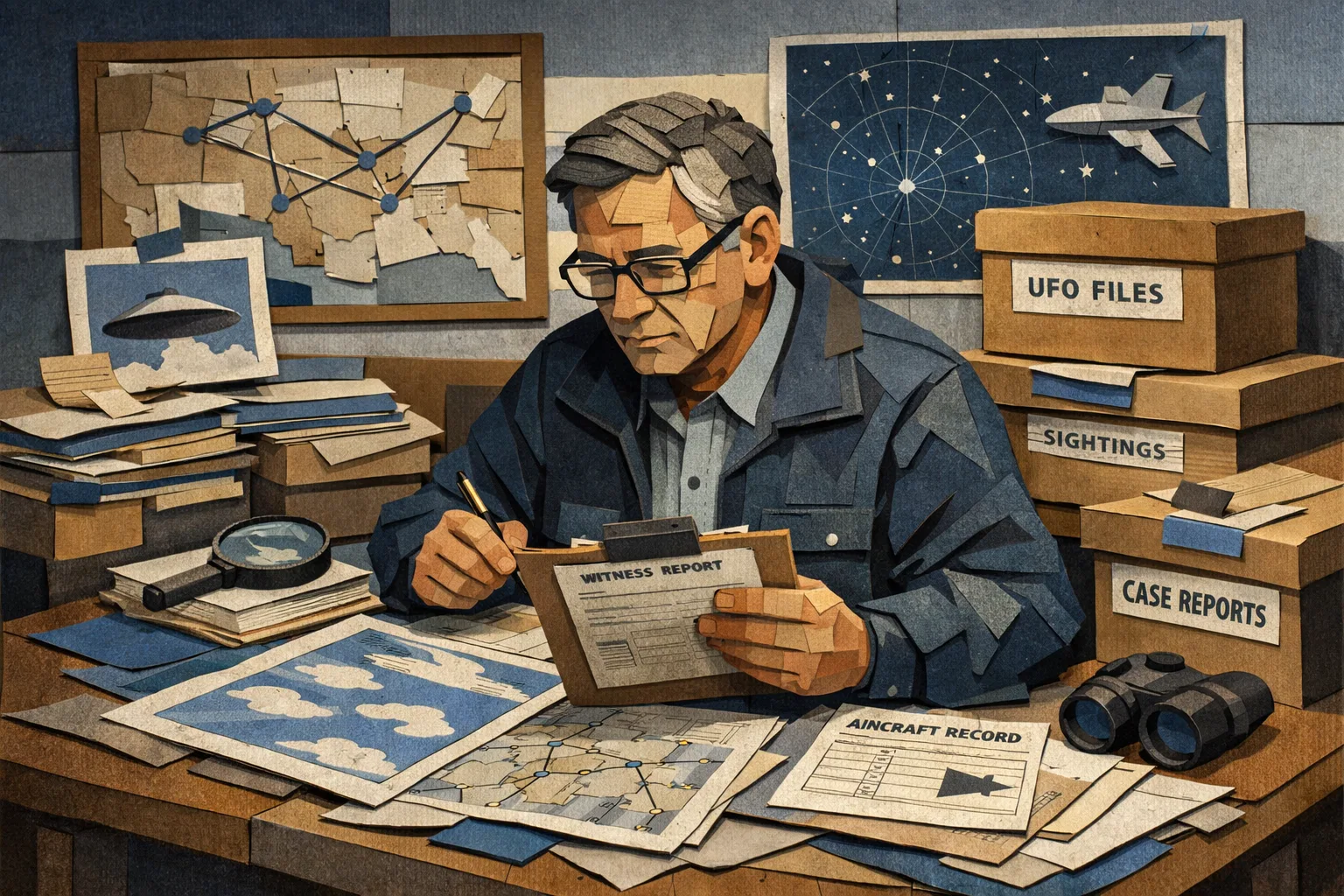
After the US Air Force closed Project Blue Book in 1969, Nebraska’s UFO reports did not stop. Responsibility simply shifted from government investigators to civilians. The most important of these was E. A. “Earl” Kral, a Grand Island schoolteacher who became Nebraska’s first state director for the Mutual UFO Network, or MUFON. He organised technically minded volunteers, recorded witness testimony on standard forms and compared reports with weather, astronomical and aviation information.
The archive he left at the University of Nebraska–Lincoln matters because it preserves more than colourful sighting stories. It shows the investigative process from initial claim to final assessment. Most reports that sounded extraordinary were eventually linked to planets, balloons, helicopters or other ordinary objects. Only a few remained unidentified, and “unidentified” meant that the available information was insufficient—not that an extraterrestrial craft had been established.[Nebraska Public Media]nebraskapublicmedia.orgNebraska Public MediaFlying saucers over the Sandhills? UFO investigations now public in University of Nebraska archives | Nebraska Publi…
Earl Kral turned sightings into case files
Kral was not a professional astronomer or military intelligence officer. He was an English teacher, writer and unusually persistent collector of information. Born in Wilber, Nebraska, in 1935, he earned bachelor’s and master’s degrees from the University of Nebraska–Lincoln and taught for about 30 years, including a long period at Grand Island Senior High School. His broader work in education included projects intended to develop formal reasoning and scientific thinking among pupils.[archivespec.unl.edu]archivespec.unl.eduUN L | Libraries | Archives & Special Collections | Finding AidsUN L | Libraries | Archives & Special Collections | Finding Aids
That background helps explain the distinctive character of his UFO work. Kral appears to have been interested in unusual claims without assuming that the claims were true. As Nebraska’s first MUFON state director, he recruited roughly 40 people with scientific or technical backgrounds to collect and analyse reports from around the state. Jack Kasher, an Omaha physics professor who later led Nebraska MUFON, recalled that Kral wanted cases investigated thoroughly and accurately rather than shaped to produce a predetermined answer.[Nebraska Public Media]nebraskapublicmedia.orgNebraska Public MediaFlying saucers over the Sandhills? UFO investigations now public in University of Nebraska archives | Nebraska Publi…
The timing was significant. Blue Book’s closure removed the most visible official destination for civilian reports, creating space for organisations such as MUFON to act as informal clearing houses. National Archives material shows that Blue Book itself had found the majority of investigated reports to be misidentified aircraft, weather balloons or other conventional objects. Nebraska’s civilian investigators continued broadly the same practical task, although without the Air Force’s authority, radar access or institutional resources.[Pieces of History]prologue.blogs.archives.govsaucers over washington the history of project blue bookPieces of HistorySaucers Over Washington: the History of Project Blue Book19 Dec 2019 — Upon further inspection, the majority of these re…
Kral’s most valuable contribution was therefore organisational. Witnesses did not merely tell a story to a newspaper or local acquaintance. Their accounts could be converted into a file containing dates, locations, directions, descriptions, drawings, photographs, correspondence and checks against possible explanations. This did not make every conclusion correct, but it made the reasoning visible and open to later review.

How the reports were tested
The archive indicates that Kral’s group used standardised forms rather than relying entirely on free-form narratives. Standard questions helped investigators separate what a witness had directly observed from later interpretation: where the object first appeared, which direction it moved, how long it remained visible, what colour or shape was reported, whether other people saw it and whether photographs or physical traces existed.[Nebraska Public Media]nebraskapublicmedia.orgNebraska Public MediaFlying saucers over the Sandhills? UFO investigations now public in University of Nebraska archives | Nebraska Publi…
The investigators then tried to reconstruct the viewing conditions. Most UFO reports contain no reliable measurement of distance, altitude or size. A light that appears to move rapidly may be a nearby object moving moderately, a distant object apparently shifting against clouds, or even a stationary planet viewed from a moving vehicle. Without a known distance, estimates of extraordinary speed or enormous dimensions are usually calculations built on assumptions rather than measurements.
Kral’s files show several recurring lines of enquiry:
- Astronomy: Investigators checked star charts and the positions of bright planets. Venus, in particular, can appear strikingly bright near the horizon and may seem to move when thin clouds pass or when the observer changes position.
- Weather: Cloud cover, visibility, wind direction and balloon activity could explain lights that seemed to hover, drift or change brightness.
- Aviation: Aircraft routes, airport activity and the presence of helicopters were examined where possible. Navigation lights seen at an unfamiliar angle can produce an appearance quite unlike a recognisable aeroplane.
- Photography: Where images existed, investigators looked for manipulation or ordinary photographic effects. A photograph could support the fact that a light was present, but usually could not establish its distance, size or origin.
- Witness follow-up: Kral often wrote to the person who had reported the event, explaining what the investigators had checked and why they had reached their conclusion.[Nebraska Public Media]nebraskapublicmedia.orgNebraska Public MediaFlying saucers over the Sandhills? UFO investigations now public in University of Nebraska archives | Nebraska Publi…
This procedure resembles modern recommendations for investigating unidentified aerial phenomena. Current guidance stresses the need to record how witnesses estimated size, speed and distance, to seek independent observers and to collect environmental and sensor data. The Nebraska files rarely contain the multiple calibrated instruments that a modern scientific study would ideally require, but their structured questions and comparison with external records were a meaningful improvement over treating every testimony as self-validating.[AAROM]aaro.milM2025 UAP Workshop: Narrative Data, Infrastructures, and…February 12, 2026 — Ask witnesses to explain how they estimated size, dis…
Ordinary explanations were the main result
The archive’s central finding is not a spectacular unidentified object. It is the high proportion of reports that weakened under checking.
Nebraska Public Media’s review found that only three or four of the dozens of MUFON cases in Kral’s papers retained an unidentified classification. Most were attributed to such things as bright planets, weather balloons or helicopters after investigators compared the accounts with weather reports, star charts and aviation records. No file was judged to demonstrate an extraterrestrial origin.[Nebraska Public Media]nebraskapublicmedia.orgNebraska Public MediaFlying saucers over the Sandhills? UFO investigations now public in University of Nebraska archives | Nebraska Publi…
That outcome does not necessarily mean witnesses were dishonest. An observer can give an honest and detailed account while being mistaken about what produced it. Night-time conditions remove familiar cues for distance and scale; memory may become more definite as the story is repeated; and witnesses naturally describe an unfamiliar object using the closest familiar shape. Kral eventually told an Omaha newspaper that his investigations had taught him about the unreliability of eyewitnesses, reflecting a gradual movement from early enthusiasm towards greater scepticism.[Nebraska Public Media]nebraskapublicmedia.orgNebraska Public MediaFlying saucers over the Sandhills? UFO investigations now public in University of Nebraska archives | Nebraska Publi…
The follow-up letters are especially revealing. Instead of merely stamping a report “explained”, Kral reportedly told witnesses which evidence had changed the assessment. That practice reduced the risk of leaving people with the impression that investigators had dismissed them without examination. It also created a traceable chain between the original observation, the proposed alternatives and the final judgement.
There was still room for bias. MUFON was an organisation founded to investigate UFO reports, and some participants hoped that compelling cases would survive conventional explanation. Kasher acknowledged that witnesses or investigators could become overly eager for a strong case and might embellish details. The archive is therefore not a neutral government dataset or a controlled scientific experiment. It is a collection produced by interested civilians—but civilians who often recorded the evidence that counted against the extraordinary interpretation.[Nebraska Public Media]nebraskapublicmedia.orgNebraska Public MediaFlying saucers over the Sandhills? UFO investigations now public in University of Nebraska archives | Nebraska Publi…
Three cases show the archive’s range
Several reports reviewed when the collection became public illustrate why its value lies in documentation rather than dramatic conclusions.
Ernest Dahlke contacted the Hamilton County sheriff after seeing a bright white light apparently descending outside his bedroom window. A report involving law enforcement may sound more authoritative than a casual anecdote, but the involvement of a sheriff’s office does not itself identify the object. Its importance rests on whether the file preserves the time, viewing direction, weather and possible aircraft or astronomical matches.[Nebraska Public Media]nebraskapublicmedia.orgNebraska Public MediaFlying saucers over the Sandhills? UFO investigations now public in University of Nebraska archives | Nebraska Publi…
In Grand Island, teenager Kevin Aldridge photographed an oblong object that he said crossed the sky for nearly four minutes. His pictures appeared in the local newspaper. The duration and photographs made the report more substantial than a momentary flash, yet photographs of an isolated object against the sky commonly lack a reference point from which distance or dimensions can be calculated. The file is useful precisely because it allows researchers to examine the claim, the images and the investigators’ handling of them together.[Nebraska Public Media]nebraskapublicmedia.orgNebraska Public MediaFlying saucers over the Sandhills? UFO investigations now public in University of Nebraska archives | Nebraska Publi…
A more striking historical report came from L. J. Garrison and his wife, who said that in 1953 they had watched two very bright objects over their ranch near Burwell, apparently joined by a beam of light. Their case was reported to MUFON many years after the event. Multiple witnesses can strengthen a claim that something unusual was seen, but a long delay creates difficulties: exact timings may be lost, contemporary weather and flight records may be unavailable, and memories can converge as witnesses discuss the experience. The archive preserves the account, but preservation cannot restore evidence that was never recorded at the time.[Nebraska Public Media]nebraskapublicmedia.orgNebraska Public MediaFlying saucers over the Sandhills? UFO investigations now public in University of Nebraska archives | Nebraska Publi…
What “unexplained” meant in Kral’s files
The collection includes a rare 1973 case in which a central Nebraska science teacher reported a hovering object in his garden that appeared to depart rapidly. The witness made notes and supplied photographs. Investigators considered conventional alternatives and examined the images for signs of trickery but found no satisfactory explanation, so the case received an “unexplained” designation.[Nebraska Public Media]nebraskapublicmedia.orgNebraska Public MediaFlying saucers over the Sandhills? UFO investigations now public in University of Nebraska archives | Nebraska Publi…
That label is easy to misread. It did not establish that the object had no ordinary explanation; it recorded that the investigators had not identified one from the surviving material. They apparently found no obvious photographic fraud, but “not shown to be a trick” is not the same as “shown to be an extraordinary craft”. Without calibrated images, independent measurements, radar confirmation or recoverable material, the case could not demonstrate the object’s actual distance, speed or physical structure.
The distinction remains central to official UAP analysis. Historical reviews repeatedly find that many unresolved cases remain open because investigators lack reliable data on altitude, dimensions and velocity. An unexplained remainder is therefore expected in any large collection of incomplete reports. It may contain genuinely unusual observations, but it will also contain ordinary events whose identifying information was missing or recorded too late.[AAROM]aaro.milOpen source on aaro.mil.
Kral’s small unexplained residue is more credible than a collection in which every case becomes mysterious, because his team was willing to eliminate its own candidates. At the same time, none of the surviving cases appears to cross the much higher threshold required to demonstrate an unknown technology or extraterrestrial origin.
Why the archive stayed closed until 2025
The witness files were donated to the University of Nebraska–Lincoln with an agreement preventing public access until 2025. The restriction was intended to protect people who had reported UFOs and might not have wanted their names or unusual experiences widely circulated. Nebraska Public Media became the first organisation to request the newly accessible material and reported on it in May 2026.[Nebraska Public Media]nebraskapublicmedia.orgNebraska Public MediaFlying saucers over the Sandhills? UFO investigations now public in University of Nebraska archives | Nebraska Publi…
The delay highlights a recurring problem in UFO history. Public ridicule can discourage witnesses from reporting promptly, yet protecting confidentiality can make independent review more difficult. Kral’s agreement attempted to balance those interests: retain the original documentation, keep it out of public circulation while witnesses might face unwanted attention, and eventually transfer it into an institutional archive.
The university’s Archives & Special Collections preserves manuscripts and research collections and makes material available through supervised reading-room access. The Kral paranormal papers are unusual within its holdings; the university’s special collections librarian described them as its only dedicated paranormal collection. They include hundreds of original documents, investigation reports, press cuttings and research materials arranged across subject folders, with the UFO case files forming the portion most directly relevant to Nebraska’s aerial history.[Nebraska Public Media]nebraskapublicmedia.orgNebraska Public MediaFlying saucers over the Sandhills? UFO investigations now public in University of Nebraska archives | Nebraska Publi…
Archival preservation does not endorse the claims inside a collection. Its function is to retain evidence of what people reported, how investigators responded and how interpretations changed. That separation between preservation and validation is essential when reading the Kral papers.
From UFO advocacy to broader sceptical enquiry
Kral’s experience with UFO reports appears to have changed his outlook. According to Kasher, his early hopes that some cases might indicate alien encounters gradually faded. Yet Kral did not abandon unusual claims altogether. During the 1980s he contributed $10,000 to the University of Nebraska Foundation to establish the Scientific Claims Investigation Hotline, which referred reports of apparently paranormal events for examination. Its subjects extended beyond UFOs to haunted houses, crop circles and other disputed phenomena.[Nebraska Public Media]nebraskapublicmedia.orgNebraska Public MediaFlying saucers over the Sandhills? UFO investigations now public in University of Nebraska archives | Nebraska Publi…
This shift is significant because it suggests that investigation, rather than belief, became the lasting focus. Kral’s later educational writing also engaged with science reasoning and sceptical enquiry. He cooperated with the Committee for Skeptical Inquiry and published an assessment of reasoning in high-school teaching in The Skeptical Inquirer.[archivespec.unl.edu]archivespec.unl.eduUN L | Libraries | Archives & Special Collections | Finding AidsUN L | Libraries | Archives & Special Collections | Finding Aids
There is a tension in that legacy. The archive includes subjects that fall well outside established science, and collecting them together can encourage readers to treat unrelated mysteries as parts of one hidden phenomenon. Yet the case files themselves often work in the opposite direction: they divide broad claims into testable questions and demonstrate how apparently extraordinary events can lose their mystery one factual check at a time.
What the collection adds to Nebraska’s UFO history
Nebraska’s better-known UFO stories tend to centre on dramatic witnesses, military installations or alleged close encounters. Kral’s archive contributes something less spectacular but more useful: a record of the ordinary investigative labour that followed reports across the state.
It reveals that civilian investigators did not simply gather tales of strange craft. They interviewed witnesses, sought corroboration, checked sky and flight conditions, assessed photographs and communicated conclusions that frequently disappointed the people who had contacted them. It also preserves failed identifications, unresolved files and the limitations of investigations conducted without calibrated sensors or timely official data.
The archive therefore supports three balanced conclusions. Nebraska residents reported experiences that were vivid and sincere; careful enquiry explained most of them conventionally; and a small number remained unresolved because the available evidence did not permit a secure identification. That final category deserves continued historical study, but it does not overturn the broader pattern. The most important discovery in Kral’s boxes is how often a UFO became an ordinary object once the surrounding records were examined—and how much uncertainty remained when those records were absent.
Amazon book picks
Further Reading
Books and field guides related to How Nebraska Investigators Tested UFO Witness Reports. Use these as the next step if you want deeper reading beyond the article.
The UFO Experience: A Scientific Inquiry
Explains systematic investigation of UFO reports, classifications, and evidence assessment.
The Encyclopedia of UFOs
Offers historical context, investigators, organizations, and notable cases relevant to civilian investigations.
UFOs: Generals, Pilots, and Government Officials Go on the Re...
Focuses on documented cases and investigative standards rather than sensational stories.
The Demon-Haunted World: Science as a Candle in the Dark
Rating: 4.5/5 from 43 Google Books ratings
Provides the critical thinking framework used to evaluate extraordinary claims such as UFO reports.
eBay marketplace picks
Marketplace Samples
Live-tested eBay searches with available results related to this page.
Selected fromUFO poster oneBay.co.uk.
Endnotes
1.
Source: prologue.blogs.archives.gov
Title: saucers over washington the history of project blue book
Link:https://prologue.blogs.archives.gov/2019/12/19/saucers-over-washington-the-history-of-project-blue-book/
Source snippet
Pieces of HistorySaucers Over Washington: the History of Project Blue Book19 Dec 2019 — Upon further inspection, the majority of these re...
2.
Source: archivespec.unl.edu
Title: UN L | Libraries | Archives & Special Collections | Finding Aids
Link:https://archivespec.unl.edu/findingaids/ms0352-kral-unl.html
3.
Source: mufon.com
Title: JULY 2023 MUFON Journal WEB
Link:https://mufon.com/wp-content/uploads/2024/11/JULY_2023_MUFON_Journal_WEB.pdf
Source snippet
A NEWCOMER'S GUIDE TO MUFON:1 Jul 2023 — MUFON Field Investigator Manual, Investigators log weather, longitude and latitude, testimo...
Published: JULY 2023
4.
Source: libraries.unl.edu
Title: Archives & Special Collections | Libraries | Nebraska
Link:https://libraries.unl.edu/archives-special-collections/
5.
Source: archives.gov
Title: moving images and sound
Link:https://www.archives.gov/research/topics/uaps/moving-images-and-sound
6.
Source: catalog.archives.gov
Link:https://catalog.archives.gov/id/1142703
7.
Source: text-message.blogs.archives.gov
Link:https://text-message.blogs.archives.gov/2017/07/05/see-something-say-something-ufo-reporting-requirements-office-of-military-government-for-bavaria-germany-may-1948/
Published: may 1948
8.
Source: archives.gov
Link:https://www.archives.gov/files/declassification/iscap/pdf/2014-004-doc01.pdf
9.
Source: archives.gov
Link:https://www.archives.gov/files/research/cartographic/cartographic-ww2-guide.pdf
10.
Source: obamawhitehouse.archives.gov
Title: bioecon (# 023SUPP) NSF NBIC
Link:https://obamawhitehouse.archives.gov/sites/default/files/microsites/ostp/bioecon-%28%23%20023SUPP%29%20NSF-NBIC.pdf
11.
Source: archives.gov
Link:https://www.archives.gov/files/iwg/declassified-records/rg-226-oss/entry-210.pdf
12.
Source: archives.gov
Link:https://www.archives.gov/files/publications/ref-info-papers/rip103.pdf
13.
Source: archives.gov
Link:https://www.archives.gov/research/americans-with-disabilities/reference-info-paper.html
14.
Source: obamawhitehouse.archives.gov
Title: single pdf bioeconomy supplementary
Link:https://obamawhitehouse.archives.gov/sites/default/files/page/files/single_pdf_bioeconomy_supplementary.pdf
15.
Source: nebraskapublicmedia.org
Link:https://nebraskapublicmedia.org/en/news/news-articles/flying-saucers-over-the-sandhills-ufo-investigations-now-public-in-university-of-nebraska-archives/
Source snippet
Nebraska Public MediaFlying saucers over the Sandhills? UFO investigations now public in University of Nebraska archives | Nebraska Publi...
16.
Source: aaro.mil
Link:https://www.aaro.mil/Portals/136/PDFs/Information%20Papers/2025_UAP_Workshop_Paper.pdf
Source snippet
M2025 UAP Workshop: Narrative Data, Infrastructures, and...February 12, 2026 — Ask witnesses to explain how they estimated size, dis...
Published: February 12, 2026
17.
Source: aaro.mil
Link:https://www.aaro.mil/Portals/136/PDFs/AARO_Historical_Record_Report_Vol_1_2024.pdf
18.
Source: nebraskapublicmedia.org
Link:https://nebraskapublicmedia.org/es/news/news-articles/flying-saucers-over-the-sandhills-ufo-investigations-now-public-in-university-of-nebraska-archives/
19.
Source: Wikipedia
Link:https://en.wikipedia.org/wiki/Flying
20.
Source: dictionary.cambridge.org
Link:https://dictionary.cambridge.org/dictionary/english/flying
21.
Source: media.nationalarchives.gov.uk
Link:https://media.nationalarchives.gov.uk/index.php/ufo-file-release-may-2008-part-2-audio-with-slides/
22.
Source: merriam-webster.com
Link:https://www.merriam-webster.com/dictionary/flying
Additional References
23.
Source: science.nasa.gov
Link:https://science.nasa.gov/wp-content/uploads/2023/09/uap-independent-study-team-final-report.pdf
Source snippet
NASA ScienceIndependent Study Team ReportThe study of Unidentified Anomalous Phenomena (UAP) presents a unique scientific opportunity tha...
24.
Source: nebraskaauthors.org
Link:https://nebraskaauthors.org/authors/elmer-a-kral
Source snippet
Elmer A. KralElmer A. Kral; Places Lived. Grand Island, NE Wilber, NE; Author Of. Biography; Keywords. Paranormal; biography; Occupat...
25.
Source: nasa.gov
Link:https://www.nasa.gov/wp-content/uploads/2025/11/fy-2025-q4-foia-log.xlsx?emrc=75e66d
26.
Source: scribd.com
Link:https://www.scribd.com/document/332404304/UFO-Related-Articles-in-Australian-NSW-Newspapers-1983-to-1992
27.
Source: flyingmag.com
Link:https://www.flyingmag.com/
28.
Source: flydays.co.uk
Link:https://www.flydays.co.uk/
29.
Source: x.com
Link:https://x.com/NebPubMediaNews/status/2052781221579563391
30.
Source: dokumen.pub
Link:https://dokumen.pub/haynes-ufo-investigations-manual-ufo-investigations-from-1892-to-the-present-day-085733400x-9780857334008.html
31.
Source: kewaskumhistoricalsociety.org
Link:https://www.kewaskumhistoricalsociety.org/assets/newspapers/1930/kts-1930-01-11.pdf
32.
Source: mufonu.com
Link:https://mufonu.com/