Within California
Was the Battle of Los Angeles a UFO?
The 1942 air-raid panic became a UFO legend only after later culture recast a confused wartime alarm as an encounter.
On this page
- What happened on 25 February 1942
- Why the famous photograph misleads
- How a false alarm became a UFO legend
Page outline Jump by section
Introduction
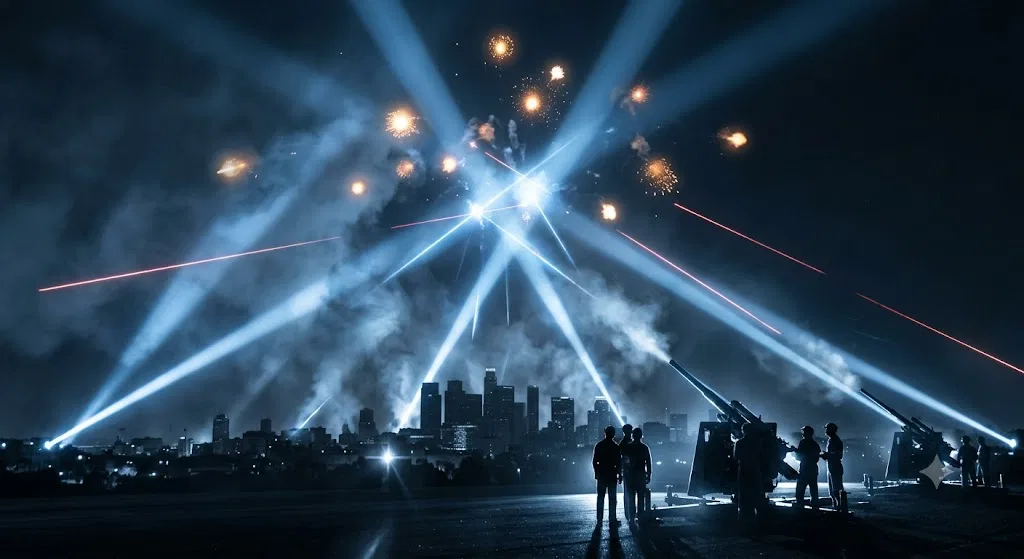
The Battle of Los Angeles was a genuine wartime emergency, but the available evidence does not support the later claim that American guns confronted an extraterrestrial craft. In the early hours of 25 February 1942, radar warnings, air-raid reports and nervous anti-aircraft crews triggered a blackout and a vast barrage over Southern California. More than 1,400 rounds were fired, yet no enemy aircraft was recovered, no bombs were dropped and post-war Japanese accounts indicated that no raid had taken place. The likeliest reconstruction is that a balloon or uncertain radar contact began the alarm, after which searchlights, flares and shell bursts generated further mistaken sightings.[San Francisco Museum]sfmuseum.orgSan Francisco Museum The Battle of Los AngelesSan Francisco MuseumThe Battle of Los Angeles - 1942…
The incident matters within California’s UFO history because its extraterrestrial meaning was added later. A heavily retouched newspaper photograph, contradictory military statements and decades of popular retelling transformed a confused air-defence failure into what is sometimes presented as an early mass UFO encounter.
What happened on 25 February 1942
Los Angeles was already primed to expect an attack. Pearl Harbor was less than three months in the past, Japanese submarines had attacked shipping off the American West Coast, and on 23 February the submarine I-17 had shelled the Ellwood oil field near Santa Barbara. The material damage at Ellwood was slight, but the raid demonstrated that California’s coast was not beyond Japan’s reach and sharply increased fears of a larger strike.[WIRED]wired.comfeb 23 1942 invasion theyre coming 223, 1942: Invasion! They're Coming!February 23, 2009 — On February 23, 1942, Japanese submarine I-17, commanded by Nishino Kozo, surfaced…
Naval intelligence warned on 24 February that an attack might occur within ten hours. Reports of flares and blinking lights near defence plants produced an evening alert, which was lifted at 10.23 pm. Early the next morning, coastal radar detected an unidentified target approximately 120 miles west of Los Angeles. Anti-aircraft units were placed on alert, a regional blackout was ordered and sirens sounded across the area. Army fighter aircraft were kept on the ground while commanders waited for clearer information about the supposed attack.[San Francisco Museum]sfmuseum.orgSan Francisco Museum The Battle of Los AngelesSan Francisco MuseumThe Battle of Los Angeles - 1942…
The radar contact apparently disappeared before reaching the coast, but reports from observers multiplied. At about 3.06 am, a balloon carrying a red flare was seen over Santa Monica. Four anti-aircraft batteries opened fire, and the sky soon filled with tracer ammunition, exploding shells, smoke and moving searchlight beams. Once the barrage began, illuminated shell bursts could themselves be interpreted as additional aircraft, encouraging other batteries and observers to report more targets.[San Francisco Museum]sfmuseum.orgSan Francisco Museum The Battle of Los AngelesSan Francisco MuseumThe Battle of Los Angeles - 1942…
Accounts rapidly became irreconcilable. Witnesses described anything from a single slow object to formations containing dozens or even hundreds of aircraft. Reported heights ranged from a few thousand feet to more than 20,000 feet, while estimated speeds varied from almost stationary to more than 200 miles per hour. Such disagreement does not prove that every witness imagined the event; it shows that people were trying to interpret brief, poorly defined lights amid gunfire, darkness, smoke and intense expectation of an enemy raid.[San Francisco Museum]sfmuseum.orgSan Francisco Museum The Battle of Los AngelesSan Francisco MuseumThe Battle of Los Angeles - 1942…
Approximately 1,440 anti-aircraft rounds were fired. Rumours circulated that several aircraft had been destroyed and that one had crashed in Hollywood, but no wreckage, enemy crew or impact site was found. No bombs fell. Damage on the ground instead came from falling fragments and anti-aircraft shells that failed to detonate at altitude. Garages, patios, vehicles and other property were struck, while several people were injured during the confusion.[San Francisco Museum]sfmuseum.orgSan Francisco Museum The Battle of Los AngelesSan Francisco MuseumThe Battle of Los Angeles - 1942…
Five deaths are commonly associated indirectly with the alarm: three in traffic accidents during the blackout and two from heart attacks. The precise attribution in contemporary accounts is not always consistent, but the human cost was real even though the supposed attacking force was not. The all-clear was finally issued at 7.21 am.[Smithsonian Magazine]smithsonianmag.comOpen source on smithsonianmag.com.
Why the official story remained confused
The military did not provide one clear explanation. Navy Secretary Frank Knox declared within hours that the incident had been a false alarm caused by strained wartime nerves. Parts of the Army initially also doubted that aircraft had been present, and the Fourth Air Force reportedly concluded that there had been no planes over Los Angeles.[San Francisco Museum]sfmuseum.orgSan Francisco Museum The Battle of Los AngelesSan Francisco MuseumThe Battle of Los Angeles - 1942…
Army commanders then interviewed witnesses and shifted towards a more dramatic position. Secretary of War Henry Stimson said that unidentified aircraft might have crossed the city, possibly civilian planes operated by enemy agents or light aircraft launched from Japanese submarines. These theories were speculative: no aircraft, pilots, clandestine airfields or submarine-launched reconnaissance mission connected with the alarm were established.[San Francisco Museum]sfmuseum.orgSan Francisco Museum The Battle of Los AngelesSan Francisco MuseumThe Battle of Los Angeles - 1942…
The contradiction between the Army and Navy helped preserve the mystery. To a frightened public, “false alarm” sounded inadequate after hours of gunfire, while claims about secret enemy aircraft sounded like an admission that something had escaped. Newspapers and politicians demanded an explanation, and rumours of crashed planes, hidden wreckage and official censorship spread in the gap between what residents had experienced and what officials could demonstrate.[San Francisco Museum]sfmuseum.orgSan Francisco Museum The Battle of Los AngelesSan Francisco MuseumThe Battle of Los Angeles - 1942…
Later military histories offered a more coherent reconstruction. A meteorological balloon, possibly one of several released with lights for tracking, may have prompted the initial visual identification. After firing began, flares and shell bursts caught in searchlights created apparent moving targets. This explanation does not establish the identity of every reported light, nor does it fully resolve the first radar return. It does, however, account for the central features of the incident without requiring an aircraft capable of surviving sustained fire while leaving no physical trace.[sfmuseum.org]sfmuseum.orgSan Francisco Museum The Battle of Los AngelesSan Francisco MuseumThe Battle of Los Angeles - 1942…
Post-war information weakened the enemy-aircraft theory further. Japanese authorities stated that no aircraft had been sent over Los Angeles that night. Japan did possess submarines capable of operating off California, as the Ellwood attack had just demonstrated, but evidence of presence at sea is not evidence of an air raid over the city.[Los Angeles Times]latimes.comla me fw archives 1942 battle la 20170221 storyLos Angeles TimesFrom the Archives: The 1942 Battle of L.A. - Los Angeles Times…
Why the famous photograph misleads
The image most closely associated with the Battle of Los Angeles appears to show several searchlights converging on a bright, solid object. In isolation, it is easy to read the illuminated patch as a disc or structured craft enduring concentrated anti-aircraft fire. That interpretation has become one of the main visual foundations of the UFO version of the story.
The photograph published by the Los Angeles Times on 26 February 1942 was not an untouched record of the scene. Examination of surviving material found that the original image was flat, soft-focused and underexposed. For newspaper reproduction, artists widened and brightened searchlight beams, removed other beams, darkened the skyline and strengthened bright spots around the point of convergence.[Los Angeles Times]latimes.comla me fw archives 1942 battle la 20170221 storyLos Angeles TimesFrom the Archives: The 1942 Battle of L.A. - Los Angeles Times…
Retouching photographs for coarse newspaper printing was common at the time. That does not mean that the entire event or photograph was fabricated. Searchlights were genuinely operating, guns were genuinely firing and at least part of the underlying exposure records the barrage. The problem is narrower but decisive: the published version cannot safely be treated as precise photographic evidence of a solid object’s shape.[Los Angeles Times]latimes.comla me fw archives 1942 battle la 20170221 storyLos Angeles TimesFrom the Archives: The 1942 Battle of L.A. - Los Angeles Times…
Former Los Angeles Times journalist Larry Harnisch, who examined the print, described airbrushed beams, painted shell bursts and a skyline reinforced with black paint. A later Times examination likewise reported that the supposed craft-like form was affected by paint added to the print. The iconic bright mass therefore reflects both light in the original scene and darkroom or editorial work carried out to make the photograph printable and dramatic.[Los Angeles Times]latimes.comLos Angeles TimesTV Skeptic: 'Fact or Faked: Paranormal Files' looks at the real 'Battle of L.A.' - Los Angeles Times…
The image also compresses a complicated three-dimensional scene into a single exposure. Searchlight beams passing through haze or smoke can appear to end where illumination becomes strongest. Multiple beams crossing at different distances may seem to meet on one surface, while overexposure can merge separate bright areas. A photograph can consequently suggest a sharply bounded target even when it records glare, airborne particles and overlapping light rather than a craft.
Other photographs from the night show searchlights and anti-aircraft activity without providing clear evidence of the large disc visible in popular reproductions. The famous image is historically valuable as a record of how Los Angeles experienced the alarm, but weak as proof of what the batteries were firing at.[Los Angeles Times]latimes.comla me fw archives 1942 battle la 20170221 storyLos Angeles TimesFrom the Archives: The 1942 Battle of L.A. - Los Angeles Times…
How a false alarm became a UFO legend
The incident was not originally understood as an extraterrestrial encounter. Contemporary arguments centred on Japanese bombers, submarine-launched aircraft, civilian planes, balloons, military error and possible sabotage. The modern “flying saucer” era had not yet begun; that language entered American popular culture after widely reported sightings in 1947.[Time]time.comSee 10 Mysterious 'UFO Sighting' Photos From HistoryThe city's anti-aircraft defenses responded vigorously, lighting up the night with searchlights and firing 1,430 rounds of ammunition ove…
The UFO interpretation developed retrospectively. Once flying saucers became a familiar cultural category, older reports of unidentified aerial objects could be reorganised into a prehistory of alien visitation. The Battle of Los Angeles offered unusually attractive material: thousands of witnesses, military radar, searchlights, gunfire, conflicting official statements and a spectacular photograph. Its genuine uncertainty made it easier to detach the event from its wartime setting.
Later retellings often reverse the proper order of evidence. They begin with the enhanced photograph, assume that the bright centre is a vehicle, and then interpret the barrage as proof that the military had identified a physical craft. Contemporary records instead show that reports varied wildly, the original radar target vanished, many later “targets” appeared only after firing started, and no object or debris was recovered.[San Francisco Museum]sfmuseum.orgSan Francisco Museum The Battle of Los AngelesSan Francisco MuseumThe Battle of Los Angeles - 1942…
Popular television and cinema further reinforced the extraterrestrial version. Investigations have sometimes concentrated on recreating the saucer-like appearance while giving less attention to the archived photograph and its documented alteration. The 2011 science-fiction film Battle: Los Angeles openly transformed the historical false alarm into the beginning of an alien invasion, illustrating how entertainment can feed back into public memory of a real event.[Los Angeles Times]latimes.comLos Angeles TimesTV Skeptic: 'Fact or Faked: Paranormal Files' looks at the real 'Battle of L.A.' - Los Angeles Times…
The case also benefits from a common but misleading argument: that because the exact first trigger is uncertain, an extraordinary explanation remains equally plausible. Historical uncertainty does not work that way. A lost balloon, an imperfect radar return and observation errors are independently familiar occurrences. An extraterrestrial machine surviving a major barrage requires additional assumptions and should produce stronger evidence, particularly physical remains, consistent tracking data or clear photographs. None has emerged.
Was the Battle of Los Angeles a UFO?
In the literal sense, some people saw things they could not identify. For a limited period, military personnel also tracked or reported unidentified aerial targets. Calling those observations “unidentified” is reasonable so long as the term describes uncertainty rather than implying alien origin.
As an extraterrestrial case, however, the Battle of Los Angeles is weak. The strongest reasons are straightforward:
- No Japanese or other hostile aircraft was verified.
- No wreckage, weapon, crew or physical trace of an unknown craft was recovered.
- Witness reports conflicted over the number, speed, direction and altitude of the supposed objects.
- Some sightings followed the start of the barrage and can plausibly be explained by flares, balloons and illuminated shell bursts.
- The iconic photograph was substantially retouched and cannot establish the shape of a solid target.
- Later military assessments favoured balloons and cascading misidentification rather than an advanced aircraft.[sfmuseum.org]sfmuseum.orgSan Francisco Museum The Battle of Los AngelesSan Francisco MuseumThe Battle of Los Angeles - 1942…
Some uncertainty remains around the initial radar return and the exact sequence by which individual batteries opened fire. That limited uncertainty is historically interesting, but it does not outweigh the broader pattern. The best-supported interpretation is a wartime false alarm that escalated through expectation, ambiguous sensory information, official confusion and weapons fire.
Within California’s UFO history, the Battle of Los Angeles is therefore most revealing not as evidence of visitation, but as an example of how an authentic unexplained alarm can acquire a very different identity. The emergency was real, the fear was justified by the wartime setting and the consequences were serious. The alien spacecraft, however, belongs to the mythology built around the event rather than to the strongest surviving evidence.
Amazon book picks
Further Reading
Books and field guides related to Was the Battle of Los Angeles a UFO?. Use these as the next step if you want deeper reading beyond the article.
UFOs and the National Security State
Places the event within broader military-UFO narratives.
UFOs: Generals, Pilots, and Government Officials Go on the Re...
Shows how evidential standards differ from wartime panic cases.
The Report on Unidentified Flying Objects
Provides context for early American UFO controversies.
The Demon-Haunted World
Rating: 4.5/5 from 43 Google Books ratings
Useful for understanding mass misinterpretation and evidence.
eBay marketplace picks
Marketplace Samples
Live-tested eBay searches with available results related to this page.
Selected fromBattle of Los Angeles poster oneBay.co.uk.
Endnotes
1.
Source: wired.com
Title: feb 23 1942 invasion theyre coming 2
Link:https://www.wired.com/2009/02/feb-23-1942-invasion-theyre-coming-2
Source snippet
23, 1942: Invasion! They're Coming!February 23, 2009 — On February 23, 1942, Japanese submarine I-17, commanded by Nishino Kozo, surfaced...
Published: February 23, 2009
2.
Source: time.com
Title: See 10 Mysterious ‘UFO Sighting’ Photos From History
Link:https://time.com/4232540/history-ufo-sightings/
Source snippet
The city's anti-aircraft defenses responded vigorously, lighting up the night with searchlights and firing 1,430 rounds of ammunition ove...
3.
Source: wired.com
Link:https://www.wired.com/2010/07/battle-los-angeles
4.
Source: history.army.mil
Link:https://history.army.mil/portals/143/Images/Publications/catalog/10-16.pdf
5.
Source: history.army.mil
Link:https://history.army.mil/portals/143/Images/Publications/catalog/5-1.pdf
6.
Source: history.army.mil
Link:https://history.army.mil/portals/143/Images/Publications/catalog/1-1.pdf
7.
Source: history.army.mil
Title: signal corps
Link:https://history.army.mil/Portals/143/Images/Publications/Publication%20By%20Title%20Images/S%20PDF/signal-corps.pdf
8.
Source: history.army.mil
Link:https://history.army.mil/portals/143/Images/Publications/catalog/1-8.pdf
9.
Source: history.army.mil
Link:https://history.army.mil/portals/143/Images/Publications/catalog/10-18.pdf
10.
Source: history.army.mil
Link:https://history.army.mil/portals/143/Images/Publications/catalog/72-1.pdf
11.
Source: history.army.mil
Link:https://history.army.mil/Portals/143/Images/Publications/ArmyHistoryMag/pdf/AH138.pdf
12.
Source: history.army.mil
Link:https://history.army.mil/portals/143/Images/Publications/catalog/11-4.pdf
13.
Source: history.army.mil
Link:https://history.army.mil/portals/143/Images/Publications/catalog/40-5-1-p1.pdf
14.
Source: military.com
Link:https://www.military.com/daily-news/investigations-and-features/2025/11/13/wwii-mystery-behind-1942-battle-of-los-angeles-axis-planes-aliens-or-mass-hysteria.html
15.
Source: history.com
Title: world war iis bizarre battle of los angeles
Link:https://www.history.com/articles/world-war-iis-bizarre-battle-of-los-angeles
16.
Source: sfmuseum.org
Title: San Francisco Museum The Battle of Los Angeles
Link:https://sfmuseum.org/hist9/aaf2.html
Source snippet
San Francisco MuseumThe Battle of Los Angeles - 1942...
17.
Source: smithsonianmag.com
Link:https://www.smithsonianmag.com/history/great-los-angeles-air-raid-terrified-citizenseven-though-no-bombs-were-dropped-180967890/
18.
Source: latimes.com
Title: la me fw archives 1942 battle la 20170221 story
Link:https://www.latimes.com/visuals/framework/la-me-fw-archives-1942-battle-la-20170221-story.html
Source snippet
Los Angeles TimesFrom the Archives: The 1942 Battle of L.A. - Los Angeles Times...
19.
Source: latimes.com
Link:https://www.latimes.com/archives/blogs/show-tracker/story/2011-03-23/tv-skeptic-fact-or-faked-paranormal-files-looks-at-the-real-battle-of-l-a
Source snippet
Los Angeles TimesTV Skeptic: 'Fact or Faked: Paranormal Files' looks at the real 'Battle of L.A.' - Los Angeles Times...
20.
Source: Wikipedia
Title: Battle of Los Angeles
Link:https://en.wikipedia.org/wiki/Battle_of_Los_Angeles
21.
Source: Wikipedia
Link:https://en.wikipedia.org/wiki/Los
22.
Source: Wikipedia
Link:https://en.wikipedia.org/wiki/Battle
23.
Source: latimes.com
Title: la xpm 2002 nov 03 me then3 story
Link:https://www.latimes.com/archives/la-xpm-2002-nov-03-me-then3-story.html
24.
Source: ebsco.com
Link:https://www.ebsco.com/research-starters/history/battle-los-angeles
25.
Source: gettyimages.com
Title: los angeles times
Link:https://www.gettyimages.com/photos/los-angeles-times
26.
Source: sussextopattractions.co.uk
Link:https://www.sussextopattractions.co.uk/locations/battle/
Additional References
27.
Source: historynet.com
Title: the battle that never was
Link:https://historynet.com/the-battle-that-never-was/
Source snippet
The Battle That Never Was1 Nov 2016 — fired more than 1,400 shells. There were, however, five civilian casualties—three from bl...
28.
Source: youtube.com
Title: Tuesday Explorers presents the Battle of Los Angeles
Link:https://www.youtube.com/watch?v=UiYIB6rqm98
Source snippet
The Battle of Los Angeles UFO 100% DEBUNKED (also The Majestic-12 UFO Documents 999% DEBUNKED)...
29.
Source: youtube.com
Title: The Alien Threat Behind the Battle of LA | History’s Greatest Mysteries (S5)
Link:https://www.youtube.com/watch?v=kIbBCIrorYY
Source snippet
Tuesday Explorers presents the Battle of Los Angeles...
30.
Source: merriam-webster.com
Link:https://www.merriam-webster.com/thesaurus/battle
31.
Source: collinsdictionary.com
Link:https://www.collinsdictionary.com/dictionary/english/battle
32.
Source: battlefestival.co.uk
Link:https://www.battlefestival.co.uk/
33.
Source: instagram.com
Link:https://www.instagram.com/reel/DWc0ObuEcBt/?hl=en
34.
Source: ladailymirror.com
Link:https://ladailymirror.com/
35.
Source: facebook.com
Link:https://www.facebook.com/wrhstol/posts/mysteries-of-wwii-1-battle-of-los-angeles/1478096644351890/
36.
Source: reddit.com
Link:https://www.reddit.com/r/aliens/comments/zl50i5/photo_of_the_unidentified_object_that_triggered/