Within Tremonton Film
Could Gulls Really Explain the Tremonton Film?
The bird explanation gained strength when later analysis showed that distant gulls could match the film's apparent speeds, fading and milling movements.
On this page
- Why birds can appear as bright points
- How distance changes the speed calculation
- Which movements and brightness changes fit gulls
Page outline Jump by section
Introduction
The strongest conventional explanation for the 1952 Tremonton film is that Delbert C. Newhouse unintentionally recorded a flock of distant, sunlit gulls rather than extraordinary craft. That conclusion did not emerge immediately. Early Navy analysts argued that the bright objects were unlikely to be birds, but later reviews by the CIA-sponsored Robertson Panel and, more importantly, William K. Hartmann’s detailed investigation for the University of Colorado found that distant white gulls could reproduce many of the film’s most puzzling visual features.[CIA]cia.govHow To Investigate a Flying SaucerHow To Investigate a Flying Saucer - CIAJanuary 21, 2016…

The gull explanation does not prove beyond doubt what Newhouse filmed. Instead, it shows that several characteristics once presented as evidence against birds—including the apparent speed, brightness changes and loose formation—can be explained naturally if the objects were much closer than originally assumed. That shift in estimated distance fundamentally changed how the film was interpreted.
Why birds can appear as bright points
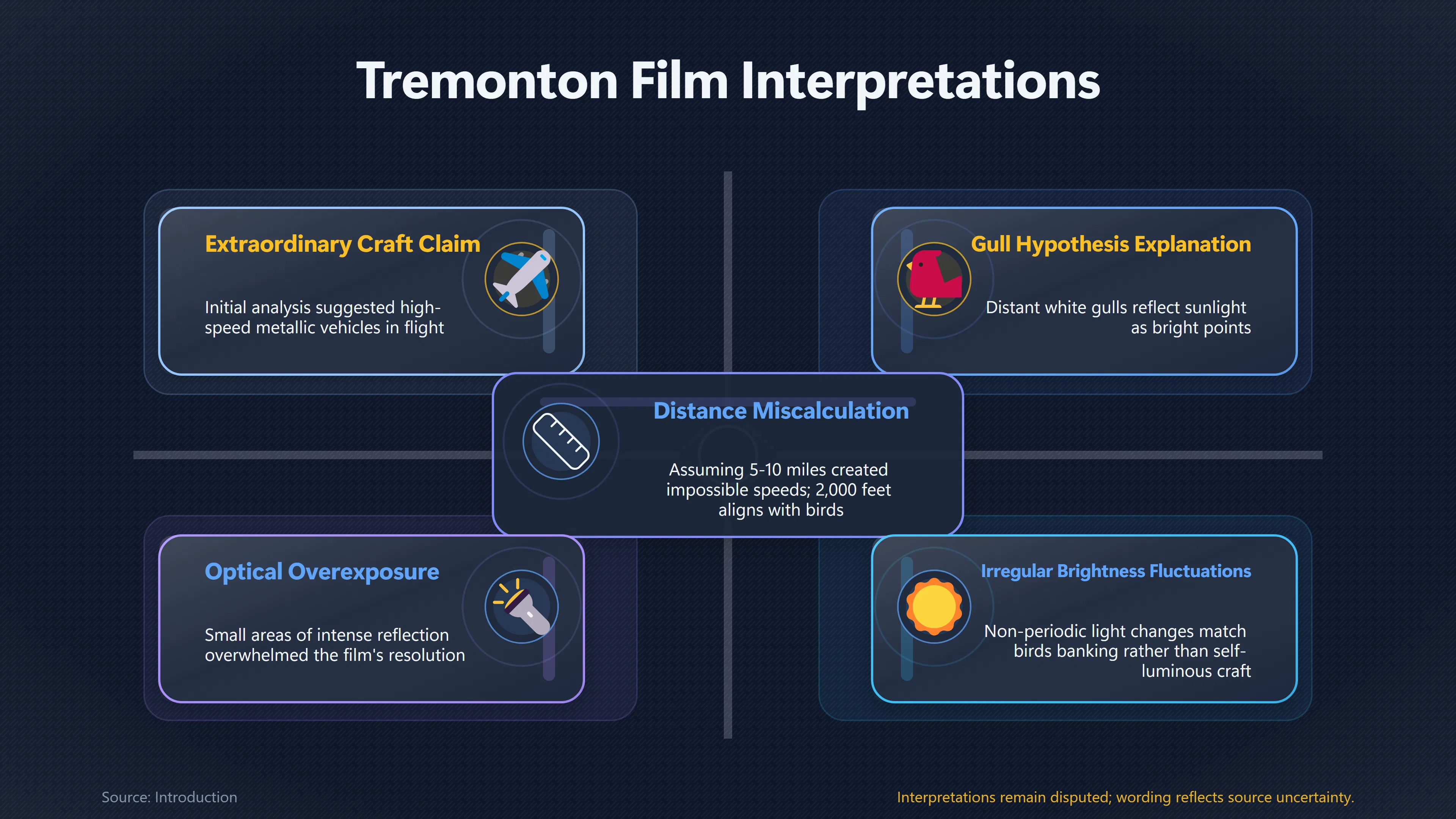
One reason the Tremonton film remained controversial is that the objects do not resemble obvious birds. They appear only as brilliant white dots against a deep blue sky, with no visible wings or body.
Later investigators argued that this appearance is exactly what might be expected if white gulls were photographed at considerable distance with the equipment Newhouse used. A gull’s bright breast or underside can reflect sunlight intensely while the darker wings remain difficult to resolve. Instead of showing a recognisable bird, the camera records a tiny overexposed point of light.[files.ncas.org]files.ncas.orgCondon Report, Case 49: Tremonton, UtahMovie Film…
Hartmann noted several factors that support this mechanism:
- White gulls were common around the Great Salt Lake region and northern Utah.
- At an estimated distance of roughly 2,000 feet (about 600 metres), individual birds would be close to the limit of visual resolution.
- Small areas of intense reflection could overwhelm the film, producing bright circular images larger than the bird’s true apparent size.
- Darker wing surfaces could become effectively invisible while the white breast continued reflecting sunlight.[files.ncas.org]files.ncas.orgCondon Report, Case 49: Tremonton, UtahMovie Film…
This explanation also addresses an early misunderstanding in the Navy analysis. Investigators initially argued that the sustained brightness implied the objects were self-luminous rather than reflecting sunlight. Later reviewers pointed out that the film actually shows irregular fluctuations in brightness, which are compatible with changing reflection angles rather than constant light emission.[files.ncas.org]files.ncas.orgCondon Report, Case 49: Tremonton, UtahMovie Film…
How distance changes the speed calculation
The most important insight behind the gull hypothesis is that the film never measured distance.
The camera recorded only angular motion—the rate at which the points moved across the field of view. Converting that motion into miles per hour requires knowing how far away the objects were.
Early calculations often assumed distances of around five to ten miles. At those ranges, the measured angular motion implied extremely high speeds, sometimes well above the performance of known aircraft in 1952. Those impressive figures became central to claims that the film captured extraordinary vehicles.[files.ncas.org]files.ncas.orgCondon Report, Case 49: Tremonton, UtahMovie Film…
Hartmann revisited the same measurements using a much shorter distance consistent with ordinary birds. At roughly 2,000 feet, the calculated speeds fall dramatically into the range expected for flying gulls:
- average flight speeds around 45–55 mph;
- relative motion within the flock of only a few miles per hour;
- movements consistent with birds drifting together while occasionally separating.[files.ncas.org]files.ncas.orgCondon Report, Case 49: Tremonton, UtahMovie Film…
The mathematics therefore changes completely depending on the assumed range. Because the film contains no independent measurement of distance, neither the extraordinary speed estimates nor the bird-speed estimates can be directly confirmed from the footage alone. The speed argument is therefore inseparable from the distance assumption.
Which movements and brightness changes fit gulls
Supporters of the gull explanation point to several features of the film that resemble normal bird behaviour.
The objects do not travel in rigid formation. Instead they drift, cluster, separate and repeatedly change relative positions. One object eventually leaves the main group, behaviour that Hartmann noted could match a bird departing a thermal or changing its flight path independently of the flock.[files.ncas.org]files.ncas.orgCondon Report, Case 49: Tremonton, UtahMovie Film…
Brightness also changes in an irregular rather than perfectly periodic way. Instead of flashing at regular intervals, individual objects brighten and fade unpredictably. This is consistent with soaring birds gradually changing orientation to the Sun while banking or wheeling through the air. Several nearby birds can also brighten almost simultaneously if they turn in a similar direction.[files.ncas.org]files.ncas.orgCondon Report, Case 49: Tremonton, UtahMovie Film…
Perhaps the most persuasive support came after Hartmann completed his formal investigation. While travelling through Utah in 1968, he deliberately watched local gulls under similar conditions. He reported seeing distant flocks whose appearance strongly reminded him of the Tremonton film: pale points milling together, pairs separating from the group, birds fading from view as others brightened, and individual birds remaining difficult to resolve even though they were plainly birds when observed taking off. Although not a controlled experiment, this field observation strengthened his confidence that the filmed objects could indeed have been gulls.[files.ncas.org]files.ncas.orgCondon Report, Case 49: Tremonton, UtahMovie Film…
Why the gull explanation remains debated
The bird hypothesis became stronger over time, but it has never achieved unanimous acceptance.
Several objections continue to be raised:
- No bird can be positively identified in any frame of the surviving film.
- Regular wing-flapping is not obvious, although the objects are too small for such detail to be expected reliably.
- The required distance places the birds close to the threshold where they become unresolvable, meaning relatively small changes in assumed range affect the calculated speeds.
- Newhouse later stated that he believed he had seen structured, metallic-looking objects rather than birds, although investigators generally gave greater weight to his earlier, more cautious statements made soon after the sighting.[files.ncas.org]files.ncas.orgCondon Report, Case 49: Tremonton, UtahMovie Film…
For these reasons, Hartmann deliberately described the identification as provisional rather than absolute. His conclusion was not that the film conclusively proved the presence of gulls, but that nothing in the surviving photographic evidence required an extraordinary explanation and that birds accounted for the observed characteristics better than competing conventional alternatives.[files.ncas.org]files.ncas.orgCondon Report, Case 49: Tremonton, UtahMovie Film…
What the gull theory changes about the Tremonton film
The significance of the gull explanation lies less in identifying a particular species than in demonstrating how easily unresolved points of light can mislead observers when their distance is unknown.
Once the assumption of distant aircraft is replaced by the possibility of nearby birds, several apparent mysteries—including extreme speed, changing brightness and loose, milling motion—become compatible with ordinary wildlife illuminated by the Sun. That does not erase every uncertainty surrounding the Tremonton film, but it substantially weakens the argument that the footage itself provides evidence for unconventional aircraft.
Within the wider debate over the Tremonton case, the gull hypothesis therefore represents the leading sceptical interpretation: not because every question has been answered, but because later analysis showed that the film’s most striking visual characteristics can be reproduced by a much less extraordinary mechanism.[files.ncas.org]files.ncas.orgCondon Report, Case 49: Tremonton, UtahMovie Film…
Amazon book picks
Further Reading
Books and field guides related to Could Gulls Really Explain the Tremonton Film?. Use these as the next step if you want deeper reading beyond the article.
The Report on Unidentified Flying Objects
Shows how mundane explanations compete with unusual claims.
The Demon-haunted World
Encourages evidence-based evaluation of competing explanations.
eBay marketplace picks
Marketplace Samples
Live-tested eBay searches with available results related to this page.
Selected fromUFO poster oneBay.co.uk.
Endnotes
1.
Source: cia.gov
Title: How To Investigate a Flying Saucer
Link:https://www.cia.gov/stories/story/how-to-investigate-a-flying-saucer/
Source snippet
How To Investigate a Flying Saucer - CIAJanuary 21, 2016...
Published: January 21, 2016
2.
Source: files.ncas.org
Title: Condon Report, Case 49: Tremonton, Utah
Link:https://files.ncas.org/condon/text/case49.htm
Source snippet
Movie Film...
3.
Source: cia.gov
Title: DUA L GAMMA VS TRENTON PROCESSING ANALYSIS | CIA FOIA (foia.cia.gov)
Link:https://www.cia.gov/readingroom/document/cia-rdp78b03817a001000020025-5
4.
Source: files.ncas.org
Title: appndx u
Link:https://files.ncas.org/condon/text/appndx-u.htm
5.
Source: gov.scot
Link:https://www.gov.scot/publications/understanding-seabird-behaviour-sea-part-2-improved-estimates-collision-risk-model-parameters/pages/4/
Source snippet
Results - Understanding seabird behaviour at sea part 2: improved estimates of collision risk model parameters - gov.scotOctober 16, 2023...
Published: October 16, 2023
Additional References
6.
Source: pmc.ncbi.nlm.nih.gov
Title: The rapid advancement of drones for ecological monitoring and research ha
Link:https://pmc.ncbi.nlm.nih.gov/articles/PMC12588502/
Source snippet
practice guidance for recreational and professional drones near colonial breeding birds - PMCNovember 5, 2025 — ABSTRACT Drone use has in...
Published: November 5, 2025
7.
Source: brightlightsfilm.com
Title: The Birds Is Us: Where Did We Come From?
Link:https://brightlightsfilm.com/hitchcock-birds-melanie-meaning-analysis/
Source snippet
Bright Lights Film JournalAugust 18, 2020 — iframe The Birds’ credit sequence works on us similarly. Instead of slashing instrumental mus...
Published: August 18, 2020
8.
Source: nsojournals.onlinelibrary.wiley.com
Title: experimenter stepping away) until the g
Link:https://nsojournals.onlinelibrary.wiley.com/doi/abs/10.1111/jav.03028
Source snippet
neophilia in wild herring gulls in urban and rural locations - Inzani - 2023 - Journal of Avian Biology - Wiley Online LibraryDecember 15...
9.
Source: history.com
Title: ufo sightings cia robertson condon
Link:https://www.history.com/articles/ufo-sightings-cia-robertson-condon
Source snippet
How the CIA Tried to Quell UFO Panic During the Cold War | HISTORYJanuary 6, 2020 — To this end, the CIA’s Office of Scientific Intellige...
Published: January 6, 2020
10.
Source: youtube.com
Title: Dark Ambient on Korg Wavestate + Montana & Utah UFO films
Link:https://www.youtube.com/watch?v=0_ubEXNVhqU
Source snippet
The Robertson Panel: UFO's, Science and Lies...
11.
Source: nicap.org
Title: The Newhouse Film, Tremonton Utah
Link:https://www.nicap.org/reports/utah1.htm
Source snippet
The Newhouse Film, Tremonton Utah - Randle...
12.
Source: cufon.org
Link:https://www.cufon.org/cufon/robert.htm
13.
Source: dare.uva.nl
Link:https://dare.uva.nl/record/1/494192
14.
Source: youtube.com
Link:https://www.youtube.com/watch?v=v9wUHdXmgQU
Source snippet
The Most Puzzling UFO Case of the 20th Century | Monstrum...
15.
Source: youtube.com
Link:https://www.youtube.com/watch?v=2k7K5H6Htl8
Source snippet
1952 UFO Sighting is Oldest Caught on Camera...