Within North Carolina
Are the Brown Mountain Lights Still a Mystery?
A century of strange-light stories meets a federal investigation that traced many sightings to trains, cars, fires and fixed lights.
On this page
- How the legend developed
- What the federal investigators measured
- Which sightings remain uncertain
Page outline Jump by section
Introduction
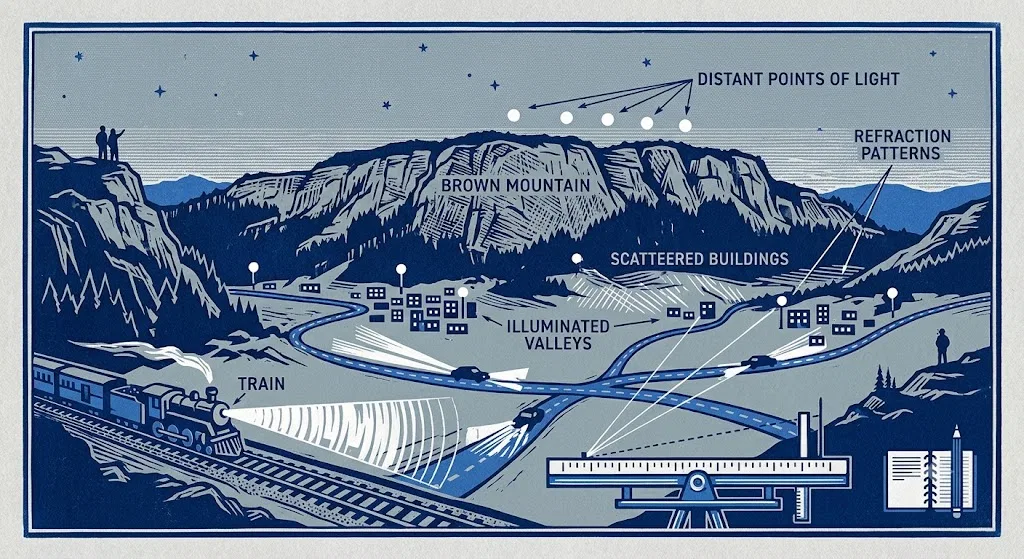
The Brown Mountain Lights are still a mystery only in a limited sense. North Carolina’s most famous strange-light tradition includes reports that cannot now be reconstructed with confidence, and modern cameras have occasionally recorded lights without securing a definite identification. Yet the best-investigated displays were not left unexplained. A United States Geological Survey investigation in 1922 traced the observed lights to automobile and locomotive headlights, fixed electric lamps and fires, their appearance altered by distance, terrain and unstable air above the Catawba Valley.[U.S. Geological Survey]pubs.usgs.govU.S. Geological SurveyU.S. Geological Survey
That distinction matters within North Carolina’s UFO history. Brown Mountain is not one continuing object or phenomenon awaiting a single solution. It is a case family: many different observations, made from different viewpoints over more than a century, gradually gathered under one famous name. The strongest evidence weakens claims of a single extraordinary cause, while leaving room for a smaller number of poorly documented or genuinely unidentified sightings.
How the legend developed
Brown Mountain is a long, comparatively low ridge in Burke and Caldwell counties, visible across deep valleys from several elevated viewpoints. At night, an observer may be looking across many miles of uneven ground towards roads, railway lines, settlements and distant ridges. A light originating beyond or below the mountain can therefore appear to sit on its slopes, hover over its crest or move through the landscape when its true distance is unknown. Mansfield’s later survey found that lines of sight to several reported lights passed hundreds of feet above Brown Mountain, even though observers naturally perceived them as belonging to the mountain itself.[U.S. Geological Survey]pubs.usgs.govU.S. Geological Survey
The early record is younger than the folklore
Modern retellings sometimes say that Indigenous people, early settlers or Civil War communities had watched the lights for generations. The surviving contemporary record is much less secure. In 1922 Mansfield collected conflicting testimony: some residents claimed much older knowledge, but others who had lived or travelled around the mountain said they had not heard of the phenomenon before about 1910. Joseph Loven, one of the people most closely associated with the early story, said he had noticed lights in 1897 but had paid them little attention until local publicity began around 1910.[U.S. Geological Survey]pubs.usgs.govU.S. Geological Survey
The difference between an old sighting and an old legend is important. A later family recollection or folkloric story may preserve a genuine experience, but it does not carry the same evidential weight as a dated newspaper report, observing log or photograph. The earliest well-documented public controversy belongs to the early twentieth century, precisely when stronger locomotive lamps, growing road traffic and spreading electric lighting were changing the night-time appearance of the valleys.
Newspaper attention turned scattered observations into a recognised attraction. A 1913 account described reddish lights appearing above the horizon at apparently regular times. North Carolina congressman Edwin Yates Webb asked the USGS to investigate, and geologist D. B. Sterrett concluded that locomotive headlights on the Southern Railway were visible along the relevant sightlines. He compared appearances with train schedules and regarded the match as decisive.[U.S. Geological Survey]pubs.usgs.govU.S. Geological Survey
That first inquiry did not end the story. Its explanation was narrow—train lights—and many local observers believed their experiences were more varied. The controversy intensified after the destructive 1916 flood interrupted nearby rail traffic while people continued to report lights. This did show that not every report could be attributed solely to trains. It did not show that the remaining lights shared an unknown or extraordinary source, because roads, buildings, fires and other light sources remained.[U.S. Geological Survey]pubs.usgs.govU.S. Geological Survey
Folklore changed the meaning of the lights
As the story spread, ghost legends supplied causes that observation alone could not provide: searching lovers, lost family members, murdered travellers and spirits wandering with lanterns. Later popular culture added extraterrestrial craft and glowing airborne orbs. These traditions are culturally significant, but their gradual appearance is a warning against reading recent descriptions back into the earliest evidence.
The original public controversy largely concerned distant, star-like or lantern-like points appearing near the horizon. Later testimony increasingly included close lights, rapid manoeuvres and encounters within the gorge. That change does not prove that newer witnesses invented their experiences. It does mean that “the Brown Mountain Lights” no longer refers to a stable description. Expectations created by ghost stories, UFO culture and media coverage may influence which unusual lights people notice, how they estimate movement and how they remember an ambiguous event.
The legend has therefore become stronger than any individual observation. A person who sees a distant flare near Brown Mountain already possesses a name and narrative for it. In many other places the same event might be reported merely as a car light, aircraft or unidentified flash; here it can immediately join a century-old mystery.
What the federal investigators measured
The most valuable investigation was George R. Mansfield’s two-week USGS study in March and April 1922. Unlike a casual viewing trip, it attempted to connect each light with geography, direction, timing and known activity. Mansfield observed on seven evenings, several times remaining in the field after midnight, and worked from stations near Loven’s Hotel, Gingercake Mountain and Blowing Rock.[U.S. Geological Survey]pubs.usgs.govU.S. Geological Survey
His main instrument was an alidade, a sighting telescope used with a map to measure the direction and vertical angle of a light. The team plotted sightlines, constructed terrain profiles, allowed for the Earth’s curvature and atmospheric refraction, and checked railway records and schedules. The method was not technologically advanced by modern standards, but it addressed the central weakness in eyewitness reports: without triangulation or a reliable horizon reference, apparent position and movement can be badly misleading.[U.S. Geological Survey]pubs.usgs.govU.S. Geological Survey
Ordinary lights did not look ordinary
The observations explain why witnesses could sincerely reject familiar sources. At long range, only a headlight directed towards the observer may be visible. As a car rounds a bend or a locomotive changes direction, its light can flare into view, fade abruptly and seem to rise or move sideways. Haze and variations in air density can further change brightness, colour and apparent steadiness.
Mansfield recorded 23 lights instrumentally and judged 11 probably to be automobile headlights. Other observations matched locomotive headlights, fixed lights in towns or buildings, and brush fires. One reddish light seemed to vanish to the naked eye after flaring twice but remained faintly visible through the telescope at the same location. Another apparent Brown Mountain-type light plotted towards streets in Lenoir and was probably produced by a car.[U.S. Geological Survey]pubs.usgs.govU.S. Geological Survey
This is the report’s most important result. The investigators did not merely propose that cars or trains might explain the lights. They measured directions and, in several instances, connected appearances with roads, railway curves, settlements or scheduled movements. The lights they saw also resembled contemporary published descriptions and were accepted by Joseph Loven as an average display, although another member of the Loven family thought they were less brilliant than the “real” phenomenon.[U.S. Geological Survey]pubs.usgs.govU.S. Geological Survey
That disagreement exposes a recurring problem in anomalous-light investigations. Once a candidate light is identified as ordinary, a believer can argue that it was never the genuine phenomenon. The category then becomes difficult to test: every explained sighting is excluded, while the least documented reports are retained as representative.
Refraction helped the illusion, but was not the source
The USGS conclusion is sometimes compressed into the claim that “a mirage” produced the Brown Mountain Lights. Mansfield’s reasoning was more specific. He rejected a conventional mirage as the general cause, noting that the terrain and night-time air movements were unfavourable to the proposed mechanism. He instead argued that ordinary lights were being viewed at very low angles through layers of air whose temperature, density and humidity varied across the basin. That atmospheric instability could refract, dim, scatter or tint the light.[U.S. Geological Survey]pubs.usgs.govU.S. Geological Survey
In other words, the atmosphere acted as a modifier rather than a mysterious lamp. The energy still came from headlights, fires or fixed lighting. Refraction helped make those sources look detached, coloured, intermittent or displaced from their actual locations.
Mansfield also considered electrical discharges resembling the so-called Andes light and St Elmo’s fire. He found their reported appearance unlike the ordinary Brown Mountain display and found no special geological basis for expecting such activity there. His conclusion was not that unusual electrical events could never occur in the region, but that they did not explain the regular lights under investigation.[U.S. Geological Survey]pubs.usgs.govU.S. Geological SurveyU.S. Geological Survey
Which sightings remain uncertain
The federal investigation explained a display, not every story ever attached to Brown Mountain. Mansfield himself discussed a striking 1916 account in which observers on Adams Mountain reported two apparent globes moving along Brown Mountain’s eastern side for roughly twenty minutes. A second observing party did not see them. Years later, the event could not be reconstructed satisfactorily. Mansfield considered nearby fireflies possible but improbable and saw no reason to infer anything supernatural.[U.S. Geological Survey]pubs.usgs.govU.S. Geological Survey
That is a reasonable classification: unresolved, but weakly evidenced. The account contains named observers and descriptive detail, yet lacks photographs, simultaneous bearings, reliable distance measurements and confirmation from the other group. Estimated size, speed and route all depend on the assumption that the lights were on the distant mountainside. A small nearby source would produce radically different calculations.
Modern monitoring has improved the evidence base without producing a clear new physical explanation. Appalachian State University researchers established cameras overlooking Brown Mountain and Linville Gorge, partly to separate transient lights from the fixed background of roads and settlements. Their project describes the commonly reported phenomenon as small, star-like points, with witness accounts ranging from slow movement to rapid, firework-like activity.[dancaton.physics.appstate.edu]dancaton.physics.appstate.eduThe Brown Mountain LightsThe Brown Mountain Lights
In July 2016, researchers reported that two cameras had recorded an anomalous light above Brown Mountain after years of monitoring. Contemporary coverage described it as a ball or pulse of light that could not then be identified. The multi-camera capture is more useful than a lone eyewitness statement because it confirms that a luminous event reached the cameras; it does not, by itself, establish the object’s distance, nature or relationship to historic reports.[bpr.org]bpr.orgApp State Researchers Capture Image Of Unexplained Light At Brown MountainApp State Researchers Capture Image Of Unexplained Light At Brown Mountain
The rarity of such captures is itself informative. Long periods of observation have not revealed a frequent, repeatable phenomenon with a consistent spectrum, route, altitude or weather association. A handful of unidentified images may justify further investigation, but they do not overturn the USGS finding that many classic displays were produced by ordinary valley lights.
Unidentified also does not mean unexplainable in principle. A distant aircraft, vehicle, fire, meteor, satellite glint, insect near the lens or camera artefact may remain unidentified when the record lacks enough information. The proper conclusion is narrower: the source was not established from the available material.
Why the mystery survives
The Brown Mountain Lights endure partly because the landscape is exceptionally good at defeating human depth perception. Viewers watch from high, dark overlooks towards a complicated field of ridges and valleys. There may be few visible landmarks between the observer and a point of light. Without knowing whether a source is hundreds of metres away or many kilometres distant, the eye cannot reliably determine its size, speed or position relative to the mountain.
Expectation adds another layer. A person who has travelled specifically to see a mystery is likely to watch longer, notice faint changes and interpret movement against the legend. Small involuntary eye movements can make an isolated point appear to wander—the autokinetic effect—while haze, branches, passing cloud and changing lines of sight can make it blink or jump. None of this implies dishonesty. It explains how compelling testimony can arise without a correspondingly unusual object.
The site also demonstrates why recurring-light traditions are harder to assess than single UFO incidents. Reports made decades apart may involve entirely different causes but acquire the same label. The 1913 scheduled lights, the 1916 globes, modern close-encounter stories and a camera pulse in 2016 should not be treated as four observations of one entity merely because each occurred near Brown Mountain.
For North Carolina’s wider UFO record, Brown Mountain is therefore less a landmark extraterrestrial case than a landmark lesson in investigation. It shows how mapping, timing and multiple viewpoints can turn a mysterious aerial light into a terrestrial one—and how a small remainder of incomplete cases can preserve a legend after its central historical display has largely been explained.
Are the Brown Mountain Lights still a mystery?
The fairest answer is: the legend remains alive, but the main historical phenomenon is substantially explained.
The strongest findings can be separated clearly:
- Well supported: Many lights observed during the 1922 investigation came from cars, trains, fixed lamps and fires. Measured sightlines and schedule checks supported those identifications. Atmospheric refraction and haze altered how the sources appeared.
- Plausible but case-dependent: Aircraft, newer road traffic, campfires, astronomical objects, insects and camera effects can explain additional reports, but each sighting requires its own evidence.
- Unresolved: A few historical accounts and modern recordings lack enough information for a confident identification.
- Not established: No verified evidence connects the Brown Mountain Lights with extraterrestrial craft, a unique geological energy source, spirits or one recurring unknown object.
Later reporting has therefore weakened the broad claim that Brown Mountain produces a single scientifically inexplicable light. It has not proved that every observer was mistaken or that every future light will be identifiable. What remains is a mixture of strong folklore, difficult viewing conditions, diverse ordinary sources and a small residue of observations that are uncertain because the necessary measurements were never obtained.
Amazon book picks
Further Reading
Books and field guides related to Are the Brown Mountain Lights Still a Mystery?. Use these as the next step if you want deeper reading beyond the article.
The Demon-Haunted World
Rating: 4.5/5 from 43 Google Books ratings
Encourages evidence-based analysis of mysterious lights.
Passport to Magonia: from folklore to flying saucers
Connects folklore with unusual light reports.
eBay marketplace picks
Marketplace Samples
Live-tested eBay searches with available results related to this page.
Selected fromBrown Mountain poster oneBay.co.uk.


Endnotes
1.
Source: pubs.usgs.gov
Title: U.S. Geological Survey
Link:https://pubs.usgs.gov/circ/1971/0646/report.pdf
2.
Source: dancaton.physics.appstate.edu
Title: The Brown Mountain Lights
Link:https://www.dancaton.physics.appstate.edu/BML/BML.htm
3.
Source: bpr.org
Title: App State Researchers Capture Image Of Unexplained Light At Brown Mountain
Link:https://www.bpr.org/news/2016-08-05/app-state-researchers-capture-image-of-unexplained-light-at-brown-mountain
4.
Source: pubs.usgs.gov
Link:https://pubs.usgs.gov/publication/cir646
5.
Source: usgs.gov
Title: map brown mountain and occurrences brown mountain lights
Link:https://www.usgs.gov/media/images/map-brown-mountain-and-occurrences-brown-mountain-lights
6.
Source: dancaton.physics.appstate.edu
Title: USGS p01
Link:https://dancaton.physics.appstate.edu/BML/USGSreport/USGS-p01.htm
7.
Source: cas.appstate.edu
Title: september 17 i saw light film screening and excursion brown mountain lights
Link:https://cas.appstate.edu/news/september-17-i-saw-light-film-screening-and-excursion-brown-mountain-lights
8.
Source: dsoftp.appstate.edu
Title: USGS p02
Link:https://dsoftp.appstate.edu/web/BML/USGSreport/USGS-p02.htm
9.
Source: dancaton.physics.appstate.edu
Link:https://www.dancaton.physics.appstate.edu/BML/Research/index.htm
10.
Source: foothillsdigest.com
Title: brown mountain lights
Link:https://foothillsdigest.com/brown-mountain-lights/
11.
Source: Wikipedia
Title: Brown Mountain lights
Link:https://en.wikipedia.org/wiki/Brown_Mountain_lights
12.
Source: ashevilleterrors.com
Title: brown mountain lights
Link:https://ashevilleterrors.com/brown-mountain-lights/
13.
Source: pbsnc.org
Title: brown mountain lights
Link:https://www.pbsnc.org/blogs/lifestyle/brown-mountain-lights/
14.
Source: youtube.com
Link:https://www.youtube.com/watch?v=f3CN6e_gH3s&vl=en
15.
Source: kids.kiddle.co
Title: Brown Mountain Lights
Link:https://kids.kiddle.co/Brown_Mountain_Lights
16.
Source: ourstate.com
Title: brown mountain lights
Link:https://www.ourstate.com/brown-mountain-lights/
17.
Source: appalachianhistory.net
Title: The Brown Mountain Lights
Link:https://www.appalachianhistory.net/2010/10/the-brown-mountain-lights.html
18.
Source: wherethedogwoodblooms.com
Title: brown mountain lights
Link:https://www.wherethedogwoodblooms.com/brown-mountain-lights/
Additional References
19.
Source: skepticalinquirer.org
Title: Skeptical Inquirer The Brown Mountain Lights: Solved!
Link:https://skepticalinquirer.org/2016/04/the-brown-mountain-lights-solved-again/
Source snippet
(Again!)As with UFOs, some lights will remain unidentified—not because they are inherently mysterious but because they are just eyewitnes...
20.
Source: appalachianhistorian.org
Link:https://appalachianhistorian.org/the-brown-mountain-lights-ghost-stories-headlights-and-a-century-of-watching-the-ridge/
Source snippet
The Brown Mountain Lights: Ghost Stories, Headlights, and a...14 Dec 2025 — The 1916 flood gave opponents of the train explanation a rea...
21.
Source: theappalachianonline.com
Title: brown mountain mystery
Link:https://theappalachianonline.com/brown-mountain-mystery/
Source snippet
The AppalachianBrown Mountain Mystery: Recurring light phenomenon baffles...23 Jan 2020 — Caton said after observing the lights for seve...
22.
Source: reddit.com
Link:https://www.reddit.com/r/Appalachia/comments/17x4cg3/anyone_here_seen_the_brown_mountain_lights_in/
23.
Source: facebook.com
Link:https://www.facebook.com/groups/AppalachianAmericans/posts/10161609126753648/
24.
Source: ncpedia.org
Link:https://www.ncpedia.org/brown-mountain-lights
25.
Source: blueridgecountry.com
Link:https://blueridgecountry.com/travel/brown-mountain-lights-revisited/
26.
Source: facebook.com
Link:https://www.facebook.com/groups/50614403543/posts/10155923338623544/
27.
Source: amazon.co.uk
Link:https://www.amazon.co.uk/Brown-Mountain-Lights-Appalachian-Contributions-ebook/dp/B06Y4GRGPB?tag=searcht-20
28.
Source: ebay.co.uk
Link:https://www.ebay.co.uk/itm/389917218713?mkevt=1&mkcid=1&mkrid=710-53481-19255-0&campid=5339151051&customid=endnote-source&toolid=10001