Within Louisiana
Did the Haynesville UFO Leave Physical Traces?
The Haynesville case remains Louisiana's strongest dispute because a close-range sighting was later linked to alleged heat damage on nearby trees.
On this page
- Louie Galloway's close range encounter
- Scorched bark, sample provenance and later energy estimates
- Why modern reanalysis revived but did not resolve the case
Page outline Jump by section
Introduction
The Haynesville incident is often presented as Louisiana’s strongest “physical trace” UFO case, but that description needs qualification. On 30 December 1966, physics lecturer Louie A. Galloway and his family saw an intensely bright, pulsating light in woodland north of Haynesville. The original official investigation could not identify the light, yet it also found no burn mark, radioactive trace or damaged vegetation connected to the event. Claims of blackened tree bark emerged only after Galloway and civilian colleagues later identified a different clearing and collected bark samples.
A 2025 aerospace-journal paper revived the case by modelling the energy supposedly required to produce the reported light and bark damage. Its calculations are striking, but they depend on uncertain distances, remembered brightness, a retrospectively selected site and samples whose history is not independently documented from the night of the sighting onwards. The fairest conclusion is therefore that Haynesville remains genuinely unexplained as a luminous observation, while its physical-trace claim is intriguing but unproven.
Louie Galloway’s close-range encounter
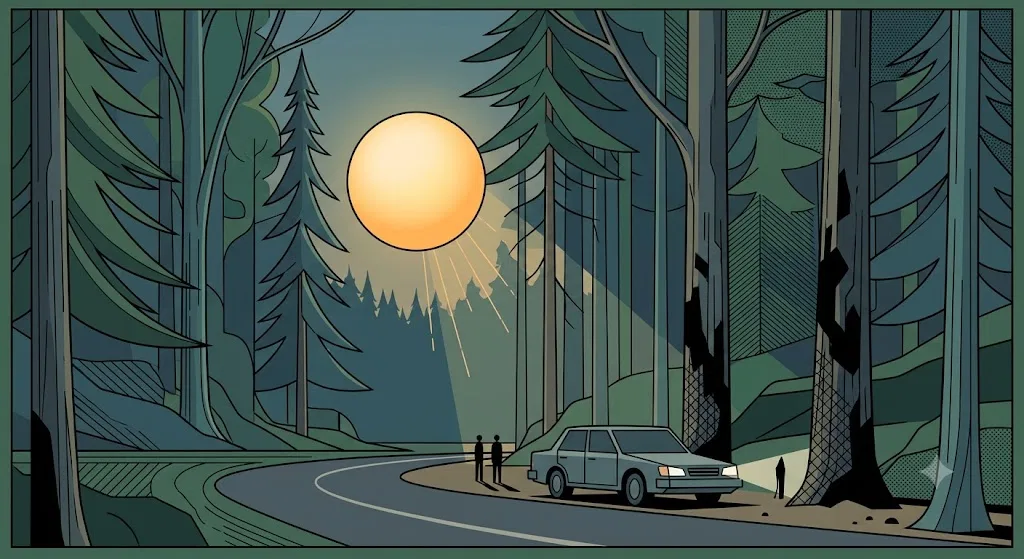
At about 8.30 pm, Galloway was driving north on US Highway 79 with his wife and two young children. The weather was poor: low cloud, fog and light drizzle, with an estimated ceiling of about 300 feet. His wife first noticed a red-orange glow ahead and to the west. As the car continued, the witnesses perceived the source as being below or among the treetops rather than high in the sky. It appeared to pulse from dull red to bright orange at roughly two-second intervals.[Internet Archive]archive.orgOpen source on archive.org.
At the point of closest approach, the glow reportedly changed to brilliant white for about four seconds. Galloway said it overwhelmed the visible effect of the car’s headlights, illuminated the surrounding woodland, cast tree shadows and forced him to shield his eyes. The brightness woke the children. The light then returned to its earlier red-orange pulsation. Galloway stopped farther along the road to take another bearing before leaving; no sound, vehicle malfunction, heat on the occupants or other immediate physical effect was reported.[Internet Archive]archive.orgOpen source on archive.org.
The sighting deserves attention because it was not merely a fleeting point of light. Two adults watched it from changing positions along the road, and Galloway attempted to record distances and directions rather than simply supplying an impressionistic story. His scientific education also made investigators more willing to pursue the report. The University of Colorado team working under physicist Edward Condon noted that the account did not initially describe a structured craft at all: it concerned a powerful, localised light whose source could not be seen clearly through trees, mist and rain.[Internet Archive]archive.orgOpen source on archive.org.
That distinction is important. Later retellings often turn Haynesville into a close encounter with a landed object, but the contemporary description supports a narrower claim: a luminous phenomenon appeared near ground level or below the apparent treeline. The witnesses did not report a metallic body, landing legs, occupants or a clear departure. The light was still present when Galloway ended his observation.[Internet Archive]archive.orgOpen source on archive.org.
There is also a geographical wrinkle. Although the case is associated with Haynesville and entered Louisiana UFO history through Galloway, Barksdale Air Force Base and the Shreveport academic community, the site reconstructed by the 2025 paper lay roughly one mile north of the state boundary, in Arkansas. “Haynesville” remains the useful case name, but the alleged trace location was technically across the border.[ScienceDirect]sciencedirect.comOpen source on sciencedirect.com.

What investigators found in 1967
Galloway reported the incident to Barksdale Air Force Base, and it reached both Project Blue Book and the newly established University of Colorado UFO project. In spring 1967, Colorado investigators David Saunders and James Wadsworth joined Galloway and an astronomer colleague for an air-and-ground search. A helicopter was used to examine possible locations, while observers on the ground took bearings. The group also maintained a night watch in case the phenomenon returned.[Internet Archive]archive.orgOpen source on archive.org.
The search occurred roughly ten weeks after the event, already limiting what could be established. The investigators found woodland, undergrowth, oil installations and several environmentally disturbed areas, but nothing that could be securely connected to the light. One burned patch with slightly elevated radioactivity proved to be an oil slick that had burned beside a pumping station. Similar readings occurred around other oil-related sites, suggesting an industrial rather than anomalous source.[Internet Archive]archive.orgOpen source on archive.org.
Galloway continued checking ordinary explanations after the Colorado team left. According to information incorporated into the Condon Report:
- a railway dispatcher said no rolling stock had been within 50 miles at the relevant time;
- the nearest high-voltage lines were said to be about nine miles away;
- five oil companies reported no burn-off, pipeline rupture, flare or other known fire in the area;
- Barksdale photographic analysts examined aerial imagery, but follow-up inspection did not identify a feature connected with the event.[Internet Archive]archive.orgOpen source on archive.org.
These enquiries weakened several obvious explanations. A locomotive headlamp, electrical fault or routine oilfield flare became less attractive if the records and reconstructed location were accurate. Yet they did not establish that an unconventional object had been present. Company records can miss unauthorised or short-lived activity, and the uncertain position of the source meant that investigators could not be sure they were asking about the correct patch of land.
The Condon Report therefore left Case 10 without an explanation. In its general discussion, the project used Haynesville as an example of an investigation rendered inconclusive by insufficient evidence. “Unidentified” in this context meant that no source had been demonstrated, not that investigators had verified extraordinary technology.[Internet Archive]archive.orgOpen source on archive.org.
Scorched bark and uncertain provenance
The famous tree damage was not part of the original field result. The Colorado investigators did not identify a circular burn site or collect vegetation samples linked to the sighting. According to the 2025 reanalysis, Galloway later returned with colleagues, reconstructed the location more successfully and found a clearing about 30 feet across. Trees around its edge were said to show blackening on the sides facing the centre. Pieces of affected and apparently shielded bark were subsequently removed and preserved.[ScienceDirect]sciencedirect.comOpen source on sciencedirect.com.
This reported inward-facing pattern is the most interesting element of the physical-trace claim. If several trees had genuinely been scorched only on surfaces exposed to the centre of one clearing, that geometry could indicate a local source of radiant energy. It would be harder to dismiss than one burned trunk or a generally fire-damaged patch of woodland.
However, the evidence has serious provenance problems. Provenance means the documented history of an item: where it was found, when it was collected, who handled it, how it was stored and whether its identity remained secure. Here, the supposedly affected site was recognised after the official search had failed, and the published account relies heavily on the witness and researchers who favoured a connection between the clearing and the light. There is no continuous, independently witnessed chain linking the bark to 30 December 1966.
Several unanswered questions follow:
- How long after the event was the exact clearing located?
- Was the bark photographed and mapped in place before removal?
- Were all surrounding trees surveyed, including those that did not fit the radial pattern?
- Could an older ground fire, controlled burn, oilfield incident, lightning-related fire or human activity have produced the blackening?
- Were comparison samples taken from enough trees of the same species, age and condition?
- Can the surviving pieces still be matched securely to particular trunks and orientations?
The 2025 paper states that laboratory work at France’s Atomic Energy Commission examined burned and intact bark, and it treats the samples as evidence of strong radiative exposure. Yet even a technically sound analysis of charring cannot by itself establish when the heating occurred or what caused it. Laboratory findings can describe the condition of a sample; they cannot repair gaps in its field documentation.[ScienceDirect]sciencedirect.comOpen source on sciencedirect.com.
The original investigation also offers a cautionary example. Its first apparently promising “trace” — burned ground with raised radiation — turned out to be an oil-contaminated industrial patch. That does not disprove the later tree claim, but it shows why the Haynesville landscape required careful discrimination between unusual damage and the ordinary effects of oil production, fire and land use.[Internet Archive]archive.orgOpen source on archive.org.
Why the energy estimates look dramatic
Galloway attempted to estimate the light’s output by comparing its illumination with his car headlights and reconstructing the distance from the road. His first calculation was around 800 megawatts; he later proposed a minimum near 500 megawatts. The reconstructed range during the white flash was approximately 1,000 to 1,400 yards.[Internet Archive]archive.orgOpen source on archive.org.
The 2025 paper used modern thermal-diffusion modelling and the alleged bark effects to produce estimates between roughly 500 and 1,400 megawatts. That is power on the scale of a power station, and it has made the case newly attractive to researchers looking for older reports with measurable environmental consequences.[ScienceDirect]sciencedirect.comOpen source on sciencedirect.com.
The number should not be mistaken for a direct measurement. No photometer recorded the light. No instrument measured its spectrum, duration at each intensity, beam width or distance. The calculation begins with remembered visual comparisons made during an unexpected glare on a dark, wet road. It then requires assumptions about whether the source radiated equally in all directions, was aimed towards the car, was magnified by reflection from low cloud or was partly obscured by rain and trees.
The Condon investigators highlighted inconsistencies in Galloway’s brightness estimates. In one written account, the illumination at the road was described as at least 100 times that of the headlamps. A later letter placed the headlamps slightly above the unknown light at a chosen point on the road. In a still later telephone conversation, Galloway did not recall a detectable difference. The report concluded that the several-hundred-megawatt result was “highly dubious” because modest changes in distance, beam geometry or perceived brightness would radically alter the answer.[Internet Archive]archive.orgOpen source on archive.org.
The same issue applies to modelling the bark. If the blackening required temperatures around the onset of charring, a model can estimate the radiative flux needed under selected conditions. But total source power depends on the assumed area illuminated, exposure time, bark properties, moisture, distance and directionality. A tightly focused source could require far less total power than an isotropic one. An incorrect site distance or a misidentified burn history could invalidate the calculation altogether.
The modern estimate is therefore best understood as conditional: if the clearing was the correct location, if the bark damage occurred during the sighting, if the heating geometry has been reconstructed properly and if the visual duration and intensity are sufficiently accurate, then the implied source would have been exceptionally energetic. It is not an independent demonstration that such a source existed.
Did later research strengthen the case?
The reanalysis strengthened Haynesville in one limited sense. It recovered neglected documentation, brought attention to physical samples and subjected an old claim to explicit modelling rather than leaving it as folklore. Publication in Progress in Aerospace Sciences also means that the argument can be examined through the normal scholarly process rather than circulating only in UFO magazines or private archives. The authors themselves call for further specialist work, including forestry expertise and renewed examination of any surviving material.[ScienceDirect]sciencedirect.comOpen source on sciencedirect.com.
It did not resolve the central historical weaknesses. The original team could not locate a relevant trace. The later clearing was selected retrospectively. The sample chain is incomplete, and the object was never independently observed or instrumentally recorded. No radar track, photograph, contemporaneous thermal measurement or securely dated biological injury connects the light to the trees.
Nor does the case require a choice between “alien craft” and fabrication. Galloway may have reported his experience accurately while misjudging distance, scale or the relationship between the light and the later tree damage. A powerful but conventional source could have been overlooked because the location reconstruction was wrong. Atmospheric scattering beneath low cloud might have made a more distant or directional light appear localised in the woods. The absence of a demonstrated explanation leaves these possibilities open rather than eliminating them.
Within Louisiana’s UFO history, Haynesville matters because it exposes the difference between three separate propositions:
- A striking luminous event occurred. The detailed family testimony and unsuccessful contemporary enquiries give this claim reasonable weight.
- The light remained unidentified. That is supported by the Colorado investigation, although “unidentified” reflects missing evidence rather than confirmed exotic performance.
- The light scorched trees with power-station-scale energy. This is the disputed step. It rests on a later site identification, uncertain sample provenance and calculations highly sensitive to assumptions.
The case is consequently stronger than a bare anecdote but weaker than a verified physical-trace event. Modern analysis has made the underlying dispute clearer, not settled it. Haynesville remains one of Louisiana’s most worthwhile UFO cases to study precisely because the witness report is substantial while the celebrated material evidence falls short of the standard needed to prove its connection to the light.

Amazon book picks
Further Reading
Books and field guides related to Did the Haynesville UFO Leave Physical Traces?. Use these as the next step if you want deeper reading beyond the article.
The UFO Experience: A Scientific Inquiry
Introduced physical-trace case categories relevant to Haynesville.
The Report on Unidentified Flying Objects
Provides historical context for official UFO investigations.
UFOs: Generals, Pilots, and Government Officials Go on the Re...
Covers well-documented UFO cases and evidence assessment, including physical-trace discussions.
The UFO Enigma: A New Review of the Physical Evidence
Examines physical evidence claims similar to those made for Haynesville.
eBay marketplace picks
Marketplace Samples
Live-tested eBay searches with available results related to this page.
Selected fromUFO poster oneBay.co.uk.

Endnotes
1.
Source: archive.org
Link:https://archive.org/stream/pdfy-4vyHjooOJagoGAwN/Scientific%20Study%20Of%20Unidentified%20Flying%20Objects_djvu.txt
2.
Source: sciencedirect.com
Link:https://www.sciencedirect.com/science/article/abs/pii/S0376042125000247
3.
Source: archive.org
Title: Brad Sparks Comprehensive Catalog of 1,600 Project Blue Book UFO Unknowns
Link:https://archive.org/download/BernardSieglerTechnicsAndTime1TheFaultOfEpimetheus/Brad%20Sparks%20-%20Comprehensive%20Catalog%20of%201%2C600%20Project%20Blue%20Book%20UFO%20Unknowns.pdf
4.
Source: archive.org
Link:https://archive.org/stream/pdfy-4vyHjooOJagoGAwN/Scientific%2BStudy%2BOf%2BUnidentified%2BFlying%2BObjects_djvu.txt
5.
Source: archives.gov
Title: project blue book 50th anniversary
Link:https://www.archives.gov/news/articles/project-blue-book-50th-anniversary
6.
Source: youtube.com
Title: The Scientist Who Failed to Disprove UFOs
Link:https://www.youtube.com/watch?v=2x4CexTS31M
Source snippet
The Condon Report | NASA's Unexplained Files...
7.
Source: youtube.com
Title: The Condon Report | NASA’s Unexplained Files
Link:https://www.youtube.com/watch?v=_W7SqS6UhE4
Source snippet
Fact-Checking the History Channel's Project Blue Book Series...
8.
Source: Wikipedia
Title: Project Blue Book
Link:https://en.wikipedia.org/wiki/Project_Blue_Book
Additional References
9.
Source: medium.com
Link:https://medium.com/%40kyeq1/the-forgotten-uap-case-jacques-vall%C3%A9e-calls-one-of-the-most-important-in-history-5f5f44f2d88c
Source snippet
The Forgotten UAP Case Jacques Vallée Calls One of...UFO, Aliens Crashed Séance Contacting the Dead: But Why? Did aliens step in to clos...
10.
Source: 3af.fr
Link:https://www.3af.fr/docs/2025110701_1328693110_2025-estimates-of-radiative-energy-values-in-ground-level-observations-of-an-0aunidentified-aerial-phenomenon-new-physical-data.pdf
Source snippet
They are often noted to impact both human health and physical devices in consistent ways.Read more...
11.
Source: youtube.com
Title: Project Blue Book: CIA MK Ultra Program (Season 2) | History
Link:https://www.youtube.com/watch?v=QYY5vVuit1Q
Source snippet
Project Blue Book Sneak Peek: The True Story Behind the Government's UFO Investigation - IGN First...
12.
Source: eia.gov
Link:https://www.eia.gov/todayinenergy/index.php?tg=Haynesville
13.
Source: youtube.com
Title: Fact-Checking the History Channel’s Project Blue Book Series
Link:https://www.youtube.com/watch?v=LU1G_8SSquk
Source snippet
Project Blue Book: CIA MK Ultra Program (Season 2) | History...
14.
Source: nicap.org
Link:https://www.nicap.org/chronos/1966fullrep.htm
Source snippet
The 1966 UFO ChronologySelfridge AFB reported tracking UFOs on radar over Lake Erie. (Hall, 2001, pp. 184-86; U.F.O. Investigator, Vol...
15.
Source: researchgate.net
Link:https://www.researchgate.net/publication/395858774_Toward_a_Reliability_Scale_for_Assessing_Reports_of_Unidentified_Anomalous_Phenomena_UAP
16.
Source: researchgate.net
Link:https://www.researchgate.net/publication/391927615_Estimates_of_radiative_energy_values_in_ground-level_observations_of_an_unidentified_aerial_phenomenon_New_physical_data
17.
Source: forestresearch.gov.uk
Link:https://www.forestresearch.gov.uk/research/provenance-variation-of-emerging-species/
18.
Source: prosilvaireland.com
Link:https://prosilvaireland.com/spring-field-day-report-2025/