Within South Dakota UFOs
Did Fighters Really Chase a UFO Over Ellsworth?
The 1953 Ellsworth episode combined radar returns, pilot sightings and two interceptions, but later analysis offered plausible ordinary explanations.
On this page
- The events of 5 6 August 1953
- What the pilots and radar operators reported
- Stars, meteors and radar ducting
Page outline Jump by section
Introduction
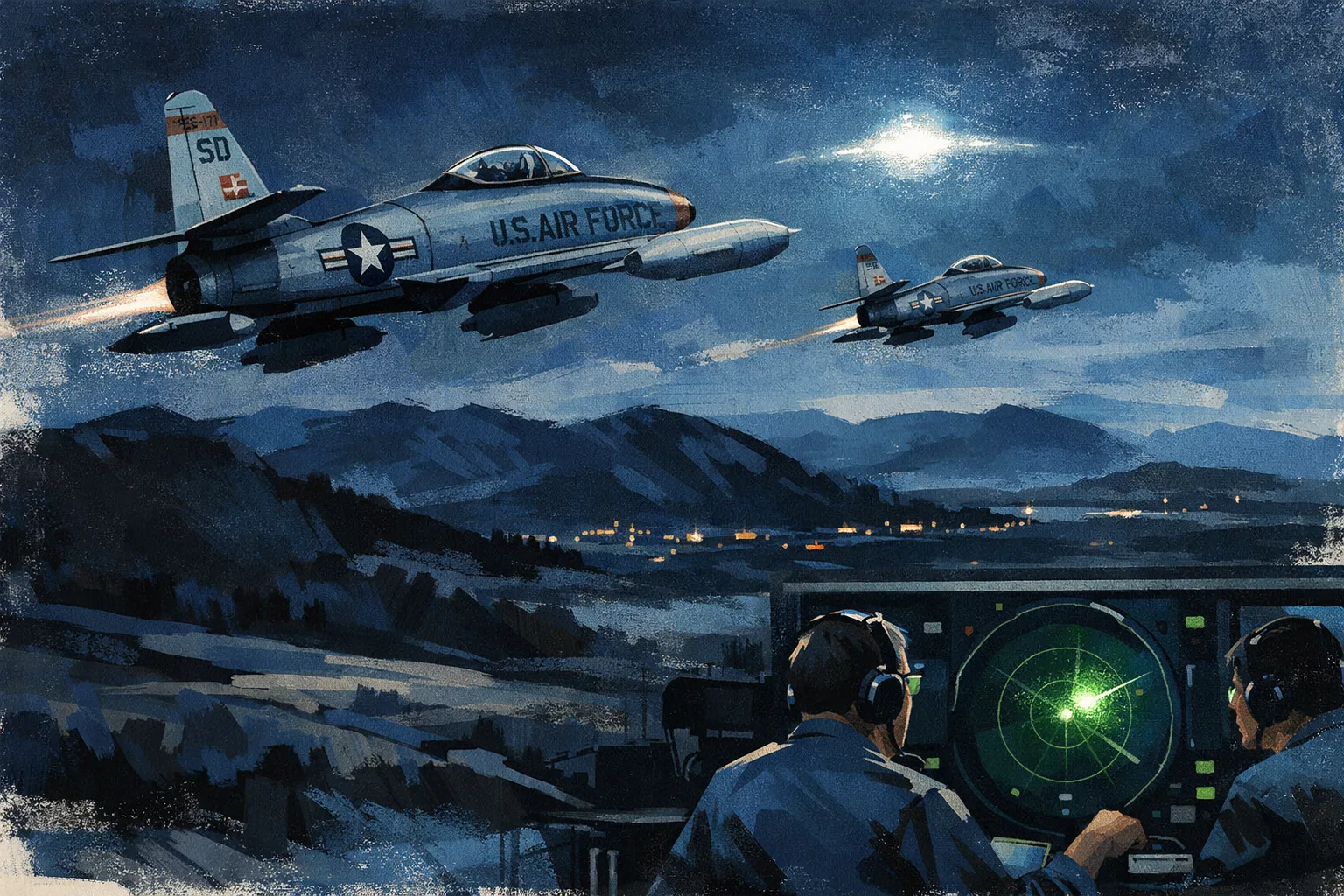
The Ellsworth radar chase of 5–6 August 1953 is South Dakota’s best-known UFO interception case because it appears, at first glance, to combine nearly every desirable kind of evidence: civilian observers, military personnel, ground radar, two F-84 fighters and a possible airborne radar contact. Yet the surviving record does not show that fighters established a continuous, independently verified track on one extraordinary craft. It shows a confused night in which several lights and numerous radar returns were treated as parts of the same developing incident.
The strongest later analysis concluded that the episode probably combined bright stars distorted near the horizon, at least one meteor, anomalous radar propagation, a possible ghost echo and a faulty fighter gunsight. That explanation is plausible rather than mathematically proven, but it substantially weakens the popular image of a solid object repeatedly outrunning interceptors. The case remains important because it demonstrates how sincere witnesses and real military responses can produce an impressive pursuit narrative without establishing that a single unknown vehicle was present.[files.bluebookfiles.org]files.bluebookfiles.org; ve - f-January 15, 2026 — 5 August 1953… Yadar, and ground-radar report, it was decided that Project Blue Book… the object or lig…
The events of 5–6 August 1953
The incident began shortly after 8pm near Black Hawk, west of Rapid City. A Ground Observer Corps volunteer reported a stationary red glowing light. According to the Air Force case material, the light appeared to move to the right, rise rapidly, shift back and return towards its original position. Another person present reportedly thought it was simply the red warning light on a local radio transmitter tower. The report nevertheless entered the regional air-defence network through the Rapid City Filter Center.[files.bluebookfiles.org]files.bluebookfiles.org; ve - f-January 15, 2026 — 5 August 1953… Yadar, and ground-radar report, it was decided that Project Blue Book… the object or lig…
Three servicemen were sent outside from the radar station to look. Their description of a separate moving light was later judged consistent with a meteor. Meanwhile, an operator began searching the ground-controlled interception radar for unexplained targets and found numerous returns. Many appeared only briefly and disappeared into ground clutter, but one apparently stationary return near Black Hawk attracted particular attention.[ufologie.patrickgross.org]ufologie.patrickgross.orgWhen the controller got the report that the object or light was headed toward Rapid City, he sent 3 airmen from the radar site to look fo…
An F-84 fighter already in the air was directed towards the reported position. The pilot saw a light and followed it on a north-westerly or northerly heading, reporting that he could not close the distance. The ground controller believed the radar showed a target remaining roughly five to ten miles ahead of the aircraft. The pursuit continued far north of Rapid City before fuel considerations forced the fighter to turn back.[files.bluebookfiles.org]files.bluebookfiles.org; ve - f-January 15, 2026 — 5 August 1953… Yadar, and ground-radar report, it was decided that Project Blue Book… the object or lig…
A second F-84 was then launched. Its pilot also saw a light and attempted to approach it. In the dramatic version later published by former Project Blue Book director Edward J. Ruppelt, the pilot tried to eliminate reflections by switching off his lights and rolling the aircraft. He then activated his radar-ranging gunsight and received an indicator suggesting something was ahead. Ruppelt wrote that the experienced combat pilot became sufficiently uneasy to request permission to end the interception.[Wikisource]en.wikisource.orgThe Report on Unidentified Flying Objects/Chapter 17The Report on Unidentified Flying Objects/Chapter 17 - Wikisource, the free online library…
The night’s reports did not end at Ellsworth. After Rapid City alerted the Bismarck Filter Center in North Dakota, personnel there went outside and identified four unusual-looking lights. Reports also reached the system from farther east. This geographical spread helped later writers present the incident as a prolonged movement across the northern Plains, but the observations were not all descriptions of the same appearance or supported by one continuous radar track.[files.ncas.org]files.ncas.orgCondon Report, Sec III, Chapter 5: Optical & Radar AnalysisCondon Report, Sec III, Chapter 5: Optical & Radar Analysis
Why the date is often given incorrectly
Ruppelt’s influential 1956 book placed the Ellsworth incident on 12 August, saying he was alerted early on 13 August. That dating was repeated in later UFO literature and in some South Dakota heritage summaries. The original Blue Book case file and the University of Colorado analysis, however, date the main Rapid City–Black Hawk–Bismarck sequence to the night of 5–6 August, between approximately 8.05pm and 2.50am local time. The earlier date is therefore better supported by the contemporary documentation.[wikisource.org]en.wikisource.orgThe Report on Unidentified Flying Objects/Chapter 17The Report on Unidentified Flying Objects/Chapter 17 - Wikisource, the free online library…
The discrepancy matters because Ruppelt’s book is vivid, readable and based partly on interviews, but it is not a verbatim reproduction of the case file. Its compressed narrative makes the visual sightings and radar returns appear more tightly synchronised than they do in the underlying report.
What the pilots and radar operators reported
The case’s reputation rests mainly on the impression of repeated radar-and-visual confirmation. A light was reported from the ground; radar displayed unexplained returns; pilots were sent towards them; and the pilots then saw lights. Ruppelt regarded this convergence as exceptionally persuasive and called the event the best UFO report in the Air Force files. In his telling, the controller, civilian spotter and first pilot all saw the object begin moving at the same time, while radar showed it accelerating whenever the fighter approached.[Wikisource]en.wikisource.orgThe Report on Unidentified Flying Objects/Chapter 17The Report on Unidentified Flying Objects/Chapter 17 - Wikisource, the free online library…
That is the strongest interpretation of the evidence, but several limitations are important.
The radar picture was unstable. The operator reported numerous unidentified returns during the night, many of them short-lived and lost in ground clutter. This is not the pattern expected from a single cleanly tracked aircraft. The surviving account also does not provide a complete plotted track, calibrated range data or preserved radar imagery from which the alleged manoeuvres can now be reconstructed.[files.ncas.org]files.ncas.orgCondon Report, Sec III, Chapter 5: Optical & Radar AnalysisCondon Report, Sec III, Chapter 5: Optical & Radar Analysis
Visual and radar contacts were not continuous. At points, observers continued to see a light when the radar could not find a corresponding target. The second fighter was directed using a visual report because no suitable ground-radar contact was initially available. A return was acquired only after the interception was under way. This leaves open the possibility that the radar operator associated unrelated or spurious echoes with the light being chased.[ufologie.patrickgross.org]ufologie.patrickgross.orgThe report was relayed to the Rapid City Filter Center, and three airmen from the radar site were sent outside to look for the UFO…. W…
The pilots saw lights, not detailed craft. No pilot reported windows, wings, a fuselage or a clearly defined solid body. The observations were of bright points or glows against a dark, moonless sky. Without a dependable distance, a light’s apparent speed and evasive behaviour are difficult to establish: a distant star remains apparently ahead no matter how quickly an aircraft flies towards it.
The airborne “lock” was questionable. The second pilot’s gunsight indicator is often described as independent radar confirmation. In a later interview with astronomer and Blue Book consultant J. Allen Hynek, however, the pilot said the equipment had malfunctioned and continued behaving irregularly as he returned to base. The gunsight was apparently not tested during the official investigation, so neither a genuine target nor a specific mechanical fault was conclusively demonstrated.[files.ncas.org]files.ncas.orgCondon Report, Sec III, Chapter 5: Optical & Radar AnalysisCondon Report, Sec III, Chapter 5: Optical & Radar Analysis
Most significantly, the second pilot later said that he believed he had probably been chasing a star, although some features of the light still troubled him. This does not prove that every observation was astronomical, but it directly contradicts later portrayals in which both pilots remained convinced that they had pursued a controlled, solid object.[files.ncas.org]files.ncas.orgCondon Report, Sec III, Chapter 5: Optical & Radar AnalysisCondon Report, Sec III, Chapter 5: Optical & Radar Analysis
Stars, meteors and radar ducting
The most detailed conventional reconstruction appeared in the radar and optical analysis prepared for the University of Colorado’s Air Force-funded UFO study, commonly called the Condon Report. Rather than seeking one explanation for every report, the analyst treated the night as a chain of separate but mutually reinforcing misidentifications.[files.ncas.org]files.ncas.orgCondon Report, Sec III, Chapter 5: Optical & Radar AnalysisCondon Report, Sec III, Chapter 5: Optical & Radar Analysis
The first servicemen sent outside probably saw a meteor. Their sighting was brief and described rapid movement unlike the relatively persistent lights later pursued by the fighters. Once this was reported into a system already searching for an unknown object, it could easily have been interpreted as evidence that the original light was moving.[files.ncas.org]files.ncas.orgCondon Report, Sec III, Chapter 5: Optical & Radar AnalysisCondon Report, Sec III, Chapter 5: Optical & Radar Analysis
The first F-84 may have been following Pollux, a bright star low in the relevant part of the sky. The report gave the pilot’s direction as about 320 degrees magnetic; the Colorado analysis calculated that Pollux lay near the horizon at roughly the corresponding true bearing. The match is not exact, and the pilot’s own position and heading estimates were uncertain, but a low star would explain why the light seemed permanently beyond reach.[files.ncas.org]files.ncas.orgCondon Report, Sec III, Chapter 5: Optical & Radar AnalysisCondon Report, Sec III, Chapter 5: Optical & Radar Analysis
For the second interception, the proposed candidate was Mirfak, another bright star positioned low in the north-north-east. Atmospheric instability near the horizon could have made it shimmer, change colour, brighten or seem to move. The pilot’s impression that the light altered its position relative to nearby stars is harder to dismiss, but such comparisons from a manoeuvring aircraft are vulnerable to shifts in viewpoint, aircraft attitude and the autokinetic effect—the tendency of an isolated light in darkness to appear to wander.[files.ncas.org]files.ncas.orgCondon Report, Sec III, Chapter 5: Optical & Radar AnalysisCondon Report, Sec III, Chapter 5: Optical & Radar Analysis
The Bismarck observations fit the astronomical interpretation still more closely. Hynek identified the four reported lights, with varying degrees of confidence, as Arcturus, Capella, Jupiter and Betelgeuse. Witnesses described objects that resembled stars but appeared unusually bright, changed colour and seemed to move slowly. One western light gradually set, while another eventually blended into the surrounding stars—behaviour consistent with celestial objects viewed through disturbed air near the horizon.[files.ncas.org]files.ncas.orgCondon Report, Sec III, Chapter 5: Optical & Radar AnalysisCondon Report, Sec III, Chapter 5: Optical & Radar Analysis
How the atmosphere could affect radar
Radar ducting occurs when sharp changes in atmospheric temperature and moisture bend radio waves more strongly than normal. A ground radar may then receive reflections from terrain or objects far beyond its expected line of sight. These anomalous-propagation returns can appear, move, split or vanish as the atmospheric layers change.
Weather soundings from the night showed temperature inversions around both Rapid City and Bismarck. The Rapid City data indicated stable conditions and the later formation of a strong elevated duct; the Bismarck profile showed a surface layer capable of producing pronounced abnormal propagation. The Colorado analyst therefore considered the many transient radar returns compatible with anomalous propagation rather than multiple physical aircraft.[files.ncas.org]files.ncas.orgCondon Report, Sec III, Chapter 5: Optical & Radar AnalysisCondon Report, Sec III, Chapter 5: Optical & Radar Analysis
A second radar problem may have affected the interception itself. A “ghost” or reflection echo can appear on the opposite side of a tracked aircraft from the radar, effectively pacing it as the aircraft moves. The reported return during the second chase behaved in this way, remaining beyond the fighter from the radar station’s viewpoint. If the pilot was looking at a star while the controller saw an aircraft-related ghost, their radio conversation could make two unrelated effects seem mutually confirming.[files.ncas.org]files.ncas.orgCondon Report, Sec III, Chapter 5: Optical & Radar AnalysisCondon Report, Sec III, Chapter 5: Optical & Radar Analysis
This reconstruction does not require anyone to have lied or performed incompetently. The controller was responding to a possible air-defence threat at night, using radar affected by clutter and atmospheric conditions. Pilots were searching a largely featureless sky while receiving headings from the ground. Each new report increased confidence that earlier reports referred to the same target, encouraging operators and aircrew to interpret ambiguous information as corroboration.
Did the fighters really chase one UFO?
The fighters unquestionably attempted interceptions, and the pilots genuinely followed lights they could not immediately identify. That limited claim is well documented. The stronger claim—that two fighters chased one solid, intelligently manoeuvring object which was simultaneously and continuously tracked by several radars—is not supported nearly as well.
No photograph, radar recording, physical trace or complete instrument log survives. The radar contacts were intermittent and mixed with many transient returns. The visual targets lacked observable structure. At least one pilot later favoured a star explanation, while his supposed airborne radar confirmation was associated with a malfunctioning gunsight. The principal sceptical reconstruction also makes testable matches between reported directions and bright stars present at the time, supported by weather conditions favourable to both optical distortion and anomalous radar propagation.[files.ncas.org]files.ncas.orgCondon Report, Sec III, Chapter 5: Optical & Radar AnalysisCondon Report, Sec III, Chapter 5: Optical & Radar Analysis
There are still uncertainties. The available records do not reconstruct every moment precisely, the first pilot’s testimony is less fully preserved than the second pilot’s, and the absence of raw radar data prevents a definitive modern reanalysis. Some apparent synchronisation described by Ruppelt is difficult to evaluate because it depends on recollection and radio conversations rather than time-stamped records. The conventional account is therefore a reasoned explanation, not proof that every reported light and blip has been individually identified.
Within South Dakota’s UFO history, the Ellsworth episode matters less as evidence of an extraordinary craft than as an unusually revealing military case. It shows how a genuine alert can grow from a questionable tower light, a meteor, bright stars and unstable radar returns into a coherent-seeming chase. Later investigation weakened the most dramatic interpretation, but it also preserved a valuable lesson: “radar-visual” does not automatically mean that radar and witnesses independently observed the same physical object.
Amazon book picks
Further Reading
Books and field guides related to Did Fighters Really Chase a UFO Over Ellsworth?. Use these as the next step if you want deeper reading beyond the article.
The Report on Unidentified Flying Objects
Most closely matches radar chase investigations.
eBay marketplace picks
Marketplace Samples
Live-tested eBay searches with available results related to this page.
Selected fromUFO poster oneBay.co.uk.
Endnotes
1.
Source: files.bluebookfiles.org
Link:https://files.bluebookfiles.org/pdfs/1953.08%20-%206979324%20-%20Rapid%20City%2C%20Blackhawk%2C%20Sough%20Dakota%20Area.pdf
Source snippet
; ve - f-January 15, 2026 — 5 August 1953... Yadar, and ground-radar report, it was decided that Project Blue Book... the object or lig...
Published: January 15, 2026
2.
Source: files.ncas.org
Title: Condon Report, Sec III, Chapter 5: Optical & Radar Analysis
Link:https://files.ncas.org/condon/text/s3chap05.htm
3.
Source: ufologie.patrickgross.org
Link:https://www.ufologie.patrickgross.org/htm/ellsworth53bluebook.htm
Source snippet
When the controller got the report that the object or light was headed toward Rapid City, he sent 3 airmen from the radar site to look fo...
4.
Source: en.wikisource.org
Title: The Report on Unidentified Flying Objects/Chapter 17
Link:https://en.wikisource.org/wiki/The_Report_on_Unidentified_Flying_Objects/Chapter_17
Source snippet
The Report on Unidentified Flying Objects/Chapter 17 - Wikisource, the free online library...
5.
Source: ufologie.patrickgross.org
Link:https://www.ufologie.patrickgross.org/htm/ellsworth53condon.htm
Source snippet
The report was relayed to the Rapid City Filter Center, and three airmen from the radar site were sent outside to look for the UFO.... W...
6.
Source: ellsworth.com
Link:https://www.ellsworth.com/?srsltid=AfmBOophizZU0F4D_Ljx1oHX4dAZgoPfyBRF1-WCio4VD0JGAMbRCUMY
7.
Source: ufologie.patrickgross.org
Link:https://ufologie.patrickgross.org/htm/ellsworth53.htm
8.
Source: ufo.se
Title: 1045 menzel donald h 1901 1976
Link:https://www.ufo.se/index.php/m/1045-menzel-donald-h
9.
Source: history.com
Title: ufo fighter jet disappears over lake superior kinross incident
Link:https://www.history.com/articles/ufo-fighter-jet-disappears-over-lake-superior-kinross-incident
10.
Source: files.ncas.org
Link:https://files.ncas.org/ufosymposium/salisbury.html
11.
Source: ufology.patrickgross.org
Link:https://ufology.patrickgross.org/htm/ellsworth53bluebook.htm
12.
Source: Wikipedia
Title: Project Blue Book
Link:https://en.wikipedia.org/wiki/Project_Blue_Book
13.
Source: Wikipedia
Link:https://en.wikipedia.org/wiki/Ellsworth
14.
Source: ufocasebook.com
Link:https://www.ufocasebook.com/ellsworth.html
15.
Source: archives.gov
Title: Project BLUE BOOK
Link:https://www.archives.gov/research/military/air-force/ufos
16.
Source: zenodo.org
Link:https://zenodo.org/records/8331502
17.
Source: cqc.org.uk
Link:https://www.cqc.org.uk/location/1-132648020/contact
Additional References
18.
Source: nicap.org
Link:https://www.nicap.org/Good_Cases/530805ellsworth_dir.htm
Source snippet
UFO ReportThere was a date discrepancy on this case. Ruppelt said it was the 12th and subsequently NICAP listed that date in The UFO...
19.
Source: enigmalabs.io
Link:https://enigmalabs.io/library/cbebd9ab-9279-43fa-9f20-6830f0113c1d
20.
Source: youtube.com
Title: What the Wall Street Journal isn’t telling you about UFOs | Reality Check
Link:https://www.youtube.com/watch?v=FVpWXxneti4
Source snippet
Project Blue Book Exposed (2020) [Documentary]...
21.
Source: archives.gov
Link:https://www.archives.gov/research/jfk/warren-commission-report/chapter-6.html
22.
Source: archives.gov
Link:https://www.archives.gov/research/jfk/select-committee-report/part-1c.html
23.
Source: archives.gov
Link:https://www.archives.gov/files/research/foreign-policy/state-dept/finding-aids/inventory15-part2.pdf
24.
Source: archives.gov
Link:https://www.archives.gov/research/guide-fed-records/groups/313.html
25.
Source: cia.gov
Link:https://www.cia.gov/readingroom/document/cia-rdp81r00560r000100010001-0
26.
Source: science.gov
Link:https://www.science.gov/topicpages/m/missile%2Bfuses.html
27.
Source: researchgate.net
Link:https://www.researchgate.net/publication/398611298_The_Unidentified_Aerial_Phenomena_between_Sociocultural_Perception_and_the_Mass_Psychogenic_Illness