Within Texas UFOs
Did a UFO Really Crash in Aurora?
The 1897 Aurora airship story became a Texas legend, but missing physical evidence and later testimony strongly suggest newspaper invention.
On this page
- The 1897 newspaper report
- Why the physical evidence is so weak
- How Roswell era retellings changed the story
Page outline Jump by section
Introduction
The evidence does not support the claim that an extraterrestrial craft crashed at Aurora, Texas, in April 1897. What can be verified is much narrower: a local newspaper correspondent, S. E. Haydon, submitted a colourful report saying that an airship struck a windmill, exploded and left behind a pilot believed to be from Mars. No authenticated wreckage, body, burial record, official investigation or securely identified eyewitness account survives.
Aurora nevertheless occupies an important place in Texas UFO history. It is the state’s oldest famous “crashed craft” story and an unusually clear example of folklore being rewritten by later generations. In 1897 it belonged to a nationwide craze for mysterious airships and imagined Martians. Decades later, after alien bodies and recovered spacecraft had become familiar features of UFO culture, Aurora was recast as an early Roswell. That change made the legend more dramatic, but it did not make the underlying evidence stronger.
The 1897 newspaper report
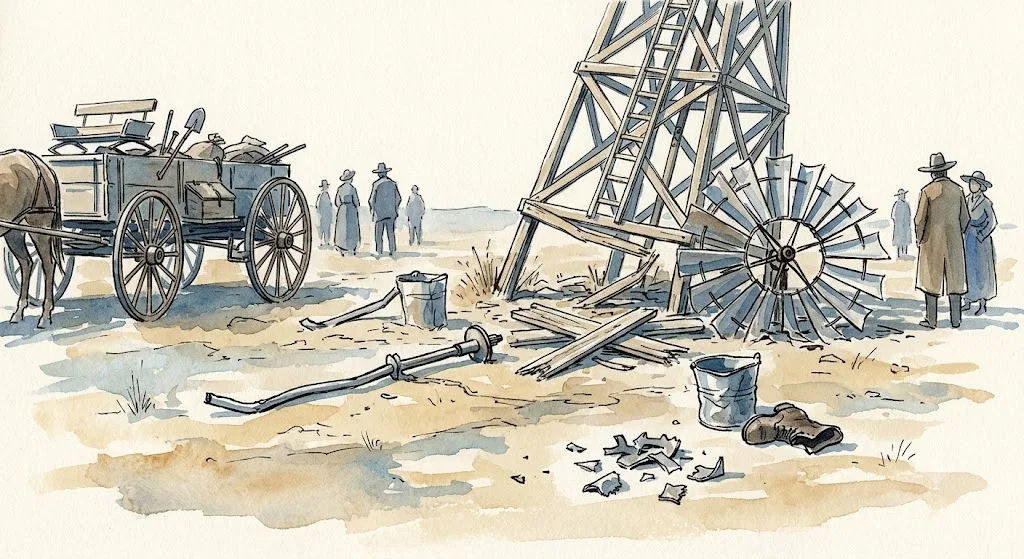
The story appeared in the Dallas Morning News on 19 April 1897, describing events supposedly witnessed two mornings earlier. Haydon reported that an airship moving at only about ten or twelve miles an hour passed over Aurora before striking the tower of Judge J. S. Proctor’s windmill. The craft was said to have broken apart in an explosion, scattering several tons of unfamiliar metal over a wide area.[Dallas Observer]dallasobserver.comDallas Observer Heavenly Hoax | Dallas ObserverDallas Observer Heavenly Hoax | Dallas Observer
The article then moved beyond an ordinary aviation accident. Haydon wrote that the pilot’s damaged remains showed that he was “not an inhabitant of this world”. A supposed US Signal Service officer, T. J. Weems, was said to have identified the dead occupant as a native of Mars. Papers found with the body allegedly contained unknown hieroglyphic writing, while the pilot was reportedly due to receive a Christian burial in Aurora Cemetery.[Dallas Observer]dallasobserver.comDallas Observer Heavenly Hoax | Dallas ObserverDallas Observer Heavenly Hoax | Dallas Observer
Read in isolation, the report sounds remarkably similar to twentieth-century alien-crash stories. In its original setting, however, it was part of the much larger mystery-airship wave of 1896–97. Newspapers across the United States were then publishing reports of advanced flying machines, secret inventors, strange passengers, kidnappings and visitors from Mars. Some accounts may have begun with sightings of lights, balloons, planets or experimental aircraft, but the press environment also encouraged satire, exaggeration and outright invention. Contemporary newspapers themselves accused rivals of manufacturing airship stories.[readex.com]readex.comufo fever americas historical newspapers mysterious airshipsThe Mysterious Airships of 1896-9712 Sept 2014 — For five months beginning in November 1896, newspapers. The fake flourishes through all…
Texas papers carried several such tales. The Texas Almanac’s historical survey places Aurora within a run of reports involving mysterious craft and highly theatrical encounters rather than treating it as an isolated, independently documented disaster.[TX Almanac]texasalmanac.comTX AlmanacWhen Airships Invaded Texas | TX AlmanacThen on April 19, S. E. Haydon, a correspondent for the News reported that an airship h…
That context does not by itself prove that Haydon invented the crash. It does, however, lower the evidential value of a single sensational newspaper item. The report resembles the imaginative airship journalism of its period more closely than it resembles a conventional account of a fatal accident.
Why the physical evidence is so weak
A genuine crash involving a large craft, an explosion, several tons of wreckage and a public burial should normally leave several independent traces. Aurora has none that can be securely connected to the alleged event.
There is no surviving official accident report, coroner’s record, medical description, military file or verified cemetery document identifying an unknown pilot. No piece of alleged wreckage has a documented chain of custody extending back to April 1897. Later pieces of metal associated with the site were found or presented many decades after the claim arose, when their location, handling and history could no longer be established.
The original story said debris was scattered across acres and that enough material existed to weigh several tons. Yet no authenticated fragment was preserved by a named witness, museum, public authority or scientific institution. This absence is especially serious because the article itself implied that pieces were readily available for examination. A case cannot be strengthened merely by finding ordinary metal near an old farm, well or windmill site; investigators would need evidence that the sample came from the reported wreck and had unusual properties inconsistent with known nineteenth-century materials.
The supposed grave proves very little
The cemetery has become the physical centre of the legend. Investigators in the 1970s reported a small damaged marker bearing a shape interpreted as an airship and obtained a metal-detector response near the supposed burial place. The stone later disappeared, and requests to open the grave were refused.[Dallas Observer]dallasobserver.comDallas Observer Heavenly Hoax | Dallas ObserverDallas Observer Heavenly Hoax | Dallas Observer
Those details are intriguing but not decisive. A crude mark on a stone can be interpreted in several ways, and a metal detector cannot identify what is underground. Metal in an old cemetery could come from coffin fittings, nails, fencing, later debris or numerous other ordinary sources. The disappearance of the stone removed the possibility of properly dating or examining it, but it does not establish that the marker belonged to an alien pilot.
A later television investigation used historical photographs and ground-penetrating radar to locate a rectangular area of disturbed soil close to the suspected position. The result was consistent with an unmarked grave, but radar could not determine who or what had been buried there. The Texas Folklore Society account explicitly notes that the occupant, if any, remains unknown.[The Portal to Texas History]texashistory.unt.eduThe Portal to Texas History
This distinction matters. Finding a grave in a cemetery is expected. To support the Aurora claim, investigators would need to connect that grave to the 1897 report and then identify remains that could not be human or animal. Neither step has been achieved.
The windmill dispute changes little
Aurora resident Etta Pegues later argued that Judge Proctor never had a windmill, a claim often presented as evidence that Haydon invented the entire incident. In a 1979 Time report, Pegues said that the story was written as a joke to attract attention after the railway bypassed Aurora and the town declined. She also said the supposed crash site lacked the windmill described in the newspaper.[TIME]time.comAmericana: Close Encounters of a KindAmericana: Close Encounters of a Kind…
Later investigators reported finding remains interpreted as a windmill or water-well structure on the property. Even if that identification is correct, it only weakens one part of Pegues’s recollection. Rural properties commonly had wells and windmills. Demonstrating that a structure once stood there would not show that an airship struck it, that an explosion occurred or that an unusual body was recovered.
The windmill question therefore should not carry more weight than it deserves. “There was no windmill” is not required for the hoax interpretation, while “there was a windmill” is not evidence of an extraterrestrial crash.
What the later witnesses actually established
Most of the witness testimony associated with Aurora was collected roughly three-quarters of a century after the alleged event. This delay creates serious problems of memory, suggestion and folklore transmission.
During the 1973 investigation led by aviation journalist and Mutual UFO Network representative Bill Case, elderly residents and relatives repeated accounts of a crash, wreckage and a small damaged body. One man reportedly said he had seen the crash site as a child. Other accounts were second-hand: Mary Evans said her parents went to the site but prevented her from attending, while Charlie Stephens described what his father later told him.[Dallas Observer]dallasobserver.comDallas Observer Heavenly Hoax | Dallas ObserverDallas Observer Heavenly Hoax | Dallas Observer
These statements deserve to be recorded, but they are not equivalent to contemporary depositions. By 1973 the original newspaper story had been rediscovered and publicised, making it difficult to separate independent childhood memory from details absorbed through community retelling. Second-hand testimony is weaker still because investigators cannot question the original observer or test how the story changed between generations.
The witness material also contains variations. Some versions describe the craft striking a windmill tower; others refer to a windlass over a well. Some accounts emphasise an explosion, others smoke or wreckage seen afterwards. Such differences are normal in oral tradition, but they prevent the testimony from serving as precise corroboration.
The strongest sceptical testimony was also late. Pegues was born close enough to the period to have known residents familiar with Haydon and Proctor, but she was a small child in 1897 and was not documenting a confession made at the time. Her account that local men concocted the story in a general store is plausible local history, not conclusive proof. A balanced assessment should therefore describe deliberate invention as the leading explanation rather than a formally demonstrated fact.
Even so, the overall witness pattern favours folklore. The dramatic event is described in detail by one contemporary newspaper correspondent, while most supporting voices appear decades later, often reporting what parents or neighbours had said.

How Roswell-era retellings changed the story
The most important change in Aurora’s history occurred not in 1897 but in the modern UFO era. The original article used the language of its own time: an “airship”, a Martian pilot and mysterious hieroglyphics. It did not describe a flying saucer, a government retrieval team, a military cover-up or the technological examination of extraterrestrial material.
After the late 1940s, public expectations changed. Flying saucers replaced Victorian airships, and alleged alien bodies became central to crash-retrieval narratives. When Aurora was revived by UFO researchers, its older elements were translated into this newer framework. The airship became a spacecraft, the Martian became an extraterrestrial, the cemetery became an alien grave and the missing wreckage became suggestive of removal or concealment.
The label “Texas’s Roswell” is therefore historically misleading. Roswell helped provide the cultural template through which Aurora was later understood, even though Aurora’s newspaper item was published fifty years earlier. The similarity between the modern versions of the two stories does not show that they describe the same kind of event; it shows how older material can be reshaped to fit a later mythology.
Modern local presentation has reinforced that process. Aurora’s official history page openly calls the account a “tall tale”, while also repeating the legend and the affectionate modern name “Ned” for the alleged occupant. The name does not appear in the original report and illustrates how community storytelling has added personality and tourism value to an otherwise thin historical claim.[auroratexas.gov]auroratexas.govApril 17, 1897…. The original front page of the Dallas Morning News, April 19…
The cemetery marker and continuing media coverage have also kept the story visible. Yet a marker acknowledging a local legend records the existence of the tradition, not the truth of the claimed crash. Similarly, repeated television investigations may create an impression of accumulating evidence when they are often re-examining the same newspaper article, grave location and oral accounts.
Did later investigations strengthen the case?
Later investigation clarified the legend but did not materially strengthen the extraordinary claim.
It established that Haydon’s article was real, that Aurora residents preserved differing stories about its origin, that an old grave marker may once have stood in the cemetery and that there are ordinary historical remains around the supposed crash property. It also documented late testimony from people who remembered hearing about the event or said they had encountered its aftermath as children.[The Portal to Texas History]texashistory.unt.eduThe Portal to Texas HistoryFirst Timers and Old Timers: the Texas Folklore Society Fire Burns On - Page 260 - The Portal to Texas History…
What investigators did not produce was more important:
- no body or scientifically examined biological sample;
- no wreckage traceable to the reported crash;
- no contemporary independent eyewitness statement;
- no burial, medical or official record;
- no reliable evidence of an explosion involving several tons of machinery;
- no verifiable credentials for the supposed expert who identified the pilot as Martian.
The Texas State Historical Association now describes Haydon’s account as a fictional story intended to revive interest in a struggling community. That is a firm institutional judgement, although the surviving record does not allow the exact circumstances of its creation to be reconstructed with complete certainty.[Texas State Historical Association]tshaonline.orgOpen source on tshaonline.org.
The most defensible conclusion is therefore that Aurora is a famous Texas newspaper legend with a strong probability of invention or humorous exaggeration. It remains historically valuable because it shows that alien-crash mythology did not emerge from nothing in the twentieth century. Long before modern UFO terminology, American newspapers were already combining speculative technology, Mars, mysterious writing, dead pilots and rural encounters into stories that could later be read as extraterrestrial events.
Within Texas UFO history, Aurora should be remembered less as an unresolved crash than as a lesson in evidence. A contemporary printed claim can prove that a story existed at a particular time. It cannot, without corroboration, prove that the extraordinary event described in that story occurred.

Amazon book picks
Further Reading
Books and field guides related to Did a UFO Really Crash in Aurora?. Use these as the next step if you want deeper reading beyond the article.
The UFO Experience: A Scientific Inquiry
Provides investigative context for famous crash claims.
The Report on Unidentified Flying Objects
Explains official approaches to unusual reports.
eBay marketplace picks
Marketplace Samples
Live-tested eBay searches with available results related to this page.
Selected fromUFO collectible oneBay.co.uk.


Endnotes
1.
Source: dallasobserver.com
Title: Dallas Observer Heavenly Hoax | Dallas Observer
Link:https://www.dallasobserver.com/news/heavenly-hoax-6389024/
2.
Source: readex.com
Title: ufo fever americas historical newspapers mysterious airships 1896 97
Link:https://www.readex.com/blog/ufo-fever-americas-historical-newspapers-mysterious-airships
Source snippet
The Mysterious Airships of 1896-9712 Sept 2014 — For five months beginning in November 1896, newspapers. The fake flourishes through all...
Published: November 1896
3.
Source: texasalmanac.com
Link:https://www.texasalmanac.com/articles/when-airships-invaded-texas
Source snippet
TX AlmanacWhen Airships Invaded Texas | TX AlmanacThen on April 19, S. E. Haydon, a correspondent for the News reported that an airship h...
4.
Source: texashistory.unt.edu
Link:https://texashistory.unt.edu/ark%3A/67531/metapth162512/m1/69/?q=Rat
Source snippet
E. Haydon, a correspondent for The Morning News reported that an airship had struck a windmill in Aurora in Wise County and exploded...
5.
Source: texashistory.unt.edu
Title: The Portal to Texas History
Link:https://texashistory.unt.edu/ark%3A/67531/metadc271468/m2/1/high_res_d/9781574414837.pdf
6.
Source: texashistory.unt.edu
Link:https://texashistory.unt.edu/ark%3A/67531/metadc271468/m1/273/
Source snippet
The Portal to Texas HistoryFirst Timers and Old Timers: the Texas Folklore Society Fire Burns On - Page 260 - The Portal to Texas History...
7.
Source: time.com
Title: Americana: Close Encounters of a Kind
Link:https://time.com/archive/6881563/americana-close-encounters-of-a-kind/
Source snippet
Americana: Close Encounters of a Kind...
8.
Source: auroratexas.gov
Link:https://www.auroratexas.gov/community/history/
Source snippet
April 17, 1897.... The original front page of the Dallas Morning News, April 19...
Published: April 17, 1897
9.
Source: tshaonline.org
Link:https://www.tshaonline.org/texas-day-by-day/entry/118
10.
Source: abc13.com
Link:https://abc13.com/archive/7096968/
11.
Source: assets.publishing.service.gov.uk
Title: 20131128 mod whitehall library resources 1990to1999.csv
Link:https://assets.publishing.service.gov.uk/media/5a7c0cdbe5274a7202e193c8/20131128-mod-whitehall-library-resources-1990to1999.csv
12.
Source: blog.newspapers.com
Title: before roswell there was the aurora spaceship
Link:https://blog.newspapers.com/before-roswell-there-was-the-aurora-spaceship/
13.
Source: pod.wave.co
Title: co Roswell of Texas: The Aurora UFO
Link:https://pod.wave.co/podcast/conspiracy-theories/roswell-of-texas-the-aurora-ufo-8b6ae805
Additional References
14.
Source: weirdhistorian.com
Link:https://www.weirdhistorian.com/martians-hoaxers-and-ufos-at-the-turn-of-the-century-the-great-airship-flap-of-1896-and-1897/
Source snippet
It has had new airship fakes every day, each introduced with “scare heads,” assuring the trustworthiness of the story.Read more...
15.
Source: youtube.com
Link:https://www.youtube.com/watch?v=6lkED7gzU4Q
Source snippet
Aurora, Texas UFO Crash 1897 | Exploring America's First Alien Mystery...
16.
Source: youtube.com
Link:https://www.youtube.com/watch?v=h3OZLxJnAgs
Source snippet
Why did a Texas town bury an alien visitor in 1897?...
17.
Source: youtube.com
Link:https://www.youtube.com/watch?v=QJuMSxt4cUQ
Source snippet
The 1897 Texas UFO crash | The Backstory...
18.
Source: youtube.com
Link:https://www.youtube.com/watch?v=tX8E77e8RWA
Source snippet
The Alien They Buried in Texas | Aurora UFO Crash 1897 (Podcast)...
19.
Source: facebook.com
Link:https://www.facebook.com/10NewsMelb/posts/heres-what-made-headlines-todayrod-laver-arena-will-play-host-to-one-of-the-most/1396615999167823/
20.
Source: facebook.com
Link:https://www.facebook.com/txchronicles/posts/for-decades-people-have-laughed-off-stories-about-ufos-uap-ufo-txchron/1526730775775957/
21.
Source: facebook.com
Link:https://www.facebook.com/dallasmorningnews/posts/local-legend-says-a-spaceship-crashed-in-aurora-texas-on-april-17-1897/10155859855393800/
22.
Source: reddit.com
Link:https://www.reddit.com/r/UFOs/comments/1p4uyqu/nasa_engineer_john_f_schuessler_claimed_he/
23.
Source: reddit.com
Link:https://www.reddit.com/r/CemeteryPorn/comments/16l4wtm/what_may_be_the_grave_of_an_alien_that_crashed/