Within Alaska
How Officials Investigated Alaska UFO Reports
Air Force and FAA files reveal how defence and aviation agencies recorded unusual reports without treating unidentified as proof of alien craft.
On this page
- Project Sign, Grudge and Blue Book in Alaska
- How defence priorities shaped case handling
- What official labels did and did not mean
Page outline Jump by section
Introduction
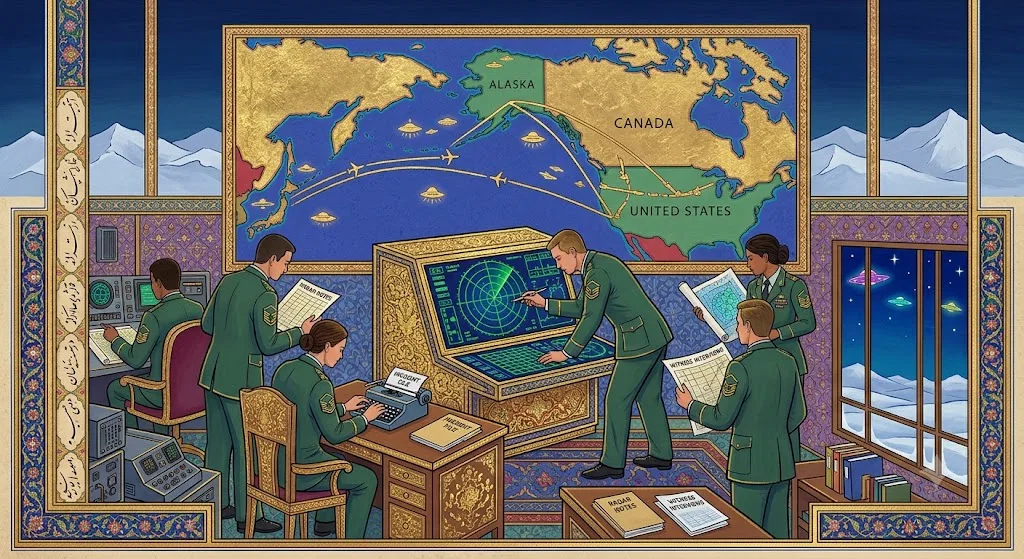
Alaska’s official UFO record is less a hidden catalogue of alien craft than a paper trail showing how defence and aviation agencies dealt with uncertain information. The US Air Force logged reports from radar stations, interceptor crews and military bases because an unexplained return over Alaska could represent a Soviet aircraft, a technical fault, unusual weather or a genuine threat. Decades later, the Federal Aviation Administration recorded pilot reports for a different reason: keeping civilian airspace safe.
These files matter because they preserve more than stories. They may contain radar notes, radio transcripts, weather checks, witness interviews and attempts to identify known aircraft. Yet they also demonstrate a crucial limit: an official label such as “unidentified” usually meant that investigators lacked enough reliable information to reach a conclusion. It did not mean that the government had confirmed an extraordinary vehicle, still less an extraterrestrial one.[National Archives]archives.govOpen source on archives.gov.
Project Sign, Grudge and Blue Book in Alaska
The Air Force’s early UFO programmes emerged from Cold War security concerns. Project Sign began in 1948, Project Grudge followed in 1949, and Project Blue Book became the best-known successor in 1952. Their practical questions were whether reported objects threatened national security and whether recurring reports revealed technology beyond known aircraft. Alaska naturally fell within this system because its northern approaches, military airfields and radar sites were strategically important.
Reports were usually gathered locally and passed through military intelligence channels to analysts at Wright-Patterson Air Force Base in Ohio. The resulting case files could combine standard forms, interviews, radar information, sketches, correspondence and press cuttings. Their quality varied greatly. A detailed military report might sit beside a short civilian letter with no dependable time, direction or distance. The National Archives now lists separate collections for Blue Book administration, Air Force Office of Special Investigations material, air-intelligence reports and case files produced by the 4602nd Air Intelligence Service Squadron, showing that the surviving record is distributed across several bureaucratic series rather than one simple Alaska register.[National Archives]archives.govNational ArchivesRecords Related to Unidentified Flying Objects (UFOs) and Unidentified Anomalous Phenomena (UAPs) at the National Archiv…
This structure explains why published totals can be misleading. Project Blue Book was a national programme, not an Alaska investigation with its own continuous staff and complete state database. A sighting might be recorded under the nearest base, radar unit or town; supporting material might be stored separately; and some defence information could remain classified or be removed from the public copy. The surviving files are therefore evidence of what entered official channels, not a complete census of everything seen over Alaska.

The Murphy Dome radar case
The clearest early example is the radar incident associated with Murphy Dome, near Fairbanks, on 22 January 1952. A declassified Blue Book status report described an unidentified radar return first observed at 10:20 Coordinated Universal Time. According to the report, the target was moving away from the station on a south-westerly bearing at about 1,500 miles per hour, appeared to reverse direction and then approached the station. Operators adjusted the radar to continue watching it.[Wikimedia Commons]upload.wikimedia.orgWikimedia Commons…
The case was significant enough to receive an appendix in a monthly status report, rather than appearing only as a line in a sighting table. That treatment indicates that Air Force analysts regarded the behaviour reported by the radar operators as unusual and potentially important. An interceptor was sent to investigate, but the episode did not produce a recovered object, photograph or confirmed visual identification that independently established the target’s size, range and physical nature.
For readers, the important distinction is between a puzzling radar event and proof of an extraordinary aircraft. Radar measures reflected or processed signals; it does not automatically reveal what produced them. Propagation effects, equipment behaviour, interference, operator interpretation and the tracking of separate returns can create apparently impressive movements. Conversely, dismissing every radar report as “just a glitch” is also unwarranted unless the equipment records and operating conditions support that conclusion. The Murphy Dome documentation establishes that trained personnel reported and investigated an unusual return. It does not establish what caused it.
Its unresolved status also reflects the priorities of the period. The central question was not “Was this alien?” but “Could this be a hostile aircraft, missile or unknown surveillance platform?” If no continuing threat emerged and the evidence could not support a firm technical answer, the case could remain unidentified without prompting an open-ended scientific investigation.
How defence priorities shaped case handling
Alaska’s geography gave military UFO reports an unusually serious setting. During the Cold War, radar stations and fighter units watched the northern approaches to North America, where an unknown contact might have only minutes to be classified as friendly, hostile or false. Reports were therefore processed through air-defence and intelligence systems designed for warning and response, not for proving unusual scientific claims.
That difference shaped what officials collected. Defence personnel cared about position, heading, altitude, speed, radar consistency and whether an interceptor could make contact. They were less likely to pursue broad questions about witness psychology or atmospheric optics once a contact ceased to present an operational concern. A report might be carefully documented at the moment of detection but receive little later fieldwork if no object remained available to inspect.
Military secrecy created another complication. During the early jet, missile and reconnaissance eras, observers sometimes encountered technologies they were not authorised to know about. The modern All-domain Anomaly Resolution Office, or AARO, has concluded that part of the historical UFO reporting surge was probably caused by witnesses seeing classified aircraft, rocket launches and other new systems. This does not explain every Alaska report, but it shows why officials could possess a conventional explanation that was not publicly disclosed at the time—or why investigators outside a compartmented programme might themselves be unable to identify what had been observed.[AARO]aaro.milUnclassified Final DSD AARO Historical ReportUnclassified Final DSD AARO Historical Report…
At the same time, later official reviews have acknowledged weaknesses in the old process. Reports often lacked dependable measurements of altitude, distance, size and speed. Reporting standards were inconsistent, investigations did not always follow the same procedure, and sensors optimised for warning or combat could provide incomplete data for scientific reconstruction. A radar system may be excellent at alerting controllers to a possible target while still preserving too little information to determine, decades later, whether a brief return represented an aircraft, weather effect or processing artefact.[AARO]aaro.milUnclassified Final DSD AARO Historical ReportUnclassified Final DSD AARO Historical Report…
This helps explain a recurring feature of Alaska cases: the initial report can sound more definite than the surviving evidence. A witness may describe rapid movement or a huge object, but those conclusions depend on assumed distance. A radar note may quote a striking speed, but the estimate may depend on which returns were treated as the same target. Official records are valuable because they preserve contemporary information, yet their existence does not remove these measurement problems.
The FAA record and Japan Air Lines Flight 1628
The best-known later Alaska investigation involved Japan Air Lines Flight 1628 on 17 November 1986. While crossing eastern Alaska towards Anchorage, the Boeing 747 cargo crew reported unusual lights and, in Captain Kenji Terauchi’s account, a much larger dark object. Air-traffic controllers discussed the report with the aircraft, checked radar displays, authorised manoeuvres and asked other aircraft in the area to look for unidentified traffic.
The episode became important because the Federal Aviation Administration retained a substantial package of material rather than treating it as a passing newspaper story. The records included air-ground communications, crew statements, radar-related material and internal correspondence. FAA Freedom of Information Act logs show continued requests for the JAL 1628 records decades later, confirming the case’s lasting public interest and the existence of an official documentary trail.[FAA]faa.govFAA FOIA Reportflight records between air traffic control and flight USAF KC135 on 1/30/87 and Japan airlines flight 1628 on 11/17/86…
The files support several basic points. The captain made a real-time report; controllers took it seriously as a possible traffic-safety issue; the crew was interviewed; and radar personnel examined recorded information. Contemporary reporting also showed that a controller saw a possible secondary return near the airliner at one stage. However, the FAA’s later review did not produce firm confirmation of a separate craft. Officials considered the relevant return insufficiently reliable and discussed possibilities including radar clutter or a split image associated with the aircraft itself.[UPI]upi.comRadar review fails to confirm UFORadar review fails to confirm UFO - UPI Archives8 Jan 1987 — The Federal Aviation Administration's examination of radar tapes shows wh…
Independent corroboration was limited. Other aircraft directed towards the area did not report seeing the object described by Terauchi. The captain’s most dramatic claims—particularly the immense scale of the supposed “mothership”—could not be measured directly. Later sceptical analyses also noted that bright planets were positioned in the relevant part of the sky and that some details in later retellings did not align neatly with the contemporaneous radio exchange. These points do not prove that every light was astronomical, but they weaken the argument that the documents demonstrate a single enormous structured craft.
The investigation therefore produced a layered result rather than a simple verdict. A professional flight crew reported something unusual, and the FAA responded appropriately. Some recorded information appeared potentially supportive, but it did not survive technical review as unambiguous independent confirmation. The case remains interesting because of the quantity of documentation and the involvement of aviation professionals, not because officials verified an alien vehicle.
What official labels did and did not mean
The word “unidentified” is often read too strongly. Within Blue Book, it generally meant that the available evidence did not permit a satisfactory identification after review. That could happen because a genuinely unusual object had been observed, but it could also result from missing weather data, delayed reporting, vague geometry, absent photographs or insufficient radar records.
An unresolved case was therefore not the programme’s highest evidential category in the sense of “most extraordinary”. In practice, it could be a measure of information shortage. A distant light with a reliable time and direction might be identified as a planet, while a more dramatic account without dependable measurements remained unexplained. The second report would sound more mysterious but might be less useful scientifically.
The Air Force’s closing summary stated that Blue Book had found no UFO that demonstrated a threat to national security, no evidence of technology beyond contemporary scientific knowledge and no evidence that the unidentified cases were extraterrestrial vehicles. Its records were transferred to the National Archives in 1975 and, after personal information was redacted, opened for public research. The files preserve observers’ reports and official analysis, but the National Archives does not present their mere retention as validation of the claims.[National Archives]archives.govOpen source on archives.gov.
Classification is similarly easy to misunderstand. A document could be secret because it mentioned radar capability, intelligence procedures, allied information or military readiness—not because the object itself had been identified as extraordinary. The 1952 Blue Book status report containing the Murphy Dome case explicitly explained that its overall classification arose from classified material supplied by originating agencies and allied information. The case’s appearance in a once-secret report therefore tells the reader about the security environment in which it was handled, not the nature of the radar target.[Wikimedia Commons]upload.wikimedia.orgWikimedia Commons…
From Blue Book to modern anomaly reporting
Project Blue Book ended in 1969, but the operational problem never disappeared. Military and aviation organisations still need to record objects that cannot immediately be identified, especially near controlled airspace or defence installations. The modern term “unidentified anomalous phenomena”, or UAP, broadens the language but does not change the fundamental first task: determine whether the report represents a known aircraft, balloon, drone, weather effect, sensor artefact, foreign surveillance system or other safety and security concern.
Alaska remains important because it combines sparse civilian observation with extensive strategic surveillance. The response to a high-altitude object detected off northern Alaska in February 2023 illustrates the modern defence sequence: ground radar detected it, aircraft were sent to inspect it, pilots assessed it as unmanned, and it was shot down because its altitude posed a potential danger to civilian aviation. Officials did not need to settle every question about its origin before acting on the immediate risk.[U.S. Department of War]defense.govair force shoots down high altitude object off alaskan coastair force shoots down high altitude object off alaskan coast
That incident should not be folded casually into historic UFO lore, but it clarifies how official labels work. “Unidentified” may be a temporary operational condition, not a final claim about origin. Defence agencies can detect, track and respond to something while still lacking enough recoverable evidence to identify it publicly. In Alaska, where weather, distance and terrain complicate retrieval, that gap can remain permanent.
What the files genuinely establish
Alaska’s official records establish that unusual aerial reports sometimes entered serious military and aviation channels. Radar operators documented unexpected contacts; interceptors were tasked; pilots and controllers exchanged real-time information; and agencies retained files that can now be compared with later interpretations. The Murphy Dome report and JAL Flight 1628 are valuable precisely because they contain this institutional evidence.
They do not establish a confirmed class of extraordinary craft. The strongest cases still suffer from incomplete sensor data, uncertain geometry, missing physical evidence or weak independent confirmation. Official investigators sometimes left reports unresolved, while later reviewers proposed radar artefacts, astronomical objects, atmospheric effects or secret technology. None of those explanations should be treated as proven merely because it is conventional, but neither should uncertainty be converted into evidence of alien origin.
The most defensible reading is therefore narrower and more useful: Alaska’s files show how government institutions manage ambiguity under pressure. They reveal what officials considered worth recording, how security priorities shaped investigation, why some cases remained open and why “unidentified” was a statement about the limits of the evidence rather than a conclusion about what was in the sky.
Amazon book picks
Further Reading
Books and field guides related to How Officials Investigated Alaska UFO Reports. Use these as the next step if you want deeper reading beyond the article.
UFOs: Generals, Pilots, and Government Officials Go on the Re...
Focuses on military, aviation, and official investigations of unexplained reports.
The Report on Unidentified Flying Objects
Directly covers official Air Force UFO investigations and case-handling practices.
The UFO Experience
Explains classification systems and investigative approaches used on UFO cases.
eBay marketplace picks
Marketplace Samples
Live-tested eBay searches with available results related to this page.
Selected fromUFO poster oneBay.co.uk.

Current eBay listing
FS02 VINTAGE UFO FLYING SAUCERS COMIC ADVERTISING A4 POSTER PRINT


Current eBay listing
VINTAGE UFO FLYING SAUCERS COMIC ADVERTISING A2 POSTER PRINT

Endnotes
1.
Source: archives.gov
Link:https://www.archives.gov/news/articles/project-blue-book-50th-anniversary
2.
Source: aaro.mil
Title: Unclassified Final DSD AARO Historical Report
Link:https://www.aaro.mil/Portals/136/PDFs/AARO_Historical_Record_Report_Vol_1_2024.pdf
Source snippet
Unclassified Final DSD AARO Historical Report...
3.
Source: archives.gov
Link:https://www.archives.gov/research/topics/uaps/rg-collections
Source snippet
National ArchivesRecords Related to Unidentified Flying Objects (UFOs) and Unidentified Anomalous Phenomena (UAPs) at the National Archiv...
4.
Source: upload.wikimedia.org
Link:https://upload.wikimedia.org/wikipedia/commons/c/c0/Project_Blue_Book%2C_BBA-PBSR6-300.pdf
Source snippet
Wikimedia Commons...
5.
Source: faa.gov
Link:https://www.faa.gov/sites/faa.gov/files/2022-09/fy21-oct20-apr21.xlsx
Source snippet
FAA FOIA Reportflight records between air traffic control and flight USAF KC135 on 1/30/87 and Japan airlines flight 1628 on 11/17/86...
6.
Source: faa.gov
Link:https://www.faa.gov/sites/faa.gov/files/2022-09/fy18-jun18-sep18.xlsx
Source snippet
FAA FOIA Reportall records in relation to an accident involving Japan Airlines flight 1628 on November 17, 1986 in Eastern Alaska. 345...
Published: November 17, 1986
7.
Source: upi.com
Title: Radar review fails to confirm UFO
Link:https://www.upi.com/Archives/1987/01/08/Radar-review-fails-to-confirm-UFO/8875537080400/
Source snippet
Radar review fails to confirm UFO - UPI Archives8 Jan 1987 — The Federal Aviation Administration's examination of radar tapes shows wh...
8.
Source: upi.com
Title: Controller confirms UFO sighting
Link:https://www.upi.com/Archives/1986/12/30/Controller-confirms-UFO-sighting/4431536302800/
Source snippet
Controller confirms UFO sighting - UPI Archives30 Dec 1986 — All three crewmen on JAL Flight 1628 told Federal Aviation Administration...
9.
Source: archives.gov
Link:https://www.archives.gov/research/topics/uaps/moving-images-and-sound
10.
Source: archives.gov
Title: uap bulk download
Link:https://www.archives.gov/research/catalog/catalog-bulk-downloads/uap-bulk-download
11.
Source: unwritten-record.blogs.archives.gov
Title: project blue book ufos in home movies
Link:https://unwritten-record.blogs.archives.gov/2013/10/28/project-blue-book-ufos-in-home-movies/
12.
Source: unwritten-record.blogs.archives.gov
Title: aliens at the archives
Link:https://unwritten-record.blogs.archives.gov/2017/04/26/aliens-at-the-archives/
13.
Source: archives.gov
Title: do records show proof of ufos
Link:https://www.archives.gov/news/articles/do-records-show-proof-of-ufos
14.
Source: unwritten-record.blogs.archives.gov
Title: project blue book looking to the film record
Link:https://unwritten-record.blogs.archives.gov/2013/09/30/project-blue-book-looking-to-the-film-record/
15.
Source: unwritten-record.blogs.archives.gov
Link:https://unwritten-record.blogs.archives.gov/tag/ufos/
16.
Source: unwritten-record.blogs.archives.gov
Title: project blue book
Link:https://unwritten-record.blogs.archives.gov/tag/project-blue-book/
17.
Source: unwritten-record.blogs.archives.gov
Title: home movies
Link:https://unwritten-record.blogs.archives.gov/tag/home-movies/
18.
Source: unwritten-record.blogs.archives.gov
Title: avrocar the u s militarys flying saucer
Link:https://unwritten-record.blogs.archives.gov/2014/04/03/avrocar-the-u-s-militarys-flying-saucer/
19.
Source: catalog.archives.gov
Link:https://catalog.archives.gov/id/72035
20.
Source: catalog.archives.gov
Link:https://catalog.archives.gov/id/733667
21.
Source: faa.gov
Link:https://www.faa.gov/foia/electronic_reading_room/logs/afn-afn-20250303-fy24-oct23-mar24.xlsx
22.
Source: faa.gov
Link:https://www.faa.gov/foia/electronic_reading_room/logs/afn-afn-20250121-fy23-oct22-mar23.xlsx
23.
Source: faa.gov
Link:https://www.faa.gov/foia/electronic_reading_room/logs/afn-afn-20250121-fy23-apr23-sept23.xlsx
24.
Source: faa.gov
Title: grants 2001.xls
Link:https://www.faa.gov/sites/faa.gov/files/airports/aip/grant_histories/grants-2001.xls
25.
Source: faa.gov
Title: document ID
Link:https://www.faa.gov/regulations_policies/orders_notices/index.cfm/go/document.information/documentID/10131
26.
Source: defense.gov
Title: air force shoots down high altitude object off alaskan coast
Link:https://www.defense.gov/News/News-Stories/Article/Article/3295813/air-force-shoots-down-high-altitude-object-off-alaskan-coast/
27.
Source: media.defense.gov
Title: 05 INTEL 13
Link:https://media.defense.gov/2017/Jan/06/2001774096/-1/-1/1/05-INTEL-13.pdf
28.
Source: media.defense.gov
Title: FOIA LOG
Link:https://media.defense.gov/2025/May/30/2003728335/-1/-1/0/FOIA%20LOG%20JANUARY%201%2C%202025%20-%20MARCH%2031%2C%202025%20REDACTED.PDF
Published: January 1, 2025
29.
Source: media.defense.gov
Title: AFD 110420 030
Link:https://media.defense.gov/2011/Apr/20/2001330073/-1/-1/0/AFD-110420-030.pdf
30.
Source: Wikipedia
Title: Japan Air Lines Cargo Flight 1628
Link:https://en.wikipedia.org/wiki/Japan_Air_Lines_Cargo_Flight_1628
31.
Source: Wikipedia
Title: Project Blue Book
Link:https://en.wikipedia.org/wiki/Project_Blue_Book
Additional References
32.
Source: youtube.com
Title: Pilots Report Terrifying UFO Sighting Mid-Flight | Close Encounters 104
Link:https://www.youtube.com/watch?v=Rym4sR6j8xs
Source snippet
Did Aliens Make a Military Plane Disappear? | The Alaska Triangle | Travel Channel...
33.
Source: youtube.com
Title: Military Radar Operators Spots Unknown Aircraft In The Sky! | Aliens In Alaska
Link:https://www.youtube.com/watch?v=wakSU4i175M
Source snippet
Japan Airlines Saw a UFO Bigger Than an Aircraft Carrier | Kevin Knuth...
34.
Source: youtube.com
Title: Missing Aircrafts and Flying Objects | The Alaska Triangle | Travel Channel
Link:https://www.youtube.com/watch?v=nMHFwKk243Q
Source snippet
Pilots Report Terrifying UFO Sighting Mid-Flight | Close Encounters 104...
35.
Source: youtube.com
Title: Japan Airlines Saw a UFO Bigger Than an Aircraft Carrier | Kevin Knuth
Link:https://www.youtube.com/watch?v=J3uHbff-GRw
Source snippet
Missing Aircrafts and Flying Objects | The Alaska Triangle | Travel Channel...
36.
Source: cbp.gov
Link:https://www.cbp.gov/sites/default/files/assets/documents/2023-Aug/Records%20pertaining%20to%20Unidentified%20Aerial%20Phenomenon.pdf
37.
Source: cia.gov
Link:https://www.cia.gov/readingroom/document/cia-rdp81r00560r000100010001-0
38.
Source: govinfo.gov
Link:https://www.govinfo.gov/content/pkg/CHRG-118hhrg53022/html/CHRG-118hhrg53022.htm
39.
Source: govinfo.gov
Link:https://www.govinfo.gov/content/pkg/GPO-CRECB-1959-pt5/pdf/GPO-CRECB-1959-pt5-1-1.pdf
40.
Source: govinfo.gov
Link:https://www.govinfo.gov/content/pkg/CHRG-89hhrg50066O/pdf/CHRG-89hhrg50066O.pdf
41.
Source: sacred-texts.com
Link:https://sacred-texts.com/ufo/rufo/rufo12.htm