Within Blue Book
How North Dakota UFO Reports Became Official Files
North Dakota reports passed through local bases, intelligence officers and weather checks before Blue Book issued often limited final classifications.
On this page
- How sightings entered military reporting channels
- What evidence local investigators collected
- How sanitisation and missing details limit later review
Page outline Jump by section
Introduction
Project Blue Book files from North Dakota were not created in a single office by a dedicated UFO team. They were assembled through a chain of military reporting, local investigation, technical review and administrative filing that stretched from air bases on the northern plains to Air Force analysts at Wright-Patterson Air Force Base in Ohio. Understanding that process is important because many later debates about North Dakota UFO cases—especially those connected to Minot and Grand Forks—depend less on what witnesses claimed than on how information was collected, filtered and ultimately classified by the Air Force. The surviving records reveal a system that gathered substantial evidence in some cases but often relied on incomplete field reports, weather checks and secondary summaries. They also show how a sighting could move from an urgent local report to a brief national file carrying a simple label such as “identified”, “insufficient data” or “unidentified”.[National Archives]archives.govNational Archives Project BLUE BOOKNational ArchivesProject BLUE BOOK - Unidentified Flying Objects25 Jun 2024 — Pro-UFO researchers claim that an extraterrestrial spacecra…
How sightings entered military reporting channels
In North Dakota, many Blue Book reports originated near military installations rather than through direct contact with Blue Book headquarters. During the Cold War, the state hosted important Air Force facilities, including strategic bomber and missile operations. When unusual aerial activity was reported, the first response normally came from local personnel: security police, radar operators, weather officers, intelligence staff, operations centres or commanders on duty. These individuals gathered the initial information and decided whether the report warranted forwarding through official channels.[Defense Logistics Agency]whs.milDefense Logistics Agency Project Blue Book Reports categorized as Insufficient Data are those for w Hich one or more elements of informaDefense Logistics AgencyProject Blue BookReports categorized as Insufficient Data are those for wHich one or more elements of informa- ti…
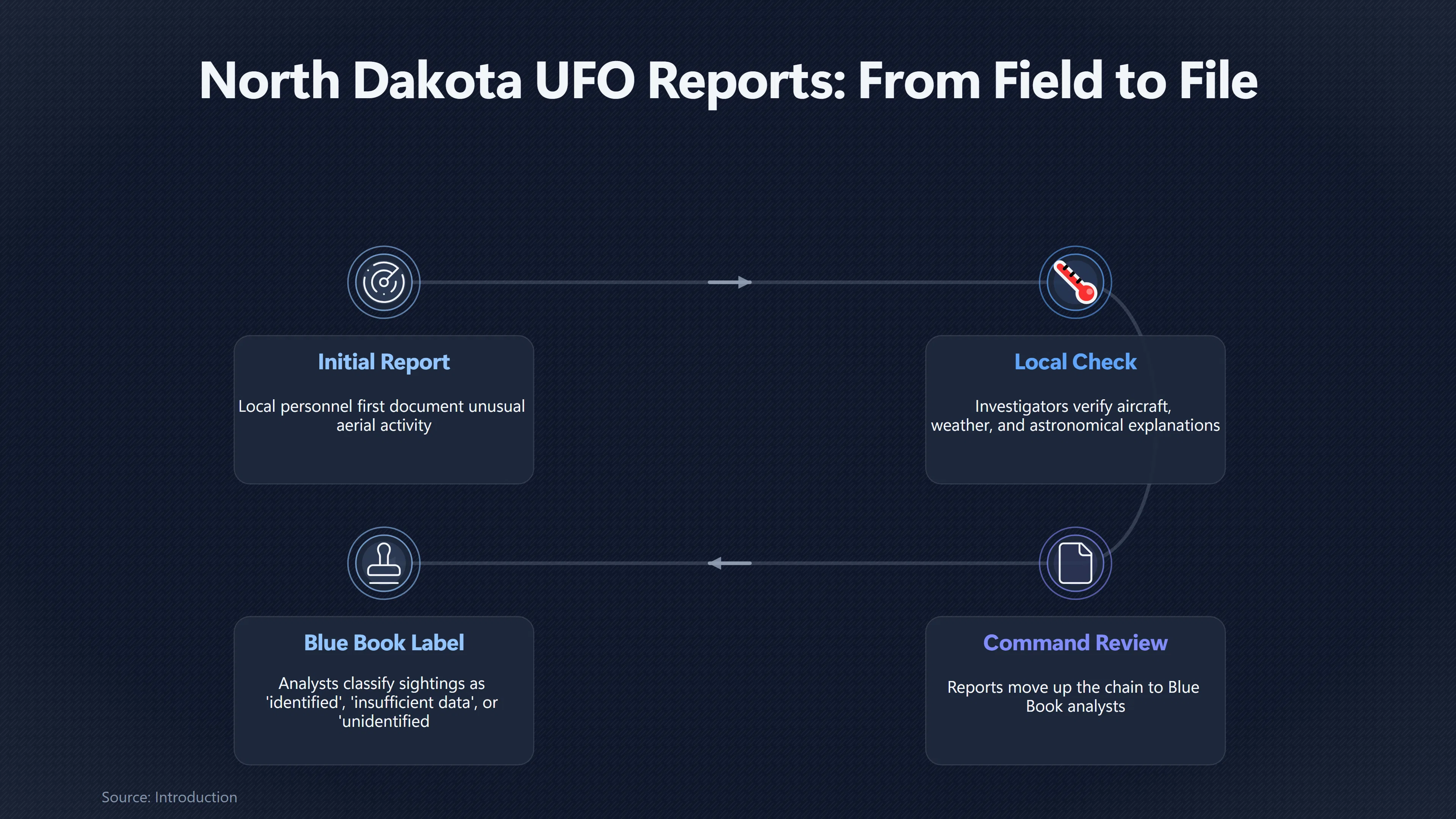
A typical reporting path looked like this:

- A witness reported an unusual object or light.
- Local military personnel recorded times, locations and descriptions.
- Investigators checked aircraft activity, weather conditions and astronomical explanations.
- Reports were forwarded through command channels to Blue Book analysts.[Wikipedia]WikipediaProject Blue BookProject Blue Book
- Blue Book reviewed the material and assigned a final classification. Defense Logistics Agency
This process meant that the quality of a North Dakota Blue Book file depended heavily on the first officers who documented the event. If radar logs, weather observations and witness interviews were collected promptly, the file could become extensive. If details were recorded late or incompletely, Blue Book often had little material on which to base a judgement. Critics of the programme later argued that local bases frequently failed to provide enough information, creating weaknesses that followed a case throughout the system. Wikipedia
What evidence local investigators collected
The contents of North Dakota Blue Book files varied widely, but surviving records show recurring categories of evidence. Investigators sought information that could either identify the object or eliminate conventional explanations.
Common materials included:
- Witness statements from civilians or military personnel.
- Sketches showing an object’s shape, movement or position.
- Radar observations where available.
- Weather data, including balloon launches and atmospheric conditions.
- Astronomical information covering planets, stars and meteor activity.
- Air traffic and military flight records.
- Newspaper clippings and correspondence. National Archives+2DocsTeach
North Dakota cases involving military facilities sometimes generated unusually detailed records because multiple observers could be involved. The well-known 1968 Minot incident, for example, produced communications records, security reports and witness testimony from military personnel. Whether one accepts the Air Force explanation or not, the case demonstrates how a sighting could generate a substantial documentary trail before reaching Blue Book’s final review stage. Prairie Public
However, the existence of a large file did not necessarily mean that all questions were answered. Blue Book analysts often worked with summaries rather than direct access to every witness. As information moved through military channels, details could be condensed, interpreted or omitted, making later reconstruction difficult. Wikipedia
How Blue Book decided on classifications
Once a North Dakota report reached Blue Book, analysts attempted to place it into one of several broad categories. The Air Force’s formal system centred on three outcomes:
- Identified – sufficient information existed to connect the sighting to a known object or phenomenon.
- Insufficient Data – important information needed for evaluation was missing.
- Unidentified – enough information existed for analysis, but no satisfactory explanation could be established. Defense Logistics Agency+2Forces News
For North Dakota cases, the most common explanations involved ordinary aircraft, weather balloons, astronomical objects, atmospheric effects or misperceptions caused by distance and darkness. Investigators routinely compared reports against balloon launches and weather observations because the state’s open skies and military activity made such checks especially relevant. Defense Logistics Agency
The distinction between “unidentified” and “insufficient data” is particularly important. A report labelled “unidentified” was not simply a mystery lacking evidence. Under Blue Book procedures, it usually meant investigators believed there was enough information to evaluate the event yet still could not match it to a known explanation. By contrast, an “insufficient data” classification often reflected reporting gaps rather than a genuinely puzzling object. Wikimedia Commons
Why classifications were not always straightforward
The classification process appears simple on paper but became more complicated in practice. Blue Book’s own history shows recurring tension between local observations and centralised analysis. Some analysts argued that reports could be resolved through conventional explanations, while critics maintained that classifications occasionally overstated certainty. Wikipedia
North Dakota cases illustrate several recurring problems:
Multiple observations merged into one file. A single case might involve several witnesses seeing different things at different times. Analysts sometimes separated those observations into distinct explanations, while later researchers viewed them as parts of one event. National Archives
Delayed reporting. By the time Blue Book reviewed a sighting, weather records, radar data or witness recollections could already be incomplete. Wikipedia
Dependence on local investigators. Blue Book headquarters often relied on information collected by officers whose primary responsibilities were operational rather than investigative. Critics within and outside the Air Force complained that this limited the consistency of case files. Wikipedia
Pressure toward conventional explanations. Historians and UFO researchers have long debated whether some cases were classified too aggressively as balloons, aircraft or astronomical objects. The available records do not prove systematic concealment, but they do show that final classifications sometimes rested on incomplete evidence. Wikipedia
How sanitisation and missing details limit later review
The North Dakota files available today are not identical to the records originally handled by investigators. The National Archives collection was released with personal information removed from witness records. Names and identifying details were redacted before public distribution. National Archives
This sanitisation protects privacy but creates challenges for historians. In some files it becomes difficult to determine:
- Whether multiple statements came from the same person.
- Which witness provided a specific observation.
- How military roles may have affected credibility or access to information.
- Whether follow-up interviews involved the original witnesses or later intermediaries. National Archives
Another limitation is that not every supporting document survived or entered the public archive. Researchers occasionally encounter references to radar checks, intelligence communications or local inquiries that are summarised rather than reproduced in full. As a result, the archival record is best understood as a record of what Blue Book received and preserved, not necessarily a complete record of everything known at the time. National Archives+2National Archives
What the files reveal about North Dakota’s UFO record
The most valuable lesson from North Dakota’s Blue Book files is procedural rather than sensational. The records show how unusual sightings were transformed into official government documents through a bureaucratic process of reporting, checking, filing and classification. In many cases the resulting explanation was mundane. In others, investigators concluded that available evidence was either incomplete or inconclusive. Defense Logistics Agency
For readers exploring Blue Book records and official North Dakota investigations, the key point is that the classification attached to a case reflects not only what witnesses saw but also the quality of the information gathered, the resources available to investigators and the limits of the Air Force’s reporting system. The files therefore provide insight into both the sightings themselves and the machinery used to evaluate them during the Cold War. National Archives+2National Archives
Amazon book picks
Further Reading
Books and field guides related to How North Dakota UFO Reports Became Official Files. Use these as the next step if you want deeper reading beyond the article.
The UFO Experience: A Scientific Inquiry
Provides context for case classification and evidence assessment.
The Report on Unidentified Flying Objects
Explains how Blue Book investigations and reporting worked.
UFOs: Generals, Pilots, and Government Officials Go on the Re...
Covers official investigations and military reporting.
UFOs and Government: A Historical Inquiry
Examines official U.S. government handling of UFO reports.
eBay marketplace picks
Marketplace Samples
Live-tested eBay searches with available results related to this page.
Selected fromUFO wall art oneBay.co.uk.


Current eBay listing
UFO ABDUCTION OVER THE OCEAN -FRAMED WALL ART PAPER PRINT POSTER

Current eBay listing
UFO ABDUCTION OVER THE OCEAN -DEEP FRAMED CANVAS WALL ART PRINT

Endnotes
1.
Source: archives.gov
Title: National Archives Project BLUE BOOK
Link:https://www.archives.gov/research/military/air-force/ufos
Source snippet
National ArchivesProject BLUE BOOK - Unidentified Flying Objects25 Jun 2024 — Pro-UFO researchers claim that an extraterrestrial spacecra...
2.
Source: archives.gov
Title: project blue book 50th anniversary
Link:https://www.archives.gov/news/articles/project-blue-book-50th-anniversary
Source snippet
Each case file relates...
3.
Source: Wikipedia
Title: Project Blue Book
Link:https://en.wikipedia.org/wiki/Project_Blue_Book
4.
Source: docsteach.org
Link:https://docsteach.org/document/ufo-questionnaire/
Source snippet
Air Force's investigations into UFOs. During the Cold War in 1952, fearful that the...Read more...
5.
Source: upload.wikimedia.org
Link:https://upload.wikimedia.org/wikipedia/commons/5/5c/Project_Blue_Book%2C_BBA-PBSR8-300.pdf
Source snippet
A great many of the cases are due to poor reporting on the...
6.
Source: war.gov
Link:https://www.war.gov/medialink/ufo/061226/release_03/documents/CIA-UAP-015-Project_Blue_Book_Special_Report_No_14.pdf
7.
Source: archives.gov
Title: textual and microfilm
Link:https://www.archives.gov/research/topics/uaps/textual-and-microfilm
8.
Source: upload.wikimedia.org
Title: Project Blue Book, BBA PBSR2 300
Link:https://upload.wikimedia.org/wikipedia/commons/e/ea/Project_Blue_Book%2C_BBA-PBSR2-300.pdf
9.
Source: upload.wikimedia.org
Title: Project Blue Book, BBA PBSR1 300
Link:https://upload.wikimedia.org/wikipedia/commons/3/3b/Project_Blue_Book%2C_BBA-PBSR1-300.pdf
10.
Source: archives.gov
Link:https://www.archives.gov/research/catalog/catalog-bulk-downloads/uap-bulk-download
11.
Source: archives.gov
Link:https://www.archives.gov/research/topics/uaps
12.
Source: archives.gov
Link:https://www.archives.gov/research/topics/uaps/photographs
13.
Source: archives.gov
Title: moving images and sound
Link:https://www.archives.gov/research/topics/uaps/moving-images-and-sound
14.
Source: archive.org
Title: Brad Sparks Comprehensive Catalog of 1,600 Project Blue Book UFO Unknowns
Link:https://archive.org/download/BernardSieglerTechnicsAndTime1TheFaultOfEpimetheus/Brad%20Sparks%20-%20Comprehensive%20Catalog%20of%201%2C600%20Project%20Blue%20Book%20UFO%20Unknowns.pdf
15.
Source: media.defense.gov
Title: DOPSR 2024 0263 AARO HISTORICAL RECORD REPORT VOLUME 1 2024
Link:https://media.defense.gov/2024/Mar/08/2003409233/-1/-1/0/DOPSR-2024-0263-AARO-HISTORICAL-RECORD-REPORT-VOLUME-1-2024.PDF
17.
Source: news.prairiepublic.org
Title: minot ufos return
Link:https://news.prairiepublic.org/show/dakota-datebook-archive/2022-05-29/minot-ufos-return
Source snippet
Prairie PublicMinot UFOs Return29 May 2022 — Referred to as “Project Blue Book,” the catalog documents dozens of UFO... North Dakota. On...
Published: May 2022
18.
Source: forcesnews.com
Title: project blue book what was us air force operation investigate ufos
Link:https://www.forcesnews.com/usa/project-blue-book-what-was-us-air-force-operation-investigate-ufos
Source snippet
Forces NewsProject Blue Book: What was US Air Force operation to...3 Aug 2022 — The US Air Force documented its findings into three grou...
19.
Source: archivesfoundation.org
Link:https://archivesfoundation.org/newsletter/archives-declassified/
Additional References
20.
Source: youtube.com
Title: Project Blue Book: America’s Obsession with UFOs
Link:https://www.youtube.com/watch?v=Xu4oTBBI5UE
Source snippet
Inside Air Force UFO Investigations - Secrets of the Aviary Revealed...
21.
Source: archivesfoundation.org
Link:https://archivesfoundation.org/documents/50-years-ago-government-stops-investigating-ufos/
22.
Source: af.mil
Link:https://www.af.mil/About-Us/Fact-Sheets/Display/Article/104590/unidentified-flying-objects-and-air-force-project-blue-book/
23.
Source: youtube.com
Link:https://www.youtube.com/watch?v=JHeZjJgO9Ns
24.
Source: youtube.com
Link:https://www.youtube.com/watch?v=9iFpZToN6yU
Source snippet
Project Blue Book Exposed (2020) [Documentary]...
25.
Source: youtube.com
Title: Inside Air Force UFO Investigations
Link:https://www.youtube.com/watch?v=10TyMSBpbV0
Source snippet
UFO Report Project Blue Book 1952...
26.
Source: ufotransparency.com
Title: decade 1970s project blue book special report 14 1955 pbbsr14
Link:https://ufotransparency.com/files/decade-1970s-project-blue-book-special-report-14-1955-pbbsr14
27.
Source: army.togetherweserved.com
Link:https://army.togetherweserved.com/dispatches-articles/130/1643/Distinguished%2BMilitary%2BUnit%3A%2BProject%2BBlue%2BBook
28.
Source: youtube.com
Link:https://www.youtube.com/playlist?list=PLugwVCjzrJsV0aHWBRLEl51H2XE8LNSN4
29.
Source: osi.af.mil
Title: mil Project Blue Book Part 1 (UFO Reports)
Link:https://www.osi.af.mil/News/Features/Display/Article/2302429/project-blue-book-part-1-ufo-reports/