Within California UFOs
How Adamski Sold California's Alien Dream
Adamski turned the Southern California desert into a stage for alien-contact stories that were influential but poorly supported.
On this page
- The claimed Venus encounter near Desert Center
- Photographs, lectures and Giant Rock gatherings
- Why investigators rejected the evidence
Page outline Jump by section
Introduction
George Adamski did not provide convincing evidence that visitors from Venus landed in California. What he did provide was a remarkably successful model for telling alien-contact stories. From a modest base near Palomar Mountain, Adamski combined photographs, desert encounters, spiritual teaching, anti-nuclear warnings, books and paid lectures into a story that reached an international audience. His supposed meeting with a Venusian near Desert Center on 20 November 1952 became the defining episode of the 1950s “contactee” era.[history.denverlibrary.org]history.denverlibrary.orgOpen source on denverlibrary.org.
The case matters to California’s UFO history because it shows how the state’s landscapes and institutions could lend authority to weak claims. Palomar suggested modern astronomy; the Southern California desert offered isolation and mystery; nearby aerospace activity made advanced craft seem plausible; and public anxiety about atomic war created an audience for benevolent “Space Brothers”. Later investigations exposed serious problems with Adamski’s witnesses, credentials and photographs, while space probes made his picture of an inhabited Venus increasingly untenable. His importance is therefore cultural rather than evidential.
The claimed Venus encounter near Desert Center
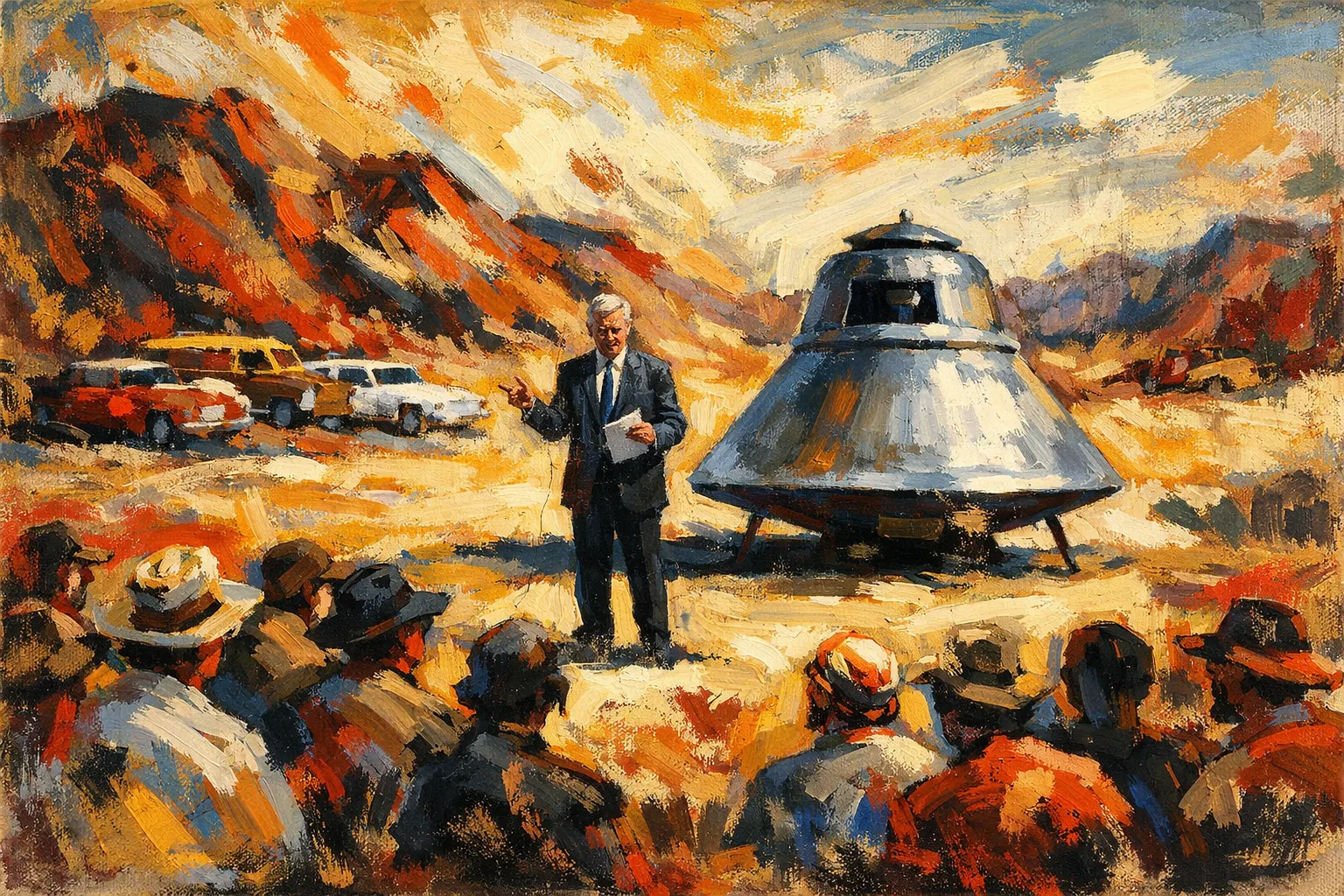
Adamski’s central story began during an outing in the Colorado Desert near Desert Center, east of Palm Springs. He said that he and several companions noticed a large, cigar-shaped object in the sky. Convinced that it had come for him, he asked to be driven away from the main group, set up camera equipment and waited while the others watched from a considerable distance. According to his later account, a smaller translucent craft descended behind nearby hills and a human-looking figure appeared on foot.[history.denverlibrary.org]history.denverlibrary.orgOpen source on denverlibrary.org.
Adamski described the visitor as younger and slightly shorter than himself, with long sandy hair, tanned skin and a close-fitting brown outfit. The being did not speak English. Instead, Adamski said they communicated through gestures and limited telepathy. He concluded that the visitor came from Venus and later called him Orthon, although Adamski presented that as a convenient name rather than one spoken during the encounter.[history.denverlibrary.org]history.denverlibrary.orgOpen source on denverlibrary.org.
The alleged message was as important as the alien’s appearance. Orthon supposedly warned that nuclear weapons threatened humanity and might disturb the wider Solar System. This transformed the incident from a simple sighting into a moral revelation: advanced beings had come not to invade California but to urge its inhabitants towards peace, spiritual maturity and restraint. Scholars of the contactee movement identify this mixture of cosmic authority, anti-nuclear concern and quasi-religious teaching as a defining feature of the genre Adamski helped popularise.[chapman.edu]digitalcommons.chapman.eduLeslie on Flying Saucers. Have. Landed, which told his "true" story of a series of philosophical.Read more…
Adamski said Orthon declined to be photographed. The physical evidence instead consisted of indistinct photographs, unusual footprints and a photographic plate that the visitor allegedly took away and later returned marked with symbols. George Hunt Williamson, one of the men associated with the outing, made plaster casts of patterned shoe impressions. None of these items established an extraterrestrial origin. The marks were never connected to a verifiable language, material or manufacturing process, while the companions were too far away to identify the person Adamski said he met.[Wikipedia]WikipediaGeorge AdamskiGeorge Adamski
This distance is a central weakness. The witnesses could support only the limited proposition that Adamski had walked into the desert and appeared to interact with something or someone. They were not close enough to confirm Orthon’s claimed appearance, origin, telepathic message or method of arrival. The extraordinary parts of the story therefore depended almost entirely on Adamski’s own narration.
Palomar Gardens gave the story borrowed authority
Adamski was already well positioned to sell such an encounter. In the 1930s he had taught a personal mixture of Christianity, esoteric philosophy and Theosophical ideas in Southern California. By the 1940s he and his associates were operating Palomar Gardens, a campground and small café near the base of Palomar Mountain. He built a wooden observatory there and used privately owned telescopes to watch and photograph the sky.[history.denverlibrary.org]history.denverlibrary.orgOpen source on denverlibrary.org.
The location was highly advantageous. The nearby Palomar Observatory was one of the world’s most famous astronomical institutions, but Adamski did not work for it and was not a professional astronomer. Visitors nevertheless sometimes assumed that the man described as “Professor Adamski” was connected with the scientific establishment on the mountain. Adamski occasionally clarified the distinction in print, but the geographical association continued to enhance his public image.[history.denverlibrary.org]history.denverlibrary.orgOpen source on denverlibrary.org.
His actual establishment was closer to a roadside spiritual centre than a research laboratory. Tourists could eat, camp, attend talks and look through telescopes. Adamski had already claimed repeated saucer sightings above Palomar Gardens and had begun giving paid lectures around Southern California before the Desert Center story appeared. His earlier assertions included inhabited planets, artificial canals on Mars and giant spacecraft observed around the Moon—claims that went far beyond what contemporary astronomers could support.[history.denverlibrary.org]history.denverlibrary.orgOpen source on denverlibrary.org.
This setting helps explain the power of the Adamski narrative. He did not need access to classified files or sophisticated instruments. He needed a location that looked scientific, an audience already interested in spiritual teaching and photographs that were suggestive enough to reproduce in newspapers, magazines and books. California supplied all three.
Photographs turned a private claim into a product
Adamski’s saucer photographs became the most recognisable part of his case. Some were little more than bright spots against dark backgrounds, but others appeared to show a sharply outlined bell-shaped craft with a rounded upper section and three structures beneath it. Adamski described the object as a Venusian “scout ship” and said that photographs taken in December 1952 showed the same type of craft connected with his desert encounter.[history.denverlibrary.org]history.denverlibrary.orgOpen source on denverlibrary.org.
The images were visually effective because they offered than most contemporary UFO photographs. A viewer could see a designed object rather than an ambiguous point of light. That very clarity, however, created problems. Critics observed that the alleged ship resembled a small domestic or industrial object photographed at close range. Suggested sources have included a chicken-brooder component, a lamp shade and parts of a pressure lantern. No surviving image provides reliable information about the object’s distance, size or movement, so the photographs cannot distinguish between a large aerial craft and a small suspended model.[Wikipedia]WikipediaGeorge AdamskiGeorge Adamski
Claims that film-industry experts had authenticated the pictures also weakened under scrutiny. Adamski invoked favourable comments attributed to photographic specialists, but later investigators reported that some of the supposed endorsements had been exaggerated or misrepresented. Even a technically untouched negative would not solve the central problem: a camera can faithfully record a model without revealing that it is a model. Authentication of film stock is not authentication of the story attached to it.
There was also no useful evidential chain of custody. Adamski and his associates controlled when and where the photographs were taken, how the equipment was arranged and which negatives were released. There were no independent measurements, simultaneous photographs from known positions or instrument records establishing the object’s scale and location. By the standards applied to modern aviation or scientific imagery, the material is badly underdetermined.
Books and lectures made Adamski internationally famous
Adamski’s account reached a much larger audience through Flying Saucers Have Landed, published in 1953 with the Anglo-Irish writer Desmond Leslie. Leslie supplied a broad history of alleged ancient visitations, while Adamski contributed the Desert Center narrative and photographs. The combination placed a vivid personal encounter inside a grand theory of extraterrestrial involvement in human history. It became one of the foundational texts of contactee culture.[Wikipedia]WikipediaGeorge AdamskiGeorge Adamski
Adamski followed it with Inside the Space Ships, in which the claims expanded from a desert meeting to journeys aboard extraterrestrial craft and conversations with inhabitants of Venus, Mars and Saturn. The progression is important. The later stories produced no stronger evidence than the first encounter, but offered more elaborate teachings and greater access to the “Space Brothers”. Adamski’s authority increasingly rested on revelation: he knew things because advanced beings had selected him to receive them.
Lectures reinforced this relationship. Audiences were shown photographs, told of private meetings and offered explanations for war, nuclear danger, religion and humanity’s future. The message was optimistic rather than frightening. The aliens were beautiful, peaceful and technologically superior; Earth’s crisis arose from human aggression and spiritual ignorance. For people living through atmospheric nuclear tests and Cold War confrontation, that was a reassuring alternative to both military invasion stories and official secrecy.[jstor.org]jstor.orgUFOs: THE RELIGIOUS DIMENSIONby TED PETERS · 1977 · Cited by 2 — Perhaps the most widely known contactée during the cold war period…
Commercial activity does not by itself prove fraud. Authors and lecturers can earn money while sincerely believing what they say. In Adamski’s case, however, the income from books, appearances and photographs matters because the evidence remained under his control and the claims became more spectacular as his audience grew. The commercial structure rewarded continuation of the story, not independent verification.
Giant Rock turned contact into a California movement
Adamski was the best-known contactee, but Southern California’s contact culture extended beyond him. Its most visible gathering place was Giant Rock, near Landers in the Mojave Desert. There, former aviation worker George Van Tassel operated an airstrip, café and meeting centre and claimed telepathic communication with extraterrestrials. Beginning in the 1950s, he organised annual spacecraft conventions that drew speakers, believers, photographers, tourists and curiosity-seekers.[spacesarchives.org]spacesarchives.orggeorge van tassel the integratrongeorge van tassel the integratron
The conventions show that the contactee era was not simply a collection of isolated claims. It was a social network. Visitors exchanged newsletters and testimony, heard lectures, inspected photographs and bought books, badges and other merchandise. LIFE photographer Ralph Crane’s images of the 1957 gathering document a broad public event rather than a secretive cult: families, enthusiasts and eccentrics assembled in the desert to listen, socialise and participate in a new subculture. At its late-1950s height, Giant Rock reportedly attracted more than 10,000 people.[Google Arts & Culture]artsandculture.google.comCAXh3kxi5w W MgCAXh3kxi5w W Mg
Adamski’s relationship with the convention circuit was not entirely straightforward. He was a major influence on its ideas, but he guarded his own authority and did not become merely one speaker among many. He appeared at Giant Rock in 1955, yet the wider movement quickly generated rival contactees, competing extraterrestrial messages and separate organisations. This was a culture built around individual revelation, so disputes over status and authenticity were almost inevitable.
California’s desert environment helped make the movement persuasive. Giant Rock, Desert Center and the country around Joshua Tree were accessible by car from Los Angeles but felt distant from ordinary urban life. Clear horizons provided dramatic viewing conditions, while military aviation and the state’s aircraft industry supplied a real-world background of unfamiliar technology. The desert functioned both as theatre and proof-by-atmosphere: it looked like the kind of place where a spacecraft might land unnoticed.

Why official attention did not validate the claims
Adamski repeatedly suggested that government officials knew more than they admitted. At times he implied that the Federal Bureau of Investigation or military intelligence had cleared, supported or privately confirmed his work. Surviving FBI files demonstrate official interest in his activities and statements, but the existence of a government file is not evidence that investigators accepted his claims. Agencies routinely record correspondence, public claims and possible misuse of their names. The FBI’s published Adamski file is an archival record of attention, not an endorsement of Venusians.[FBI]vault.fbi.gov— Federal Bureau of Investigation— Federal Bureau of Investigation
This distinction is especially important in UFO history. A contactee could transform a visit, warning or routine inquiry from officials into proof that the government considered him important. Once retold to an audience already expecting secrecy, denial itself could be interpreted as confirmation. The result was a self-protecting claim: government attention proved the story mattered, while government rejection proved a cover-up.
The US Air Force’s Project Blue Book collected and assessed UFO reports between 1952 and 1969, and its records are now held by the US National Archives. Edward Ruppelt, who led the project during its early period, investigated Adamski’s public claims and attended one of his California lectures. Ruppelt’s published account was scathing: he regarded Adamski as an effective performer rather than a reliable witness and found no matching independent report that established the alleged Desert Center spacecraft.[National Archives]archives.govNational Archives Project BLUE BOOKNational Archives Project BLUE BOOK
Official interest therefore weakened rather than strengthened Adamski’s case. No authenticated government analysis established that his photographs showed large flying vehicles, that the footprints were non-human or that an extraterrestrial landed near Desert Center. Nor did the files produce radar tracks, military observations or physical material corresponding to his narrative.
Why investigators rejected the evidence
The most serious objections were cumulative rather than dependent on one decisive exposure. Each category of evidence failed in a different way.
The encounter was not independently witnessed at close range. Adamski’s companions were positioned too far away to identify the alleged visitor or verify the conversation. Later accounts of what each person observed were not sufficiently consistent or detailed to establish the extraordinary parts of the story.
The physical traces were uncontrolled. Footprints and symbols could easily have been produced by people, and there was no secure chain of custody or independent laboratory result pointing to a non-terrestrial source.
The photographs lacked scale and provenance. They may show real physical objects, but they do not demonstrate that those objects were large, distant or airborne. Their resemblance to manufactured household components supports the model hypothesis.
Adamski’s authority was overstated. He was not a Palomar Observatory astronomer or an academic professor. The prestige surrounding Palomar Mountain was repeatedly allowed to colour public presentation of his work.
His claims expanded without better evidence. The story progressed from sightings to a desert meeting, then to spacecraft journeys and detailed knowledge of other planets. Greater specificity should have produced more opportunities for verification, but it did not.
Government records offered no confirmation. FBI attention and Blue Book investigation documented Adamski’s prominence and official concern about his representations. They did not support his extraterrestrial interpretation.[fbi.gov]vault.fbi.gov— Federal Bureau of Investigation— Federal Bureau of Investigation
Supporters have argued that the photographs were too detailed for crude models, that multiple witnesses signed statements and that Adamski’s international reception showed he was taken seriously. These points establish influence, not reliability. A detailed model can produce a detailed photograph; signed testimony can preserve an honest mistake or a coordinated story; and popularity measures cultural appeal rather than physical truth.
Space exploration made the Venus story less credible
In 1952 the surface of Venus was hidden beneath clouds, leaving more room for popular speculation than exists today. Even so, Adamski’s claim involved human-like beings living on a nearby planet and travelling casually between worlds—an assertion that required evidence far beyond a personal narrative. That evidence never appeared.
The scientific position became much less forgiving in December 1962, when NASA’s Mariner 2 made the first successful planetary fly-by. Its instruments confirmed that Venus was extremely hot, overturning lingering popular images of a humid or tropical world beneath the clouds. Later measurements established a surface temperature of roughly 460°C and crushing atmospheric pressure, conditions wholly incompatible with unprotected human-like inhabitants of the kind Adamski described.[nasa.gov]nasa.gov60 Years Ago: Mariner 2 First to Explore Venus60 Years Ago: Mariner 2 First to Explore Venus
Some believers responded by relocating the Venusians underground, into another dimension or to hidden “etheric” levels of existence. Such revisions protected the belief but moved it beyond testable physical claims. Adamski had presented Orthon as a bodily visitor who left footprints, travelled in a photographed machine and came from an inhabited planet. Once those propositions conflicted with planetary science, redefining Venus changed the original claim rather than confirming it.
Mariner 2 did not prove that Adamski staged every photograph or invented every detail. It did, however, remove one of the central factual supports of his story. Later reporting and exploration therefore weakened, rather than strengthened, his account.
What Adamski changed in California’s UFO history
Adamski’s lasting achievement was to change the role of the UFO witness. Earlier reports usually involved people who saw something unexplained and tried to describe it. The contactee claimed much more: selection by extraterrestrials, repeated access to their craft and authority to deliver their teachings. The mystery was no longer merely “What crossed the sky?” but “What do the visitors want humanity to become?”
That formula flourished in California because it could draw on several local traditions at once. Southern California already supported alternative religions, metaphysical teaching, health movements, science-fiction fandom and experimental communities. The aerospace boom gave futuristic ideas material credibility, while the desert supplied places in which extraordinary meetings could supposedly occur without inconvenient observers.
Adamski also demonstrated the power of a complete media package. A compelling contactee needed a recognisable craft, a named visitor, a moral message, photographs, witnesses, lectures and books. Giant Rock conventions and similar gatherings then allowed audiences to reinforce the story socially. Even people unconvinced by a particular photograph could believe that the quantity of testimony pointed to a larger hidden reality.
For that reason, Adamski belongs in California’s UFO history even though his case is poorly supported. His story did not survive careful scrutiny as evidence of extraterrestrial visitation. It survived as a cultural template—one that fused the California desert, borrowed scientific prestige, Cold War anxiety and spiritual optimism into an alien dream that could be photographed, published, performed and sold.
Amazon book picks
Further Reading
Books and field guides related to How Adamski Sold California's Alien Dream. Use these as the next step if you want deeper reading beyond the article.
Flying Saucers Have Landed
Primary source for the Venusian contact claims discussed on the page.
The Demon-Haunted World
Rating: 4.5/5 from 43 Google Books ratings
Explains skepticism toward extraordinary claims lacking evidence.
eBay marketplace picks
Marketplace Samples
Live-tested eBay searches with available results related to this page.
Selected fromGeorge Adamski collectible oneBay.co.uk.
Endnotes
1.
Source: history.denverlibrary.org
Link:https://history.denverlibrary.org/news/western-history/man-who-met-venusian-allegedly
2.
Source: Wikipedia
Title: George Adamski
Link:https://en.wikipedia.org/wiki/George_Adamski
3.
Source: cdamm.org
Title: Extraterrestrial/UFO Religion
Link:https://www.cdamm.org/articles/extraterrestrial
Source snippet
Extraterrestrial/UFO Religion - CDAMM15 Jan 2021 — in the 1950s, UFO religion, saw a flying saucer in California's Mojave Desert on...
4.
Source: digitalcommons.chapman.edu
Link:https://digitalcommons.chapman.edu/cgi/viewcontent.cgi?article=1002&context=sociology_articles
Source snippet
Leslie on Flying Saucers. Have. Landed, which told his "true" story of a series of philosophical.Read more...
5.
Source: jstor.org
Link:https://www.jstor.org/stable/24458392
Source snippet
UFOs: THE RELIGIOUS DIMENSIONby TED PETERS · 1977 · Cited by 2 — Perhaps the most widely known contactée during the cold war period...
6.
Source: history.com
Title: george adamski ufo alien photos
Link:https://www.history.com/articles/george-adamski-ufo-alien-photos
7.
Source: artsandculture.google.com
Title: CAXh3kxi5w W Mg
Link:https://artsandculture.google.com/story/visit-the-1957-flying-saucer-convention/CAXh3kxi5wW_Mg?hl=en
8.
Source: spacesarchives.org
Title: george van tassel the integratron
Link:https://spacesarchives.org/explore/search-the-online-collection/george-van-tassel-the-integratron/
9.
Source: vault.fbi.gov
Title: — Federal Bureau of Investigation
Link:https://vault.fbi.gov/george-adamski/george-adamski-final.pdf/view
10.
Source: archives.gov
Title: National Archives Project BLUE BOOK
Link:https://www.archives.gov/research/military/air-force/ufos
11.
Source: nasa.gov
Title: 60 Years Ago: Mariner 2 First to Explore Venus
Link:https://www.nasa.gov/history/60-years-ago-mariner-2-first-to-explore-venus/
12.
Source: Wikipedia
Link:https://en.wikipedia.org/wiki/George
13.
Source: Wikipedia
Title: UFO photographs
Link:https://en.wikipedia.org/wiki/UFO_photographs
14.
Source: Wikipedia
Title: George Adamski
Link:https://it.wikipedia.org/wiki/George_Adamski
15.
Source: Wikipedia
Link:https://en.wikipedia.org/wiki/Contactee
16.
Source: Wikipedia
Title: Project Blue Book
Link:https://en.wikipedia.org/wiki/Project_Blue_Book
17.
Source: Wikipedia
Title: Mariner 2
Link:https://en.wikipedia.org/wiki/Mariner_2
18.
Source: daily.jstor.org
Title: our space brothers might not actually look like little green men after all
Link:https://daily.jstor.org/our-space-brothers-might-not-actually-look-like-little-green-men-after-all/
19.
Source: jstor.org
Link:https://www.jstor.org/stable/jj.4391391.17
20.
Source: jpl.nasa.gov
Title: celebrates 50 years of planetary exploration
Link:https://www.jpl.nasa.gov/news/nasa-celebrates-50-years-of-planetary-exploration/
21.
Source: vault.fbi.gov
Title: george adamski
Link:https://vault.fbi.gov/george-adamski
22.
Source: vault.fbi.gov
Link:https://vault.fbi.gov/search?SearchableText=Capt+Ruppelt
23.
Source: history.denverlibrary.org
Title: man who boarded flying saucer allegedly
Link:https://history.denverlibrary.org/news/western-history/man-who-boarded-flying-saucer-allegedly
24.
Source: history.denverlibrary.org
Title: man who hitched ride venus allegedly
Link:https://history.denverlibrary.org/news/western-history/man-who-hitched-ride-venus-allegedly
25.
Source: space.com
Title: mariner 2 venus flyby 60 year anniversary
Link:https://www.space.com/mariner-2-venus-flyby-60-year-anniversary
26.
Source: historical-figures-and-celebrity.fandom.com
Title: George Adamski
Link:https://historical-figures-and-celebrity.fandom.com/wiki/George_Adamski
27.
Source: kids.kiddle.co
Title: George Adamski
Link:https://kids.kiddle.co/George_Adamski
Source snippet
George Adamski Facts for Kids17 Oct 2025 — On November 20, 1952, Adamski and friends were in the California desert.... Another con...
Published: November 20, 1952
28.
Source: latimes.com
Title: giant rock a century of stories in the mojave desert
Link:https://www.latimes.com/environment/story/2024-06-23/giant-rock-a-century-of-stories-in-the-mojave-desert
29.
Source: airandspace.si.edu
Link:https://airandspace.si.edu/collection-objects/mariner-2/nasm_A19760027000
30.
Source: archive.org
Title: George Adamski
Link:https://archive.org/details/GeorgeAdamski
31.
Source: cia.gov
Link:https://www.cia.gov/readingroom/document/00046885
32.
Source: youtube.com
Link:https://www.youtube.com/watch?v=B77O8MuEl-s
33.
Source: science.howstuffworks.com
Title: george adamski
Link:https://science.howstuffworks.com/space/aliens-ufos/george-adamski.htm
34.
Source: scribd.com
Link:https://www.scribd.com/document/800711166/adamski
35.
Source: geekchocolate.co.uk
Title: project blue book
Link:https://geekchocolate.co.uk/project-blue-book/
36.
Source: web2.ph.utexas.edu
Link:https://web2.ph.utexas.edu/~coker2/index.files/adamski.htm
37.
Source: bahaistudies.net
Title: George Adamski
Link:https://www.bahaistudies.net/asma/George_Adamski.pdf
38.
Source: yumpu.com
Title: George Adamski
Link:https://www.yumpu.com/en/document/view/12444403/george-adamski-how-to-find-lost-objects
Additional References
39.
Source: youtube.com
Title: George Adamski: Alien Contactee!
Link:https://www.youtube.com/watch?v=eh_LMjd_dZA
Source snippet
Mysteries and Monsters: Mountain of God UFO Cult | Episode 5 | The George Adamski Story...
40.
Source: cia.gov
Link:https://www.cia.gov/readingroom/docs/CIA-RDP81R00560R000100010012-8.pdf
41.
Source: cia.gov
Link:https://www.cia.gov/readingroom/document/cia-rdp81-01043r001600160002-1
42.
Source: cia.gov
Link:https://www.cia.gov/readingroom/docs/CIA-RDP96-00788R001200230018-6.pdf
43.
Source: cia.gov
Link:https://www.cia.gov/readingroom/document/cia-rdp81r00560r000100010001-0
44.
Source: cia.gov
Link:https://www.cia.gov/readingroom/document/cia-rdp79b00752a000300130001-1
45.
Source: cia.gov
Link:https://www.cia.gov/readingroom/docs/CIA-RDP79B00752A000300130001-1.pdf
46.
Source: youtube.com
Link:https://www.youtube.com/watch?v=pcRWbnOCw2c
Source snippet
The Secret of the Nordic Aliens // 3D CGI Animation...
47.
Source: anb.org
Link:https://www.anb.org/view/10.1093/anb/9780198606697.001.0001/anb-9780198606697-e-0801882
Source snippet
Adamski, GeorgeAdamski and his works epitomize the quasireligious nature of the 1950s' UFO “contactee” movement, which portrayed beautifu...
48.
Source: researchgate.net
Link:https://www.researchgate.net/publication/341176637_Hey_I_Told_You_Flying_Saucers_Are_Real_An_investigation_of_the_truth_value_of_UFO_photographs_within_contemporary_art