Within Idaho
What Did the Flight 105 Crew See?
The Flight 105 crew were credible aviation witnesses, but uncertain distance, sunset conditions and missing instrument data left the objects unresolved.
On this page
- The crew's account after leaving Boise
- Why professional witnesses mattered
- Evidence gaps and possible explanations
Page outline Jump by section
Introduction
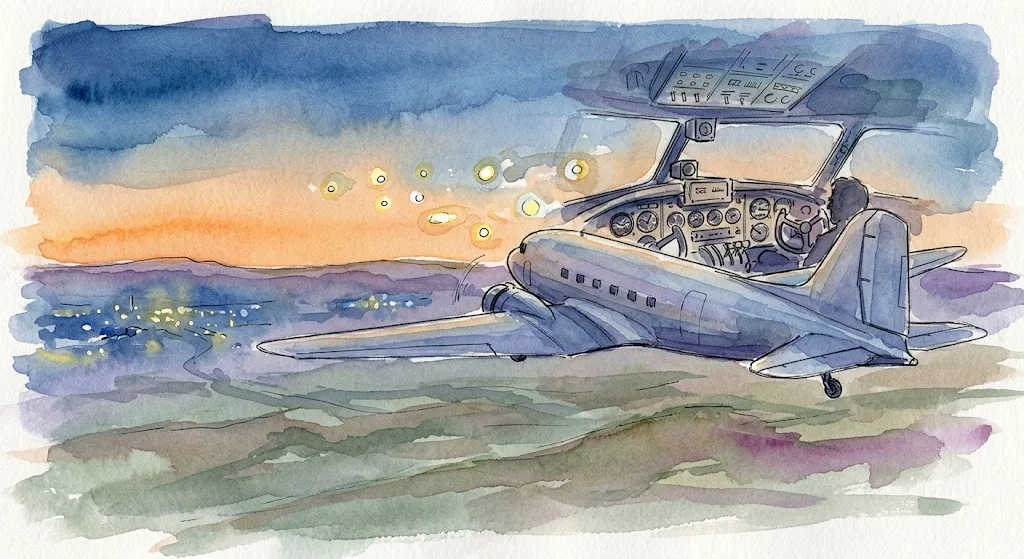
United Airlines Flight 105 remains one of the most important early UFO cases connected with Idaho because the witnesses were not casual observers. On 4 July 1947, Captain Emil J. Smith, First Officer Ralph Stevens and flight attendant Marty Morrow reported several unidentified objects after their Douglas DC-3 departed Boise. The pilots watched them for roughly ten to fifteen minutes, attempted to obtain confirmation by radio and described two separate groups travelling ahead of the airliner.[Wikipedia]WikipediaFlight 105 UFO sightingFlight 105 UFO sighting
The case deserves attention, but not because professional pilots are incapable of error. Their experience makes the report harder to dismiss as invention or simple confusion about ordinary aircraft. It does not, however, supply the missing distance, size, altitude or speed measurements needed to establish what the objects were. Flight 105 is therefore best regarded as a credible unresolved observation: strong testimony that something unusual was seen, but weak evidence for claims about an extraordinary craft.
The crew’s account after leaving Boise
Flight 105 took off from Boise at about 9.04 p.m., bound first for Pendleton, Oregon, and then north towards Seattle. The sighting began approximately eight minutes after departure, when the DC-3 was near Emmett and still climbing. Stevens initially interpreted the objects as approaching aircraft and flashed the airliner’s landing lights, a response that suggests the sighting began as a practical traffic concern rather than a search for something mysterious.[Wikipedia]WikipediaFlight 105 UFO sightingFlight 105 UFO sighting
Smith and Stevens subsequently reported seeing four or five objects, one apparently larger than the others, moving in a loose formation. After that group disappeared, a second group of four came into view. Accounts generally place the total observation time at between ten and fifteen minutes and the distance covered by the DC-3 during the episode at about 45 miles. The pilots called Morrow to the cockpit or forward cabin area, where she also saw the objects.[Wikipedia]WikipediaFlight 105 UFO sightingFlight 105 UFO sighting
Descriptions varied slightly between interviews and later summaries. The objects were commonly reported as thin, flat or disc-like, with no visible wings or tails. Smith said they seemed smooth underneath and rougher or rounded on top. Yet he was notably cautious about the most important details. Contemporary reporting recorded him saying that the crew could not be certain whether the objects were saucer-shaped or oval, and that their size could not be established because their position and distance were unknown.[Wikipedia]WikipediaFlight 105 UFO sightingFlight 105 UFO sighting
That qualification is central to the case. Later retellings often convert impressions into firm characteristics: the objects become large, solid discs travelling at extreme speed. Smith’s own reported language was more restrained. He believed they were unusual and apparently unlike conventional aircraft, but he did not claim to know their dimensions, range or origin.
The crew attempted to obtain independent confirmation. They contacted the Civil Aeronautics Administration station at Ontario, Oregon, and reportedly alerted another United aircraft travelling through the region. Neither produced a corroborating sighting. The DC-3’s passengers also failed to see the objects, although Smith explained that the view was largely ahead of the cockpit and poorly positioned for people seated in the cabin.[Wikipedia]WikipediaFlight 105 UFO sightingFlight 105 UFO sighting
These unsuccessful checks do not prove that nothing was there. Visibility differs sharply with viewing angle, altitude, window position and illumination. They do mean, however, that the case rests on three witnesses observing from essentially one moving platform. It was a multiple-witness event, but not a truly independent multi-location observation.

Why professional witnesses mattered
Flight 105 appeared during the intense “flying disc” wave that followed Kenneth Arnold’s 24 June 1947 report near Mount Rainier. Newspapers were already publishing large numbers of sightings when Smith’s story reached the press on 5 July. What distinguished it was the occupation of the witnesses. An experienced airline captain and first officer were assumed to know the appearance, movement and lighting of ordinary aircraft better than most members of the public.[Wikipedia]WikipediaFlying saucerFlying saucer
Smith’s earlier scepticism also strengthened the story’s public impact. Before his own encounter, he had reportedly suggested that Arnold might have seen a reflection from his instrument panel. On the evening of the Flight 105 sighting, Smith and Boise tower personnel joked about flying saucers before departure. His subsequent change of view was widely presented as the conversion of a practical, reluctant witness rather than the fulfilment of an existing belief.[project1947.com]project1947.comUA L Flight 105,J. SmithI located and interviewed the pilot, Capt. Emil J. Smith, now with United's New York office. He confirmed the reliability of prev…
This history makes deliberate fabrication seem unlikely. The crew reported the objects immediately, tried to secure confirmation and did not build an elaborate story about occupants, messages or extraterrestrial origins. Smith continued to say that he could not identify what he had seen. When atmospheric scientist James McDonald interviewed him years later, Smith reportedly confirmed the broad published account but still declined to speculate about the objects’ nature.[project1947.com]project1947.comUA L Flight 105,J. SmithI located and interviewed the pilot, Capt. Emil J. Smith, now with United's New York office. He confirmed the reliability of prev…
Professional competence nevertheless answers only some questions. A pilot may be a particularly reliable witness to cockpit procedures, aircraft configuration and normal traffic behaviour. That does not automatically make the pilot able to determine the range of a small, unfamiliar object viewed against an open sky.
Human vision normally estimates size and speed by combining apparent angular movement with clues about distance. Against a nearly featureless sky, those clues may be absent. A nearby small object and a distant large object can occupy the same apparent angle. Once distance is uncertain, estimates of physical size, altitude and velocity become interdependent guesses. Aviation experience may reduce some forms of misidentification, but it cannot create depth information that the visual scene does not contain. Contemporary scientific approaches to unidentified aerial phenomena therefore emphasise triangulation, calibrated cameras, radar-derived range and multiple sensor types rather than relying on testimony alone.[arXiv]arxiv.orgThe Scientific Investigation of Unidentified Aerial Phenomena (UAP) Using Multimodal Ground-Based ObservatoriesMay 29, 2023…
The Flight 105 crew’s shared view also requires careful interpretation. Three witnesses are better than one for establishing that the report was sincere and that more than one person perceived something. Yet Stevens first drew the others’ attention to a particular area of sky, and all observed under the same lighting conditions from the same aircraft. Their agreement does not remove the possibility of a common misperception or ambiguous stimulus.
What the testimony could not establish
The surviving account contains no photograph, film, radar return or recovered material. There is no known instrument record fixing the objects’ bearings at timed intervals, and no dependable measurement of their angular size. The crew could not provide a secure range, which meant that descriptions such as “larger than aircraft” or “far beyond known speed” remained impressions rather than calculations.[Wikipedia]WikipediaFlight 105 UFO sightingFlight 105 UFO sighting
The apparent inability of the DC-3 to catch the objects is similarly inconclusive. An observer following a distant object with an unknown track may experience little change in its bearing even when the object is moving slowly. Conversely, a small nearby object may cross the field of view rapidly without possessing exceptional speed. Without range and geometry, relative motion cannot be converted reliably into miles per hour.
Reports that the objects changed formation after Stevens flashed the landing lights are intriguing but also uncertain. A genuine coordinated change would imply structured objects responding or manoeuvring together. Other possibilities include shifts in viewing angle, individual objects moving at different rates, intermittent reflections or the witnesses’ changing perception of a loose group. No timed record or second vantage point exists to distinguish among these interpretations.
The description of wingless shapes also has limits. At dusk, an aircraft’s wings and tail can disappear into low contrast while a sunlit fuselage remains visible. Birds viewed edge-on can appear as dark or bright flattened forms, and distant balloons or aircraft may seem to change shape as their illumination changes. Edward Ruppelt, who later led the US Air Force’s Project Blue Book, noted more generally that balloons and aircraft near sunset can suddenly brighten when they reflect sunlight, producing misleading impressions of luminous or metallic objects.[Project Gutenberg]gutenberg.orgProject GutenbergThe Report on Unidentified Flying Objectsby Edward J. Ruppelt. Unusual lighting conditions are a common cause of such il…
These possibilities should not be mistaken for a demonstrated solution. No specific flock, balloon release or set of aircraft has been matched conclusively to the Flight 105 observation. They show why a confident identification cannot be built from the crew’s visual impressions alone.
Sunset, expectation and possible explanations
The sighting occurred in evening twilight with the DC-3 flying roughly towards the sunset. Air Materiel Command later treated this as an important weakness, suggesting that ordinary aircraft, balloons, birds or illusion might account for the report because sunset conditions are particularly favourable to misleading reflections and contrast effects.[Wikipedia]WikipediaFlight 105 UFO sightingFlight 105 UFO sighting
Sunset can produce a striking separation between observer and object. A lower aircraft may already be in shadow while objects at greater altitude remain illuminated. Polished surfaces, windows, balloon envelopes or birds’ bodies can briefly reflect sunlight against a darkening sky. As the observer and target move, the reflection can fade abruptly, creating the impression that an object has accelerated away, merged with another object or vanished.
The reported loose formations make birds a plausible category rather than a proven identification. Flocks can alter spacing, lack visible aircraft-like appendages at a distance and appear bright when their bodies or wings catch low sunlight. Against this explanation, the pilots said the objects maintained an unusual appearance for several minutes and seemed unlike birds or known aircraft. The duration may count against a fleeting reflection, but it does not eliminate a group of distant conventional objects whose true range was misunderstood.
Ordinary aircraft are another possibility. Stevens initially thought the objects were traffic, and the low-contrast twilight background may have hidden their wings. The absence of confirmation from another aircraft or the Ontario station does not rule this out, particularly if the objects were far from the locations imagined by the crew. Yet no matching flight formation was documented, leaving the proposal generic.
Expectation may also have influenced interpretation. Arnold’s report had been widely publicised, Boise tower personnel mentioned flying saucers before take-off, and the Fourth of July produced a surge of reports across the region. This does not mean that the crew invented the sighting. It means that an ambiguous formation was encountered in a cultural setting that supplied an immediate label and encouraged observers to inspect unfamiliar lights as possible “discs”. The 1947 wave demonstrates how attention and interpretation can change rapidly once a new aerial mystery enters the news.[Wikipedia]WikipediaFlying saucerFlying saucer
Did later investigation strengthen the case?
The publicity surrounding Flight 105 gave it a longer afterlife than most Idaho sightings from the 1947 wave. Smith met Kenneth Arnold, and the two men were photographed comparing their experiences. Arnold regarded the airline crew’s report as support for his own, reasoning that several competent pilots could not all simply be “seeing things”. A later retracing of the route by Arnold and an Idaho newspaper aviation editor produced no repeat observation, although a negative result on another day could not settle what happened on 4 July.[Wikipedia]WikipediaFlight 105 UFO sightingFlight 105 UFO sighting
Smith and Arnold were also interviewed by federal personnel in July 1947. The military’s broader UFO investigations did not begin in their more organised form until Project Sign was established later that year; Sign was followed by Project Grudge and, from 1952, Project Blue Book. The official record of these programmes shows that the Air Force collected and assessed reports but did not treat an “unidentified” classification as evidence of extraterrestrial technology. It meant that the available information had not supported a satisfactory conventional identification.[National Archives]archives.govproject blue book 50th anniversaryproject blue book 50th anniversary
McDonald’s later treatment strengthened the case for the witnesses’ sincerity and the durability of their recollections. He interviewed Smith and argued before a congressional symposium in 1968 that the clear weather, duration and aviation experience of the observers made a simple optical explanation inadequate. McDonald also reported that Smith was regarded as reliable by colleagues.[project1947.com]project1947.comSHG - UFO Symposium 1968: McDonald Statementby JE MCDONALD — Capt. Emil J. Smith, now. United Flight 105 had left Boise at 9:04 p.m. en r…
However, that later interview could not reconstruct missing measurements. More than two decades had passed, and the fundamental evidential position remained unchanged: no radar data, independent ground observation, photograph or precisely recorded geometry had emerged. Later reporting therefore strengthened confidence that Smith consistently described a genuine puzzling experience, but it did not materially strengthen claims about the objects’ physical characteristics.

What Flight 105 proves — and what it does not
Flight 105 supports three relatively firm conclusions. The crew sincerely reported an aerial observation; more than one trained aviation witness saw the stimulus; and the objects were not identified at the time. The immediate radio calls, cautious language and absence of extravagant claims all weigh in favour of good-faith testimony.
The case does not establish that nine solid discs travelled at extraordinary speed. Those conclusions require knowledge of distance, size and trajectory that the witnesses did not possess. Nor does the professional status of the pilots remove the perceptual problems created by twilight, an open sky and a moving observation platform.
Within Idaho’s UFO history, Flight 105 is consequently more valuable as an evidence lesson than as proof of an exotic vehicle. It shows why pilot reports deserve serious investigation: pilots can recognise abnormal traffic situations, describe flight conditions and respond methodically. It also shows why testimony reaches a limit. Credibility can establish that witnesses are honestly puzzled; it cannot by itself turn an unidentified sighting into a measured aircraft.
The most balanced classification is therefore unresolved but evidentially incomplete. Conventional explanations involving distant aircraft, birds, balloons or sunset reflections remain plausible, but none has been demonstrated. An extraordinary explanation remains possible only in the broad logical sense, not positively supported by the surviving evidence. Flight 105 endures because competent witnesses saw something they could not explain—not because the historical record tells us what that something was.
Amazon book picks
Further Reading
Books and field guides related to What Did the Flight 105 Crew See?. Use these as the next step if you want deeper reading beyond the article.
The Report on Unidentified Flying Objects
Covers early landmark UFO cases and how credible witnesses were evaluated.
UFOs: Generals, Pilots, and Government Officials Go on the Re...
Emphasizes testimony from pilots and other professional observers.
The UFO Experience: A Scientific Inquiry
Explains how sightings are assessed and categorized.
eBay marketplace picks
Marketplace Samples
Live-tested eBay searches with available results related to this page.
Selected fromaviation poster oneBay.co.uk.


Endnotes
1.
Source: Wikipedia
Title: Flight 105 UFO sighting
Link:https://en.wikipedia.org/wiki/Flight_105_UFO_sighting
2.
Source: project1947.com
Title: UA L Flight 105,
Link:https://www.project1947.com/fig/ual105.htm
Source snippet
J. SmithI located and interviewed the pilot, Capt. Emil J. Smith, now with United's New York office. He confirmed the reliability of prev...
3.
Source: project1947.com
Link:https://www.project1947.com/shg/symposium/mcdonald.html
Source snippet
SHG - UFO Symposium 1968: McDonald Statementby JE MCDONALD — Capt. Emil J. Smith, now. United Flight 105 had left Boise at 9:04 p.m. en r...
4.
Source: Wikipedia
Title: Flying saucer
Link:https://en.wikipedia.org/wiki/Flying_saucer
5.
Source: arxiv.org
Link:https://arxiv.org/abs/2305.18566
Source snippet
The Scientific Investigation of Unidentified Aerial Phenomena (UAP) Using Multimodal Ground-Based ObservatoriesMay 29, 2023...
Published: May 29, 2023
6.
Source: gutenberg.org
Link:https://www.gutenberg.org/cache/epub/17346/pg17346-images.html
Source snippet
Project GutenbergThe Report on Unidentified Flying Objectsby Edward J. Ruppelt. Unusual lighting conditions are a common cause of such il...
7.
Source: Wikipedia
Title: 1947 flying disc craze
Link:https://en.wikipedia.org/wiki/1947_flying_disc_craze
Source snippet
Writes Bloecher: "There were no 'attitudes' about UFOs in June 1947.... Flight 105. edit. Main article: Flight 105 UFO sighting · 1947 f...
Published: June 1947
8.
Source: archives.gov
Title: project blue book 50th anniversary
Link:https://www.archives.gov/news/articles/project-blue-book-50th-anniversary
9.
Source: archives.gov
Title: National Archives Project BLUE BOOK
Link:https://www.archives.gov/research/military/air-force/ufos
10.
Source: newspapers.com
Title: ufo mentions in arizona republic
Link:https://www.newspapers.com/article/5307356/ufo_mentions_in_arizona_republic/
11.
Source: Wikipedia
Title: Project Blue Book
Link:https://en.wikipedia.org/wiki/Project_Blue_Book
12.
Source: Wikipedia
Title: Identification studies of UFOs
Link:https://en.wikipedia.org/wiki/Identification_studies_of_UFOs
13.
Source: archives.gov
Title: 1992 annual report
Link:https://www.archives.gov/files/about/history/sources/reports/1992-annual-report.pdf
14.
Source: history.com
Title: u s air force closes the book on ufos 45 years ago
Link:https://www.history.com/articles/u-s-air-force-closes-the-book-on-ufos-45-years-ago
15.
Source: time.graphics
Link:https://time.graphics/event/10182928
16.
Source: youtube.com
Link:https://www.youtube.com/watch?v=yYmvf-KknTQ
Source snippet
FLIGHT 105 - THE SIGHTING THAT CHANGED EVERYTHING...
17.
Source: youtube.com
Title: FLIGHT 105
Link:https://www.youtube.com/watch?v=mFVUmmaRdXo
Source snippet
Kenneth Arnold UFO Sighting, 1947...
18.
Source: facebook.com
Link:https://www.facebook.com/groups/869897817697371/posts/1636062371080908/
19.
Source: arewealoneinthisuniverse.fandom.com
Title: Flight 105 UFO sighting
Link:https://arewealoneinthisuniverse.fandom.com/wiki/Flight_105_UFO_sighting
20.
Source: spacedoutclassroom.com
Title: flight 105
Link:https://spacedoutclassroom.com/tag/flight-105/
Additional References
21.
Source: cia.gov
Link:https://www.cia.gov/readingroom/docs/CIA-RDP96-00788R001200230018-6.pdf
22.
Source: cia.gov
Link:https://www.cia.gov/readingroom/document/cia-rdp81r00560r000100010001-0
23.
Source: kirkmcd.princeton.edu
Title: bloecher 67
Link:https://kirkmcd.princeton.edu/JEMcDonald/bloecher_67.pdf
Source snippet
1947. It includes a detailed chronology of more than 850 UFO cases for June and July with complete references, primarily from 140 newspap...
24.
Source: youtube.com
Link:https://www.youtube.com/watch?v=OarL8ymktIE
Source snippet
Kenneth Arnold 1947 UFO sighting Kenneth Arnold UFO Sighting, 1947 Think Anomalous...
25.
Source: youtube.com
Link:https://www.youtube.com/watch?v=cCxtUqZA2Zw
Source snippet
United Airlines Crew Encounters MYSTERIOUS UFO on July 4th 1947...
26.
Source: instagram.com
Link:https://www.instagram.com/p/DablBzyFmn6/
27.
Source: researchgate.net
Link:https://www.researchgate.net/publication/378719698_Anomaly_A_Scientific_Exploration_of_the_UFO_Phenomenon
28.
Source: amazon.com
Link:https://www.amazon.com/stores/author/B002JTQ71Q?tag=searcht-20
29.
Source: jasoncolavito.com
Link:https://www.jasoncolavito.com/flying-saucers-are-real.html
30.
Source: reddit.com
Link:https://www.reddit.com/r/UFOs/comments/16vc2eu/have_you_read_the_report_on_unidentified_flying/