Within Alaska UFOs
What Did Radar Detect Near Nenana?
The 1952 Nenana incident involved ground and airborne radar contacts, yet no visual sighting or surviving scope film settled what was detected.
On this page
- The Murphy Dome detection and F 94 interception
- Why two radar systems made the case notable
- What the missing visual and technical evidence limits
Page outline Jump by section
Introduction
The Nenana radar encounter of 22 January 1952 is one of Alaska’s most intriguing early military UFO cases, but also one of its easiest to overstate. A ground radar station at Murphy Dome detected an apparently fast-moving target, and an F-94 interceptor later obtained separate airborne radar contacts near Nenana. The aircrew twice appeared to close to roughly 200 yards, yet nobody saw an object, the ground station did not confirm the airborne targets, and no radar-scope photographs survive in the published record. The US Air Force eventually attributed the incident to weather-related radar effects, although experienced radar personnel reportedly disputed that conclusion.[Wikimedia Commons]upload.wikimedia.orgWikimedia Commons…
The case matters because it captures a central problem in Alaska’s Cold War UFO history. Radar contacts could not simply be ignored in airspace facing the Soviet Union, but early-1950s equipment, incomplete meteorological data and hurried reporting made it difficult to distinguish an aircraft from an atmospheric effect or an instrumental anomaly. Nenana therefore remains historically important without providing firm evidence of an extraordinary craft.
The Murphy Dome detection and F-94 interception
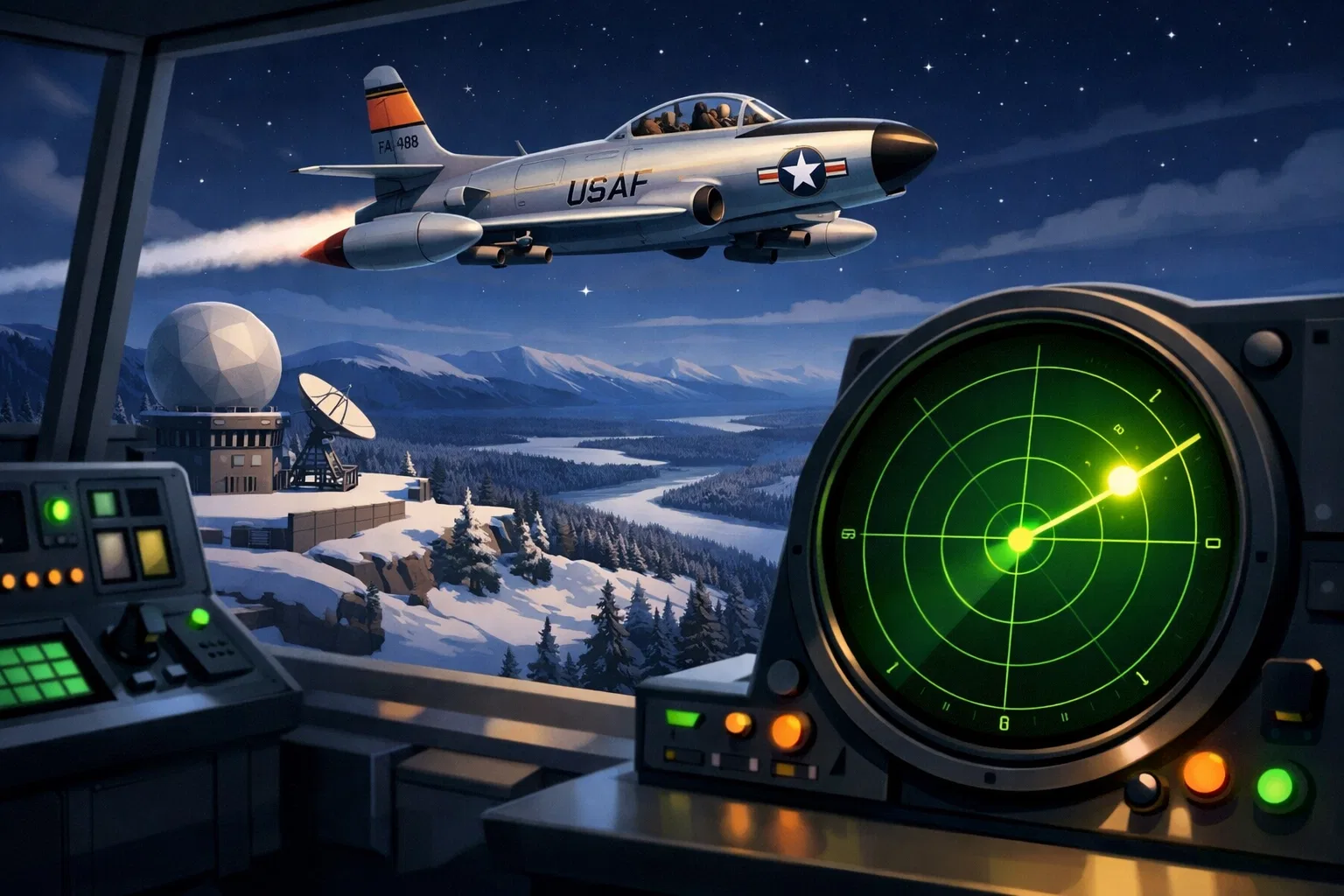
The incident began at 10:20 Coordinated Universal Time, or 1:20 a.m. local Alaska time, at the Murphy Dome radar station northwest of Fairbanks. According to Project Blue Book Status Report No. 6, operators detected an unidentified return travelling away from the station along an azimuth of 210 degrees. Its speed was estimated at about 1,500 miles per hour. The return then appeared to reverse direction and head back towards the station.[Wikimedia Commons]upload.wikimedia.orgWikimedia Commons…
Operators changed the radar setting so that they could follow the target as it approached. The return disappeared after the adjustment. About seven minutes later it reappeared close to its original position, again travelling away, and seemed to begin another turn before fading. These movements produced the case’s most dramatic headline figures, but they depended entirely on how successive radar returns were interpreted. A calculated speed of 1,500 miles per hour did not necessarily mean that one solid object had been continuously tracked over a measured course.[Wikimedia Commons]upload.wikimedia.orgWikimedia Commons…
An F-94 Starfire interceptor was already airborne by approximately 10:30 UTC. The F-94 was a two-seat, radar-equipped jet used for all-weather air defence, making it better suited to a night interception than fighters dependent on visual contact alone. Its presence also shows why the event was treated seriously: Murphy Dome formed part of Alaska’s developing aircraft-control-and-warning network, whose practical purpose was to detect and direct interceptors towards possible intruders.[Wikimedia Commons]upload.wikimedia.orgWikimedia Commons…
The ground station initially told the fighter to orbit because the unknown return appeared to be moving away rapidly. Murphy Dome then lost the unidentified contact but continued tracking the F-94. At about 11:00 UTC, as the aircraft approached Nenana, the radar operator aboard the interceptor detected two returns, described as one faint and one bright. The aircraft was reported at 30,000 feet and the target at about 25,000 feet. The returns crossed from right to left; when the F-94 turned towards them, its equipment indicated a high rate of closure. Contact was lost at an indicated range of 200 yards.[Wikimedia Commons]upload.wikimedia.orgWikimedia Commons…
Roughly an hour later, the airborne radar acquired another target near Nenana. This time the pilot kept it directly ahead during the approach. The crew reported closing at about 100 knots despite lowering the F-94’s flaps, a configuration that reduced the fighter’s speed. At an indicated distance of 200 yards, the pilot pulled up and the radar return disappeared. The aircraft continued searching until it was released at 12:10 UTC.[Wikimedia Commons]upload.wikimedia.orgWikimedia Commons…
The official record is less clear about how many aircraft participated than later retellings sometimes suggest. The surviving Blue Book status reports consistently describe “an F-94” and two airborne contacts. Edward Ruppelt, the Air Force officer who led Project Blue Book, later published a more elaborate account involving successive interceptions and additional passes. His narrative is valuable because he had access to Blue Book material and interviewed personnel, but it was a retrospective popular book rather than the original operational record. Where it differs from the contemporary status report, the contemporary document is the safer foundation.[Wikimedia Commons]upload.wikimedia.orgWikimedia Commons…
Why two radar systems made the case notable
Nenana was stronger than an ordinary radar-only report because apparently unusual returns appeared on two different types of equipment: a large ground installation and the compact intercept radar carried by the F-94. Neither radar was merely repeating information transmitted by the other. In principle, independent detection systems reduce the chance that a single faulty component created the entire event.[Wikimedia Commons]upload.wikimedia.orgWikimedia Commons…
The chronology, however, falls short of simultaneous confirmation. During both airborne contacts, Murphy Dome could see the F-94 but did not detect the object supposedly ahead of it. The ground target had already vanished before the fighter’s own radar acquired returns near Nenana. The evidence therefore consists of a sequence of unusual radar events rather than one object continuously followed by ground and airborne observers at the same time.[Wikimedia Commons]upload.wikimedia.orgWikimedia Commons…
That distinction matters. A genuine aircraft large enough to produce a strong F-94 return at close range might reasonably be expected to appear on ground radar as well, depending on altitude, range, terrain and radar coverage. Conversely, different radars can experience different forms of clutter or anomalous propagation. The fact that both systems produced unexplained contacts is interesting; it does not prove that both detected the same physical object.
The human element also strengthened the report. The aircrew were trained military personnel operating equipment designed to locate aircraft in darkness. The Blue Book report stated that no malfunction was found in either radar set. It also noted that the same crew had visually identified a C-54 transport, a C-47 and a small civilian aircraft at distances of 300 to 500 yards that night. This was included to show that the crew was capable of recognising conventional traffic at comparable ranges.[Wikimedia Commons]upload.wikimedia.orgWikimedia Commons…
Yet the comparison has limits. Recognising a known aircraft visually does not establish that every radar return must represent an aircraft. The F-94’s indicated 200-yard range was itself a radar-derived figure, not a distance confirmed by sight, formation flying or a known landmark. If the return was produced by clutter, propagation or an instrumental effect, the displayed range could not be treated as the position of a solid object.
Why the Air Force blamed weather
Project Blue Book initially left the case open. Status Report No. 6, dated 30 April 1952, said that the Electronics Branch of the Air Technical Intelligence Center was studying it and listed the conclusion as pending. By the following month, Status Report No. 7 recorded an official explanation: weather phenomena.[Wikimedia Commons]upload.wikimedia.orgWikimedia Commons…
The Electronics Branch focused on the shape and behaviour of the ground return. The target was reportedly “slanted” rather than perpendicular to the radial line from the radar station, a characteristic investigators regarded as suggestive of a weather target. They proposed that the extraordinary apparent speed could have resulted from separate weather returns appearing and disappearing in succession, creating the impression that one object was moving rapidly. The report nevertheless admitted that no further explanation could be made.[Wikimedia Commons]upload.wikimedia.orgWikimedia Commons…
This is a plausible mechanism. Radar does not display a photographic image of an aircraft. It shows echoes produced when transmitted energy is reflected or refracted back towards the receiver. Layers of air with sharp differences in temperature or moisture can bend radar energy beyond its expected path, sometimes producing returns from terrain or distant objects in misleading positions. Precipitation, ice crystals and other atmospheric structures can also generate clutter.
The official explanation was not a complete reconstruction. No detailed atmospheric profile appears in the published status report, and the original account described clear skies rather than obvious storm activity. Clear weather does not exclude anomalous radar propagation, but without measurements of temperature, humidity and wind at the relevant altitudes, investigators could not demonstrate exactly how the reported returns were produced.
Ruppelt later wrote that the chief of Blue Book’s radar section supported the weather explanation because the ground return disappeared when the operator switched to short range. He also recorded dissent from an Air Defense Command radar specialist who had visited Alaska shortly after the incident. That officer reportedly argued that both the F-94 and the unknown return disappeared during the range change, suggesting a problem with the radar’s short-range operation rather than weather selectively erasing the target. He further questioned whether the same atmospheric conditions could account for both the ground return and contacts at roughly 25,000 feet.[Internet Sacred Text Archive]sacred-texts.comOpen source on sacred-texts.com.
This disagreement is one reason the case remains debated. It shows that “weather” was not an uncontested finding reached from decisive measurements. It was the judgement adopted by the responsible technical branch from incomplete information. The unnamed specialist’s objection, however, is also preserved through Ruppelt’s later recollection rather than a signed technical report available for independent examination.

What the missing visual and technical evidence limits
The greatest weakness is simple: no one saw an object. The official report described clear conditions but a dark night. The F-94 crew twice approached returns that appeared to be only 200 yards away, yet reported no silhouette, navigation lights, exhaust, reflection or obstruction against the sky.[Wikimedia Commons]upload.wikimedia.orgWikimedia Commons…
Supporters of the case sometimes argue that a dark, unlit object could have remained invisible. That is possible in principle, particularly in winter darkness over sparsely lit terrain. But the absence of a visual observation also removes the evidence needed to establish shape, size, orientation or even whether the radar contacts represented a single object. The case cannot support later descriptions of a disc, craft or structured vehicle because none was reported visually.
There is also no surviving radar-scope film attached to the published Blue Book account. The status reports provide written summaries, estimated speeds and ranges, but not a sequence of photographed displays from which modern analysts could reconstruct the tracks. Significantly, the following month Blue Book reported asking Air Defense Command to place available O-15 radar-scope cameras on continuous alert so that future unidentified returns could be photographed. That request illustrates the programme’s recognition that written operator descriptions were inadequate for rigorous electronic analysis.[Wikimedia Commons]upload.wikimedia.orgWikimedia Commons…
Without scope imagery, analysts cannot check whether the return had the compact appearance expected from an aircraft, whether it was elongated or broken, how many sweeps it persisted through, or whether the apparent reversals resulted from separate echoes. Nor can they independently verify the claimed speed. The figures in the report are operational estimates produced during an uncertain event, not measurements preserved in a modern digital track file.
The surviving documentation does not provide full calibration records, raw maintenance logs, detailed operator statements, radio transcripts or a sufficiently precise weather sounding for the encounter area. “No malfunctions were found” means that post-event checks revealed no recognised fault; it does not exclude intermittent behaviour, unsuitable settings, operator interpretation or propagation effects that left no mechanical defect.[Wikimedia Commons]upload.wikimedia.orgWikimedia Commons…
Cold War uncertainty rather than proof
Nenana occurred at a particularly sensitive moment. Murphy Dome had become operational only months earlier as part of the expanding Alaskan air-defence system. Alaska’s position facing the Soviet Far East meant that an unidentified high-speed radar return carried a potential national-security significance quite apart from speculation about extraterrestrial visitors. The Air Force’s UFO investigations were being reorganised into Project Blue Book as Cold War concern about unknown aircraft and secret weapons intensified.[wikipedia.org]WikipediaAlaskan Air CommandAlaskan Air Command
That environment cuts both ways when assessing the case. Military operators had good reason to take unexplained returns seriously, scramble an interceptor and document what happened. Their professional responsibilities make the incident more valuable than a casual sighting. At the same time, a newly established radar network operating in Arctic conditions was still developing its procedures and learning how local atmospheric effects appeared on its equipment.
Later reporting neither decisively strengthened nor destroyed the original claim. Ruppelt’s account preserved technical disagreement within the Air Force and conveyed the concern of personnel who believed the returns looked too strong and coherent to be weather. Yet it also reinforced the central problem: the Air Force lacked adequate meteorological information, the targets were never seen, and specialists could not agree on how to interpret the radar behaviour.[Internet Sacred Text Archive]sacred-texts.comOpen source on sacred-texts.com.
The most defensible conclusion is therefore narrower than either the extraterrestrial or fully solved versions of the story. Several unusual radar contacts were reported during a genuine military interception near Nenana. The contemporary record does not establish that the ground and airborne systems tracked one continuous object, and it contains too little technical evidence to test the Air Force’s weather explanation properly. “Unresolved in practical terms” is fair; “confirmed extraordinary craft” is not.
Within Alaska’s UFO history, Nenana matters less as evidence of a mysterious vehicle than as an early example of the uncertainty created when radar, Arctic conditions and Cold War defence operations met. The incident shows why radar cases can appear powerful while remaining resistant to firm conclusions: instruments may provide numbers and tracks, but without simultaneous confirmation, preserved displays and environmental data, precision on a screen can still mask uncertainty about what was actually there.
Amazon book picks
Further Reading
Books and field guides related to What Did Radar Detect Near Nenana?. Use these as the next step if you want deeper reading beyond the article.
The Report on Unidentified Flying Objects
Highly relevant to military radar incidents such as Nenana.
UFOs: Generals, Pilots, and Government Officials Go on the Re...
Contains military and aviation cases involving radar evidence.
The UFO Experience: A Scientific Inquiry
Provides analytical context for unexplained radar encounters.
eBay marketplace picks
Marketplace Samples
Live-tested eBay searches with available results related to this page.
Selected fromUFO collectible oneBay.co.uk.




Endnotes
1.
Source: upload.wikimedia.org
Link:https://upload.wikimedia.org/wikipedia/commons/c/c0/Project_Blue_Book%2C_BBA-PBSR6-300.pdf
Source snippet
Wikimedia Commons...
2.
Source: upload.wikimedia.org
Link:https://upload.wikimedia.org/wikipedia/commons/d/d2/Project_Blue_Book%2C_BBA-PBSR7-300.pdf
Source snippet
Wikimedia Commons...
3.
Source: Wikipedia
Title: Alaskan Air Command
Link:https://en.wikipedia.org/wiki/Alaskan_Air_Command
4.
Source: archives.gov
Link:https://www.archives.gov/news/articles/project-blue-book-50th-anniversary
5.
Source: prologue.blogs.archives.gov
Link:https://prologue.blogs.archives.gov/2019/12/19/saucers-over-washington-the-history-of-project-blue-book/
6.
Source: Wikipedia
Title: Project Blue Book
Link:https://en.wikipedia.org/wiki/Project_Blue_Book
7.
Source: Wikipedia
Title: 1952 Washington, D.C. UFO incident
Link:https://en.wikipedia.org/wiki/1952_Washington%2C_D.C._UFO_incident
8.
Source: archives.gov
Title: Project BLUE BOOK
Link:https://www.archives.gov/research/military/air-force/ufos
9.
Source: archive.org
Title: Brad Sparks Comprehensive Catalog of 1,600 Project Blue Book UFO Unknowns
Link:https://archive.org/download/BernardSieglerTechnicsAndTime1TheFaultOfEpimetheus/Brad%20Sparks%20-%20Comprehensive%20Catalog%20of%201%2C600%20Project%20Blue%20Book%20UFO%20Unknowns.pdf
10.
Source: sacred-texts.com
Link:https://sacred-texts.com/ufo/rufo/rufo12.htm
11.
Source: scribd.com
Title: BBA PBSR6 300
Link:https://www.scribd.com/document/52369346/BBA-PBSR6-300
Additional References
12.
Source: youtube.com
Link:https://www.youtube.com/watch?v=3sfDx-VkupU
Source snippet
DEW Line Arctic Radar Station Built to Defend Against Russia...
13.
Source: static1.squarespace.com
Title: narcap revised tr 4
Link:https://static1.squarespace.com/static/5cf80ff422b5a90001351e31/t/5d02eb46935aac0001690f62/1560472408972/narcap_revised_tr-4.pdf
Source snippet
Alaska. M one USAF F-94... a UFO followed a meteorological weather balloon. M287. 03. 52.03.04. 01:35ZT...Read more...
14.
Source: cia.gov
Link:https://www.cia.gov/readingroom/document/cia-rdp81r00560r000100010001-0
15.
Source: youtube.com
Link:https://www.youtube.com/watch?v=x8hFgRz5C8A
Source snippet
The DEW Line: 63 Arctic Radar Stations That Guarded North America | Cold War Engineering (1957)...
16.
Source: sunrisepage.com
Link:https://www.sunrisepage.com/ufo/files/government/USA/DoD/AirForce/Project_Blue_Book/Project_Blue_Book_Status_Reports_31_March_1952_to_31_May_1955.pdf
Source snippet
5 - SUNRISE Information ServicesProject Blue Book has recently received a copy of a report written by... UFO, or the time and place of t...
17.
Source: facebook.com
Link:https://www.facebook.com/HISTORY/posts/during-the-cold-war-as-project-blue-book-investigated-potential-ufo-threats-a-sh/1473622884330683/
18.
Source: nicap.org
Link:https://www.nicap.org/docs/pbbsr/nicap_pbr1-12_srch.pdf
19.
Source: docsteach.org
Link:https://docsteach.org/document/project-blue-book-status-report-number-eight/
20.
Source: academia.edu
Link:https://www.academia.edu/104599778/The_Investigation_of_UFO_Events_at_Minot_Air_Force_Base_North_Dakota
21.
Source: af.mil
Link:https://www.af.mil/About-Us/Fact-Sheets/Display/Article/104590/unidentified-flying-objects-and-air-force-project-blue-book/