Within Rhode Island UFOs
What Do Official Files Say About Rhode Island UFOs?
Federal archives can show how Rhode Island reports were recorded and classified, but surviving files do not automatically resolve disputed sightings.
On this page
- How Project Blue Book handled state reports
- What survives in the National Archives
- What official classification can and cannot prove
Page outline Jump by section
Introduction
Project Blue Book’s surviving Rhode Island records show a modest, uneven federal paper trail rather than a hidden catalogue of extraordinary encounters. The files demonstrate that the US Air Force received reports from the state, entered them into its national system and sometimes sought ordinary explanations. They also show the limits of that system: one Rhode Island case received laboratory analysis, another survives as only a single summary card, and some later entries are currently represented online by catalogue metadata without accessible scans.
The most useful conclusion is therefore not that official files confirm or disprove Rhode Island’s wider UFO history. They show how particular reports were recorded, filtered and classified. The strongest documented Rhode Island investigation—the 1962 Bristol debris case—ended with an everyday materials explanation. The 1956 Newport sighting was tentatively attributed to a weather balloon. Providence and Bradford files survive in the federal catalogue, but their publicly accessible records reveal too little to judge the sightings themselves.[govweird]govweird.combristol ri october 1962Project Blue Book: Bristol, Rhode Island, October 1962 · govweird…
How Blue Book handled Rhode Island reports
Project Blue Book was the best-known phase of the US Air Force’s Cold War investigation of unidentified flying objects. The Air Force says that its programmes examined 12,618 reports between 1947 and 1969, of which 701 remained classified as “unidentified”. Blue Book was closed in December 1969 after the Air Force concluded that the investigated reports had produced no evidence of a national-security threat, technology beyond contemporary scientific knowledge or extraterrestrial vehicles.[National Archives]archives.govNational Archives Project BLUE BOOKNational ArchivesProject BLUE BOOK - Unidentified Flying Objects | National Archives…
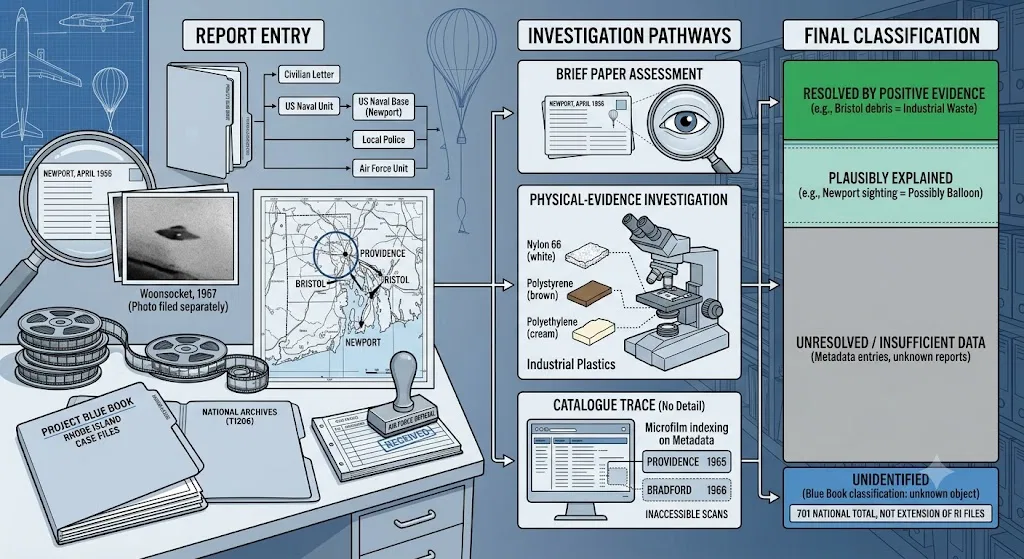
Those national figures can make the programme sound more uniform and scientific than its individual files sometimes were. In practice, a Rhode Island report might enter the system through a civilian letter, a military or naval office, a local authority or another Air Force unit. The information could then be reduced to a standard record card containing the date, location, source, duration, number of objects, observation type and proposed conclusion.
The resulting classification depended heavily on the evidence available. Typical labels included balloon, aircraft, astronomical object, insufficient data and unknown. These were administrative conclusions, not verdicts delivered after an identical level of investigation in every case. A report supported only by a short letter could receive a tentative explanation, while a case involving physical material might trigger laboratory tests and correspondence.
The surviving Rhode Island examples illustrate three distinct levels of official attention:
- A brief paper assessment: the 1956 Newport sighting appears on a one-page card and was judged “possibly balloon”.
- A physical-evidence investigation: material recovered in Bristol in 1962 was examined by an Air Force laboratory and traced to common plastics.
- A catalogue trace without accessible detail: Providence in 1965 and Bradford in 1966 have identifiable National Archives entries, but no scanned case pages are currently presented with their online records.[govweird]govweird.combristol ri october 1962Project Blue Book: Bristol, Rhode Island, October 1962 · govweird…
This variation matters when comparing Rhode Island cases. The existence of a Blue Book file establishes that a report entered the federal system. It does not establish that investigators interviewed every witness, checked radar records, reconstructed the sky or reached a strongly supported conclusion.
What the surviving Rhode Island files actually say
Newport, April 1956
On 5 April 1956, a civilian in Newport reported a silver, circular object seen through binoculars for about five minutes. The witness described it as roughly the apparent size of a large grapefruit held at arm’s length. It appeared to the north, at an estimated elevation of 45 degrees, remained approximately stationary and then disappeared by “whirling into the haze”. The record noted clear visibility and no surface wind.[govweird]govweird.comnewport ri april 1956Project Blue Book: Newport, Rhode Island, April 1956 · govweird…
Blue Book classified the object as possibly a weather balloon. Its reasoning was brief: the description and colour were considered consistent with pilot balloons, often called pibals, released for meteorological observations. The card also states “no report in file”, indicating that the surviving case consisted only of the summary rather than a fuller questionnaire, interview or technical analysis.[govweird]govweird.comnewport ri april 1956Project Blue Book: Newport, Rhode Island, April 1956 · govweird…
The balloon interpretation is plausible but not demonstrated. A silver or pale object apparently hovering in a clear sky can be a high-altitude balloon, and the absence of surface wind does not reveal what winds were doing higher in the atmosphere. However, the file contains no launch record, calculated bearing, upper-air wind data or confirmed balloon track. “Possibly balloon” should therefore be read as a tentative fit, not a positive identification.
This case is valuable precisely because it reveals Blue Book’s classification threshold. Officials could select a conventional explanation on resemblance alone when the report lacked enough information for a more rigorous test.
Bristol, October 1962
The Bristol file is more substantial because it involved recoverable material. Two 11-year-old boys reportedly saw a grey object fall with a rushing or “whooshing” sound on or around 20 October 1962. One boy said the object felt warm. Plastic-like fragments were taken to a science teacher, passed to authorities at the US Naval Base in Newport and eventually submitted to the Air Force for analysis.[govweird]govweird.combristol ri october 1962Project Blue Book: Bristol, Rhode Island, October 1962 · govweird…
Laboratory examination identified the samples as familiar industrial substances. The white material was consistent with Nylon 66; a brown fragment was polystyrene; and a cream-coloured component was polyethylene. Investigators reported no sign that the pieces had been used in a space application or exposed to a space environment. Their appearance instead resembled surplus or end-of-run waste from plastic extrusion machinery.[govweird]govweird.combristol ri october 1962Project Blue Book: Bristol, Rhode Island, October 1962 · govweird…
The Air Force also considered local industrial sources. Rhode Island manufacturers working with insulated wire and cable used similar plastics, and the submitted pieces matched the appearance of ordinary production scrap. The record card consequently treated the material as local industrial waste and described the boys’ account as a hoax.[govweird]govweird.combristol ri october 1962Project Blue Book: Bristol, Rhode Island, October 1962 · govweird…
This is the clearest Rhode Island example of Blue Book moving beyond a witness description. Investigators had physical samples, identified their composition and compared them with a mundane source. That substantially weakens any claim that the fragments represented unusual aerospace debris.
Even here, the word “hoax” deserves some caution. The laboratory results establish what the fragments were; they do not independently reconstruct how the boys found them or prove what each child intended. Misinterpretation, embellishment and deliberate invention are separate possibilities. The material evidence supports the industrial-scrap conclusion much more firmly than it proves the witnesses’ motives.

Providence, August 1965
A Providence report from August 1965 is identifiable in the National Archives catalogue as a Blue Book case on microfilm publication T1206, roll 56. The available online entry confirms the location and month, but provides no scanned pages, witness description or Air Force reasoning. Its evaluation cannot therefore be independently assessed from the currently accessible digital material.[govweird]govweird.comprovidence ri august 1965Project Blue Book: Providence, Rhode Island, August 1965 · govweird…
This absence is important. A catalogue entry is evidence that a file was created, not evidence that the sighting was impressive or unexplained. It could represent a detailed multi-witness report, a short letter, a duplicate submission or an observation readily resolved in material not yet digitised. Any fuller retelling that supplies object shape, duration or witness details without consulting the underlying roll would be speculation.
The timing places the report shortly before the widely publicised Exeter, New Hampshire, sightings of September 1965, but proximity in time does not establish that the cases formed a connected New England wave. The Providence record would need to be recovered and compared directly before such a relationship could be argued.
Bradford, April 1966
The Bradford case has a similar archival status. The National Archives catalogue identifies a Rhode Island sighting from April 1966 on T1206, roll 61, yet the online listing currently supplies no scanned pages and no substantive narrative. The file’s original contents may still be available through the microfilm record, but its evidential quality cannot be judged from metadata alone.[govweird]govweird.combradford ri april 1966Project Blue Book: Bradford, Rhode Island, April 1966 · govweird…
Its date falls during a nationally active period for UFO reporting, when Blue Book was receiving intense public and political scrutiny. That broader setting may explain why even thin local reports entered the system, but it does not make the Bradford sighting stronger. Without the witness account, observation conditions and official comments, its correct status is documented as a report, otherwise unevaluable.
What survives in the National Archives
The National Archives holds far more than a simple list of Blue Book’s unexplained cases. Its reference description identifies about two cubic feet of administrative material, 37 cubic feet of chronological case files and three cubic feet connected with the Air Force Office of Special Investigations. The public-access copy is arranged across 94 rolls of 35mm microfilm under publication T1206. The first roll contains finding aids and a contents list, while photographs were also filmed separately on the final rolls.[National Archives]archives.govNational Archives Project BLUE BOOKNational ArchivesProject BLUE BOOK - Unidentified Flying Objects | National Archives…
The case index is organised by date and location, which is why Rhode Island entries may be found under Newport, Bristol, Providence or Bradford rather than grouped in a narrative state history. This arrangement is useful for confirming that a report exists, but it can fragment related material. Correspondence, laboratory memoranda, record cards and images may occupy different pages or sections, while related military records may fall outside the main case file.
The digitised record is also incomplete from the ordinary reader’s point of view. Some cases, including Bristol and Newport, can be examined through page scans and transcriptions. Others presently expose only catalogue-level information. The National Archives states that the declassified files are available for examination, but full investigation may require consulting the microfilm rather than relying on search-engine results or later summaries.[archives.gov]archives.govNational Archives Project BLUE BOOKNational ArchivesProject BLUE BOOK - Unidentified Flying Objects | National Archives…
Names and other identifying details were removed from the public archival version. This protects privacy but can make historical checking harder, particularly when researchers want to compare a file with newspapers, weather records or later witness statements. A surviving classification may therefore be easier to locate than the information needed to test it.
The absence of a famous Rhode Island incident from a quick catalogue search should not automatically be treated as evidence that the Air Force ignored or concealed it. Reports could be filed under a nearby town, the date received rather than the date observed, a military installation, a correspondent’s location or a broader multi-case grouping. Some incidents may never have been formally reported to Blue Book at all.

What official classifications can and cannot prove
Blue Book labels are most persuasive when they are tied to case-specific evidence. Bristol’s plastics analysis is strong because the proposed explanation rests on identifiable materials and laboratory findings. Newport’s balloon label is weaker because it rests largely on visual similarity. Providence and Bradford cannot presently be evaluated beyond confirming that federal case entries exist.
The classifications are best read in three broad ways:
Resolved by positive evidence. A conventional object or material is identified through testing, records or direct comparison. Bristol comes closest to this standard.
Plausibly explained. A known phenomenon fits the description, but the record lacks enough information to prove the match. Newport belongs here.
Unresolved because the evidence is inadequate. A report remains unclassified, carries an “insufficient data” label or survives without enough accessible material for modern assessment. Such a status means that a reliable conclusion cannot be drawn; it does not increase the probability of an extraordinary craft.
This distinction addresses a common misunderstanding about Blue Book’s 701 “unidentified” reports. The Air Force did not describe them as confirmed advanced vehicles. Its formal position was that no investigated sighting had demonstrated a national-security threat, unknown scientific principles or extraterrestrial origin. “Unidentified” meant that the submitted information was not successfully matched to a known cause within the investigation, not that every ordinary explanation had been eliminated.[National Archives]archives.govNational Archives Project BLUE BOOKNational ArchivesProject BLUE BOOK - Unidentified Flying Objects | National Archives…
The reverse caution also applies. An official label does not become correct merely because it appears on an Air Force form. A proposed balloon, aircraft or astronomical explanation should still be checked against time, direction, weather, movement and witness testimony. Newport’s file offers a hypothesis but too little supporting work to settle the matter conclusively.
Why the files matter to Rhode Island’s UFO history
Rhode Island’s Blue Book record is most revealing as a study in evidence quality. The state’s cases range from a fleeting visual observation to alleged physical debris, and the federal response changed accordingly. Where investigators had testable material, they produced a strong ordinary explanation. Where they had only a short description, they offered a tentative classification. Where the surviving digital record is little more than metadata, no responsible conclusion is possible.
The files also place the state’s better-known UFO stories in perspective. Official archiving was selective and procedural: a nationally circulated photograph was not necessarily investigated more thoroughly than a piece of submitted debris, and a dramatic local story did not automatically generate a complete federal dossier. Blue Book’s Rhode Island holdings should therefore complement, rather than replace, separate examination of the Woonsocket photographs, coastal and aviation reports, newspaper coverage and civilian investigative archives.
Taken together, the available records neither reveal a concentrated Rhode Island mystery nor erase every unexplained observation. They show a small state participating in a much larger Cold War reporting system—one capable of useful technical work in favourable cases, but also prone to thin files, tentative labels and conclusions limited by whatever information happened to reach the Air Force.
Amazon book picks
Further Reading
Books and field guides related to What Do Official Files Say About Rhode Island UFOs?. Use these as the next step if you want deeper reading beyond the article.
The Report on Unidentified Flying Objects
Directly covers official Air Force investigations.
UFOs: Generals, Pilots, and Government Officials Go on the Re...
Adds context from official and military witnesses.
eBay marketplace picks
Marketplace Samples
Live-tested eBay searches with available results related to this page.
Selected fromUFO poster oneBay.co.uk.



Endnotes
1.
Source: govweird.com
Title: bristol ri october 1962
Link:https://www.govweird.com/topics/ufo/project-blue-book/bristol-ri-october-1962
Source snippet
Project Blue Book: Bristol, Rhode Island, October 1962 · govweird...
Published: october 1962
2.
Source: govweird.com
Title: newport ri april 1956
Link:https://www.govweird.com/topics/ufo/project-blue-book/newport-ri-april-1956
Source snippet
Project Blue Book: Newport, Rhode Island, April 1956 · govweird...
Published: april 1956
3.
Source: govweird.com
Title: providence ri august 1965
Link:https://www.govweird.com/topics/ufo/project-blue-book/providence-ri-august-1965
Source snippet
Project Blue Book: Providence, Rhode Island, August 1965 · govweird...
Published: august 1965
4.
Source: govweird.com
Title: bradford ri april 1966
Link:https://www.govweird.com/topics/ufo/project-blue-book/bradford-ri-april-1966
Source snippet
Project Blue Book: Bradford, Rhode Island, April 1966 · govweird...
Published: april 1966
5.
Source: archives.gov
Title: National Archives Project BLUE BOOK
Link:https://www.archives.gov/research/military/air-force/ufos
Source snippet
National ArchivesProject BLUE BOOK - Unidentified Flying Objects | National Archives...
6.
Source: archives.gov
Title: We also house some federal military records
Link:https://www.archives.gov/boston
Source snippet
National Archives at Boston (Waltham, Massachusetts)October 2, 2024 — We hold the permanent records of Federal agencies and courts locate...
Published: October 2, 2024
7.
Source: archives.gov
Link:https://www.archives.gov/citizen-archivist/missions
Source snippet
ook, the U.S. Air Force investigation into...Read more...
8.
Source: archives.gov
Title: presidential libraries
Link:https://www.archives.gov/research/topics/uaps/presidential-libraries
9.
Source: prologue.blogs.archives.gov
Title: ufos man made made up and unknown
Link:https://prologue.blogs.archives.gov/2018/04/23/ufos-man-made-made-up-and-unknown/
10.
Source: archives.gov
Title: project blue book 50th anniversary
Link:https://www.archives.gov/news/articles/project-blue-book-50th-anniversary
11.
Source: archives.gov
Link:https://www.archives.gov/news/articles
12.
Source: archives.gov
Title: nara documents2
Link:https://www.archives.gov/research/foreign-policy/cold-war/1961-berlin-crisis/nara-documents2
13.
Source: unwritten-record.blogs.archives.gov
Link:https://unwritten-record.blogs.archives.gov/page/60/
14.
Source: archives.gov
Link:https://www.archives.gov/digitization/digitized-by-partners
15.
Source: archives.gov
Link:https://www.archives.gov/citizen-archivist/missions/history
16.
Source: archives.gov
Link:https://www.archives.gov/
17.
Source: archives.gov
Link:https://www.archives.gov/boston/holdings/rg-300-donated-materials.html
18.
Source: archives.gov
Title: Record Groups 4
Link:https://www.archives.gov/boston/holdings/rg-001-049.html
19.
Source: govweird.com
Link:https://www.govweird.com/topics/ufo/project-blue-book/year/1956
20.
Source: history.com
Title: Project Blue Book
Link:https://www.history.com/articles/project-blue-book
21.
Source: nicap.org
Title: UFOWaves hall
Link:https://www.nicap.org/articles/UFOWaves_hall.pdf
22.
Source: Wikipedia
Title: Project Blue Book
Link:https://en.wikipedia.org/wiki/Project_Blue_Book
23.
Source: vault.fbi.gov
Link:https://vault.fbi.gov/Project%20Blue%20Book%20%28UFO%29%20/Project%20Blue%20Book%20%28UFO%29%20Part%2001%20%28Final%29/at_download/file
Additional References
24.
Source: youtube.com
Title: Inside Project Blue Book: The True Stories of UFO Investigations (Part 1)
Link:https://www.youtube.com/watch?v=nn1EdNXgBxM
Source snippet
Explaining the '[Silver Canister]({{ 'silver-canister/' | relative_url }})' over Rhode Island: A Technical Breakdown...
25.
Source: youtube.com
Title: Parallax, Relative Motion and UFOs: How Pilots are Fooled
Link:https://www.youtube.com/watch?v=0FqCRPpg57c
Source snippet
The 1962 Bristol Debris Case: Official Lab Analysis of 'UFO' Material...
26.
Source: youtube.com
Link:https://www.youtube.com/watch?v=1cO5K1np2Ig
Source snippet
Inside Project Blue Book: The True Stories of UFO Investigations (Part 1)...
27.
Source: governmentattic.org
Link:https://www.governmentattic.org/13docs/UFOsRelatedSubjBiblio_Catoe_1969.pdf
28.
Source: reddit.com
Link:https://www.reddit.com/r/UFOs/comments/ezra6u/i_am_writing_a_master_thesis_about_ufos/
29.
Source: instagram.com
Link:https://www.instagram.com/p/DZfJv-BlNIl/
30.
Source: instagram.com
Link:https://www.instagram.com/reel/DDihqOzyERI/
31.
Source: instagram.com
Link:https://www.instagram.com/p/DTqQwvAE2x2/
32.
Source: nicap.org
Link:https://www.nicap.org/docs/pbbsr/nicap_pbr1-12_srch.pdf
33.
Source: scribd.com
Link:https://www.scribd.com/document/798530947/T206