Within Pilot Reports
How Large Was the Shreveport Object Really?
The Shreveport tower sighting shows how night-time distance, size and altitude estimates can make ordinary lights seem extraordinary.
On this page
- What controllers reported near Shreveport Regional Airport
- Why apparent size and altitude were uncertain
- What missing radar, imagery and witness confirmation mean
Page outline Jump by section
Introduction
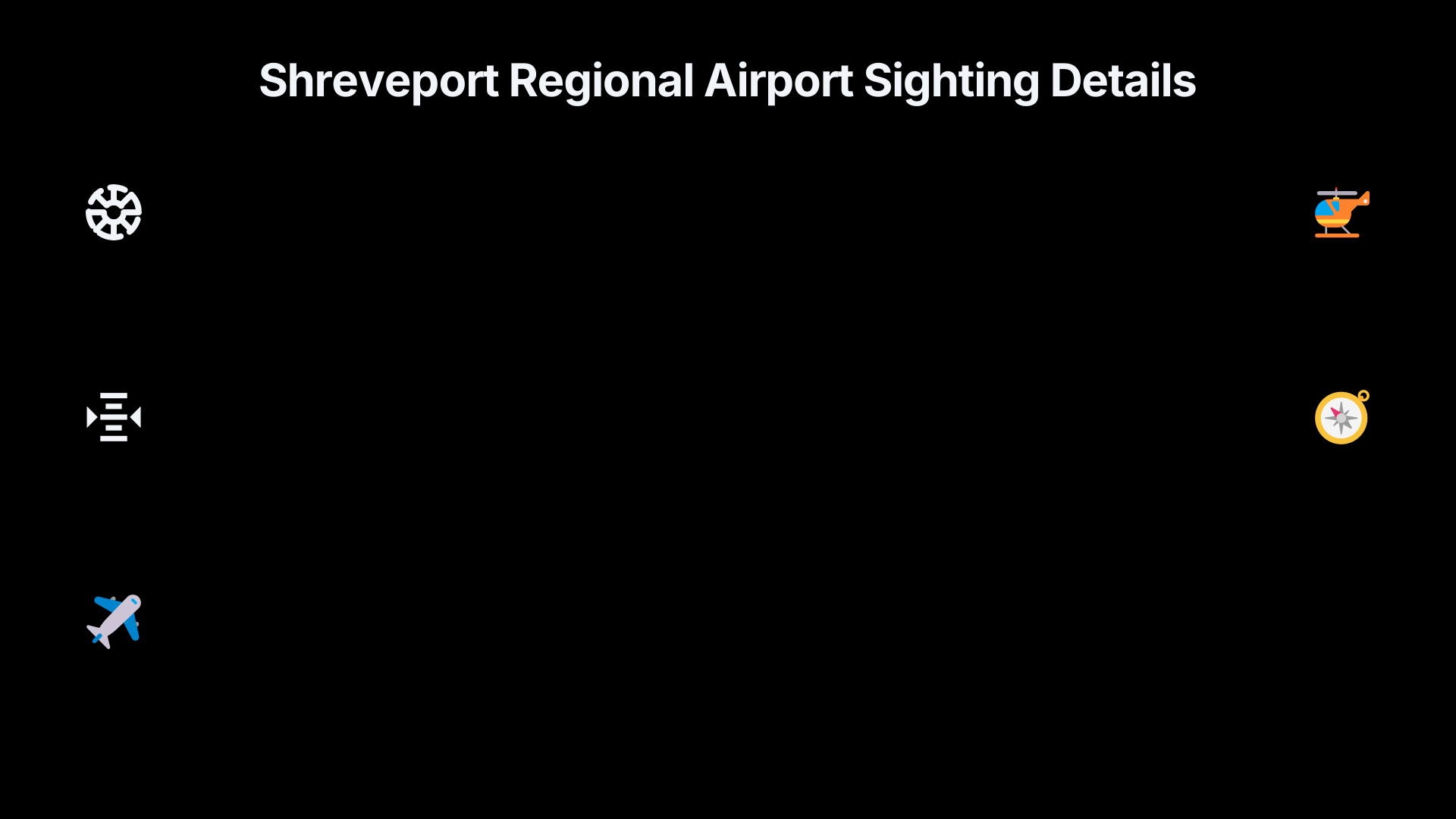
The January 2018 Shreveport hovering-lights report is one of the more intriguing entries in Louisiana’s modern aviation-UFO record, not because it provides strong evidence of an unknown craft, but because it highlights how difficult it can be to judge size, distance and altitude from isolated lights at night. Airport personnel at Shreveport Regional Airport reported a hovering object displaying red, green and amber lights, initially estimated to be one or two miles away and at roughly 1,500–2,000 feet. Later observations suggested it had moved farther away and climbed higher. Yet no nearby aircraft could confirm the sighting, and no publicly available radar track, photograph or sensor record established what was actually there.[TWZ]twz.comThe Strangest Encounters With Unidentified Aircraft We've…20 Jul 2021 — We found over 50 highly unusual incidents with our new FAA…
For readers interested in Louisiana’s aviation-related UFO reports, the key question is not whether controllers saw unusual lights—they clearly believed they did—but how much can be learned from those observations alone. The Shreveport case is a useful reminder that even experienced observers can struggle to estimate the true characteristics of a distant light source after dark.
What Controllers Reported Near Shreveport Regional Airport
The incident was recorded in the Federal Aviation Administration’s Mandatory Occurrence Reporting system and later surfaced through analysis of FAA records. According to the available report, tower personnel observed lights showing multiple colours—green, red and amber or yellow—south-west of the airport. The object appeared to hover before apparently moving southward and gaining altitude. One description compared its apparent size to that of a helicopter. Local law enforcement was notified, and controllers asked a nearby aircraft to look for the object. The crew could not verify it.[TWZ]twz.comThe Strangest Encounters With Unidentified Aircraft We've…20 Jul 2021 — We found over 50 highly unusual incidents with our new FAA…
Those details explain why the report attracted attention. Air-traffic controllers spend their working lives watching aircraft movements and identifying aviation traffic. When trained observers report something they cannot immediately explain, the event naturally becomes part of the wider discussion of unusual aerial sightings over Louisiana.
However, the report also contains important limitations. The object was never positively identified, and there is no publicly released evidence showing that it was tracked by radar or recorded by imaging equipment. The observation therefore rests primarily on visual perception.[TWZ]twz.comThe Strangest Encounters With Unidentified Aircraft We've…20 Jul 2021 — We found over 50 highly unusual incidents with our new FAA…
Why Apparent Size and Altitude Were Uncertain
The most frequently repeated detail is that the object seemed “as large as a helicopter”. That sounds like a physical measurement, but it was not.
Human observers do not directly perceive the true size of distant objects. They perceive angular size—the amount of visual space an object occupies. To convert that into a real size, the observer must also know the object’s distance. Without a reliable range estimate, a small nearby light source and a much larger distant object can appear identical.
This problem becomes especially severe at night. Unlike daylight observations, night sightings often reduce an object to a handful of lights floating against a dark background. The body of the object may be invisible, leaving observers to infer its size and position from lighting alone. Aviation training materials have long warned that night operations can produce size-distance illusions and other visual misjudgements when pilots or observers lack reliable reference points.[chinook-helicopter.com]chinook-helicopter.comVisual IllusionsAt night it is very difficult to judge distance estimation of lights. A bright light may be perceived to be closer than…Read more…
The altitude estimates in the Shreveport report face the same difficulty. The observation suggested an initial altitude of roughly 1,500–2,000 feet and a later altitude around 4,000 feet. Yet unless the object’s distance was known, those figures were estimates rather than measurements. A light moving away from the observer can appear to climb. A light changing brightness can appear to alter position. Horizontal movement can sometimes be interpreted as vertical movement when depth cues are limited.[fivemilefinal.com]fivemilefinal.comPilots may interpret the light as…
Why Night-Time Lights Can Appear More Extraordinary Than They Are
The Shreveport case illustrates several well-known limitations of human night vision.
One is the lack of depth perception. During daylight, buildings, terrain, clouds and other objects provide constant visual references. At night, especially beyond the airport environment, those references can disappear. The observer may see only isolated points of light against darkness. Aviation safety guidance repeatedly notes that reduced visual cues can lead to errors in judging distance, speed and altitude.[faasafety.gov]faasafety.govYour Senses in the ShadowsNighttime Visual Illusions…By using visual references, the pilot can gather information about distance, speed, and depth. Any conditio…
Another issue is apparent motion. A stationary light viewed against a dark background can sometimes seem to drift or move. This phenomenon, known as autokinesis, has a long history in aviation and has occasionally contributed to reports of unusual aerial objects. Observers are not imagining the light itself; rather, the human visual system can misinterpret tiny involuntary eye movements as movement of the object being watched.[Wikipedia]WikipediaSensory illusions in aviationSensory illusions in aviation
Brightness can also distort perception. Aviation references describe how brighter lights are often perceived as closer than dimmer ones, even when they are at similar distances. Changes in intensity may therefore create the impression that an object is approaching, retreating or changing altitude when the observer lacks independent range information.[chinook-helicopter.com]chinook-helicopter.comVisual IllusionsAt night it is very difficult to judge distance estimation of lights. A bright light may be perceived to be closer than…Read more…
None of these effects proves that the Shreveport lights were misidentified. They simply demonstrate why visual descriptions alone are often insufficient to establish an object’s true characteristics.
What Missing Radar, Imagery and Witness Confirmation Mean
The strongest UFO or unidentified-aircraft cases typically combine multiple forms of evidence: eyewitness reports, radar returns, photographs, video, infrared imagery, independent observers or corroborating sensor data.
The Shreveport incident lacks most of those elements. The nearby aircraft asked to verify the object could not do so. No publicly available photograph has emerged. No radar track has been released linking a target to the reported lights. The available record therefore cannot independently confirm the reported distance, altitude, speed or size.[TWZ]twz.comThe Strangest Encounters With Unidentified Aircraft We've…20 Jul 2021 — We found over 50 highly unusual incidents with our new FAA…
This absence of corroboration does not mean the observation was false. It means investigators have little ability to reconstruct the event after the fact. Without range data, the reported altitude remains uncertain. Without imagery, the object’s shape remains unknown. Without radar, it is difficult to determine whether the lights belonged to an aircraft, drone, distant ground source, atmospheric effect or something else entirely.
That distinction matters because many UFO discussions treat eyewitness estimates as measurements. In reality, the Shreveport report records perceptions rather than instrument readings.
What the Case Means Within Louisiana’s Aviation-UFO History
Within the broader history of Louisiana aviation sightings, the Shreveport lights are best understood as an example of documented uncertainty rather than documented anomaly.
The report shows airport personnel responding appropriately to an unidentified observation near controlled airspace. It also demonstrates the limits of what can be concluded from a night-time visual sighting without supporting sensor evidence. The most defensible conclusion is that observers saw lights they could not identify at the time. Beyond that, the available evidence becomes increasingly speculative.[TWZ]twz.comThe Strangest Encounters With Unidentified Aircraft We've…20 Jul 2021 — We found over 50 highly unusual incidents with our new FAA…
As a result, the case remains interesting but unresolved. It neither provides convincing evidence of an extraordinary craft nor collapses into a clear, documented explanation. Its lasting value lies in showing how easily apparent size, altitude and movement can become uncertain when observers are forced to estimate them from isolated lights in the night sky. That lesson is relevant not only to the Shreveport incident but to many aviation-related UFO reports across Louisiana and beyond.
Amazon book picks
Further Reading
Books and field guides related to How Large Was the Shreveport Object Really?. Use these as the next step if you want deeper reading beyond the article.
UFOs: Generals, Pilots, and Government Officials Go on the Re...
Strong fit for pilot and controller sightings.
The UFO Experience: A Scientific Inquiry
Addresses observational uncertainty and witness interpretation.
The Invisible Gorilla
Explains perception limits relevant to judging size and distance at night.
eBay marketplace picks
Marketplace Samples
Live-tested eBay searches with available results related to this page.
Selected frompilot patch oneBay.co.uk.




Endnotes
1.
Source: twz.com
Link:https://www.twz.com/41573/the-strangest-encounters-with-unidentified-aircraft-weve-found-in-the-faas-huge-database
Source snippet
The Strangest Encounters With Unidentified Aircraft We've...20 Jul 2021 — We found over 50 highly unusual incidents with our new FAA...
2.
Source: chinook-helicopter.com
Title: Visual Illusions
Link:https://www.chinook-helicopter.com/standards/Illusions/Visual_Illusions.html
Source snippet
At night it is very difficult to judge distance estimation of lights. A bright light may be perceived to be closer than...Read more...
3.
Source: faasafety.gov
Title: Your Senses in the Shadows
Link:https://www.faasafety.gov/files/events/SO/SO15/2024/SO15134204/YourSensesInTheShadows.pdf
Source snippet
Nighttime Visual Illusions...By using visual references, the pilot can gather information about distance, speed, and depth. Any conditio...
4.
Source: faa.gov
Link:https://www.faa.gov/sites/faa.gov/files/regulations_policies/handbooks_manuals/aviation/airplane_handbook/12_afh_ch11.pdf
Source snippet
Airplane Flying Handbook (3C) Chapter 11Bright runway and approach lighting systems, especially where few lights illuminate the surrou...
5.
Source: fivemilefinal.com
Link:https://www.fivemilefinal.com/cfi/technical/nightops.shtml
Source snippet
Pilots may interpret the light as...
6.
Source: atsb.gov.au
Link:https://www.atsb.gov.au/sites/default/files/2024-05/FAA-H-8083-3B%20Chapter%2010.pdf
Source snippet
the only source of light. Without.Read more...
7.
Source: Wikipedia
Title: Sensory illusions in aviation
Link:https://en.wikipedia.org/wiki/Sensory_illusions_in_aviation
8.
Source: twz.com
Link:https://www.twz.com/40904/faa-data-shows-strange-pattern-of-military-encounters-with-unidentified-aircraft-in-sensitive-airspace
Additional References
9.
Source: migflug.com
Title: your first night flight why everything changes after sunset
Link:https://migflug.com/jetflights/your-first-night-flight-why-everything-changes-after-sunset/
Source snippet
Your First Night Flight: Illusions & Skills9 Apr 2026 — Master the sensory illusions and practical skills needed for your first ni...
10.
Source: youtube.com
Link:https://www.youtube.com/watch?v=e3d4pzpYCXk
Source snippet
Strange lights spotted in Louisiana sky likely 'Starlink'...
11.
Source: researchgate.net
Link:https://www.researchgate.net/publication/400385806_Physiology_in_Aviation_Hearing_Vision_Spatial_Disorientation_and_Visual_Illusions
12.
Source: facebook.com
Link:https://www.facebook.com/abc13Houston/posts/a-drone-sighting-that-temporarily-raised-alarms-at-one-of-the-united-states-air-/1351396153685406/
13.
Source: skybrary.aero
Link:https://skybrary.aero/sites/default/files/bookshelf/3720.pdf
14.
Source: instagram.com
Link:https://www.instagram.com/p/DTsx87zij6o/?hl=en
15.
Source: flightsafety.org
Link:https://flightsafety.org/wp-content/uploads/2016/11/asw_aug10_p14-18.pdf
16.
Source: facebook.com
Link:https://www.facebook.com/ProjectFEAROfficial/posts/our-area-51-video-is-out-now-please-if-you-have-experience-in-military-aviation-/1631286848350718/
17.
Source: facebook.com
Link:https://www.facebook.com/FAA/posts/pilots-dyk-optical-illusions-can-drastically-compromise-your-safety-while-flying/1119304286892494/
18.
Source: cfinotebook.net
Link:https://www.cfinotebook.net/notebook/aeromedical-and-human-factors/spatial-disorientation-and-illusions-in-flight