Within Louisiana UFOs
What Did Project Blue Book Find in Louisiana?
Louisiana's Blue Book records show which sightings reached military investigators and why an official file did not mean an exotic craft was verified.
On this page
- How Louisiana reports entered Air Force records
- The Mangham case and other documented locations
- Unidentified, explained and insufficient information outcomes
Page outline Jump by section
Introduction
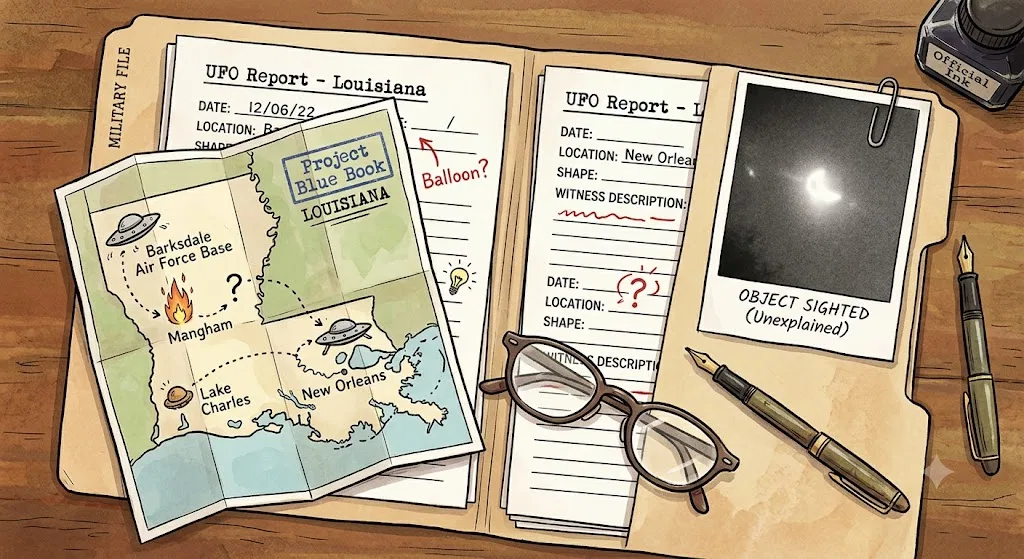
Louisiana’s Project Blue Book files reveal a record that is more bureaucratic than sensational. They show that reports from civilians, police officers and military personnel could reach Air Force intelligence channels, prompt witness interviews, weather checks and even interceptor launches. They do not show that the Air Force verified alien spacecraft.
The most useful Louisiana records also expose the difference between three often-confused outcomes. An identified report was matched, firmly or provisionally, with something conventional. An unidentified report contained enough information to assess but could not be fitted confidently to a known object or phenomenon. An insufficient-data report lacked essential details and therefore could not support a reliable conclusion. Project Blue Book recorded 12,618 sightings nationally between 1947 and 1969, leaving 701 officially unidentified, but the Air Force stated that none demonstrated extraterrestrial vehicles, technology beyond contemporary scientific knowledge or a threat to national security.[National Archives]archives.govNational Archives Project BLUE BOOKNational ArchivesProject BLUE BOOK - Unidentified Flying Objects | National Archives…
Louisiana’s surviving files support a restrained conclusion: some observations were genuinely difficult to explain from the available evidence, while others were probably balloons, aircraft or astronomical objects. What the archive chiefly preserves is the government’s attempt—sometimes thorough, sometimes incomplete and occasionally inconsistent—to turn fleeting eyewitness experiences into administrative findings.
How Louisiana reports entered Air Force records
Project Blue Book was created in 1952 during the early Cold War, when an unfamiliar light or aircraft might raise questions about hostile reconnaissance, experimental technology or weaknesses in American air defence. It followed the earlier Project Sign and Project Grudge investigations. Although popular interest concentrated on visitors from space, the programme’s practical concern was whether unexplained aerial activity represented a security or aviation problem.[Pieces of History]prologue.blogs.archives.govOpen source on archives.gov.
A Louisiana report did not enter the system merely because someone used the words “flying saucer”. Information could pass through an Air Force base, local law enforcement, intelligence personnel or another military command. Investigators sought details such as the time and location, direction of travel, apparent shape, colour, duration, weather, aircraft activity and the observer’s reliability. Witnesses might be asked to complete standard questionnaires or draw what they had seen. Air Force Office of Special Investigations guidance also called for examination of the object’s reported manoeuvres and the credibility of those reporting it.[Pieces of History]prologue.blogs.archives.govOpen source on archives.gov.
The surviving collection reflects this administrative process. The National Archives holds approximately 37 cubic feet of chronologically arranged sighting case files, together with project records and Office of Special Investigations material. The principal Blue Book collection was reproduced on 94 rolls of microfilm, with indexes arranged by date and location. That structure makes it possible to identify Louisiana entries from Barksdale Air Force Base, Lake Charles, Mangham, New Orleans, Shreveport, Alexandria and smaller communities such as Atlanta, Louisiana.[National Archives]archives.govNational Archives Project BLUE BOOKNational ArchivesProject BLUE BOOK - Unidentified Flying Objects | National Archives…
An official file therefore proves several limited but important points: a report was made, it entered a government channel, and some form of classification or review followed. It does not prove that every detail was verified. Nor does the number of pages indicate the strength of a case. Ten pages may include duplicated forms, weather tables and routing messages rather than ten pages of independent evidence.
The records also vary greatly in readability and completeness. Some contain clear witness summaries and weather information; others survive as faded, poorly reproduced microfilm. Later catalogue descriptions can simplify or even conflict with conclusions written on the original record cards. Those limitations matter when modern accounts treat a database label as if it were a final scientific judgement.

The Mangham file shows how identification could change
The Mangham sighting of 22 May 1960 is one of Louisiana’s most instructive Blue Book cases because it demonstrates how an impressive report could narrow towards an ordinary explanation—and how later archival labels can obscure that process.
A man near Mangham was preparing to shoot blackbirds when he noticed a bright object and called his wife to watch. They described something initially round, roughly the apparent size of a basketball, with a glittering surface that alternated between a fiery brilliance and a silvery appearance. Its shape appeared to change from round to tubular and back again, at times with what looked like a tail. It moved steadily from north to south, without abrupt manoeuvres, and remained visible for about two hours. Several other local people reportedly saw it.[govweird]govweird.commangham la may 1960Project Blue Book: Mangham, Louisiana, May 1960 · govweird…
The duration and multiple witnesses made the observation more substantial than a momentary flash. Military interest was also real. Two interceptor aircraft were dispatched from England Air Force Base near Alexandria but failed to reach or locate the object. A local sheriff who was also a licensed civilian pilot believed it was a weather balloon. More importantly, the England base weather office stated that it had definite information identifying the object as a balloon released elsewhere. Investigating officers and the intelligence chief at Barksdale Air Force Base agreed that a weather balloon was the probable explanation.[govweird]govweird.commangham la may 1960Project Blue Book: Mangham, Louisiana, May 1960 · govweird…
The original Blue Book record card is especially revealing. Its conclusion field reads “Probably Balloon”, and the comments attribute the identification to the England Air Force Base weather office. Yet modern archive presentations can display the case under an “unidentified” heading. The discrepancy is a warning against relying on a single database field without reading the underlying document.[govweird]govweird.commangham la may 1960Project Blue Book: Mangham, Louisiana, May 1960 · govweird…
Mangham was not a laboratory-quality identification. No recovered balloon is documented in the accessible summary, and the interceptors did not make contact. The object’s apparent changes of shape and brightness were interpretations made at a distance, without a measured range or altitude. A balloon twisting, reflecting sunlight and trailing equipment could plausibly produce changing outlines, while its apparent size would be impossible to calculate reliably without knowing how far away it was.
The most defensible assessment is therefore probably explained, not proven beyond doubt. The case matters because it shows Blue Book operating as an air-defence and identification system: an unusual report was circulated, aircraft responded, local aviation knowledge was consulted and meteorological information supplied the preferred answer.
Lake Charles produced a stronger unresolved case
A less easily dismissed Louisiana file came from Lake Charles Air Force Base on 6 October 1952. At about 9.20 pm, three Air Force aircraft mechanics working on the flight line saw a white, round light almost overhead. They estimated its apparent size as roughly that of a nickel held at half-arm’s length and watched it for about five minutes.[govweird]govweird.comlake charles afb la october 1952Project Blue Book: LAKE CHARLES AFB, LA, October 1952 · govweird…
According to the case summary, the object varied in brightness and moved generally from north to south. The mechanics reported changes of speed, near-stops and three or four sharp turns at different angles. It eventually disappeared at an apparently greater altitude. The location is significant because the witnesses were accustomed to aircraft and were observing from an active military airfield, although heavy air traffic also made it difficult to determine whether the object produced any sound.[govweird]govweird.comlake charles afb la october 1952Project Blue Book: LAKE CHARLES AFB, LA, October 1952 · govweird…
Investigators checked the weather. Visibility was about ten miles, scattered clouds were reported near 9,500 feet, and the wind was from the north-east. A balloon had been released from the base roughly twenty minutes before the sighting, making it an obvious candidate. The file nevertheless states that investigators found no meteorological or other conditions that satisfactorily produced the reported behaviour, and the case was officially classified as unidentified.[govweird]govweird.comlake charles afb la october 1952Project Blue Book: LAKE CHARLES AFB, LA, October 1952 · govweird…
That outcome deserves attention, but not exaggeration. The witnesses’ aviation experience strengthens the report, as does the presence of three observers. Conversely, there was no photograph, radar confirmation, instrument-derived speed, measured altitude or known distance. The description of right-angle turns was based on visual perception against the night sky, where an observer may have few fixed reference points. Changes in brightness can also create an impression that a light has stopped, accelerated or changed direction.
The file therefore supports the limited proposition that Blue Book could not identify what the mechanics saw. It does not establish that an object performed physically impossible manoeuvres. The gap between those two statements is central to reading Blue Book responsibly.
Barksdale’s records are important but incomplete
Barksdale Air Force Base appears repeatedly in Louisiana’s Blue Book history, both as a sighting location and as an intelligence centre involved in reviewing reports from elsewhere in the state. Its strategic aviation role made unexplained activity around the installation worthy of attention even when the available evidence was weak.
One surviving case from August 1952 is labelled unidentified and contains a Project 10073 record card, an Air Intelligence Information Report, a worksheet and weather material. The observation apparently lasted more than an hour, and balloon and aircraft explanations were considered. However, the surviving microfilm reproduction is so degraded that the central narrative—what was seen, who saw it and precisely why the conventional explanations were rejected—cannot be reconstructed confidently from the accessible text.[govweird]govweird.combarksdale afb la august 1952Project Blue Book: Barksdale, AFB, Louisiana, August 1952 · govweird…
This is a valuable negative finding. A classification of “unidentified” may sound decisive when removed from its file, but an unreadable or fragmentary case cannot carry the same evidential weight as a well-documented radar-visual encounter. Barksdale’s 1952 entry confirms that a report remained unresolved in the administrative record. It does not provide enough surviving detail for a modern reader to judge whether it was genuinely anomalous, merely ambiguous or a casualty of poor documentation.
Barksdale also appears in the Mangham investigation, where its intelligence chief agreed with the probable-balloon assessment. That connection shows how Louisiana’s bases formed part of a regional investigative network. Reports were not necessarily handled only where the sighting occurred; weather offices, intelligence units and aircraft from different installations could contribute to the final evaluation.[govweird]govweird.commangham la may 1960Project Blue Book: Mangham, Louisiana, May 1960 · govweird…
Unidentified, explained and insufficient information
The Louisiana files make the most sense when Blue Book’s categories are treated as judgements about evidence rather than descriptions of objects.
Identified or probably identified cases contained enough information for investigators to favour a conventional answer. The answer could remain probabilistic. Mangham’s “Probably Balloon” conclusion did not require recovery of the specific balloon; it reflected the reported movement, the sheriff-pilot’s opinion and information from the military weather office.
Unidentified cases contained sufficient information for assessment but could not be matched satisfactorily with a known object or phenomenon. Blue Book’s own analytical material described this category as reports with enough data to evaluate whose characteristics could not be associated with a known explanation, while acknowledging that additional information about balloon tracks or aircraft movements might eventually resolve some of them.[Wikimedia Commons]upload.wikimedia.orgWikimedia CommonsThe Project Blue Book ArchiveSeptember 9, 2005 — by AIRTI CENTER · Cited by 1 — Insufficient Data This category represen…
Insufficient data meant that essential information was absent. Blue Book guidance listed missing duration, date, time, location, sky position, weather conditions or manner of appearance as examples of deficiencies that could prevent evaluation.[Defense Logistics Agency]esd.whs.milDefense Logistics Agency Project Blue BookDefense Logistics Agency Project Blue Book
Late Louisiana entries illustrate the last category. Records exist for Lake Charles in October 1967 and Atlanta, Louisiana, in August 1968, but the accessible catalogue entries provide no scanned case pages and no detailed witness narrative. Both are associated with insufficient information or uncertain archival metadata rather than a demonstrably exotic event.[govweird]govweird.comlake charles la october 1967lake charles la october 1967
This distinction corrects a common misunderstanding. “Insufficient data” is not a more mysterious version of “unidentified”. It is usually weaker. It means investigators could not perform a meaningful comparison in the first place. An unresolved but detailed military case, such as Lake Charles in 1952, has more historical and evidential value than an entry consisting only of a location, month and classification.
What the files ultimately reveal
Louisiana’s Blue Book archive does not present a hidden sequence of confirmed extraordinary craft. It presents a mixed administrative dataset shaped by witness perception, weather records, military priorities, incomplete reporting and the limitations of mid-century investigation.
Its strongest lessons are methodological:
- A military response shows that officials took a report seriously enough to check, not that they endorsed the witness’s interpretation.
- Trained or aviation-experienced witnesses can improve a report, but they cannot supply missing range, altitude or speed measurements.
- “Unidentified” means no satisfactory explanation was reached from the available information; it is not a statement about extraterrestrial origin.
- “Probably explained” cases can retain uncertainty without becoming equally compatible with every possible theory.
- Catalogue headings and modern databases should be checked against the original record card, as the Mangham classification discrepancy demonstrates.
- Poorly preserved files, such as the Barksdale 1952 record, should be treated as evidentially limited rather than filled out with speculation.
The Lake Charles mechanics’ report remains the clearest Louisiana example of a Blue Book case whose conventional explanation was not established. Mangham is more useful for understanding the investigative process and the difference between an initial mystery and a probable identification. Barksdale demonstrates the importance—and the frustrating limitations—of military archival survival.
Together, these records strengthen Louisiana’s place in the history of official UFO investigation while weakening the assumption that an official file was itself confirmation of an extraordinary craft. Blue Book’s most durable contribution is not proof of what was in the sky, but a paper trail showing how uncertainty was reported, processed and sometimes left unresolved.
Amazon book picks
Further Reading
Books and field guides related to What Did Project Blue Book Find in Louisiana?. Use these as the next step if you want deeper reading beyond the article.
The Report on Unidentified Flying Objects
Directly tied to the investigative framework behind Louisiana cases.
The UFO Experience: A Scientific Inquiry
Provides a framework for assessing unidentified reports.
UFOs and Government: A Historical Inquiry
Examines official UFO investigations in depth.
eBay marketplace picks
Marketplace Samples
Live-tested eBay searches with available results related to this page.
Selected fromUFO memorabilia oneBay.co.uk.

Endnotes
1.
Source: archives.gov
Title: National Archives Project BLUE BOOK
Link:https://www.archives.gov/research/military/air-force/ufos
Source snippet
National ArchivesProject BLUE BOOK - Unidentified Flying Objects | National Archives...
2.
Source: prologue.blogs.archives.gov
Link:https://prologue.blogs.archives.gov/2019/12/19/saucers-over-washington-the-history-of-project-blue-book/
3.
Source: osi.af.mil
Title: Office of Special Investigations
Link:https://www.osi.af.mil/News/Features/Display/Article/2302429/project-blue-book-part-1-ufo-reports/
Source snippet
Project Blue Book Part 1 (UFO Reports) > Office of Special Investigations > Display...
4.
Source: govweird.com
Title: mangham la may 1960
Link:https://www.govweird.com/topics/ufo/project-blue-book/mangham-la-may-1960
Source snippet
Project Blue Book: Mangham, Louisiana, May 1960 · govweird...
Published: may 1960
5.
Source: govweird.com
Title: lake charles afb la october 1952
Link:https://www.govweird.com/topics/ufo/project-blue-book/lake-charles-afb-la-october-1952
Source snippet
Project Blue Book: LAKE CHARLES AFB, LA, October 1952 · govweird...
Published: october 1952
6.
Source: govweird.com
Title: barksdale afb la august 1952
Link:https://www.govweird.com/topics/ufo/project-blue-book/barksdale-afb-la-august-1952
Source snippet
Project Blue Book: Barksdale, AFB, Louisiana, August 1952 · govweird...
Published: august 1952
7.
Source: upload.wikimedia.org
Link:https://upload.wikimedia.org/wikipedia/commons/5/5c/Project_Blue_Book%2C_BBA-PBSR8-300.pdf
Source snippet
Wikimedia CommonsThe Project Blue Book ArchiveSeptember 9, 2005 — by AIRTI CENTER · Cited by 1 — Insufficient Data This category represen...
Published: September 9, 2005
8.
Source: govweird.com
Title: lake charles la october 1967
Link:https://www.govweird.com/topics/ufo/project-blue-book/lake-charles-la-october-1967
Published: october 1967
9.
Source: govweird.com
Title: atlanta la august 1968
Link:https://www.govweird.com/topics/ufo/project-blue-book/atlanta-la-august-1968
Published: august 1968
10.
Source: archives.gov
Title: nara documents2
Link:https://www.archives.gov/research/foreign-policy/cold-war/1961-berlin-crisis/nara-documents2
11.
Source: archives.gov
Link:https://www.archives.gov/publications/prologue/index/2001.html
12.
Source: unwritten-record.blogs.archives.gov
Title: project blue book looking to the film record
Link:https://unwritten-record.blogs.archives.gov/2013/09/30/project-blue-book-looking-to-the-film-record/
13.
Source: govweird.com
Title: morocco september 1960 28989188
Link:https://www.govweird.com/topics/ufo/project-blue-book/morocco-september-1960-28989188
Published: september 1960
14.
Source: govweird.com
Title: 500 mi w of california october 1960 28989601
Link:https://www.govweird.com/topics/ufo/project-blue-book/500-mi-w-of-california-october-1960-28989601
Published: october 1960
15.
Source: upload.wikimedia.org
Title: Project Blue Book, BBA PBSR1 300
Link:https://upload.wikimedia.org/wikipedia/commons/3/3b/Project_Blue_Book%2C_BBA-PBSR1-300.pdf
16.
Source: commons.wikimedia.org
Title: Category:Project Blue Book 1960s reports to be checked
Link:https://commons.wikimedia.org/wiki/Category%3AProject_Blue_Book_-_1960s_reports_to_be_checked
17.
Source: media.defense.gov
Title: DOPSR 2024 0263 AARO HISTORICAL RECORD REPORT VOLUME 1 2024
Link:https://media.defense.gov/2024/Mar/08/2003409233/-1/-1/0/DOPSR-2024-0263-AARO-HISTORICAL-RECORD-REPORT-VOLUME-1-2024.PDF
18.
Source: history.com
Title: Project Blue Book
Link:https://www.history.com/articles/project-blue-book
19.
Source: esd.whs.mil
Title: Defense Logistics Agency Project Blue Book
Link:https://www.esd.whs.mil/Portals/54/Documents/FOID/Reading%20Room/UFOsandUAPs/proj_b1.pdf?ver=2017-05-22-113513-837
20.
Source: Wikipedia
Title: Project Blue Book
Link:https://en.wikipedia.org/wiki/Project_Blue_Book
21.
Source: Wikipedia
Title: Levelland UFO case
Link:https://en.wikipedia.org/wiki/Levelland_UFO_case
22.
Source: Wikipedia
Title: Project Blue Book
Link:https://de.wikipedia.org/wiki/Project_Blue_Book
23.
Source: slideshare.net
Link:https://www.slideshare.net/slideshow/project-blue-book-140388203/140388203
24.
Source: origins.osu.edu
Title: project blue book
Link:https://origins.osu.edu/watch/project-blue-book
Additional References
25.
Source: af.mil
Link:https://www.af.mil/About-Us/Fact-Sheets/Display/Article/104590/unidentified-flying-objects-and-air-force-project-blue-book/
Source snippet
Air ForceUnidentified Flying Objects and Air Force Project Blue BookWith the termination of Project Blue Book, the Air Force regulation e...
26.
Source: youtube.com
Title: Project Blue Book: Declassified – The True Story of The Scoutmaster
Link:https://www.youtube.com/watch?v=L7wVNu0fP28
Source snippet
Project Blue Book: Declassified – The True Story of the Flatwoods Monster...
27.
Source: nsa.gov
Link:https://www.nsa.gov/portals/75/documents/news-features/declassified-documents/ufo/usaf_fact_sheet_95_03.pdf
28.
Source: archivesfoundation.org
Link:https://archivesfoundation.org/documents/50-years-ago-government-stops-investigating-ufos/
29.
Source: facebook.com
Link:https://www.facebook.com/jose.boily/posts/back-on-traplapointe-sports-joliette-big-bill/6933097666725474/
30.
Source: facebook.com
Link:https://www.facebook.com/61568253067750/posts/-guest-announcement-were-thrilled-to-welcome-david-hewlett-to-comic-con-connecti/122182452968608435/
31.
Source: 3af.fr
Link:https://www.3af.fr/docs/2025110701_1328693110_2025-estimates-of-radiative-energy-values-in-ground-level-observations-of-an-0aunidentified-aerial-phenomenon-new-physical-data.pdf
32.
Source: americanarchive.org
Link:https://americanarchive.org/catalog/cpb-aacip-17-623bm45m
33.
Source: medium.com
Link:https://medium.com/%40kyeq1/the-forgotten-uap-case-jacques-vall%C3%A9e-calls-one-of-the-most-important-in-history-5f5f44f2d88c
34.
Source: gutenberg.org
Link:https://www.gutenberg.org/cache/epub/17346/pg17346-images.html