Within Military Links
Why Aircraft Near JBLM Can Look Like UFOs
Low-flying military traffic, shared civilian airspace and poor distance cues can make ordinary aircraft appear silent, hovering or impossibly fast.
On this page
- Military and civilian traffic around the base
- How terrain, light and sound distort perception
- Which observations remain difficult to explain
Page outline Jump by section
Introduction
Aircraft seen around Joint Base Lewis-McChord (JBLM) can sometimes appear to behave in ways that seem extraordinary: hovering motionless, changing direction abruptly, flying silently, or accelerating at impossible speeds. Within Washington’s UFO history, this area generates repeated reports because it combines a major military airfield, Army helicopter operations, busy civilian air traffic and the varied landscape of the southern Puget Sound. Most of these reports can be understood through well-known aviation and perception effects rather than requiring an unusual aircraft. That does not mean every observation is fully explained, but it does mean that witnesses near JBLM are observing one of the most visually complex pieces of airspace in the Pacific Northwest.

Military and civilian traffic around the base
JBLM is not simply a military installation with occasional flights. It is one of the busiest military aviation centres in the western United States, centred on McChord Field, while nearby Gray Army Airfield supports extensive helicopter operations. The base also sits within the wider Seattle airspace system, where military and civilian aircraft routinely operate in close proximity under Federal Aviation Administration (FAA) procedures. McChord’s published flight-safety information specifically advises civilian pilots about heavy military traffic, coordination with Seattle Approach and the need to remain alert around the airfield.[mcchord.af.mil]mcchord.af.milMc Chord Airfield InformationMcChord Airfield InformationOctober 19, 2025…
For someone on the ground, this produces several effects that can make aircraft appear unfamiliar:
- Large transport aircraft such as the C-17 Globemaster III often fly lower and slower than commercial jetliners during approach or departure.
- Army helicopters may operate at relatively low altitude during training.
- Visiting military aircraft from other US services occasionally use McChord Field, introducing shapes and lighting patterns that local residents rarely see.
- Military training sometimes continues after dark, when judging distance and speed becomes significantly more difficult.[Army Home]home.army.milHome Noise and Disturbances:: Joint Base Lewis-Mc ChordArmy HomeNoise and Disturbances:: Joint Base Lewis-McChord…
Unlike an airport where most aircraft follow predictable airline routes, JBLM traffic includes training profiles, tactical approaches and repeated circuits that can surprise observers who expect straight, level flight.
How terrain, light and sound distort perception
The geography around JBLM encourages optical illusions. Forests, rolling ground, waterways and changing weather all reduce reliable distance cues.
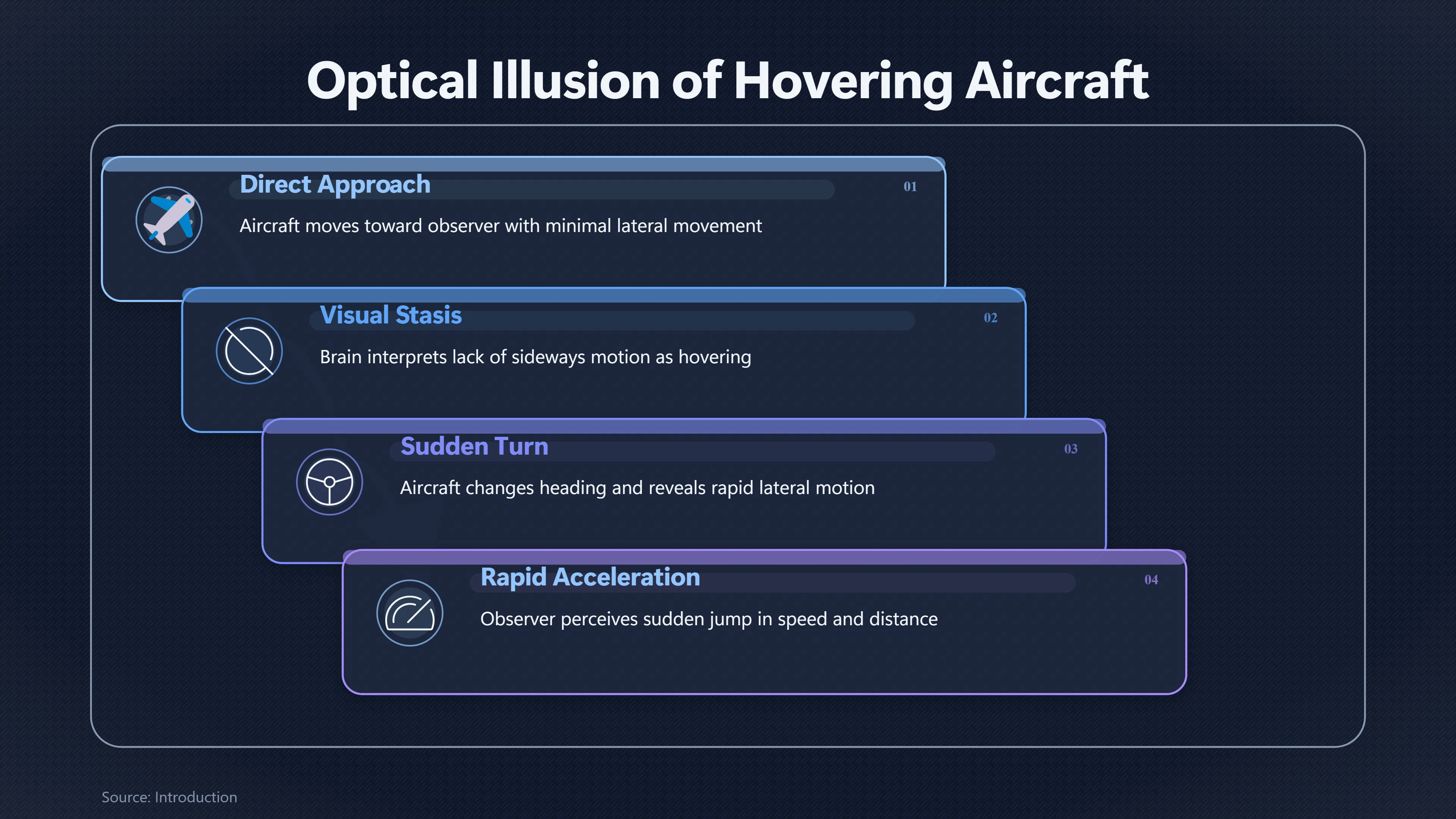
An aircraft approaching directly towards an observer shows little sideways movement. Without lateral motion, the brain can interpret it as stationary, creating the familiar “hovering aircraft” illusion. Once the aircraft turns or passes overhead, it suddenly appears to accelerate away.
Bright landing lights strengthen this effect. Long before the aircraft’s outline becomes visible, observers may see only one or two intense lights against a dark background. The lights conceal the aircraft’s shape and make it difficult to estimate distance. FAA guidance recognises that lighting, featureless terrain, haze and limited visual references can all produce misleading impressions of aircraft position and movement, even for trained pilots.[Federal Aviation Administration]faa.govFederal Aviation Administration Fitness for FlightFederal Aviation Administration Fitness for Flight
This is particularly relevant around southern Puget Sound, where:
- Water reflects lights at night.
- Low cloud can obscure the aircraft while leaving landing lights visible.
- Hills and tree lines repeatedly hide and reveal aircraft during approach.
- Rain and haze reduce depth perception.
These conditions can make an ordinary transport aircraft appear much larger, slower or more distant than it really is.
Why aircraft sometimes seem silent
Silence is one of the most common features reported in UFO accounts around military bases. Near JBLM, several ordinary mechanisms can produce that impression.
Sound travels far more slowly than light. A low aircraft approaching directly towards an observer may be seen well before its engine noise arrives. By the time the sound reaches the observer, the aircraft may already have passed overhead.
Wind direction also matters. Strong winds can carry engine noise away from an observer, while terrain can block or scatter sound. The result is an aircraft that appears almost silent until it reaches a different position.
Large military transports can also produce a surprisingly low-frequency sound signature that blends into background environmental noise until the aircraft is very close. Helicopters may similarly seem quieter when their rotors are viewed edge-on during certain phases of flight.
JBLM itself acknowledges that routine military aviation and helicopter training create varying noise patterns across surrounding communities depending on location, weather and the type of activity taking place.[Army Home]home.army.milHome Noise and Disturbances:: Joint Base Lewis-Mc ChordArmy HomeNoise and Disturbances:: Joint Base Lewis-McChord…
Why military aircraft often look unfamiliar
Many people are used to recognising commercial airliners but have little experience with military aircraft.
Aircraft operating from JBLM may display combinations of features that appear unusual:
- High-mounted wings on heavy transport aircraft.
- Large T-shaped tails.
- Formation lighting designed for military flying.
- Different landing-light arrangements from civilian aircraft.
- Camouflage or grey paint that makes the fuselage difficult to distinguish against cloud or dusk.
Night operations can exaggerate these effects. Observers may see only navigation lights or bright landing lights without being able to identify the aircraft itself.
Some military lighting configurations also change during different phases of flight or training, making an aircraft appear to alter shape unexpectedly when viewed from the ground.
Why apparent speed is often misleading
Estimating speed without knowing distance is extremely difficult.
A nearby helicopter crossing the observer’s field of view may appear faster than a distant jet. Conversely, a large transport flying almost directly towards an observer may appear almost stationary despite travelling at several hundred kilometres per hour.
Military aircraft also use climb profiles and banking manoeuvres that differ from airline operations. During a turn, perspective changes rapidly, making an aircraft appear to accelerate, reverse direction or “jump” sideways when it is simply changing heading.
These effects become stronger after sunset, when observers have fewer visual references.
Which observations remain difficult to explain
These mechanisms explain a substantial proportion of unusual aircraft reports made around JBLM, particularly those centred on apparent hovering, silence, strange lighting or dramatic changes in speed.
Some reports nevertheless remain unresolved because they contain too little reliable information. Common limitations include:
- only one witness;
- no photographs or radar information;
- uncertain time or location;
- inability to estimate distance or altitude;
- observations lasting only a few seconds.
An unresolved sighting is not necessarily evidence of an extraordinary object. It usually means there is insufficient information to identify the aircraft with confidence.
That distinction is important within Washington’s broader UFO history. JBLM sits beneath busy military and civilian flight paths while also housing air-defence operations through the Western Air Defense Sector, meaning unusual aerial activity is expected to receive attention for safety reasons. In aviation, an object can remain “unidentified” simply because available evidence is incomplete, not because it has been shown to be something beyond conventional explanation.[m.mil.wa.gov]m.mil.wa.govWestern Air Defense Sector | Washington State Military DepartmentWestern Air Defense Sector | Washington State Military Department

Amazon book picks
Further Reading
Books and field guides related to Why Aircraft Near JBLM Can Look Like UFOs. Use these as the next step if you want deeper reading beyond the article.
UFOs: Generals, Pilots, and Government Officials Go on the Re...
Examines credible UFO reports, including aviation witness accounts, providing context for evaluating unusual sightings.
The UFO Experience: A Scientific Inquiry
Introduces systematic approaches to assessing UFO reports and distinguishing observation from interpretation.
Skunk Works: A Personal Memoir of My Years at Lockheed
Explains advanced military aircraft development, helping readers understand why unfamiliar aircraft can appear extraordinary.
Flight: The Complete History of Aviation
Provides background on aircraft types, flight operations, and aviation technology relevant to busy airspace around military bases.
eBay marketplace picks
Marketplace Samples
Live-tested eBay searches with available results related to this page.
Selected frommilitary aircraft model oneBay.co.uk.
Endnotes
1.
Source: mcchord.af.mil
Title: Mc Chord Airfield Information
Link:https://www.mcchord.af.mil/Portals/29/McChord%20AFB%20MACA%20Pamphlet_2024_1.pdf
Source snippet
McChord Airfield InformationOctober 19, 2025...
Published: October 19, 2025
2.
Source: mcchord.af.mil
Title: Maintaining a safe and operational airfield > Team Mc Chord > Article Display
Link:https://www.mcchord.af.mil/News/Article-Display/Article/1099610/maintaining-a-safe-and-operational-airfield/
Source snippet
Urouse Williams, 62nd Airlift Wing airfield driving program manager, demonstrates the proper way of contacting the air traffic control to...
3.
Source: home.army.mil
Title: Home Noise and Disturbances:: Joint Base Lewis-Mc Chord
Link:https://home.army.mil/lewis-mcchord/index.php/contact/noise-and-public-disturbances
Source snippet
Army HomeNoise and Disturbances:: Joint Base Lewis-McChord...
4.
Source: faa.gov
Title: Federal Aviation Administration Fitness for Flight
Link:https://www.faa.gov/air_traffic/publications/atpubs/aip_html/chap8_section_1.html
5.
Source: m.mil.wa.gov
Title: Western Air Defense Sector | Washington State Military Department
Link:https://m.mil.wa.gov/western-air-defense-sector
6.
Source: faa.gov
Link:https://www.faa.gov/flight_deck/bfi
Source snippet
June 5, 2026 — BOEING FIELD/KING COUNTY INTERNATIONAL AIRPORT (BFI) Boeing Field/King County International Airport (BFI) is a multi-use a...
Published: June 5, 2026
7.
Source: home.army.mil
Link:https://home.army.mil/lewis-mcchord/my-Joint-Base-Lewis-Mcchord/all-services/public_works-environmental_division/ENVIRONMENTAL-IMPACT-ANALYSIS
Source snippet
IMPACT ANALYSIS:: Joint Base Lewis-McChordJoint Base Lewis-McChord Joint Base Lewis-McChord Image Joint Base Lewis-McChord HOME OF I COR...
Additional References
8.
Source: portseattle.org
Link:https://www.portseattle.org/node/19499
Source snippet
Aircraft Noise Questions and Answers | Port of SeattleAIRCRAFT NOISE QUESTIONS AND ANSWERS SEA Part 150 Noise Study Contact Airport Noise...
9.
Source: amc.af.mil
Link:https://www.amc.af.mil/News/Article-Display/Article/148700/new-system-sheds-light-on-short-field-combat-landings/
Source snippet
16, 2004 * By Staff Sgt. A.C. Eggman MCCHORD AIR FORCE BASE, Wash. (AMCNS -- Thanks to a new runway lighting system, McCh...
10.
Source: scribd.com
Title: Final Scoping Document JBLM HTA Submittal 25Jun15
Link:https://www.scribd.com/doc/271711539/Final-Scoping-Document-JBLM-HTA-Submittal-25Jun15
Source snippet
JBLM Off-Base Helicopter Training Areas | PDFJune 1, 2015 — JBLM Off-Base Helicopter Training Areas The Department of the Army is proposi...
Published: June 1, 2015
11.
Source: kingcounty.gov
Title: Part 150 Study
Link:https://kingcounty.gov/en/dept/executive-services/transit-transportation-roads/airport/projects/part-150-study
Source snippet
King County, WashingtonPART 150 STUDY The Part 150 Study is a voluntary Federal Aviation Administration (FAA) noise study that King Count...
12.
Source: faasafety.gov
Link:https://www.faasafety.gov/gslac/ALC/libview_chapter.aspx?chapter=Illusions+-+Have+I+Considered+Them%3F&id=6580
Source snippet
Learning Center Library Contents - FAA - FAASTeam - FAASafety.govLearning Center Library Contents Image: Aviation Learning Center Documen...
13.
Source: youtube.com
Title: The Most Insane Flight On The C-17 Globemaster
Link:https://www.youtube.com/watch?v=yuA0Qyc2iXM
Source snippet
2012 Joint Base Lewis-McChord Air Expo - C-17 Globemaster III Demonstration...
14.
Source: icao.int
Link:https://www.icao.int/environmental-protection/noise-abatement-operational-procedures
Source snippet
ICAO assists on t...
15.
Source: youtube.com
Title: 3 Ways your BRAIN Tricks You into Thinking AIRPLANES HOVER!
Link:https://www.youtube.com/watch?v=3osSwf7dgUI
Source snippet
The Most Insane Flight On The C-17 Globemaster...
16.
Source: youtube.com
Title: C-17 Tactical Descent 🛬
Link:https://www.youtube.com/watch?v=s1mBbbY5AvU
Source snippet
Why do large planes look like they are hovering optical illusion Flying Ships 🚢 🪽 😲 Jack O'Mural...
17.
Source: youtube.com
Link:https://www.youtube.com/watch?v=-26S9UWeJC8
Source snippet
McChord AFB C-17 flying over my house...