Within Utah UFOs
What Did Project Blue Book Find in Utah?
Utah's official UFO files show that an unresolved label usually reflected missing or weak evidence rather than proof of an exotic craft.
On this page
- How Utah reports entered the Air Force system
- What identified and unidentified classifications meant
- Why old case files are difficult to reassess
Page outline Jump by section
Introduction
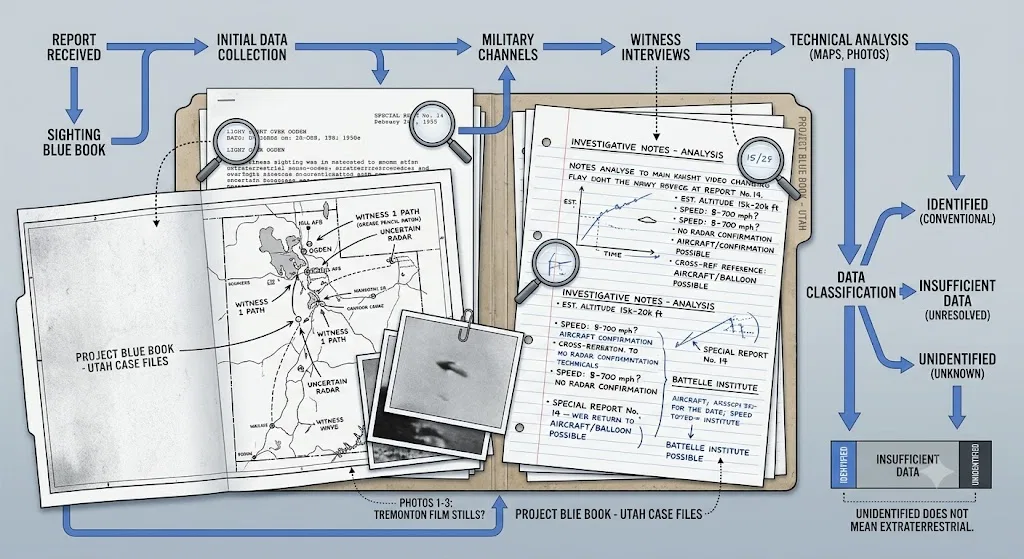
Project Blue Book’s Utah files do not reveal a hidden catalogue of proven exotic craft. They show something more useful: how the US Air Force collected, filtered and classified reports that ranged from brief lights over towns to observations near military installations and the unusually well-documented 1952 Tremonton film. Most Utah reports were either identified, tentatively explained or placed in an “insufficient data” category. A smaller number remained unidentified because investigators could not match the surviving description to a known object or phenomenon.
That distinction matters. In Blue Book terminology, “unidentified” did not mean extraterrestrial, technologically advanced or even necessarily inexplicable in principle. It meant that the Air Force had not reached a satisfactory identification from the evidence available. In some Utah files, the limiting factor was not the strangeness of the object but the thinness of the record: no photograph, no radar return, uncertain distances, late reporting or only a short summary card.[National Archives]archives.govNational Archives Project BLUE BOOKNational ArchivesProject BLUE BOOK - Unidentified Flying Objects | National Archives…
How Utah reports entered the Air Force system
Project Blue Book operated from 1952 until 1969, following the earlier Projects Sign and Grudge. Its national purpose was partly defensive: the Air Force wanted reports that might indicate hostile aircraft, unfamiliar technology or interference with military operations. The programme ultimately received 12,618 sightings from 1947 onwards, of which 701 retained an official “unidentified” classification. The Air Force nevertheless concluded that none of the investigated cases demonstrated a national-security threat, technology beyond contemporary scientific knowledge or extraterrestrial vehicles.[National Archives]archives.govNational Archives Project BLUE BOOKNational ArchivesProject BLUE BOOK - Unidentified Flying Objects | National Archives…
Utah reports could reach Blue Book through several routes. Military personnel reported through their commands or local intelligence and investigative offices. Civilians might contact an Air Force base, write directly to the authorities or have their account forwarded by police, newspapers or other officials. Hill Air Force Base, near Ogden, was an obvious collection point because it had operational personnel, radar facilities and links to the Air Force reporting structure.
A typical case file could contain a witness questionnaire, correspondence, newspaper cuttings, local investigative notes and a control or record card summarising the event and its official conclusion. Yet the completeness varied enormously. Some files contain detailed sequences of interviews and technical analysis; others preserve only a page or two. National Archives descriptions confirm that individual files may concern one sighting or a group of related reports and that photographs, film and physical-evidence analyses were included only where such material existed.[National Archives]archives.govOpen source on archives.gov.
The surviving Utah material covers more than one familiar landmark. Indexed files refer to places including Hill Air Force Base, Salt Lake City, Ogden, Mount Pleasant, Cedar City, Fairfield, Farmington, Jensen, Eureka, Dugway and rural locations recorded only approximately. This spread is important because Blue Book’s Utah record was not simply a collection of stories about one secretive military site. It was an administrative cross-section of what people across the state reported seeing.
What identified and unidentified really meant
Blue Book’s classifications are easy to overread. A case marked “aircraft”, “balloon”, “astronomical” or “meteor” indicated that investigators believed a conventional source best fitted the report. Some conclusions were expressed with confidence; others were qualified as “possible” or “probable”. An identification could therefore be a reasoned judgement rather than a demonstrated reconstruction.
“Insufficient data” was different. It indicated that investigators lacked enough reliable information to decide. This might result from uncertain time and location, no meaningful angular measurements, conflicting descriptions, a long delay before investigation or the absence of corroborating records. Such a file was unresolved administratively, but not necessarily mysterious scientifically.
“Unidentified” was reserved for reports that could not be fitted satisfactorily to a recognised object or phenomenon after evaluation. Project Blue Book Special Report No. 14, a statistical study prepared with the Battelle Memorial Institute, treated “unknown” and “insufficient information” as distinct categories. Its analysts explicitly recognised that a report might resist identification because its reported characteristics did not match a known pattern, while another might simply be too incomplete to assess. The report also cautioned that the available data varied considerably in quality and found no physical material establishing technology outside existing scientific knowledge.[U.S. Department of War]war.govCIA UAP 015 Project Blue Book Special Report No 14Department of WarCIA-UAP-015-Project_Blue_Book_Special_Report_No_14…I. The special study which resulted in this report (Analysis of Re…
For Utah’s history, the practical lesson is that three very different propositions are often collapsed into one:
- Identified: investigators selected a conventional explanation.
- Insufficient data: no dependable judgement could be made.
- Unidentified: the evidence was considered adequate for review, but no satisfactory identification was reached.
None of these labels by itself establishes what physically occupied the sky. An identified case can have been explained incorrectly, while an unidentified case can still have had an ordinary cause that was never documented.
The Hill Air Force Base file shows the problem clearly
A July 1950 report from Hill Air Force Base is a compact example of how ambiguity entered the official record. Three staff sergeants at the base’s radar station reportedly watched a silver, circular-looking object for about three minutes. The summary described it as roughly 50 feet long, silent and without an exhaust trail. It was said to pass over the base at an estimated altitude of 20,000 feet. Radar equipment was activated, but the object disappeared before a contact was obtained.[govweird]govweird.comhill afb ut july 1950Project Blue Book: Hill AFB, Utah, July 1950 · govweird…
At first glance, the military setting and trained witnesses make the case appear strong. The documentary weaknesses are equally important, however. There was no photograph and no radar confirmation. Estimates of speed ranged from approximately 8 to 700 miles per hour, a span so broad that it provides almost no useful constraint. The record card considered possibilities including a balloon, aircraft or astronomical source, but the surviving conclusion is partly illegible and the case is presented as having insufficient data. Only two scanned pages survive in the indexed file.[govweird]govweird.comhill afb ut july 1950Project Blue Book: Hill AFB, Utah, July 1950 · govweird…
The file therefore does not demonstrate that an extraordinary object penetrated Hill’s airspace. It demonstrates that several military witnesses made a report that could not be reconstructed convincingly. Without a measured range, confirmed altitude or timed radar track, the apparent size and speed depend on assumptions. A small nearby object and a large distant one can create a similar visual impression when viewed against an open sky.
The case also shows why “military witness” should not be treated as a complete guarantee of accuracy. Training can improve observation and reporting, especially when witnesses are familiar with aircraft. It cannot give an observer unaided depth perception or reliable distance estimates for a featureless object with no known scale.
Tremonton was different, but not decisive
The 2 July 1952 Tremonton case stands apart because Delbert C. Newhouse, a US Navy photographer travelling through northern Utah, recorded bright objects on colour motion-picture film. Unlike most Blue Book reports, the case therefore left physical imagery that could be replayed and analysed rather than only a retrospective description.
The film received attention from military photographic specialists and was shown to the CIA-sponsored Robertson Panel in January 1953. Its importance within Utah’s official UFO history rests on this level of scrutiny. The bright images could be measured frame by frame, and the footage survived in federal audiovisual holdings rather than existing only as a story repeated in later books. The National Archives identifies the Tremonton material among the notable motion pictures associated with Project Blue Book.[The Unwritten Record]unwritten-record.blogs.archives.govThe Unwritten Record Project Blue Book: Spotting UFOs in the Film RecordThe Unwritten RecordProject Blue Book: Spotting UFOs in the Film RecordOctober 1, 2013 — 30 Sept 2013 — Project Blue Book was actually th…
Even so, film did not solve the central problems of range and scale. The objects appear mainly as bright points without visible structural detail. Investigators could measure their movement across the image, but they could not securely determine their distance, altitude or physical dimensions. Those missing quantities are essential: apparent motion on film cannot be converted into extraordinary speed without knowing how far away the object was.
A conventional interpretation proposed that the film showed birds, often described as gulls, reflecting sunlight as they banked. Supporters of this explanation point to the fluctuating brightness, loose group movement and lack of discernible craft structure. Critics argue that the duration and apparent behaviour did not fit ordinary birds and note that the case survived serious contemporary analysis without an agreed identification.
The most defensible conclusion lies between dismissal and exaggeration. Tremonton was a better evidential case than a fleeting verbal report, and its unresolved status was historically meaningful. Yet the images never supplied enough spatial information to prove exceptional performance. Later reproductions and digital viewing have made the footage easier to inspect, but they cannot recover range, lens calibration, atmospheric conditions or detail that the original film did not capture.
Military locations did not guarantee military evidence
Utah’s Blue Book files contain repeated connections with Hill Air Force Base and occasional references to areas such as Dugway. These links are unsurprising. Military personnel were required to report potentially significant aerial activity, bases provided an established channel for forwarding accounts, and Utah contained large areas of defence-related aviation and testing.
A location near a base nevertheless says little by itself about the nature of a sighting. It may increase the chance of seeing unfamiliar aircraft, balloons, flares or classified activity. It may also increase the chance that a report is formally recorded. This creates a selection effect: military areas can appear prominent in official files partly because they had personnel, communications systems and reporting obligations that ordinary rural communities lacked.
The Utah records should therefore be read as governance documents as well as sighting reports. They show what information moved through the Air Force system, which incidents received attention and what standards officials applied. They are not a complete census of everything seen in Utah, and the number of files associated with a facility cannot be treated as a measure of anomalous activity around it.
There is also little justification for interpreting ordinary redactions or sparse military wording as evidence of a concealed solution. When the National Archives made the records publicly available, witness names and other personal information had to be removed. The archive’s sanitised format reflects privacy requirements as well as the way the Air Force originally assembled the files.[National Archives]archives.govOpen source on archives.gov.
Why old Utah files are difficult to reassess
Reinvestigating a Blue Book case decades later is not simply a matter of reading the final label and choosing whether to believe it. The investigator must establish what observations were actually measured, what was estimated and what information disappeared before the report reached headquarters.
Several recurring problems limit Utah reassessments.
Distance was usually unknown. Witnesses commonly supplied an altitude, size or speed even though they had no independent range measurement. Those estimates can reinforce one another falsely: assuming a distant object leads to a large size, and the large assumed size then makes its movement appear exceptionally fast.
Radar claims were not always radar cases. A report made near a radar station may have involved no recorded return, as in the July 1950 Hill file. For evidential purposes, “radar was present” is not equivalent to a preserved track with range, bearing, altitude and equipment checks.
Astronomical and aviation records were uneven. Modern researchers can sometimes reconstruct planets, bright stars, meteors, balloon launches or known flights. They cannot assume that every local flight, training exercise or research balloon was preserved in searchable records.
The archive contains administrative compression. A control card may reduce a complicated observation to a few lines. Handwriting can be illegible, pages may be duplicated or out of order, and the surviving microfilm may not reproduce photographs or faint typing well. The National Archives describes 94 microfilm rolls, with case files organised chiefly by date and separate holdings for some photographs and motion pictures. That arrangement makes research possible, but cross-checking material across formats remains laborious.[National Archives]archives.govNational Archives Project BLUE BOOKNational ArchivesProject BLUE BOOK - Unidentified Flying Objects | National Archives…
Witness follow-up is rarely possible. Memories change, witnesses die and the original viewing site may have been altered. A modern explanation that depends on precise direction, cloud cover or timing may therefore be impossible to test.
These limitations cut both ways. They prevent researchers from proving some conventional explanations, but they also prevent confident claims of unusual technology.
Did Blue Book leave Utah mysteries unsolved?
Yes, in the narrow administrative sense. Some Utah cases remained unidentified or inadequately resolved, and Tremonton remains one of the most discussed film cases in the entire Blue Book record. The files also preserve reports from military witnesses and incidents near strategically important facilities that deserved examination at the time.
But the unresolved Utah files do not form a coherent body of evidence for one unknown type of craft. They vary in date, location, witness quality, documentation and reported appearance. Many lack instrumental confirmation. Others are difficult mainly because the original inquiry failed to secure the information that would now be needed for a confident answer.
Project Blue Book’s broader conclusions should not be accepted uncritically simply because they were official. Investigative effort and standards varied over the programme’s lifetime, and a tentative conventional label is not automatically correct. Equally, criticism of Blue Book does not reverse the burden of proof. An inadequate investigation can leave a genuine question unanswered without making the most exotic interpretation more likely.
The fairest reading of Utah’s Blue Book legacy is therefore modest. The archive documents how Cold War authorities handled uncertain aerial reports, preserves a few cases worthy of continued historical and technical discussion, and exposes the large gap between a compelling sighting and a scientifically testable event. “Unresolved” is a description of the file’s ending, not a verdict on extraterrestrial origin.
Amazon book picks
Further Reading
Books and field guides related to What Did Project Blue Book Find in Utah?. Use these as the next step if you want deeper reading beyond the article.
The Report on Unidentified Flying Objects
Directly relevant to Project Blue Book investigations.
UFOs and Government: A Historical Inquiry
Explains Blue Book and related programs in detail.
UFOs: Generals, Pilots, and Government Officials Go on the Re...
Places Blue Book findings in modern context.
eBay marketplace picks
Marketplace Samples
Live-tested eBay searches with available results related to this page.
Selected fromUFO memorabilia oneBay.co.uk.

Endnotes
1.
Source: archives.gov
Title: National Archives Project BLUE BOOK
Link:https://www.archives.gov/research/military/air-force/ufos
Source snippet
National ArchivesProject BLUE BOOK - Unidentified Flying Objects | National Archives...
2.
Source: archives.gov
Link:https://www.archives.gov/news/articles/project-blue-book-50th-anniversary
3.
Source: war.gov
Title: CIA UAP 015 Project Blue Book Special Report No 14
Link:https://www.war.gov/medialink/ufo/061226/release_03/documents/CIA-UAP-015-Project_Blue_Book_Special_Report_No_14.pdf
Source snippet
Department of WarCIA-UAP-015-Project_Blue_Book_Special_Report_No_14...I. The special study which resulted in this report (Analysis of Re...
4.
Source: cia.gov
Link:https://www.cia.gov/readingroom/docs/CIA-RDP81R00560R000100060001-5.pdf
Source snippet
CIA(ANALYSIS OF REPORTS OF UNIDENTIFIED AERIAL...PROJECT BLUE BOOK SPECIAL REPORT NO. 14 (ANALYSIS OF REPORTS OF UNIDENTIFIED AERIAL OB...
5.
Source: govweird.com
Title: hill afb ut july 1950
Link:https://www.govweird.com/topics/ufo/project-blue-book/hill-afb-ut-july-1950
Source snippet
Project Blue Book: Hill AFB, Utah, July 1950 · govweird...
Published: july 1950
6.
Source: unwritten-record.blogs.archives.gov
Title: The Unwritten Record Project Blue Book: Spotting UFOs in the Film Record
Link:https://unwritten-record.blogs.archives.gov/2013/09/30/project-blue-book-looking-to-the-film-record/
Source snippet
The Unwritten RecordProject Blue Book: Spotting UFOs in the Film RecordOctober 1, 2013 — 30 Sept 2013 — Project Blue Book was actually th...
Published: October 1, 2013
7.
Source: archives.gov
Link:https://www.archives.gov/research/topics/uaps/rg-collections
Source snippet
National ArchivesRecords Related to Unidentified Flying Objects (UFOs) and Unidentified Anomalous Phenomena (UAPs) at the National Archiv...
8.
Source: archives.gov
Link:https://www.archives.gov/research/catalog/catalog-bulk-downloads/uap-bulk-download
9.
Source: archives.gov
Link:https://www.archives.gov/research/topics/uaps/textual-and-microfilm
10.
Source: history.navy.mil
Title: mil UF O Research Guide
Link:https://www.history.navy.mil/content/history/nhhc/research/library/bibliographies-and-research-guides/research-guides/ufo-research-guide.html
11.
Source: prologue.blogs.archives.gov
Link:https://prologue.blogs.archives.gov/wp-content/uploads/sites/9/2018/03/report.pdf
12.
Source: archives.gov
Title: air force
Link:https://www.archives.gov/research/military/air-force
13.
Source: bidenwhitehouse.archives.gov
Title: Utah IIA State Fact Sheet
Link:https://bidenwhitehouse.archives.gov/wp-content/uploads/2024/05/Utah-IIA-State-Fact-Sheet.pdf
14.
Source: archives.gov
Link:https://www.archives.gov/news/articles
15.
Source: archives.gov
Title: utah honor flight 9 18 2021
Link:https://www.archives.gov/news/articles/utah-honor-flight
16.
Source: archives.gov
Link:https://www.archives.gov/research/guide-fed-records/groups/070.html
17.
Source: archives.gov
Link:https://www.archives.gov/files/declassification/iscap/pdf/2014-004-doc01.pdf
18.
Source: archives.gov
Title: Federal Records Guide: Alphabetical Index
Link:https://www.archives.gov/research/guide-fed-records/index-alpha/a.html
19.
Source: text-message.blogs.archives.gov
Title: the ccc in color
Link:https://text-message.blogs.archives.gov/2016/11/15/the-ccc-in-color/
20.
Source: govweird.com
Link:https://www.govweird.com/topics/ufo/project-blue-book/year/1963
21.
Source: govweird.com
Link:https://www.govweird.com/topics/ufo/project-blue-book/year/1955
22.
Source: govweird.com
Link:https://www.govweird.com/topics/ufo/project-blue-book/year/1960
23.
Source: govweird.com
Link:https://www.govweird.com/topics/ufo/project-blue-book/year/1957
24.
Source: govweird.com
Link:https://www.govweird.com/topics/ufo/project-blue-book/year/1951
25.
Source: govweird.com
Link:https://www.govweird.com/topics/ufo/project-blue-book/year/1956
26.
Source: govweird.com
Link:https://www.govweird.com/topics/ufo/project-blue-book/year/1949
27.
Source: govweird.com
Link:https://www.govweird.com/topics/ufo/project-blue-book/year/1962
28.
Source: govweird.com
Link:https://www.govweird.com/topics/ufo/project-blue-book/state/wyoming
29.
Source: govweird.com
Link:https://www.govweird.com/topics/ufo/project-blue-book/year/1959
30.
Source: war.gov
Title: DOW UAP D092 DAF Committee to Review Project Bluebook 1966 1967
Link:https://www.war.gov/medialink/ufo/071026/release_04/documents/DOW-UAP-D092_DAF-Committee-to-Review-Project-Bluebook_1966-1967.pdf
31.
Source: archive.org
Link:https://archive.org/stream/ProjectBlueBookSpecialReport14/pbbsr14_djvu.txt
32.
Source: attheu.utah.edu
Title: the west is best to spot ufos
Link:https://attheu.utah.edu/facultystaff/the-west-is-best-to-spot-ufos/
33.
Source: history.com
Title: Project Blue Book
Link:https://www.history.com/articles/project-blue-book
34.
Source: govweird.com
Title: 60 14n 13 36w atlantic october 1962 28999600
Link:https://www.govweird.com/topics/ufo/project-blue-book/60-14n-13-36w-atlantic-october-1962-28999600
Published: october 1962
35.
Source: govweird.com
Title: edwards afb ca may 1957
Link:https://www.govweird.com/topics/ufo/project-blue-book/edwards-afb-ca-may-1957
Published: may 1957
36.
Source: Wikipedia
Title: Project Blue Book
Link:https://en.wikipedia.org/wiki/Project_Blue_Book
37.
Source: satyori.com
Title: project blue book
Link:https://satyori.com/suppressed-history/project-blue-book/
Additional References
38.
Source: youtube.com
Title: The True Story Behind US Government Investigations Into UFOs | Project Blue Book
Link:https://www.youtube.com/watch?v=qdTVsr4O4HA
Source snippet
Project Blue Book Exposed (2020) [Documentary]...
39.
Source: nsa.gov
Link:https://www.nsa.gov/portals/75/documents/news-features/declassified-documents/ufo/usaf_fact_sheet_95_03.pdf
40.
Source: youtube.com
Title: Why This UFO Sighting Was Different | Monstrum
Link:https://www.youtube.com/watch?v=dHGn_yPSgg0
Source snippet
The True Story Behind US Government Investigations Into UFOs | Project Blue Book...
41.
Source: youtube.com
Title: Dark Ambient on Korg Wavestate + Montana & Utah UFO films
Link:https://www.youtube.com/watch?v=0_ubEXNVhqU
Source snippet
Why This UFO Sighting Was Different | Monstrum...
42.
Source: commons.wikimedia.org
Link:https://commons.wikimedia.org/wiki/Category%3AUS_National_Archives_series%3A_Sanitized_Version_of_Project_Blue_Book_Case_Files_on_Sightings_of_Unidentified_Flying_Objects%2C
43.
Source: encyclopedia.com
Link:https://www.encyclopedia.com/science/encyclopedias-almanacs-transcripts-and-maps/condon-report
44.
Source: reddit.com
Link:https://www.reddit.com/r/UFOs/comments/1iuah33/dugway_proving_ground_and_ufo_legacy_programs/
45.
Source: facebook.com
Link:https://www.facebook.com/HISTORY/posts/during-the-cold-war-as-project-blue-book-investigated-potential-ufo-threats-a-sh/1473622884330683/
46.
Source: academia.edu
Link:https://www.academia.edu/49680297/Project_Blue_Book_Special_Report_14
47.
Source: docsteach.org
Link:https://docsteach.org/document/project-blue-book-status-report-number-eight/