Within Nevada UFOs
Did Project Twinkle Explain the Green Fireballs?
Project Twinkle shows that officials took Nevada's green fireball reports seriously, yet failed to collect decisive measurements.
On this page
- The late 1940 s fireball wave
- The camera plan and its failures
- Why unresolved did not mean extraterrestrial
Page outline Jump by section
Introduction
Project Twinkle did not explain the green fireballs conclusively. It showed that the United States Air Force regarded the reports as serious enough to justify cameras, triangulation equipment and scientific consultation, but the programme never gathered the measurements needed to settle the question. The strongest surviving records centre on northern and central New Mexico, although a modern Pentagon history places the wider report pattern across both New Mexico and Nevada.[AAROM]aaro.milMUnclassified Final DSD AARO Historical ReportMUnclassified Final DSD AARO Historical Report…
For Nevada’s UFO history, the episode matters mainly as an early example of a problem that would recur around the state’s military ranges: trained witnesses reported unfamiliar lights near sensitive installations, security officials worried about hostile technology, and an investigation produced an “unresolved” residue largely because its observation system failed. That failure is not evidence of extraterrestrial activity. It means that witness accounts were never converted into reliable data on distance, speed, height, composition or flight path.
The late-1940s fireball wave
The best-documented wave began in late 1948, when pilots, military personnel, scientists and civilians reported brilliant green objects crossing the New Mexico sky. One frequently cited incident occurred on 5 December, when several separate fireballs were reported. On 8 December, two airborne military observers described an intensely bright, green, flare-like object apparently approaching their aircraft on a nearly level path before dropping away after about two seconds.[Project Gutenberg]gutenberg.orgOpen source on gutenberg.org.
The reports attracted unusual attention because they came from the region surrounding Los Alamos, Sandia Base, Kirtland Air Force Base, White Sands and Holloman Air Force Base. These were not ordinary civilian locations: they were connected with nuclear-weapons work, missile testing, aviation research and military security. An unexplained object near such sites could represent a natural meteor, a domestic experiment, a foreign reconnaissance device or simply a mistaken observation. Officials did not need to believe in alien spacecraft to consider the matter urgent.
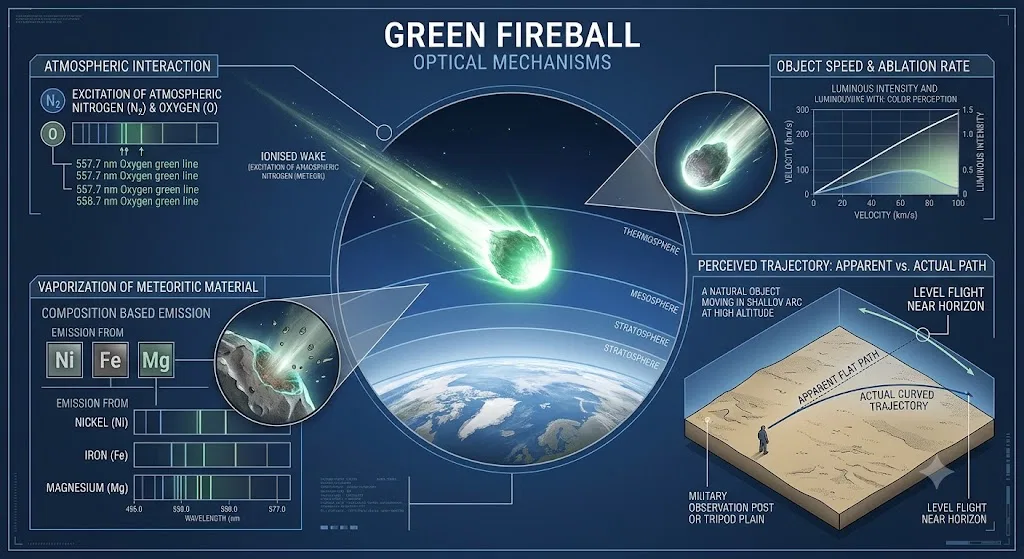
Meteor specialist Lincoln LaPaz of the University of New Mexico became one of the most prominent investigators. According to the later account of Air Force UFO officer Edward Ruppelt, LaPaz attempted to reconstruct trajectories from witness statements and searched predicted impact areas without finding fragments. He argued that some objects appeared unusually green, bright and level in flight. Other scientists countered that green meteors were already known and that a shallow or distant meteor could appear to follow a flat path.[Project Gutenberg]gutenberg.orgOpen source on gutenberg.org.
A Los Alamos conference in October 1949 reached the most important practical conclusion: the available testimony was not sufficiently quantitative for firm scientific judgement. Photographs, simultaneous observations from different locations, spectroscopic records and accurate angular measurements were needed. The conference record acknowledged that trained, independent witnesses had seen something, while also stating that discussion of possible explanations had achieved little.[The Black Vault]documents2.theblackvault.comThe Black Vault
That distinction is central to understanding the case. Officials accepted that real luminous events had occurred. They did not establish that every report described the same phenomenon, or that the objects possessed extraordinary technology.
Where Nevada fits
Project Twinkle is usually described as a New Mexico investigation because its observation posts, instruments and principal cases were concentrated around Vaughn, Holloman and White Sands. The original final report repeatedly refers to phenomena in northern New Mexico and to a high concentration of reports near Vaughn.[The Black Vault]documents2.theblackvault.comThe Black Vault
A 2024 report by the Pentagon’s All-domain Anomaly Resolution Office, or AARO, describes the green fireballs as having been witnessed in both Nevada and New Mexico. It does not, however, identify a comparable Nevada camera station or provide detailed Nevada cases in its short summary. The surviving operational record therefore supports a cautious interpretation: Nevada formed part of the wider south-western military and aerial-security setting, but Project Twinkle’s actual fieldwork was overwhelmingly conducted in New Mexico.[AAROM]aaro.milMUnclassified Final DSD AARO Historical ReportMUnclassified Final DSD AARO Historical Report…
The timing also prevents a common historical mix-up. Nevada already possessed the large Las Vegas Bombing and Gunnery Range, but the Nevada Proving Ground was not designated for nuclear testing until December 1950. Its first atmospheric nuclear detonation took place on 27 January 1951, near the end of Twinkle’s active observation period rather than at the beginning of the original 1948–49 fireball wave.[Nevada National Security Site]nnss.govNevada National Security SiteOur HistoryOn January 27, 1951, the first atmospheric nuclear test was detonated at the NTS, code-named “Abl…
This does not make Nevada irrelevant. The green-fireball episode established an early pattern that would later become familiar in the state: unusual sightings interpreted against a background of restricted airspace, weapons development and incomplete public knowledge. It should not, however, be presented as though Twinkle was principally a Nevada Test Site investigation.
The camera plan and its failures
Project Twinkle’s proposed method was sensible. Several camera stations would observe the same object from known positions. Instruments known as cinetheodolites or photographic theodolites would record the viewing angle and time. With simultaneous images from two stations, investigators could use triangulation to calculate an object’s altitude, route and speed. A spectrum camera might also separate the object’s light into wavelengths, offering clues about whether it was a meteor, flare, rocket exhaust or another luminous source.[Project Gutenberg]gutenberg.orgOpen source on gutenberg.org.
The March 1950 plan contained three elements:
- triangulation with Askania photographic instruments;
- observations through a camera fitted with a spectral grating;
- attempted monitoring of electromagnetic frequencies.
Two Askania stations were to maintain a constant watch near Vaughn, where officials believed an abnormal number of reports had occurred.[The Black Vault]documents2.theblackvault.comThe Black Vault
In practice, the system never operated as originally imagined. Some camera activity occurred on 27 April and 24 May 1950, but the two stations did not obtain simultaneous sightings, so no useful triangulation resulted. On 30 August, witnesses at Holloman reported an aerial phenomenon during a Bell aircraft missile launch, but project personnel were not alerted in time. A further event after a V-2 launch on 31 August was filmed, yet the cameras failed to obtain proper triangulation.[The Black Vault]documents2.theblackvault.comThe Black Vault
Staffing and funding weakened the project further. The spectral cameras operated only intermittently because military personnel assigned to them were withdrawn for duties associated with the Korean War. The planned electromagnetic monitoring was abandoned because officials judged that the sightings were too infrequent to justify an annual transfer of $50,000 to the Signal Corps.[The Black Vault]documents2.theblackvault.comThe Black Vault
During the extended observation period ending in March 1951, the Askania cameras recorded none of the sought-after phenomena. Reports continued to arrive occasionally, but the final report called them sketchy, inconclusive and of no scientific value. Constant surveillance then ended, leaving only a standby arrangement in which pilots, weather personnel and contractors were asked to report anything unusual.[The Black Vault]documents2.theblackvault.comThe Black Vault
Later summaries sometimes reduce this history to the claim that Twinkle obtained only one camera and photographed nothing. The underlying record is more complicated: at stages it refers to two Askania stations and to film being exposed, but no event was captured from enough properly coordinated viewpoints to yield decisive measurements. AARO’s broader conclusion remains fair — Twinkle failed to obtain usable photographs of the green fireballs themselves — but the failure involved poor coordination and incomplete instrumentation as well as simple lack of sightings.[AAROM]aaro.milMUnclassified Final DSD AARO Historical ReportMUnclassified Final DSD AARO Historical Report…

Why “unresolved” did not mean extraterrestrial
Twinkle’s final report was broadly dismissive. It stated that many reports could be attributed to aircraft, balloons, rockets and other human-made objects, while others could be caused by birds, small clouds, planets or meteors. It found no indication that the “somewhat strange” green-fireball observations were anything other than natural phenomena and recommended against further major expenditure.[The Black Vault]documents2.theblackvault.comThe Black Vault
That wording was stronger than the evidence warranted. Twinkle had not successfully measured the original fireballs, reproduced their reported characteristics or identified a single mechanism explaining every case. Its conclusion was therefore not a demonstrated solution comparable to calculating a meteor’s trajectory from multiple photographs. It was an assessment that, after an unsuccessful search, there was insufficient evidence to justify treating the reports as an exotic or hostile phenomenon.
LaPaz remained dissatisfied. In an August 1951 conversation recorded in the project papers, he maintained that the recent appearance and unusual trajectories of the green fireballs argued against a natural explanation. He reportedly considered a secret American military origin possible and regarded the matter as serious if that explanation was wrong.[The Black Vault]documents2.theblackvault.comThe Black Vault
His objections deserve attention, but they do not establish an artificial origin. Estimates of size, level flight and distance made from brief lights against an empty night sky are highly uncertain. Failure to recover a meteorite is also weak negative evidence: most visible meteors disintegrate completely, and surviving fragments can be scattered over large areas or resemble ordinary stones.
Nor is the colour itself extraordinary. Modern meteor science routinely records green fireballs. Their colour can be influenced by the vaporisation of materials such as nickel or magnesium, by atmospheric emissions and by the object’s speed. The American Meteor Society notes that green is a recognised fireball colour rather than a feature requiring an unconventional explanation.[American Meteor Society]amsmeteors.orgAmerican Meteor SocietyFireball FAQsFor example, sodium produces a bright yellow color, nickel shows as green, and magnesium as blue-whit…
A natural explanation for many reports is therefore credible. The remaining uncertainty lies in whether all the late-1940s witnesses saw ordinary meteors or whether the case file combined several causes — meteors, military launches, balloons and misperceived aircraft — under one memorable label.
What Project Twinkle actually established
Project Twinkle produced three defensible findings.[archive.org]archive.orgproject twinkle november 1951project twinkle november 1951
First, the reports were taken seriously. Air Force scientists, intelligence officers and military commanders discussed them, established observation posts and contracted technical equipment. The programme was not merely a public-relations exercise invented decades later.[The Black Vault]documents2.theblackvault.comThe Black Vault
Second, the original evidence was inadequate. Even trained witnesses could not provide the precise range, altitude and velocity needed to distinguish a nearby slow object from a distant fast one. The investigation’s most important scientific proposal — simultaneous instrumented observation — largely failed in execution.
Third, no evidence collected by Twinkle demonstrated extraterrestrial craft or foreign technology. The cameras produced no decisive fireball photographs, no physical material was recovered, and no reliable performance measurements showed controlled or impossible movement. The official natural-phenomena judgement was not a complete explanation, but neither did the evidential gap favour an alien one.
For Nevada, that is the lasting value of the episode. Green fireballs belong in the state’s UFO history because they formed part of the early south-western anxiety surrounding military airspace and sensitive weapons work. Yet the detailed record also warns against turning an inconclusive investigation into proof of concealment. Twinkle left the original case family partly unresolved because it missed its chance to gather good data, not because it discovered something extraordinary and suppressed the result.
Amazon book picks
Further Reading
Books and field guides related to Did Project Twinkle Explain the Green Fireballs?. Use these as the next step if you want deeper reading beyond the article.
The UFO Experience: A Scientific Inquiry
Provides historical context for unexplained aerial phenomena.
UFOs: Generals, Pilots, and Government Officials Go on the Re...
Explores credible military reports and investigative limits.
Area 51: An Uncensored History of America's Top Secret Milita...
Explains how secrecy shaped later UFO narratives.
The Demon-Haunted World: Science as a Candle in the Dark
Frames unresolved phenomena within scientific skepticism.
eBay marketplace picks
Marketplace Samples
Live-tested eBay searches with available results related to this page.
Selected fromUFO wall art oneBay.co.uk.

Current eBay listing
UFO ABDUCTION OVER THE OCEAN -DEEP FRAMED CANVAS WALL ART PRINT
Current eBay listing
UFO ABDUCTION OVER THE OCEAN -FRAMED WALL ART PAPER PRINT POSTER

Endnotes
1.
Source: aaro.mil
Title: MUnclassified Final DSD AARO Historical Report
Link:https://www.aaro.mil/Portals/136/PDFs/AARO_Historical_Record_Report_Vol_1_2024.pdf
Source snippet
MUnclassified Final DSD AARO Historical Report...
2.
Source: documents2.theblackvault.com
Title: The Black Vault
Link:https://documents2.theblackvault.com/documents/projectbluebook/ProjectTwinkle-November1951.pdf
3.
Source: gutenberg.org
Link:https://www.gutenberg.org/cache/epub/17346/pg17346.html
4.
Source: aaro.mil
Link:https://www.aaro.mil/UAP-Cases/Official-UAP-Imagery/
5.
Source: history.com
Link:https://www.history.com/videos/project-[blue-book
6.
Source: history.com
Title: ufos green fireballs nuclear facilities new mexico
Link:https://www.history.com/articles/ufos-green-fireballs-nuclear-facilities-new-mexico
7.
Source: sandia.gov
Link:https://www.sandia.gov/about/history/
8.
Source: nnss.gov
Link:https://nnss.gov/about-the-nnss/nnss-history/
Source snippet
Nevada National Security SiteOur HistoryOn January 27, 1951, the first atmospheric nuclear test was detonated at the NTS, code-named “Abl...
Published: January 27, 1951
9.
Source: nnss.gov
Title: DOENV 1243 1
Link:https://nnss.gov/wp-content/uploads/2023/04/DOENV_1243-1.pdf
Source snippet
Nevada National Security SiteIntroduction1951 January—President Truman approves the Atomic Energy Commission's first test series Operatio...
10.
Source: amsmeteors.org
Link:https://www.amsmeteors.org/fireballs/faqf/
Source snippet
American Meteor SocietyFireball FAQsFor example, sodium produces a bright yellow color, nickel shows as green, and magnesium as blue-whit...
11.
Source: Wikipedia
Title: Green fireballs
Link:https://en.wikipedia.org/wiki/Green_fireballs
12.
Source: nnss.gov
Title: DOE MA0518 1
Link:https://nnss.gov/wp-content/uploads/2023/04/DOE_MA0518-1.pdf
13.
Source: nnss.gov
Link:https://nnss.gov/wp-content/uploads/2023/04/DOENV_715_Rev1.pdf
14.
Source: nnss.gov
Title: NT S 50th Anniversary Newsletter Between
Link:https://nnss.gov/publication-library/anniversary-publications/
15.
Source: nnss.gov
Link:https://nnss.gov/wp-content/uploads/2023/08/DOE_NV-209_Rev16.pdf
16.
Source: nnss.gov
Link:https://nnss.gov/wp-content/uploads/2023/04/Tour-Booklet-FINAL-RED.pdf
17.
Source: nnss.gov
Title: Environmental Report
Link:https://nnss.gov/wp-content/uploads/2023/04/Nevada-National-Security-Site-Environmental-Report-2021-Summary-Final.pdf
18.
Source: nnss.gov
Link:https://nnss.gov/wp-content/uploads/2023/04/OneVoice_Winter_2016.pdf
19.
Source: nnss.gov
Title: Environmental Report
Link:https://nnss.gov/wp-content/uploads/2023/04/Nevada-National-Security-Site-Environmental-Report-2020-Summary-Final.pdf
20.
Source: archive.org
Title: project twinkle november 1951
Link:https://archive.org/details/project-twinkle-november-1951
Published: november 1951
21.
Source: daviddarling.info
Link:https://www.daviddarling.info/encyclopedia/T/Twinkle.html
22.
Source: slideshare.net
Title: Project twinkle | PDF
Link:https://www.slideshare.net/slideshow/project-twinkle/38733495
Additional References
23.
Source: youtube.com
Link:https://www.youtube.com/watch?v=AJsok8Dqv54
Source snippet
Mysterious 'green fireballs,' Space Shuttle photos among newly released UFO files...
24.
Source: youtube.com
Link:https://www.youtube.com/watch?v=XzdWYmlxdnU
Source snippet
The Mysterious 'Green Fireball' Phenomenon...
25.
Source: arxiv.org
Link:https://arxiv.org/html/2502.06794v2
26.
Source: arxiv.org
Link:https://arxiv.org/abs/2211.15793
27.
Source: youtube.com
Title: The Mysterious ‘Green Fireball’ Phenomenon
Link:https://www.youtube.com/watch?v=s4wz12slEZo
Source snippet
The Report on Unidentified Flying Objects by Edward J. RUPPELT Part 1/3 | Full Audio Book...
28.
Source: energy.gov
Link:https://www.energy.gov/sites/prod/files/DOENTSAtmospheric.pdf
29.
Source: energy.gov
Link:https://www.energy.gov/em/manhattan-project-department-energy-formation-1939-1977-timeline
30.
Source: en.wikisource.org
Link:https://en.wikisource.org/wiki/Page%3ARuppelt_-_The_Report_on_Unidentified_Flying_Objects.djvu/82
Source snippet
18 Jan 2023 — Some people thought the green fireballs were natural fireballs. The proponents of the natural meteor, or meteorite, theory...
31.
Source: energy.gov
Link:https://www.energy.gov/nnsa/articles/nnsa-administrator-jill-hruby-remarks-doennsa-nevada-national-security-site-clean
32.
Source: reddit.com
Link:https://www.reddit.com/r/UFOs/comments/1jdxsme/repost_with_images_green_fireball_and_unnatural/