Within Mississippi UFOs
Why Did UFO Reports Surge in 1973?
The surge of reports around Pascagoula may reveal as much about publicity and attention as about unusual objects in the sky.
On this page
- Reports before and after Pascagoula
- How publicity changes what people notice
- Whether one event linked the sightings
Page outline Jump by section
Introduction
Mississippi’s 1973 UFO reporting wave did not begin with the famous Pascagoula claim, but Pascagoula transformed it. Newspapers were already carrying reports of strange lights in Mississippi and neighbouring Southern states during September and early October. After Charles Hickson and Calvin Parker reported their extraordinary encounter on 11 October, however, the number, visibility and variety of reports rose sharply. Ordinary lights, distant aircraft, possible rockets, deliberate hoaxes and genuinely puzzling observations were all drawn into the same news cycle.[Wikipedia]WikipediaPascagoula incidentPascagoula incident
The most defensible conclusion is not that one object travelled across Mississippi producing every sighting. It is that an existing regional flap met an unusually powerful publicity event. Pascagoula gave people a reason to watch the sky, a familiar language for describing ambiguous lights and an obvious place—newspapers, police stations and radio programmes—to report them. The wave therefore matters as much for what it reveals about attention and reporting as for what may actually have been overhead.
Reports before and after Pascagoula
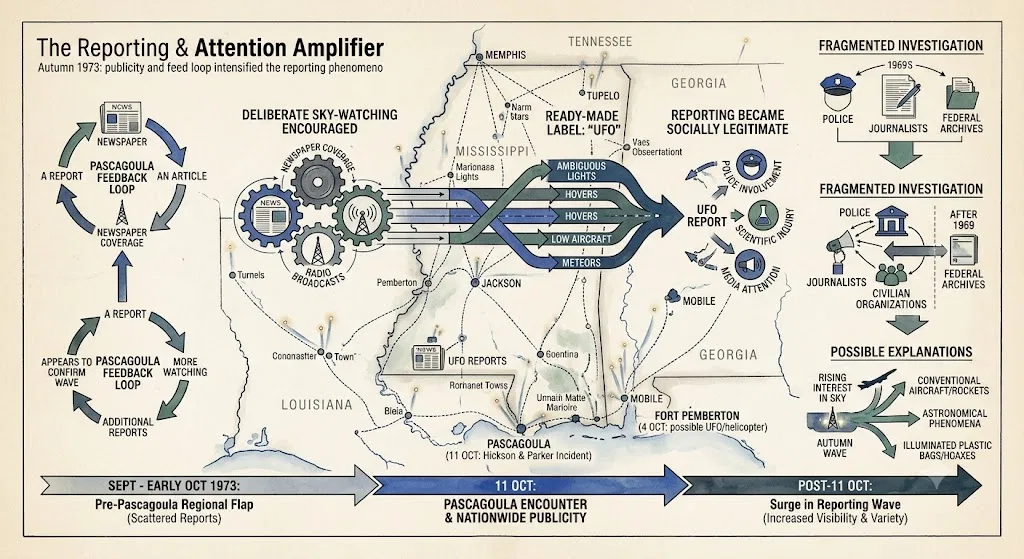
The autumn wave was already under way before Hickson and Parker entered the Jackson County Sheriff’s Office. Contemporary Mississippi newspaper references include reports from the south-eastern United States by 10 September, a possible UFO or helicopter near Fort Pemberton on 4 October, and a Mississippi Press story about a deputy confronting an unidentified object on 7 October. Reports in Tennessee, Georgia and other nearby states were also appearing during this period.[Wikipedia]WikipediaPascagoula incidentPascagoula incident
This earlier activity is important because it rules out the simplest version of the publicity explanation: Pascagoula did not invent the entire wave. Mississippi was already participating in a broader concentration of reports across the South and Midwest. Later compilations describe autumn 1973 as one of the largest American UFO waves, with hundreds of reports reaching police departments and news organisations and particularly heavy activity in the South-east.[Center for UFO Studies]cufos.org55 took place in the continental United StatesCenter for UFO Studies[PDF] 1973 – Year of the Humanoids - Center for UFO Studies -May 3, 1976 — The fall of 1973 saw one of the largest…
Pascagoula nevertheless changed the scale of attention. At about 8 p.m. on 11 October, before Hickson and Parker made their report, a local service-station operator reportedly telephoned the sheriff after seeing a strange craft or light pass overhead. Later that evening, the two fishermen told officers that a luminous oval object had appeared beside the Pascagoula River and that beings had taken them aboard. The Mississippi Press published the story on 12 October, and the Associated Press and United Press International distributed it far beyond the Gulf Coast.[Wikipedia]WikipediaPascagoula incidentPascagoula incident
The result was an unusually strong feedback loop. Pascagoula combined named witnesses, police involvement, a dramatic close encounter and immediate national distribution. Reports of distant lights no longer appeared as isolated curiosities: they could be framed as possible evidence that the phenomenon described by Hickson and Parker was still present. By 17 October, newspapers were explicitly discussing additional sightings following the case’s nationwide publicity.[Wikipedia]WikipediaPascagoula incidentPascagoula incident
The wave also widened geographically. Reports associated with the same news cycle appeared across Mississippi and in Louisiana, Alabama, Tennessee, Georgia, Ohio and other states. The national pattern does not establish that these observations shared a physical cause. It shows that Pascagoula became one of several highly publicised incidents around which the autumn’s scattered reports were organised.[citybeat.com]citybeat.comspace invaders 1218405431 finally arrived in 1973, the UFO fever began to cool. Police phones weren't ringing off the hook. Stories of glowing disks skimming…
How publicity changed what people noticed
Publicity can increase UFO reports without requiring witnesses to lie. Most people normally ignore a distant moving light, assuming it is an aircraft, star or something too unimportant to pursue. When newspapers repeatedly announce mysterious objects, the threshold for noticing and reporting the same light becomes much lower.
Three overlapping effects probably operated in Mississippi.
More people deliberately watched the sky. Newspaper coverage encouraged residents to step outdoors, compare observations with neighbours and interpret unfamiliar lights as potentially significant. A larger observing population will produce more reports even if the actual number of aircraft, meteors, satellites and atmospheric effects remains unchanged.
Ambiguous sights acquired a ready-made label. Once “UFO” became the obvious public category, witnesses did not need to identify an object before contacting police or a newspaper. Different observations—steady lights, flashing lights, low aircraft and objects apparently hovering—could be collected under one heading despite having little else in common.
Reporting became socially legitimate. Pascagoula placed sheriff’s officers, military doctors, scientists and national reporters around an extraordinary claim. That attention signalled that seeing something unusual was worth mentioning. People who would previously have kept quiet for fear of ridicule may have felt able to report an earlier or recent observation.
The process was intensified by the way newspapers covered each new claim. A report generated an article; the article encouraged more watching; increased watching produced additional reports; and those reports appeared to confirm that a wave was in progress. This does not mean every observation was imagined. It means the volume of reports cannot be treated as a direct count of unusual objects.
Contemporary events elsewhere show how easily a flap could absorb mundane or artificial causes. During the October wave, police in Indiana investigated reported UFOs and found illuminated plastic bags suspended over wooden supports, apparently launched as pranks. In Ohio, police departments received large numbers of calls before reporting declined as explanations circulated and public excitement faded.[old.straipsniai.lt]old.straipsniai.ltOpen source on straipsniai.lt.
Mississippi newspapers likewise published possible conventional explanations. A 17 October Mississippi Press article suggested that rockets might account for some reports. Other sightings were described uncertainly even in their original headlines: the Fort Pemberton object, for example, was framed as either a UFO or a helicopter. Such wording preserves the ambiguity that later retellings often lose.[Wikipedia]WikipediaPascagoula incidentPascagoula incident
Did one event link the sightings?
There is no strong evidence that a single aircraft, astronomical event or unknown craft connected the Mississippi reports. The reported objects varied too widely in timing, location, behaviour and description. Some were coloured or flashing lights; others were described as hovering shapes, low-flying objects or possible helicopters. Pascagoula itself involved a detailed claim of an object on or near the ground, alleged occupants and missing control over the witnesses’ bodies—features absent from most reports in the wave.
A genuine common cause would normally leave more consistent evidence. Investigators would want observations made at the same time from separate locations, bearings that could be triangulated, radar records, photographs with reliable provenance, identifiable flight paths or physical traces. The surviving Mississippi wave record consists largely of newspaper summaries and individual testimony. Those materials are valuable for reconstructing what people reported, but they seldom contain enough measurements to determine whether two witnesses were observing the same thing.
Even reports made on the same night cannot automatically be linked to Hickson and Parker’s claim. The service-station operator’s earlier call on 11 October is potentially relevant because it was reportedly made before the fishermen arrived at the sheriff’s office. Yet a coloured or blinking light passing overhead is not a close match for the oval object and beings described beside the river. It offers some evidence that another person noticed something unusual in the area, but it does not independently verify the alleged abduction.[Wikipedia]WikipediaPascagoula incidentPascagoula incident
The wider national context weakens the case for a uniquely Mississippi source. Major reports were arriving from several states, including the well-known 18 October encounter between an Army Reserve helicopter and an unidentified light near Mansfield, Ohio. The geographical spread is more consistent with a national reporting wave containing many separate events than with one object moving through a single coherent route.[Richland Source]richlandsource.comRichland SourceCoyne Incident over Charles Mill Lake was most credible UFO…According to the Center for UFO Studies, the Coyne Incident…
Why investigation was so fragmented
By 1973, the United States no longer had the public Air Force reporting system that had handled earlier waves. Project Blue Book had closed on 17 December 1969, and the Air Force states that its former personnel no longer received, documented or investigated civilian UFO reports. The National Archives accordingly holds Blue Book material only through 1969, not a federal case file covering the Mississippi wave.[National Archives]archives.govNational Archives Project BLUE BOOKNational Archives Project BLUE BOOK
That left the 1973 reports to a patchwork of local police officers, journalists and civilian UFO organisations. In Pascagoula, sheriff’s officers questioned Hickson and Parker and secretly recorded them while they were alone. The men were examined at Keesler Air Force Base, but the examination reportedly found no harmful radiation exposure and did not establish the presence of an unusual craft. Civilian investigators J. Allen Hynek and James Harder interviewed them, while newspapers pursued witnesses and possible explanations.[Wikipedia]WikipediaPascagoula incidentPascagoula incident
This arrangement produced abundant publicity but uneven evidence. Police were equipped to assess possible crime, intoxication or deception, not to reconstruct aerial trajectories. Journalists worked under daily deadlines and often condensed uncertain observations into striking headlines. Civilian investigators brought experience with UFO testimony but lacked authority to obtain every military, aviation or radar record. Reports from elsewhere in Mississippi were therefore rarely examined according to one standard.
The absence of a central investigation also affected how the wave was remembered. Pascagoula generated names, recordings, interviews and a continuing narrative. Most surrounding reports survived only as brief newspaper items. This imbalance can make the famous encounter seem like the centre of a tightly connected chain when the historical record actually shows a dramatic case surrounded by loosely documented observations.
Did later reporting strengthen the wave?
Later testimony has added possible witnesses to the Pascagoula story, but it has not converted the broader wave into a verified sequence of connected events. In 2019, WLOX reported that a woman had come forward saying she and others saw an unusual object from the opposite side of the river on the night of the encounter. Such testimony is potentially relevant because the claimed position and date overlap with the original report. Its value is limited, however, by the long interval before public disclosure and the absence of a contemporaneous statement that investigators could compare with records from 1973.[https://www.wlox.com]wlox.compascagoula ufo new witness comes forwardpascagoula ufo new witness comes forward
Later accounts can preserve genuine memories, but they are also exposed to decades of media coverage, anniversary stories and repeated versions of the case. They should therefore be weighed differently from the 11 October police report, the secret recording and newspaper items published before the story became established folklore.
The broader reporting wave has gained little comparable support. No recovered object, conclusive photograph, coordinated radar record or comprehensive set of official files has emerged to demonstrate that Mississippi was visited by one extraordinary craft or formation. Nor has every report been conclusively explained. The historical position remains mixed: some observations were probably aircraft, rockets, astronomical objects or pranks; some are too poorly recorded to assess; and a smaller group remains unexplained because the necessary information was never collected.
What the 1973 flap means for Mississippi
The Mississippi wave is best understood as an interaction between unusual observations and an unusual information environment. Reports were circulating before Pascagoula, so the underlying regional flap was real in the limited sense that many people genuinely contacted authorities and newspapers about things they could not identify. Pascagoula then supplied the wave with a powerful narrative, dramatically increasing attention and making subsequent reports more likely to be noticed, interpreted and published.
That distinction prevents two opposite mistakes. It is too dismissive to say that publicity proves every witness imagined or fabricated an observation. It is equally misleading to treat a rise in reports as independent confirmation of Hickson and Parker’s account. Once the case became national news, later sightings were no longer statistically or culturally independent of it.
Within Mississippi’s UFO history, 1973 therefore matters less as proof of a statewide visitation than as the clearest example of how a flap forms. A few reports preceded the landmark incident; one extraordinary story captured the media; public vigilance intensified; ambiguous lights accumulated around the story; and the wave subsided without producing decisive physical evidence. Pascagoula remains unresolved as a witness claim, while the wider Mississippi wave remains a mixture of plausible misidentifications, weakly documented reports and a limited number of observations that cannot now be reconstructed.
Amazon book picks
Further Reading
Books and field guides related to Why Did UFO Reports Surge in 1973?. Use these as the next step if you want deeper reading beyond the article.
The UFO Experience: A Scientific Inquiry
Places the 1973 flap within broader UFO investigation.
UFOs: Generals, Pilots, and Government Officials Go on the Re...
Provides context for significant historical UFO reports.
Pascagoula – The Closest Encounter: My Story
Describes the famous Mississippi incident at the center of the 1973 wave.
eBay marketplace picks
Marketplace Samples
Live-tested eBay searches with available results related to this page.
Selected fromUFO poster oneBay.co.uk.

Endnotes
1.
Source: Wikipedia
Title: Pascagoula incident
Link:https://en.wikipedia.org/wiki/Pascagoula_incident
2.
Source: newspapers.com
Link:https://www.newspapers.com/article/the-greenwood-commonwealth-pascagoula-fi/10694220/
Source snippet
ishermen Thursday night, took them aboard and then released them unharmed...
3.
Source: citybeat.com
Title: space invaders 12184054
Link:https://www.citybeat.com/news/space-invaders-12184054/
Source snippet
31 finally arrived in 1973, the UFO fever began to cool. Police phones weren't ringing off the hook. Stories of glowing disks skimming...
4.
Source: old.straipsniai.lt
Link:https://www.old.straipsniai.lt/en/UFO/page/6654
5.
Source: archives.gov
Title: National Archives Project BLUE BOOK
Link:https://www.archives.gov/research/military/air-force/ufos
6.
Source: wlox.com
Title: pascagoula ufo new witness comes forward
Link:https://www.wlox.com/2019/03/15/pascagoula-ufo-new-witness-comes-forward/
7.
Source: news.sky.com
Title: ufo abductee still haunted 40 years on 10431808
Link:https://news.sky.com/story/ufo-abductee-still-haunted-40-years-on-10431808
8.
Source: Wikipedia
Title: Rapimento alieno di Pascagoula
Link:https://it.wikipedia.org/wiki/Rapimento_alieno_di_Pascagoula
9.
Source: Wikipedia
Title: Project Blue Book
Link:https://en.wikipedia.org/wiki/Project_Blue_Book
10.
Source: Wikipedia
Title: List of reported UFO sightings
Link:https://en.wikipedia.org/wiki/List_of_reported_UFO_sightings
11.
Source: wlox.com
Title: calvin parker who claimed he was abducted by aliens pascagoula 1973 has died
Link:https://www.wlox.com/2023/09/02/calvin-parker-who-claimed-he-was-abducted-by-aliens-pascagoula-1973-has-died/
12.
Source: wlox.com
Title: pascagoula holds viewing party netflix documentary 1973 ufo sighting
Link:https://www.wlox.com/2024/04/20/pascagoula-holds-viewing-party-netflix-documentary-1973-ufo-sighting/
13.
Source: time.com
Title: science the ufo clans gather
Link:https://time.com/archive/6847378/science-the-ufo-clans-gather/
14.
Source: cufos.org
Title: 55 took place in the continental United States
Link:https://cufos.org/PDFs/books/1973-Year_of_the_Humanoids.pdf
Source snippet
Center for UFO Studies[PDF] 1973 – Year of the Humanoids - Center for UFO Studies -May 3, 1976 — The fall of 1973 saw one of the largest...
Published: May 3, 1976
15.
Source: richlandsource.com
Link:https://www.richlandsource.com/2020/10/04/coyne-incident-over-charles-mill-lake-was-most-credible-ufo-sighting-of-1973/
Source snippet
Richland SourceCoyne Incident over Charles Mill Lake was most credible UFO...According to the Center for UFO Studies, the Coyne Incident...
16.
Source: facebook.com
Link:https://www.facebook.com/mscoastnha/posts/on-the-night-of-october-11-1973-charles-hickson-and-calvin-parker-were-fishing-o/1116652410584620/
17.
Source: youtube.com
Link:https://www.youtube.com/watch?v=_ldhiji54-s
Additional References
18.
Source: youtube.com
Link:https://www.youtube.com/watch?v=99telRuTBg0
Source snippet
"The UFO abduction I believe... Pascagoula 1973 | SOUTHVESTIGATIONS[https://www.youtube.com/watch?v=_ldhiji54-s..."](https://www.youtube.com/watch?v=_ldhiji54-s...")...
19.
Source: aquila.usm.edu
Link:https://aquila.usm.edu/cgi/viewcontent.cgi?article=1985&context=honors_theses
Source snippet
Aquila Digital CommunityMedia Coverage of the 1973 Pascagoula Alien Abductionby J Fort · 2024 — Fort, Jane, "“UFO Reports Swamp Mississip...
20.
Source: youtube.com
Title: Beyond Reasonable Doubt: The Pascagoula Alien Abduction
Link:https://www.youtube.com/watch?v=YOQ6k4WuhH4
Source snippet
Calvin Parker's alien abduction: 'I saw the blue lights reflected across the water'...
21.
Source: nsa.gov
Link:https://www.nsa.gov/portals/75/documents/news-features/declassified-documents/ufo/usaf_fact_sheet_95_03.pdf
22.
Source: researchgate.net
Link:https://www.researchgate.net/publication/376891986_A_global_picture_of_unidentified_anomalous_phenomena_Towards_a_cross-cultural_understanding_of_a_potentially_universal_issue
23.
Source: archivesfoundation.org
Link:https://archivesfoundation.org/documents/50-years-ago-government-stops-investigating-ufos/
24.
Source: af.mil
Link:https://www.af.mil/About-Us/Fact-Sheets/Display/Article/104590/unidentified-flying-objects-and-air-force-project-blue-book/
25.
Source: facebook.com
Link:https://www.facebook.com/mscoastnha/posts/as-we-close-the-anniversary-of-the-pascagoula-ufo-experience-i-thought-i-would-s/1117142080535653/
26.
Source: facebook.com
Link:https://www.facebook.com/HISTORY/posts/during-the-cold-war-as-project-blue-book-investigated-potential-ufo-threats-a-sh/1473622884330683/
27.
Source: instagram.com
Link:https://www.instagram.com/reel/DYKWi5NoMHc/?hl=en