Within Hynek and Archives
What Hynek's Case Files Really Reveal
Hynek's surviving files show how witness reports could strengthen, weaken or remain unresolved as investigators added interviews, maps and calculations.
On this page
- From first witness letter to final case label
- Which details strengthened or weakened a report
- Why missing measurements often prevented firm conclusions
Page outline Jump by section
Introduction
The most revealing part of J. Allen Hynek’s legacy in Illinois is not a single famous sighting but the paper trail left behind by hundreds of investigations. Hynek’s surviving files, preserved through Northwestern University collections and later archival efforts associated with the Center for UFO Studies (CUFOS), show that UFO reports were rarely static stories. A case might begin as a dramatic witness account, gain credibility through additional interviews or independent observations, or weaken when investigators discovered inconsistencies, astronomical explanations or missing data. The files demonstrate that “unidentified” was often a temporary status rather than a final verdict. They also reveal why some reports remained unresolved: not because investigators proved something extraordinary had occurred, but because crucial evidence was never collected.[findingaids.library.northwestern.edu]findingaids.library.northwestern.eduCollection: JAllen Hynek (1910-1986) PapersThe papers include biographical materials, clippings, reports relating to Hynek's work on Project Stargazer…

Within Illinois UFO history, these records matter because they document a shift from headline-driven speculation to evidence-based case assessment. Rather than treating every sighting as equally persuasive, Hynek increasingly focused on how reports changed when subjected to systematic investigation.[Wikipedia]WikipediaJ. Allen HynekJ. Allen Hynek
From First Witness Letter to Final Case Label
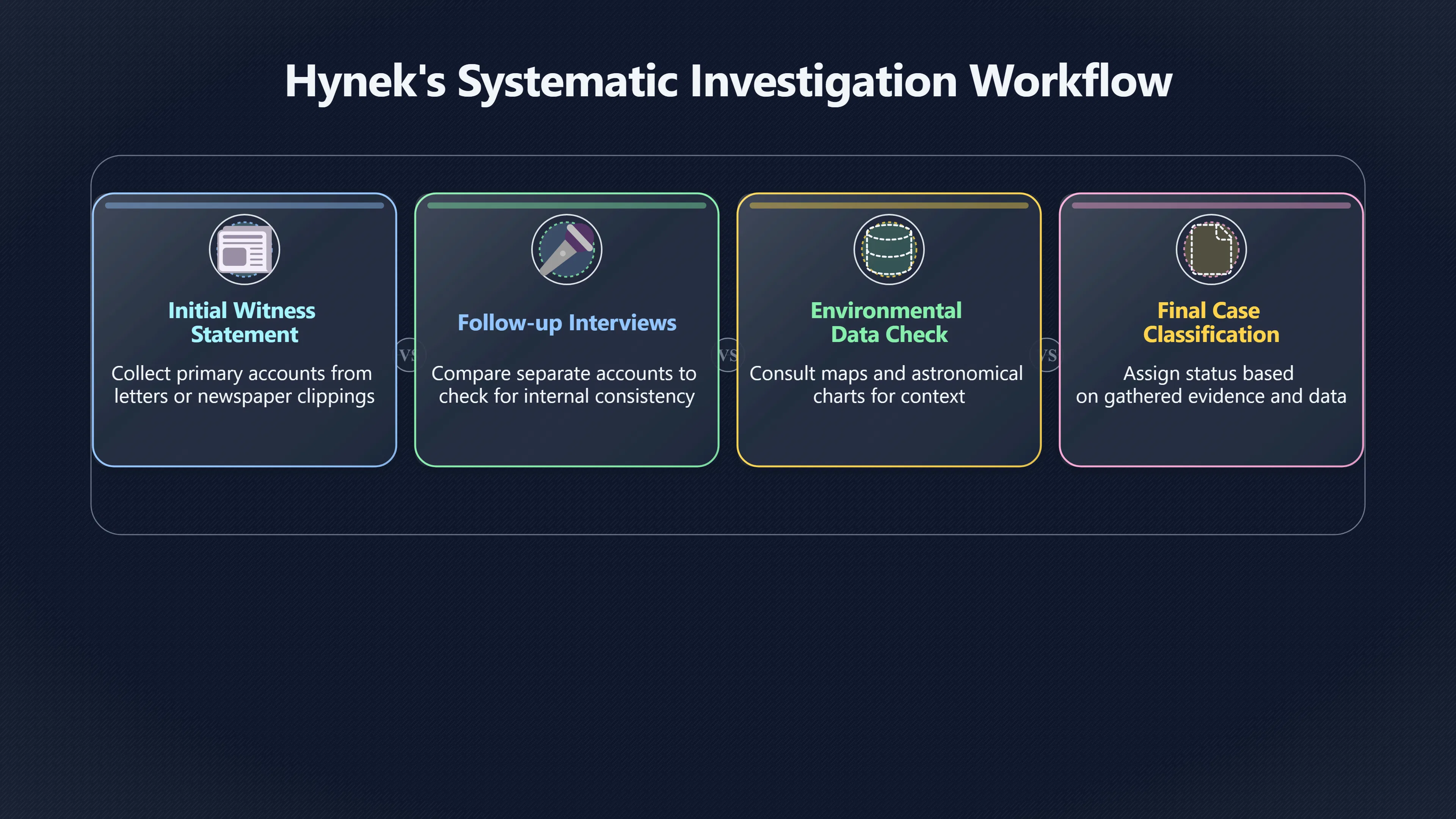
Hynek’s files show a recurring investigative pattern. A report usually began with a witness statement, newspaper clipping or letter. Investigators then attempted to gather supporting details such as time, location, weather conditions, flight activity, astronomical data and additional witnesses. Only after that process could a case be classified.[Wikipedia]WikipediaJ. Allen HynekJ. Allen Hynek
The most important lesson from these files is that the original account often changed substantially during follow-up.
A typical progression looked like this:
- Initial report: A witness described an unusual object, light or aerial movement.
- Follow-up interviews: Investigators compared separate witness accounts and checked for consistency.
- Environmental checks: Maps, astronomical charts, radar information or aviation records were consulted when available.

- Assessment: The report might be identified, remain unresolved or be judged too incomplete for firm conclusions. Defense Logistics Agency
Hynek became increasingly frustrated with investigations that stopped after the first step. In later writings and correspondence, he criticised approaches that rushed to explanations before sufficient evidence had been collected. He argued that a report could not be evaluated properly without detailed field investigation and careful documentation. Wikipedia
Which Details Strengthened a Report?
The files reveal that investigators looked for specific forms of corroboration rather than dramatic storytelling.
Reports generally became stronger when they included:
- Multiple independent witnesses describing similar events.
- Precise times and locations.
- Sketches, maps or measurements made close to the event.
- Observations from trained observers such as pilots, police officers or military personnel.
- Evidence allowing comparison with aircraft routes, astronomical objects or weather conditions. Wikipedia
Hynek did not treat witness status as proof. However, he believed that cases involving experienced observers deserved closer attention because they sometimes provided more precise descriptions and estimates. His interest in cases such as police observations and pilot reports reflected this emphasis on observational quality rather than celebrity or publicity value. Wikipedia
Another factor that strengthened a file was documentation gathered quickly. Memories change over time. Reports investigated within days often contained more useful information than accounts reconstructed months later. The case files repeatedly illustrate how delays reduced evidential value even when witnesses appeared sincere. Wikipedia
How Reports Became Weaker During Investigation
Just as important are the cases that lost strength.
Many reports initially appeared impressive because witnesses interpreted what they saw as nearby, structured or intelligently controlled. Later investigation sometimes suggested a different picture. Distance estimates proved uncertain, apparent manoeuvres resulted from perspective effects, and unusual lights matched known astronomical or aviation sources. Wikipedia
Hynek’s years working with Project Sign, Project Grudge and Project Blue Book exposed him to numerous examples where confident eyewitness descriptions did not survive detailed checking. This experience made him wary of both automatic dismissal and automatic belief. Wikipedia
Several recurring problems appear throughout the broader case record:
- Witnesses disagreed on timing.
- Object size estimates changed between interviews.
- Directions of travel could not be reconciled.
- No independent witnesses could be located.
- Weather, aircraft or astronomical explanations matched key details.
- Newspaper accounts exaggerated what witnesses had originally reported. Wikipedia
These patterns help explain why Hynek’s archives are valuable. They preserve not only successful investigations but also the gradual erosion of apparently strong claims.
Why Missing Measurements Often Prevented Firm Conclusions
One of the clearest themes in Hynek’s files is the importance of missing information.
Many reports could not be identified, but neither could they be treated as evidence of something extraordinary. They simply lacked enough data. This problem became formalised in official UFO classifications, which distinguished between identified cases, insufficient-data cases and genuinely unidentified cases. Defense Logistics Agency
The missing elements were often basic:
- Exact observation times.
- Angular position in the sky.
- Duration estimates.
- Photographs with known camera settings.
- Independent measurements from separate locations.
- Physical traces collected under controlled conditions. Defense Logistics Agency
Hynek repeatedly argued that better field procedures could improve future investigations. He wanted more systematic collection of measurements, photographs and environmental data rather than reliance on memory alone. His frustration was that many reports arrived after the opportunity to gather such evidence had already passed. Wikipedia
The consequence was that a significant number of files remained suspended between explanation and mystery. They were not solved, but they were not strong enough to support extraordinary conclusions either.
What the Illinois Archives Reveal About Changing UFO Interpretation
The Illinois collections connected with Hynek and later CUFOS show an important change in how UFO reports were interpreted over time. Early public discussions often treated a sighting as a single event with a single explanation. The files reveal a more complicated reality. A report could evolve as new witnesses emerged, as maps were examined, as calculations were performed or as contradictions appeared. findingaids.library.northwestern.edu
This gradual evolution helps explain Hynek’s own intellectual journey. He began as a sceptical consultant whose role was often to identify conventional explanations. Later he argued that a small minority of cases appeared worthy of deeper scientific attention. Yet even then, he did not claim that unresolved cases automatically demonstrated extraterrestrial visitors. Instead, he emphasised careful classification, better evidence collection and a willingness to leave some questions unanswered when the data were inadequate. Wikipedia
For readers exploring Illinois UFO history, the most important lesson from these archives is methodological rather than sensational. The files show that UFO claims often changed significantly after investigation. Some became more convincing, some collapsed under scrutiny, and many remained unresolved because crucial measurements were never obtained. The enduring value of Hynek’s case files lies in documenting that process. They reveal how evidence, not initial excitement, ultimately determined the strength of a claim. findingaids.library.northwestern.edu+2findingaids.library.northwestern.edu
Amazon book picks
Further Reading
Books and field guides related to What Hynek's Case Files Really Reveal. Use these as the next step if you want deeper reading beyond the article.
The UFO Experience: A Scientific Inquiry
Explains investigative methods and evidential standards.
The Report on Unidentified Flying Objects
Shows how official UFO cases were documented and reviewed.
eBay marketplace picks
Marketplace Samples
Live-tested eBay searches with available results related to this page.
Selected fromUFO poster oneBay.co.uk.


Endnotes
1.
Source: findingaids.library.northwestern.edu
Title: Collection: J
Link:https://findingaids.library.northwestern.edu/repositories/6/resources/373/collection_organization
Source snippet
Allen Hynek (1910-1986) PapersThe papers include biographical materials, clippings, reports relating to Hynek's work on Project Stargazer...
2.
Source: findingaids.library.northwestern.edu
Link:https://findingaids.library.northwestern.edu/repositories/6/resources/373
Source snippet
northwestern.eduJ. Allen Hynek (1910-1986) PapersThe papers include biographical materials, clippings, reports relating to Hynek's work o...
3.
Source: cufos.org
Link:https://cufos.org/
4.
Source: Wikipedia
Title: J. Allen Hynek
Link:https://en.wikipedia.org/wiki/J._Allen_Hynek
5.
Source: Wikipedia
Title: Project Blue Book
Link:https://en.wikipedia.org/wiki/Project_Blue_Book
6.
Source: findingaids.library.northwestern.edu
Link:https://findingaids.library.northwestern.edu/agents/people/1473
Source snippet
Allen (Joseph Allen), 1910-1986Allen Hynek led Northwestern's Astronomy Department into the Space Age and became the nation's foremost ex...
7.
Source: findingaids.library.northwestern.edu
Link:https://findingaids.library.northwestern.edu/agents/people/1473?filter_fields%5B%5D=subjects&filter_values%5B%5D=Artificial+satellites–Tracking
8.
Source: findingaids.library.northwestern.edu
Title: archival objects
Link:https://findingaids.library.northwestern.edu/repositories/6/archival_objects/78674
9.
Source: dc.library.northwestern.edu
Link:https://dc.library.northwestern.edu/items/0a312c99-59b7-4bec-9cfa-329dc3337d84
10.
Source: findingaids.library.northwestern.edu
Title: archival objects
Link:https://findingaids.library.northwestern.edu/repositories/6/archival_objects/78747
11.
Source: Wikipedia
Title: Close encounter
Link:https://en.wikipedia.org/wiki/Close_encounter
12.
Source: unwritten-record.blogs.archives.gov
Title: aliens at the archives
Link:https://unwritten-record.blogs.archives.gov/2017/04/26/aliens-at-the-archives/
13.
Source: archives.gov
Title: Project BLUE BOOK
Link:https://www.archives.gov/research/military/air-force/ufos
14.
Source: history.com
Title: j allen hynek ufos project blue book
Link:https://www.history.com/articles/j-allen-hynek-ufos-project-blue-book
16.
Source: library.osu.edu
Link:https://library.osu.edu/site/archives/2012/11/
Additional References
17.
Source: wired.com
Link:https://www.wired.com/story/jacques-vallee-still-doesnt-know-what-ufos-are
Source snippet
Despite his extensive research, Vallée maintains that he does not know what UFOs truly are but believes the answer lies beyond simplistic...
18.
Source: cia.gov
Link:https://www.cia.gov/readingroom/docs/CIA-RDP81R00560R000100060001-5.pdf
19.
Source: youtube.com
Link:https://www.youtube.com/watch?v=0I47_FAUhGE
Source snippet
First Ever UFO Database Reveals Strange Pattern...
20.
Source: youtube.com
Title: Did the Air Force obstruct Roswell and UAP investigations?
Link:https://www.youtube.com/watch?v=UVr9q1ShoVU
Source snippet
This Man Sparked Spielberg's Interest in UFOs...
21.
Source: youtube.com
Title: The Center For UFO Studies with Mark Rodeghier
Link:https://www.youtube.com/watch?v=I_QwQVDzpwI
Source snippet
Did the Air Force obstruct Roswell and UAP investigations?...
22.
Source: reddit.com
Link:https://www.reddit.com/r/space/comments/ivsmf/dr_j_allen_hynek_astronomer_and_chief/
23.
Source: archive.org
Link:https://archive.org/stream/TheHynekUFOReport/The_Hynek_UFO_Report_djvu.txt
24.
Source: enigmalabs.io
Link:https://enigmalabs.io/library/6483dd0f-9d12-41fa-842b-c064d636c3bb
25.
Source: reddit.com
Link:https://www.reddit.com/r/UFOs/comments/161dq7p/images_from_j_allen_hyneks_personal_collection_of/
26.
Source: facebook.com
Link:https://www.facebook.com/groups/12117541695/posts/10160259707551696/