Within West Virginia
Could Birds Explain West Virginia's Strangest Sightings?
Owls, cranes and other large birds offer plausible explanations for several famous reports, especially under poor night-time viewing conditions.
On this page
- Why owls can appear humanoid at night
- The sandhill crane and heron proposals
- Where bird explanations fit and where they do not
Page outline Jump by section
Introduction
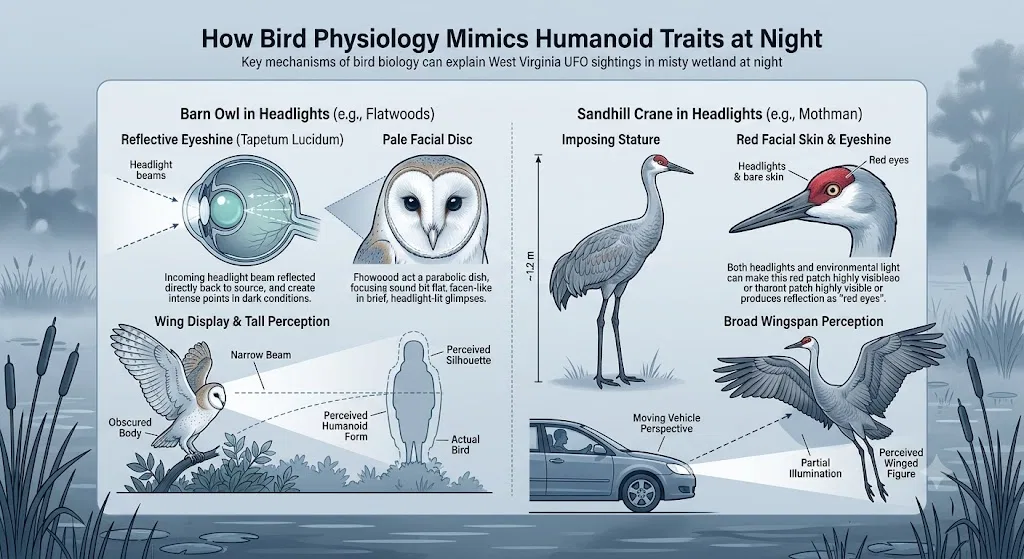
Bird misidentification offers a plausible explanation for some of West Virginia’s strangest encounter stories, particularly the Flatwoods Monster report of 1952 and parts of the Mothman wave around Point Pleasant in 1966–67. Owls can present pale, face-like discs and intensely reflective eyes; cranes and herons can stand roughly human-high, unfold unexpectedly broad wings and appear almost headless when their necks are held at certain angles. Brief sightings through headlights, vegetation or darkness make these features easier to misread.
That does not mean every witness saw the same species, or that identifying a possible bird settles every detail. The surviving reports vary, some were recorded only after publicity had begun, and exact distances and viewing conditions are often uncertain. Bird explanations are strongest when they match the location, behaviour and original description of a particular sighting—not when “it was a bird” is used as a blanket dismissal.

Why owls can appear humanoid at night
An owl seen clearly in daylight is unlikely to be mistaken for a towering humanoid. At night, however, observers may see only a pale face, two reflective points, a broad outline and sudden wing movement. Distance is difficult to judge without familiar reference objects, while a bird perched above shrubs can be unconsciously combined with the vegetation beneath it. The result may appear far taller than the animal itself.
Barn owls are especially relevant to the Flatwoods story. They have a white, heart-shaped facial disc, dark eyes and pale underparts that can look almost completely white at night. Although their bodies are only about 32–40 centimetres long, their wingspans can exceed a metre. They also roost in trees, abandoned buildings and other sheltered places, making their presence near rural farms entirely ordinary even when the observer does not recognise them. West Virginia’s official bird checklist records barn owls in the state throughout the year, although as a rare species.[All About Birds]allaboutbirds.orgOpen source on allaboutbirds.org.
The Flatwoods encounter began after witnesses saw a bright object cross the sky on 12 September 1952 and then went towards a nearby hillside. There they reported a tall figure with a round or glowing face, eye-like shapes and a pointed, hood-like outline. Sceptical investigator Joe Nickell proposed that the aerial light was a meteor, a flashing red beacon contributed another unusual light, and the supposed creature was a startled barn owl perched in a tree. Under this interpretation, the owl’s face became the reported “head”, its wings or surrounding foliage formed the hood, and vegetation below produced the impression of a long, skirt-like body.[Wikipedia]WikipediaFlatwoods monsterFlatwoods monster
This explanation is persuasive because it separates two observations that frightened witnesses understandably joined together. Seeing a meteor apparently descend beyond a ridge created an expectation that something had landed. Minutes later, an unfamiliar pale animal caught in a torch beam could therefore be interpreted not simply as wildlife but as the occupant of the object. The owl proposal does not require the witnesses to have invented their experience; it argues that fear, expectation and an ambiguous view changed how a real animal was perceived.
There are still imperfect fits. The figure was reported as much larger than a barn owl, and retellings include details such as claw-like hands, gliding movement and an unpleasant smell. Yet size estimates made in darkness are particularly fragile, while talons, wing edges and branches can produce claw-like forms. The reported smell is not evidence for an owl, but neither does it establish an extraordinary creature; the group was in a damp rural setting and some physical symptoms were described after an intensely stressful encounter. The bird hypothesis explains the figure’s central visual features better than it explains every later detail.
Barred owls are more often proposed for Mothman. They are stocky, round-headed woodland birds with wingspans of roughly one metre and very dark eyes. West Virginia lists them as fairly common in every season, so no wandering exotic species is needed to place one near Point Pleasant. Their physical size is much smaller than the reported six- or seven-foot creature, but their silhouette becomes harder to interpret when perched above eye level or launching towards an observer.[All About Birds]allaboutbirds.orgOpen source on allaboutbirds.org.
The strongest owl-related feature in the Mothman accounts is eyeshine. An animal’s eyes can reflect a vehicle’s headlights or a hand-held light back towards the observer, producing conspicuous glowing points even when the rest of its body remains indistinct. Audubon notes that barred owls can show extreme eyeshine when illuminated, offering a straightforward mechanism for the famous red-eye descriptions. The first major Point Pleasant encounter also occurred at night beside an overgrown former munitions complex, with the witnesses viewing the figure largely in car headlights while frightened and in motion.[Audubon]audubon.orgIs the Mothman of West Virginia an Owl? | AudubonIs the Mothman of West Virginia an Owl? | Audubon…
The phrase “red eyes” therefore does not necessarily mean that the animal generated light. The colour perceived in reflected eyes can vary with angle, light source, distance and the observer’s own visual adaptation. Once the glowing eyes became the defining feature in newspaper coverage, later witnesses also knew what they were expected to notice.
The sandhill crane and heron proposals
The sandhill crane became the best-known natural explanation for Mothman soon after the reports began. It is easy to see why. A sandhill crane stands about 1.2 metres tall and has a wingspan of around two metres. Adults are grey, with long dark legs and a patch of exposed red skin on the crown. A person encountering one unexpectedly beside a dark road could reasonably describe it as a very large bird with reddish colouring near its eyes.[All About Birds]allaboutbirds.orgOpen source on allaboutbirds.org.
The crane theory also addresses a weakness in the owl explanation: reported height. A crane standing upright is already large before fear or faulty distance estimation exaggerates it. When it opens its wings, its apparent scale changes abruptly. Long legs beneath a dark body can suggest a man-like stance, while the narrow head and neck may become invisible against trees or a night sky.
However, sandhill cranes are not an ideal universal answer. West Virginia’s Division of Natural Resources classifies them as rare in the state in every season, whereas great blue herons are fairly common throughout the year. This does not rule out an unusual crane near Point Pleasant—the species does wander and migrate—but it makes repeated crane encounters less economical than explanations involving more familiar local birds.[wvdnr.gov]wvdnr.govBirds of WV FINAL 113022Birds of WV FINAL 113022
A later reassessment by Daniel A. Reed challenged the routine use of sandhill cranes by examining their migration geography and the characteristics of Mothman reports. Reed concluded that the principal crane migration routes lay at significant distances from West Virginia. He argued that great blue herons may be a better candidate for some encounters in which shining eyes were not reported, because herons were substantially more likely to be present locally.[Skeptical Inquirer]skepticalinquirer.orgSkeptical InquirerThe Mothman and the Crane: A Contemporary PerspectiveThis study showed the distance of the migratory routes of the sand…
Herons fit the Point Pleasant landscape particularly well. The TNT area contained ponds, wetlands, woods and abandoned structures, while the nearby Ohio and Kanawha rivers support large waterbirds. A great blue heron has a long neck and legs, a broad wingspan and a slow, heavy take-off. When resting, it can draw its neck tightly against its body, making its head difficult to distinguish and creating the impression of a bulky, nearly headless shape.
There are nevertheless mismatches. Herons normally fly with slow, recognisable wingbeats rather than closely pursuing cars, and neither herons nor cranes naturally account for every report of bright eyes. Conversely, an owl fits eyeshine and nocturnal woodland behaviour but not the claimed height. This suggests that the Point Pleasant wave should not be treated as a single zoological observation requiring one species. Different reports may have involved owls, herons, other birds, ordinary objects, heightened expectation or—in some cases—insufficient information for any confident identification.
That mixed explanation is consistent with the character of the flap. West Virginia Encyclopedia records 26 reported Mothman sightings over approximately a year, centred on the Point Pleasant area and especially the former TNT plant. Once the first encounters were publicised, witnesses were not observing in a neutral setting: the district had acquired a reputation as the home of a large red-eyed creature.[West Virginia Encyclopedia]wvencyclopedia.orgWest Virginia Encyclopediae-WVWest Virginia Encyclopediae-WV
Why headlights and movement distort what people see
The most memorable West Virginia reports took place under conditions that are poor for accurate wildlife identification. Vehicle headlights illuminate a narrow cone and often reveal an animal in fragments: eyes first, then part of a wing or body. Objects outside the beam disappear, while shadows from branches and weeds can seem attached to the animal.
A moving vehicle adds further problems. The observer has only seconds to estimate distance, speed and size, often through a windscreen and while watching the road. A bird taking off as a car approaches can remain within the headlight beam for several moments, giving the impression that it is following or matching the vehicle. Changes in the road’s direction can make a bird travelling independently appear to maintain pursuit.
Stress also affects interpretation. The first witnesses at both Flatwoods and Point Pleasant believed they had encountered something dangerous and unfamiliar. Once alarm begins, attention narrows towards threatening features such as eyes, claws or wings. Details may be accurately remembered in isolation yet incorrectly assembled into a single body. A face-like owl disc above leaves, for example, may be recalled as the head of a creature whose “torso” was actually undergrowth.
Later illustrations can then reverse the process. Instead of drawings merely preserving what witnesses saw, a widely circulated image may become the mental template through which later accounts are remembered and compared. West Virginia’s best-known creatures now have stable visual forms—the hooded Flatwoods figure and the winged, red-eyed Mothman—but the early descriptions were less uniform than those familiar images suggest.
Where bird explanations fit—and where they do not
Bird explanations work best when several independent features converge. A useful assessment asks whether the proposed species was likely to be present, whether the habitat suits it, whether its posture and movement resemble the original account, and whether lighting could produce the reported colours or glow.
For Flatwoods, the barn owl hypothesis has unusually strong explanatory reach. It matches the pale round face, dark or reflective eye area, hood-like outline, claws and apparent gliding movement. A perch above vegetation helps explain the exaggerated height, while the preceding meteor and nearby beacon explain why the group expected to find something other than an animal. The case is therefore substantially weakened as evidence of an unknown being, even though no photograph or captured animal can prove exactly what stood on the hillside.
For Mothman, birds provide a plausible family of explanations rather than one decisive solution. Barred owls fit nocturnal sightings, startling wing displays and eyeshine. Sandhill cranes fit great height, broad wings and red facial skin but were rare locally. Great blue herons fit the region’s wetlands and were far more common, though they are less convincing where witnesses specifically described brilliant eyes or sustained pursuit.
Some details remain outside the reach of these proposals. Reports of a creature keeping pace with a fast car, displaying a distinctly muscular human torso or repeatedly appearing at separate locations cannot be tested well from the surviving testimony. Nor can a bird explanation verify exactly which encounters were independent, influenced by publicity or elaborated in later retellings. The absence of contemporary photographs, biological traces or precise field notes leaves many comparisons dependent on recollection.
The careful conclusion is not that all West Virginia UFO and monster witnesses simply “saw owls”. It is that large birds supply realistic mechanisms for the central visual features of the state’s most famous creature reports. In Flatwoods, an owl is arguably the strongest explanation for the figure itself. Around Point Pleasant, owls, cranes and especially local herons may explain different portions of a broader sighting wave. The remaining uncertainty largely reflects missing evidence, not positive proof that the witnesses encountered something beyond known wildlife.
Amazon book picks
Further Reading
Books and field guides related to Could Birds Explain West Virginia's Strangest Sightings?. Use these as the next step if you want deeper reading beyond the article.
Peterson Field Guide to Birds of Eastern and Central North Am...
Focuses on the birds most relevant to West Virginia, including species commonly proposed in famous sightings.
The Mothman Prophecies
Rating: 4.5/5 from 6 Google Books ratings
Gives the historical context for the Point Pleasant reports that bird explanations seek to interpret.
The Sibley Guide to Birds
Helps readers compare owl, heron, crane and other species that can be misidentified in poor viewing conditions.
What an Owl Knows
Provides accessible insight into owl biology and behavior, supporting discussion of nighttime owl misidentification.
eBay marketplace picks
Marketplace Samples
Live-tested eBay searches with available results related to this page.
Selected fromMothman poster oneBay.co.uk.
Endnotes
1.
Source: wvdnr.gov
Title: Birds of WV FINAL 113022
Link:https://wvdnr.gov/wp-content/uploads/2022/12/Birds-of-WV-FINAL-113022.pdf
2.
Source: Wikipedia
Title: Flatwoods monster
Link:https://en.wikipedia.org/wiki/Flatwoods_monster
3.
Source: audubon.org
Title: Is the Mothman of West Virginia an Owl? | Audubon
Link:https://www.audubon.org/news/is-mothman-west-virginia-owl
Source snippet
Is the Mothman of West Virginia an Owl? | Audubon...
4.
Source: wvdnr.gov
Link:https://wvdnr.gov/the-2026-west-virginia-wildlife-calendar-is-here/amp/
5.
Source: wvdnr.gov
Title: 2026 west virginia wildlife calendar now available to purchase
Link:https://wvdnr.gov/2026-west-virginia-wildlife-calendar-now-available-to-purchase/
6.
Source: wvdnr.gov
Title: 2024 west virginia wildlife calendar now available to purchase
Link:https://wvdnr.gov/2024-west-virginia-wildlife-calendar-now-available-to-purchase/
7.
Source: wvdnr.gov
Title: New West Virginia Wildlife Center biologist ready for busy summer
Link:https://wvdnr.gov/new-west-virginia-wildlife-center-biologist-ready-for-busy-summer/
8.
Source: wvdnr.gov
Title: Birds in West Virginia
Link:https://wvdnr.gov/birds-in-west-virginia/
9.
Source: wvdnr.gov
Title: West Virginian artists capture wildlife with realism true to nature
Link:https://wvdnr.gov/west-virginian-artists-capture-wildlife-with-realism-true-to-nature/
10.
Source: wvdnr.gov
Title: West Virginia winter wildlife viewing checklist
Link:https://wvdnr.gov/wv-winter-wildlife-viewing-checklist/
11.
Source: wvdnr.gov
Title: W V Wildlife Calendar artist draws on nature for inspiration
Link:https://wvdnr.gov/wv-wildlife-calendar-artist-draws-on-nature-for-inspiration/
12.
Source: Wikipedia
Link:https://en.wikipedia.org/wiki/Mothman
13.
Source: audubon.org
Title: mothman west virginia owl
Link:https://www.audubon.org/magazine/mothman-west-virginia-owl
14.
Source: wvdnr.gov
Link:https://wvdnr.gov/hunting-seasons/
15.
Source: wvdnr.gov
Title: Coloring Sheets
Link:https://wvdnr.gov/programs-publications/classroom-resources/coloring-sheets/
16.
Source: wvdnr.gov
Link:https://wvdnr.gov/outdoor-recreation/plants-fungi/hemlock/
17.
Source: wvdnr.gov
Link:https://wvdnr.gov/author/jaden-c-hardesty/
18.
Source: allaboutbirds.org
Link:https://www.allaboutbirds.org/guide/American_Barn_Owl/id
19.
Source: skepticalinquirer.org
Title: Apparently, when first encountered, it was twenty-five
Link:https://skepticalinquirer.org/wp-content/uploads/sites/29/2015/05/p12.pdf
Source snippet
Skeptical InquirerMonster Lookalikes: Reflections of a Paranatural NaturalistThey described, in other words, quite accu- rately, a barn o...
20.
Source: allaboutbirds.org
Link:https://www.allaboutbirds.org/guide/Barred_Owl/id
21.
Source: allaboutbirds.org
Link:https://www.allaboutbirds.org/guide/sandhill_crane/id
22.
Source: skepticalinquirer.org
Link:https://skepticalinquirer.org/2022/06/the-mothman-and-the-crane-a-contemporary-perspective/
Source snippet
Skeptical InquirerThe Mothman and the Crane: A Contemporary PerspectiveThis study showed the distance of the migratory routes of the sand...
23.
Source: wvencyclopedia.org
Title: West Virginia Encyclopediae-WV
Link:https://www.wvencyclopedia.org/entries/1369
24.
Source: allaboutbirds.org
Title: Following Whooping Cranes by Plane Along the “Whooper Highway” | All About Birds
Link:https://www.allaboutbirds.org/news/following-whooping-cranes-by-plane-along-the-whooper-highway/
25.
Source: allaboutbirds.org
Title: Gallery: A Sandhill Crane’s Fall Colors | Living Bird | All About Birds
Link:https://www.allaboutbirds.org/news/gallery-a-sandhill-cranes-fall-colors/
26.
Source: allaboutbirds.org
Title: Bird Cams FAQ: Barred Owl Nest | All About Birds
Link:https://www.allaboutbirds.org/news/bird-cams-faq-barred-owl-nest/?pid=2688
27.
Source: allaboutbirds.org
Title: Bird Cams FAQ: Barn Owl Nest | All About Birds
Link:https://www.allaboutbirds.org/news/bird-cams-faq-barn-owl-nest/
28.
Source: allaboutbirds.org
Title: Which Is Your Favorite Owl? Here’s a Sampler Platter | All About Birds
Link:https://www.allaboutbirds.org/news/which-is-your-favorite-owl-heres-a-sampler-platter/
29.
Source: allaboutbirds.org
Link:https://www.allaboutbirds.org/guide/Spotted_Owl/id
30.
Source: allaboutbirds.org
Link:https://www.allaboutbirds.org/guide/Great_Horned_Owl/id
31.
Source: allaboutbirds.org
Link:https://www.allaboutbirds.org/guide/American_Barn_Owl/photo-gallery/218625811
32.
Source: allaboutbirds.org
Link:https://www.allaboutbirds.org/guide/Boreal_Owl/id
33.
Source: allaboutbirds.org
Link:https://www.allaboutbirds.org/guide/Burrowing_Owl/id
34.
Source: allaboutbirds.org
Link:https://www.allaboutbirds.org/guide/Great_Gray_Owl/id
35.
Source: academy.allaboutbirds.org
Title: young owls grow up
Link:https://academy.allaboutbirds.org/discussion/topic/young-owls-grow-up/
36.
Source: allaboutbirds.org
Link:https://www.allaboutbirds.org/guide/Flammulated_Owl/id
37.
Source: allaboutbirds.org
Link:https://www.allaboutbirds.org/guide/Long-eared_Owl/id
38.
Source: allaboutbirds.org
Link:https://www.allaboutbirds.org/guide/Short-eared_Owl/id
39.
Source: allaboutbirds.org
Link:https://www.allaboutbirds.org/guide/Sandhill_Crane/species-compare
40.
Source: allaboutbirds.org
Link:https://www.allaboutbirds.org/guide/Sandhill_Crane/photo-gallery/303216851
41.
Source: allaboutbirds.org
Link:https://www.allaboutbirds.org/guide/Whooping_Crane/id
42.
Source: academy.allaboutbirds.org
Link:https://academy.allaboutbirds.org/discussion/topic/who-is-that-owl/page/16/
43.
Source: allaboutbirds.org
Link:https://www.allaboutbirds.org/guide/Great_Horned_Owl/species-compare/60394861
44.
Source: allaboutbirds.org
Link:https://www.allaboutbirds.org/guide/barn_owl/overview
45.
Source: allaboutbirds.org
Link:https://www.allaboutbirds.org/guide/Sandhill_Crane/overview
46.
Source: allaboutbirds.org
Link:https://www.allaboutbirds.org/guide/sandhill_crane/lifehistory
47.
Source: allaboutbirds.org
Link:https://www.allaboutbirds.org/guide/Sandhill_Crane
48.
Source: allaboutbirds.org
Link:https://www.allaboutbirds.org/guide/Sandhill_Crane/maps-range
49.
Source: allaboutbirds.org
Link:https://www.allaboutbirds.org/guide/Whooping_Crane
50.
Source: allaboutbirds.org
Link:https://www.allaboutbirds.org/guide/Barn_Owl/lifehistory
51.
Source: academy.allaboutbirds.org
Link:https://academy.allaboutbirds.org/discussion/topic/who-is-that-owl/page/15
52.
Source: allaboutbirds.org
Link:https://www.allaboutbirds.org/guide/Whooping_Crane/maps-range
53.
Source: allaboutbirds.org
Link:https://www.allaboutbirds.org/guide/Northern_Pygmy-Owl/overview
54.
Source: allaboutbirds.org
Link:https://www.allaboutbirds.org/guide/Great_Horned_Owl
55.
Source: skepticalinquirer.org
Title: mothman revisitedinvestigating on site
Link:https://skepticalinquirer.org/newsletter/mothman-revisitedinvestigating-on-site/
56.
Source: skepticalinquirer.org
Link:https://skepticalinquirer.org/2023/10/revealing-the-real-carolina-lizard-man/
57.
Source: skepticalinquirer.org
Title: bigfoot lookalikes tracking hairy man beasts
Link:https://skepticalinquirer.org/2013/09/bigfoot-lookalikes-tracking-hairy-man-beasts/
58.
Source: skepticalinquirer.org
Link:https://skepticalinquirer.org/wp-content/uploads/sites/29/2019/03/SI-MJ-12.pdf
59.
Source: skepticalinquirer.org
Title: N D 06
Link:https://skepticalinquirer.org/wp-content/uploads/sites/29/2019/04/N-D-06.pdf
60.
Source: skepticalinquirer.org
Link:https://skepticalinquirer.org/2019/05/the-history-channel-mangles-project-blue-book-mixing-fact-with-fiction/
61.
Source: skepticalinquirer.org
Link:https://skepticalinquirer.org/wp-content/uploads/sites/29/2019/03/Issue-03-23.pdf
62.
Source: skepticalinquirer.org
Title: SI SO 13
Link:https://skepticalinquirer.org/wp-content/uploads/sites/29/2019/03/SI-SO-13.pdf
63.
Source: skepticalinquirer.org
Link:https://skepticalinquirer.org/wp-content/uploads/sites/29/2019/03/Issue-04-23.pdf
64.
Source: wvencyclopedia.org
Link:https://www.wvencyclopedia.org/articles/2192
65.
Source: cryptozoologycryptids.fandom.com
Link:https://cryptozoologycryptids.fandom.com/wiki/Mothman
66.
Source: muc.fandom.com
Title: The Flatwoods Monster
Link:https://muc.fandom.com/wiki/The_Flatwoods_Monster
67.
Source: science.howstuffworks.com
Title: flatwoods monster
Link:https://science.howstuffworks.com/science-vs-myth/strange-creatures/flatwoods-monster.htm
Additional References
68.
Source: pocketmags.com
Link:https://pocketmags.com/us/skeptical-inquirer-magazine/julyaugust-2022/articles/the-mothman-and-the-crane-a-contemporary-perspective?srsltid=AfmBOoouD8YkK70OaZJQwZS_WTA6hKJVYlWxE-JMXURgIRnhx-nOyIhK
Source snippet
The Mothman and the Crane: A Contemporary PerspectiveIn cases where eyeshine wasn't reported, is the sandhill crane the most li...
69.
Source: researchgate.net
Link:https://www.researchgate.net/publication/392185086_Deciphering_Cryptic_Population_Structure_in_Western_Sandhill_Crane_Subspecies_Antigone_canadensis_of_the_Pacific_Flyway
70.
Source: reddit.com
Link:https://www.reddit.com/r/Cryptozoology/comments/jrzroh/flat_woods_monster_of_west_virginia/
71.
Source: instagram.com
Link:https://www.instagram.com/p/DQNvQxUk1W_/
72.
Source: dtc-wsuv.org
Link:https://dtc-wsuv.org/rsegura22/miniproject-1/
73.
Source: facebook.com
Link:https://www.facebook.com/groups/TransformersBotposting/posts/2538287266535800/
74.
Source: facebook.com
Link:https://www.facebook.com/PBSDigitalStudios/videos/mothman-americas-notorious-winged-monster/663936454136838/
75.
Source: reddit.com
Link:https://www.reddit.com/r/Cryptozoology/comments/1h02c9r/just_a_guess/
76.
Source: pbs.org
Link:https://www.pbs.org/video/mothman-americas-notorious-winged-monster-ivhuou/
77.
Source: mothmanmuseum.com
Link:https://www.mothmanmuseum.com/