Within Nebraska UFOs
Were Nebraska's 1897 Airships Real or Invented?
Nebraska's 1897 airship reports reveal how newspapers, technology and mistaken sightings turned strange lights into lasting folklore.
On this page
- How the sightings spread across Nebraska
- What witnesses and newspapers claimed
- Hoaxes, planets, balloons and other explanations
Page outline Jump by section
Introduction
Nebraska’s 1897 “airships” were almost certainly not a fleet of secret, highly advanced aircraft. What the surviving record shows is a fast-moving mixture of genuine observations of unexplained lights, mistaken planets and stars, illuminated kites or balloons, practical jokes, newspaper exaggeration and outright fiction. The reports began around Hastings and Inavale in early February, multiplied across the state during March and April, and then became part of a wider Midwestern wave. Historian Roger Welsch found nearly 200 Nebraska sighting reports in contemporary newspapers, but no photographs, wreckage, technical drawings or independently verified aircraft survived.[Nebraska State Historical Society]history.nebraska.govState Historical Society Microsoft WordNebraska State Historical SocietyMicrosoft Word - NH1979UFO1897 intro.doc…
The episode matters to Nebraska’s UFO history because it reveals a pattern that would recur in later decades: an unfamiliar light is reported, publicity supplies a possible identity, later witnesses interpret ambiguous sights through that shared idea, and colourful retellings gradually overshadow the weaker original evidence. The mystery is therefore less about whether one extraordinary craft crossed Nebraska than about how observation, expectation and journalism combined to create a lasting aerial legend.
How the sightings spread across Nebraska
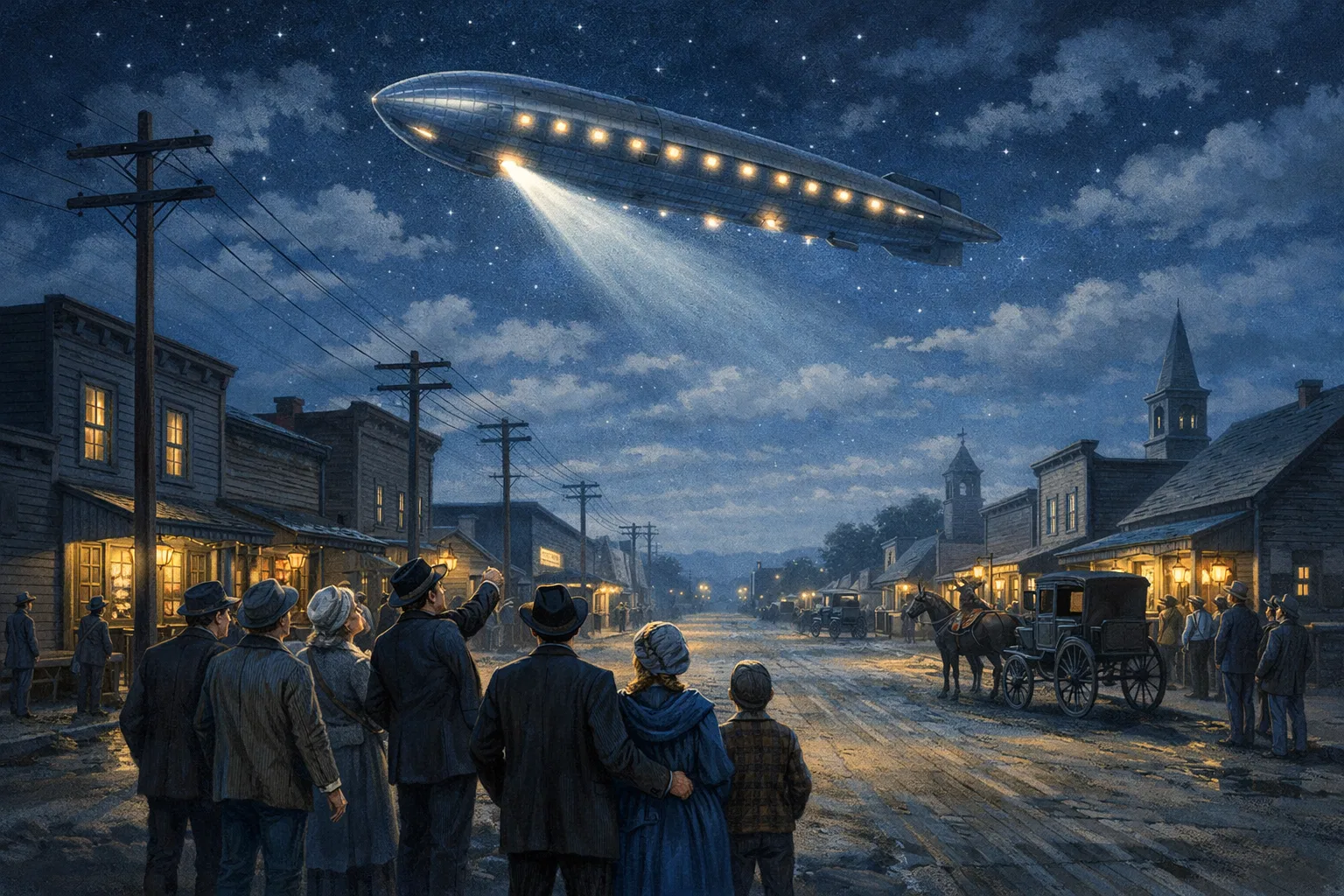
The Nebraska wave is usually dated from a report published on 2 February 1897 concerning Hastings. Residents said that an “air ship, or something of the kind” had appeared west of the town, first resembling an immense star but then seeming artificial because of its colour and brilliance. It was said to hover, circle, descend and travel several miles before disappearing. The account supplied estimates of height and movement, but those figures were visual guesses made at night without a known object size or measured distance.[Nebraska State Historical Society]history.nebraska.govState Historical Society Microsoft WordNebraska State Historical SocietyMicrosoft Word - NH1979UFO1897 intro.doc…
Three days later, the Omaha Daily Bee reported sightings near Inavale, about 40 miles south of Hastings. One reported group consisted of ten people returning from a prayer meeting—an apparently deliberate detail intended to make drunkenness or frivolity seem less likely. Reports then appeared from York, Beatrice, Grand Island and communities in south-eastern Nebraska. Welsch found more than 20 claimed appearances in that region within roughly three weeks.[Nebraska State Historical Society]history.nebraska.govState Historical Society Microsoft WordNebraska State Historical SocietyMicrosoft Word - NH1979UFO1897 intro.doc…
The geographical spread widened sharply in April. Newspapers recorded stories from Omaha, Lincoln, Hastings, North Platte, Nebraska City, Table Rock, Havelock, Clarks, Clay Center, Lyons, Juniata, Franklin, Portal and Harrison, among other places. By the middle of that month, one historical count placed the accumulated Nebraska reports at about 150. The wave was not a single object tracked continuously from town to town; it was a collection of separate stories, often reported after the event and sometimes copied or summarised by other papers.[Nebraska State Historical Society]history.nebraska.govState Historical Society Microsoft WordNebraska State Historical SocietyMicrosoft Word - NH1979UFO1897 intro.doc…
Nebraska was also part of a larger sequence. Similar stories had been widely printed in California from November 1896. After the Nebraska reports gathered momentum, the wave spread across Kansas, Missouri, Iowa, Illinois, Wisconsin, Indiana, Texas and other states before fading in late spring or early summer. The apparent eastward movement may partly reflect the circulation of newspaper stories rather than the route of one physical machine. Once editors and readers knew what an “airship” was supposed to look like, a distant light elsewhere could be fitted into the same narrative.[nebraska.gov]history.nebraska.govState Historical Society"Look! Up in the Air…!Nebraska State Historical Society"Look! Up in the Air…! - Nebraska State Historical Society…
What witnesses and newspapers claimed
The earliest Nebraska accounts were often descriptions of light rather than machinery. Witnesses reported a bright point that hovered, swayed, changed altitude or travelled against the wind. In more elaborate versions, the light acquired a canoe-shaped or conical body, wings, a rudder, rows of smaller lamps and a powerful forward searchlight. Some people claimed to hear an engine, voices or laughter.[Nebraska State Historical Society]history.nebraska.govState Historical Society Microsoft WordNebraska State Historical SocietyMicrosoft Word - NH1979UFO1897 intro.doc…
These details were never consistent enough to establish a common design. Some craft were cigar-shaped; others resembled balloons, boats, umbrellas or railway carriages. Their estimated dimensions, altitude and speed varied widely. The reported performance was even more problematic: the object could supposedly hover motionless, make abrupt turns, climb rapidly, reverse direction and cross large distances at speeds beyond the practical airships of the period. Welsch noted that known balloons could not perform the manoeuvres attributed to the mystery craft, while steerable experimental airships had not demonstrated the combination of speed, range and control claimed in Nebraska.[Nebraska State Historical Society]history.nebraska.govState Historical Society Microsoft WordNebraska State Historical SocietyMicrosoft Word - NH1979UFO1897 intro.doc…
As publicity increased, some stories became less like witness testimony and more like frontier humour or speculative fiction. A Table Rock report described an illuminated craft with windows, passengers, two women, a man holding a revolver and what appeared to be a card game taking place on board. The newspaper assured readers that the witnesses were reputable and not prone to strong drink or vivid imagination—language that could be read either as earnest certification or as a comic convention familiar to contemporary audiences.[Nebraska State Historical Society]history.nebraska.govState Historical Society Microsoft WordNebraska State Historical SocietyMicrosoft Word - NH1979UFO1897 intro.doc…
Another Nebraska tale claimed that an airship vanished on landing and that its operator could shrink it small enough to fit in his pocket. A rival paper added a backwards message which, when reversed, told readers to subscribe. Such examples make it unsafe to treat every printed “sighting” as a literal report. Nineteenth-century newspapers commonly mixed information, satire, promotional rivalry and fictional entertainment without always marking the boundary as clearly as a modern reader would expect.[Wikipedia]WikipediaMystery airshipMystery airship
Editors nevertheless disagreed among themselves. Some mocked witnesses as drunk, excitable or deceived by stars. Others argued that recent inventions—the telephone, phonograph, electric motor and moving pictures—had repeatedly made yesterday’s impossibilities seem ordinary. An undisclosed breakthrough in aerial navigation therefore appeared plausible to readers living through rapid technological change. That cultural setting helps explain why “secret inventor” was often the preferred theory, rather than the modern assumption of extraterrestrial visitors.[Nebraska State Historical Society]history.nebraska.govState Historical Society Microsoft WordNebraska State Historical SocietyMicrosoft Word - NH1979UFO1897 intro.doc…
Hoaxes, planets, balloons and other explanations
No single explanation comfortably accounts for every Nebraska report. The evidence instead favours several causes operating together, reinforced by publicity.
Venus and other astronomical objects. Contemporary Nebraska newspapers explicitly identified some sightings as Venus. A Beatrice report described a greatly magnified star with uneven rays and an apparent swaying motion, explaining these effects as atmospheric distortion. The Grand Island Independent similarly attributed a local “airship” to the brilliant evening planet. A bright object viewed near the horizon can appear to flicker, change colour or move when thin clouds pass, while small involuntary eye movements can make an isolated light seem to wander.[Nebraska State Historical Society]history.nebraska.govState Historical Society Microsoft WordNebraska State Historical SocietyMicrosoft Word - NH1979UFO1897 intro.doc…
This explanation is strongest for reports involving a single stationary or slowly moving light. It is weaker for accounts that claimed a close, structured body or audible machinery—but those added details may represent inference rather than direct perception. Once observers expected an airship, glare, cloud edges and atmospheric shimmer could be interpreted as wings, windows or a hull.
Illuminated kites. A railway station agent near Juniata reportedly flew specialised box kites carrying lights. Contemporary discussion noted that such kites could reach substantial height and that a brilliant lamp might be visible many miles away. The visible light could appear much higher or farther away than it really was, especially when the kite line and structure disappeared against the night sky.[Nebraska State Historical Society]history.nebraska.govState Historical Society Microsoft WordNebraska State Historical SocietyMicrosoft Word - NH1979UFO1897 intro.doc…
Kites could reproduce hovering, circling and some apparent changes of direction. They could not explain every claimed high-speed journey across Nebraska, but those speeds were generally calculated from unsupported assumptions that sightings in different places involved the same object. A stationary or local prank could therefore be transformed in print into a fast-moving interstate machine.
Balloons and fire balloons. In April, pranksters near Stromsburg reportedly launched a hot-air balloon with two lanterns attached. Witnesses had previously insisted that they could see a large body, rudder and wings, illustrating how observers may add structure to a bright, unfamiliar light after being told what they are seeing. History Nebraska also records that balloons and illuminated devices were used by practical jokers during the wave.[Nebraska State Historical Society]history.nebraska.govState Historical Society Microsoft WordNebraska State Historical SocietyMicrosoft Word - NH1979UFO1897 intro.doc…
Balloons drifting with the wind could account for silent lights moving slowly over towns. They would not fly reliably against the wind or perform sudden powered turns, but descriptions of those movements depended upon uncertain visual judgement. Without distance and scale, a light moving in an arc can seem to accelerate dramatically or reverse direction.
Newspaper invention and publicity. This is essential to understanding the wave. History Nebraska states directly that some editors fabricated reports to publicise their communities and that newspapers profited from exaggerating both genuine and false stories. Local papers had a commercial reason to ensure that their town was not excluded from a popular mystery already attracting attention elsewhere.[Nebraska State Historical Society]history.nebraska.govState Historical Society"Look! Up in the Air…!Nebraska State Historical Society"Look! Up in the Air…! - Nebraska State Historical Society…
The reports also show signs of narrative escalation. Early stories often concerned a light; later ones supplied decks, propellers, passengers, conversations, weapons and secret inventors. That does not prove that every later witness lied. It does show that the newspaper record cannot be treated as a neutral database of independent observations. Reporters copied previous descriptions, witnesses knew what details other towns had reported, and humorous stories could reappear decades later stripped of their original tone.
A real experimental airship. The most intriguing alternative is that at least a few people saw an undisclosed human-built craft. Experimental steerable balloons existed before 1897, and public discussion of aerial navigation was widespread. A genuine test flight somewhere in the United States was not impossible.[Wikipedia]WikipediaMystery airshipMystery airship
The Nebraska version of this theory remains poorly supported. No inventor later demonstrated a machine matching the reported capabilities; no credible workshop, crew, financing trail or wreckage emerged; and the descriptions do not converge on a consistent craft. A secret aircraft capable of repeatedly crossing the Plains, hovering, flying rapidly against winds and carrying powerful electric lights would have represented a major leap beyond contemporary aviation. Keeping such a programme hidden while flying over scores of populated places would also be difficult to reconcile with the supposed need for secrecy.
Why the wave became convincing
The wave’s power came from accumulation. A single person seeing a strange light might doubt their own judgement. After reading that residents of Hastings, Inavale and York had already seen an airship, the same person could interpret a later light with greater confidence. Multiple reports then seemed to confirm one another, even when the observations were caused by different objects.
Telegraph networks and newspaper exchanges accelerated this process. Stories could be copied rapidly from one paper to another, giving the impression of a coherent national phenomenon. Headlines, editorials and claims by supposed inventors supplied readers with a ready-made explanation before they looked at the sky. Newspapers did not merely document the wave; they helped organise its expectations and vocabulary.[Readex]readex.comufo fever americas historical newspapers mysterious airshipsUFO Fever in America’s Historical Newspapers: The Mysterious Airships of 1896-97 | Readex…
Technological optimism made the idea especially persuasive. Electric lighting, telephones, phonographs and motor vehicles had recently altered everyday life. A steerable flying machine seemed like the next breakthrough, and secrecy could explain why nobody had seen it openly. The mystery therefore occupied a credible middle ground: extraordinary enough to sell newspapers, but close enough to anticipated invention that ordinary citizens could accept it.
This does not require witnesses to have been foolish or dishonest. People are poor at estimating the distance, dimensions and speed of lights against an empty night sky. Expectation then influences how incomplete visual information is interpreted. The Nebraska reports are valuable precisely because contemporary newspapers sometimes recorded the process in real time: an object first looked like a star, was judged to be an artificial light, and finally became a winged airship with a crew.
Were Nebraska’s airships real?
Something was undoubtedly being seen on at least some nights. The weakest sceptical position would be to dismiss every witness as a liar. Contemporary explanations identify plausible physical stimuli: Venus, other bright celestial objects, illuminated kites and lantern-bearing balloons. Pranksters demonstrably contributed, while editors acknowledged or produced fabricated stories.[Nebraska State Historical Society]history.nebraska.govState Historical Society Microsoft WordNebraska State Historical SocietyMicrosoft Word - NH1979UFO1897 intro.doc…
What is not established is that these observations involved one advanced aircraft—or even several similar aircraft. The case lacks the evidence needed to bridge the gap between “people reported unusual lights” and “a remarkable flying machine crossed Nebraska”. Most surviving material consists of newspaper prose, often anonymous, second-hand, humorous or contradictory. There are no surviving photographs, measurements, engineering remains or records from a verifiable operator.
The most reasonable assessment is therefore that Nebraska’s 1897 airship wave was a composite event. Ordinary sights triggered sincere reports; publicity encouraged further observation; expectations supplied mechanical detail; jokers manufactured convincing imitations; and newspapers expanded the story into folklore. A small number of individual observations cannot now be reconstructed and remain unexplained in the limited historical sense. That uncertainty does not provide positive evidence for extraterrestrial craft or a lost aviation technology.
Within Nebraska’s wider UFO history, the airship wave is important not as an early confirmed visitation but as an unusually clear example of how aerial mysteries take shape. The machinery imagined in 1897 reflected the approaching age of powered flight, just as later sightings would reflect rockets, flying saucers, stealth aircraft or drones. The object in the sky may be ambiguous; the form people give it is often drawn from the technology and anxieties of their own time.

Amazon book picks
Further Reading
Books and field guides related to Were Nebraska's 1897 Airships Real or Invented?. Use these as the next step if you want deeper reading beyond the article.
Wonders in the Sky: Unexplained Aerial Objects from Antiquity...
Places the 1897 airship wave within the longer history of mysterious aerial reports.
The Report on Unidentified Flying Objects
Provides context for how later investigators handled unexplained reports.
The UFO Experience: A Scientific Inquiry
Explains approaches for evaluating historical sighting reports.
eBay marketplace picks
Marketplace Samples
Live-tested eBay searches with available results related to this page.
Selected fromairship model oneBay.co.uk.

Endnotes
1.
Source: history.nebraska.gov
Title: State Historical Society Microsoft Word
Link:https://history.nebraska.gov/wp-content/uploads/2017/12/doc_publications_NH1979UFOs.pdf
Source snippet
Nebraska State Historical SocietyMicrosoft Word - NH1979UFO1897 intro.doc...
2.
Source: history.nebraska.gov
Title: State Historical Society”Look! Up in the Air…!
Link:https://history.nebraska.gov/look-up-in-the-air/
Source snippet
Nebraska State Historical Society"Look! Up in the Air...! - Nebraska State Historical Society...
3.
Source: readex.com
Title: ufo fever americas historical newspapers mysterious airships 1896 97
Link:https://www.readex.com/blog/ufo-fever-americas-historical-newspapers-mysterious-airships
Source snippet
UFO Fever in America’s Historical Newspapers: The Mysterious Airships of 1896-97 | Readex...
4.
Source: Wikipedia
Title: Mystery airship
Link:https://en.wikipedia.org/wiki/Mystery_airship
5.
Source: history.nebraska.gov
Link:https://history.nebraska.gov/flashback-friday-a-celestial-visitor-revisited-a-nebraska-newspaper-hoax-from-1884-patricia-c-gaster/
6.
Source: history.nebraska.gov
Title: this mysterious light called an airship nebraska saucer sightings 1897
Link:https://history.nebraska.gov/document/this-mysterious-light-called-an-airship-nebraska-saucer-sightings-1897/
7.
Source: designegov.nebraska.gov
Link:https://designegov.nebraska.gov/
8.
Source: history.nebraska.gov
Title: roger l welsch
Link:https://history.nebraska.gov/document-author/roger-l-welsch/
9.
Source: history.nebraska.gov
Title: howard k clovers picturesque career
Link:https://history.nebraska.gov/publications_section/howard-k-clovers-picturesque-career/
10.
Source: history.nebraska.gov
Title: gov60 Archives
Link:https://history.nebraska.gov/magazine_volume/60/
11.
Source: Wikipedia
Link:https://en.wikipedia.org/wiki/Nebraska
12.
Source: Wikipedia
Link:https://en.wikipedia.org/wiki/History
13.
Source: wildquincy.com
Link:https://www.wildquincy.com/episodes/airship
Additional References
14.
Source: americanghostwalks.com
Title: Witnesses all over Milwaukee saw something strange in the sky
Link:https://www.americanghostwalks.com/articles/1897-milwaukee-airship-mystery
Source snippet
1897 Milwaukee Airship Mystery: Unexplained UFO SightingsFebruary 7, 2023 — On the night of April 11th 1897 at around 8 p.m., Milwaukee h...
Published: February 7, 2023
15.
Source: daily.jstor.org
Title: phantom flying machines
Link:https://daily.jstor.org/phantom-flying-machines/
Source snippet
JSTOR DailyThe History of UFOs1 Apr 2016 — Robert E. Bartholomew calls the numerous Michigan sightings of “airships” in 1897 an episode o...
16.
Source: youtube.com
Link:https://www.youtube.com/watch?v=Mq0pmfgeAt4
Source snippet
Airship Mystery of 1896 and 1897 (Mystery Airships, UFOs)...
17.
Source: youtube.com
Link:https://www.youtube.com/watch?v=DoJUsaTknNw
Source snippet
Phantom Airships of the 19th Century | The Dark Histories Podcast...
18.
Source: reddit.com
Link:https://www.reddit.com/r/UFOs/comments/vwm47k/accounts_of_airship_sightings_in_nebraska_125/
19.
Source: facebook.com
Link:https://www.facebook.com/ButtermilkJunction/posts/look-up-in-the-skytoday-in-ufo-history-on-todays-date-129-years-ago-friday-april/1505822224237915/
20.
Source: academia.edu
Link:https://www.academia.edu/43868466/UFOs_and_Intelligence_A_Timeline_By_George_M_Eberhart
21.
Source: unl.edu
Link:https://www.unl.edu/
22.
Source: visitnebraska.com
Link:https://visitnebraska.com/
23.
Source: facebook.com
Title: an 1897 ufo this clipping is just one of many mystery airship reports that fille
Link:https://www.facebook.com/newspaperscom/posts/an-1897-ufo-this-clipping-is-just-one-of-many-mystery-airship-reports-that-fille/1415480043926635/