Within Nevada
What Nevada's Blue Book Files Can Prove
Nevada's Blue Book files preserve useful dates and witness accounts, but many cases lack the data needed for reliable identification.
On this page
- Where Nevada sightings were recorded
- What the surviving files preserve
- Why weak data leaves cases unresolved
Page outline Jump by section
Introduction
Project Blue Book’s Nevada files prove that the US Air Force received and investigated reports from across the state’s cities, military bases and remote test corridors. They preserve dates, locations, witness descriptions, correspondence and official evaluations, sometimes in enough detail to test an ordinary explanation. They do not, however, provide a reliable body of evidence for extraterrestrial craft. Many Nevada reports were classified as aircraft, balloons, astronomical objects or “insufficient data”, while a smaller number remained officially unidentified because the available information did not support a firm conclusion.
That distinction matters. In Blue Book terminology, “unidentified” did not mean alien; it meant that investigators could not confidently match the report to a known object or phenomenon. Nevada’s record is therefore most useful as evidence of what people reported, how the Air Force processed those reports and why secrecy, distance and missing measurements so often prevented certainty.[Defense Logistics Agency]esd.whs.milDefense Logistics Agency
Where Nevada sightings were recorded
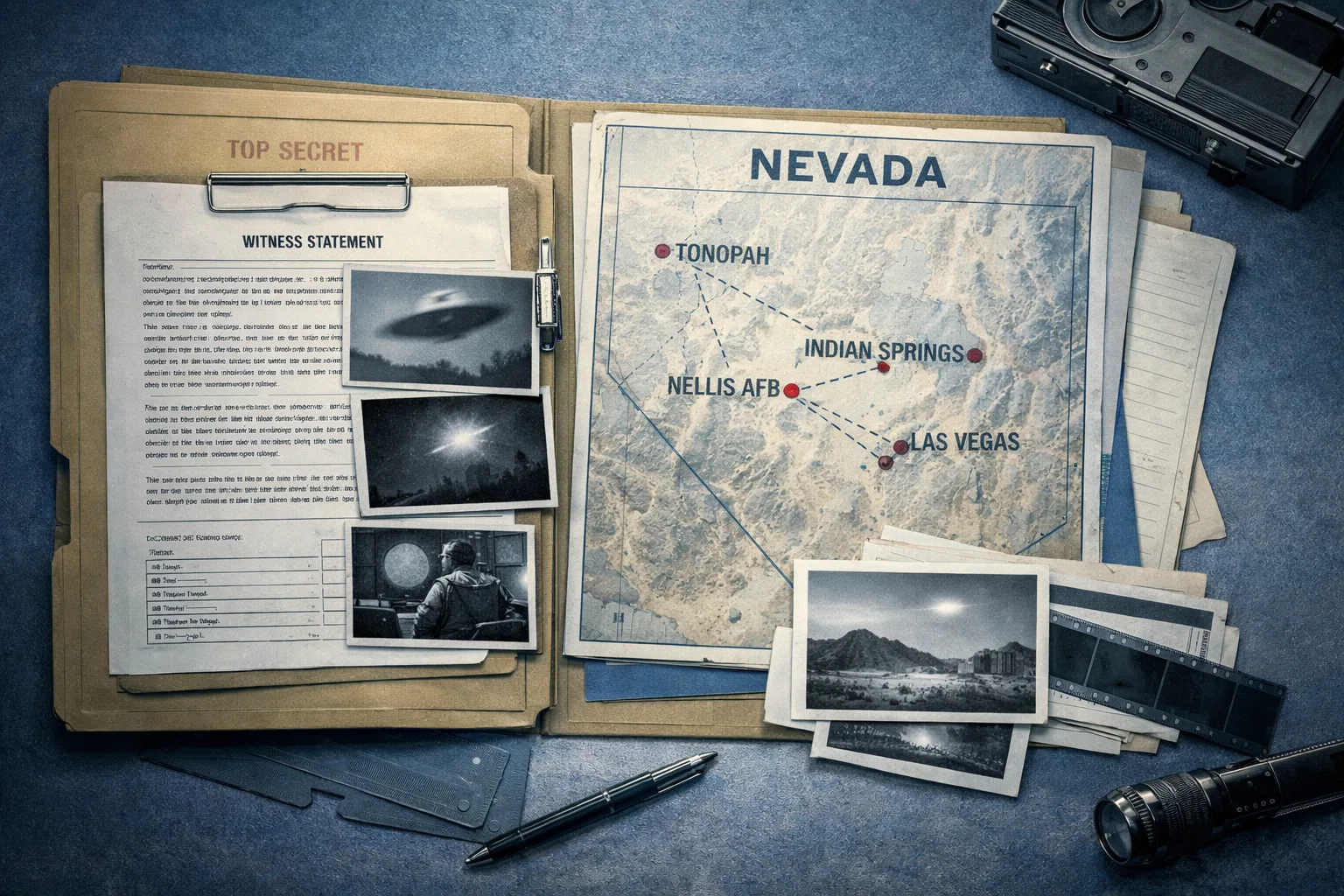
The surviving files show that Nevada reporting was not confined to the place now popularly associated with UFOs, Area 51. Case locations include Las Vegas, Reno, Elko, Boulder City, Nellis Air Force Base, Indian Springs, Tonopah and sparsely populated parts of central Nevada. One archival sequence also lists reports from Panaca, Angel’s Peak, the vicinity of Jean and locations east of Indian Springs.[govweird]govweird.comOpen source on govweird.com.
This geographical spread reflects several different viewing environments. Reports from Las Vegas and Reno arose near populated areas, airports and established air routes. Those from Nellis and Indian Springs came from a region of intensive military aviation. Cases around Tonopah and the central Nevada ranges involved isolated roads, long sightlines and very few landmarks by which an observer could judge distance, height or speed.
The record should not be treated as a complete census of everything seen over Nevada. Blue Book investigated reports that reached the Air Force, usually through a nearby base, police agency, military channel or direct correspondence. Its own published procedure placed responsibility for the initial investigation on the Air Force installation nearest the sighting, which then forwarded material to Blue Book headquarters at Wright-Patterson Air Force Base. Reports that were never submitted, arrived late or lacked sufficient detail could not be assessed in the same way.[Defense Logistics Agency]esd.whs.milDefense Logistics Agency
Nor is there a simple authoritative total for “Nevada Blue Book cases” on the National Archives’ public information pages. The collection is organised as individual or closely related case files within a much larger national record set, rather than as a ready-made state statistical table. Any modern Nevada count therefore depends on search rules: whether to include reports made just across the state line, cases assigned to a Nevada base, duplicate entries, and records inherited from Blue Book’s predecessors, Projects Sign and Grudge. The archive is better used as a set of primary case documents than as a precise measure of Nevada’s sighting rate.[National Archives]archives.govOpen source on archives.gov.
What the surviving files preserve
A typical Blue Book file may contain an observer’s questionnaire, letters or telegrams, newspaper cuttings, internal correspondence and a control sheet summarising the Air Force’s conclusion. Some files also include weather checks, astronomical calculations, aircraft enquiries or analysis of photographs and alleged physical traces.[National Archives]archives.govOpen source on archives.gov.
For a Nevada researcher, these records can establish several useful facts:
- When and where a report entered the official system. Dates, times and approximate viewing locations can often be compared with astronomical positions, weather conditions or known aviation activity.
- What the witness originally described. Contemporary forms are generally more valuable than stories retold decades later because they reduce the effects of memory drift and later UFO folklore.
- How long the observation lasted. A brief streak is more consistent with a meteor than an object reportedly watched for several minutes, although duration estimates can themselves be unreliable.
- Whether instruments or additional witnesses were involved. Radar confirmation, photographs or independent observers can strengthen a case, but only when the records preserve enough technical detail to evaluate them.
- What explanation the Air Force selected. The control card may identify an aircraft, balloon, planet, meteor or other cause, or mark the report as insufficient or unidentified.
The archive also preserves the limitations of the investigation. Witness names and other identifying details were redacted before the public version was released in 1976, partly to protect personal information. Those deletions can make later verification difficult, especially when a witness’s occupation, experience or precise position would affect the credibility assessment.[National Archives]archives.govOpen source on archives.gov.
The files vary greatly in depth. A well-documented case may contain several pages of testimony and follow-up enquiries. Another may amount to little more than a short description and a conclusion written on a control card. Civilian researcher Don Berliner, who examined the original unexplained files before their transfer to the National Archives, argued that many lacked completed questionnaires or adequate follow-up. His assessment is not an official finding, but it matches an obvious feature of the surviving collection: the evidential quality is uneven, and an impressive-sounding description is not necessarily supported by precise measurements.[NICAP]nicap.orgThe Project Bluebook "UnknownsThe Project Bluebook "Unknowns"…
The Tonopah case shows both the value and the weakness
A September 1961 report from north of Tonopah is a useful example because the file contains a detailed witness narrative yet still fails to produce a secure identification. On 24 September, a Bureau of Land Management geologist travelling through Monitor Valley reported seeing an intensely bright light above a ridge in the Toquima Range. He watched it through binoculars for about eight minutes and described a downward beam before the light disappeared. Later that night, he reported a second orange-yellow object moving rapidly over the Monitor Range.[govweird]govweird.comOpen source on govweird.com.
The witness subsequently searched the area where he thought the first object might have been located. He found no landing marks, debris, tracks or other physical evidence. The Air Force considered Jupiter a probable explanation for the first light because the planet was in the reported direction near the horizon. It could not confirm an aircraft explanation for the second observation, and the case record ultimately carries an unknown or insufficiently resolved evaluation.[govweird]govweird.comOpen source on govweird.com.
This is more informative than a bare label of “unidentified”. The file gives a date, viewing direction, observing equipment, duration, weather description and the result of a ground search. It also shows why the report remained difficult. There was no photograph, radar record, recovered material or reliable measurement of range. The witness’s estimate that a beam was more than 100 feet wide depended on an assumed distance to the light; without knowing how far away it was, its physical size could not be calculated.
The case also demonstrates that an observation can contain more than one event with different levels of explainability. The first light may have had a plausible astronomical cause, while the second remained uncertain. Treating the entire episode either as fully solved or wholly extraordinary would erase that distinction.
Why military geography complicates the record
Nevada’s Blue Book cases were collected within one of the most difficult environments for identifying unfamiliar aerial objects. Nellis and the ranges to its north supported military flying, weapons work and restricted test activity. Ordinary training aircraft, flares, high-altitude balloons and distant engine exhaust could all appear unusual, especially at night.
Blue Book’s own explanatory guide identified aircraft, satellites, balloons, astronomical bodies, meteors, searchlights, flares, reflections, mirages and spurious radar returns as recurring sources of UFO reports. It noted that an aircraft seen at distance might appear disc- or rocket-shaped, and that afterburners could remain visible even when the airframe itself could not be distinguished. It also acknowledged an important investigative gap: some local aircraft movements were not carried in the records available to its investigators, leaving probable aircraft reports impossible to confirm conclusively.[Defense Logistics Agency]esd.whs.milDefense Logistics Agency
That problem was especially serious in Nevada. A Blue Book investigator could check reported civilian traffic and acknowledged military operations, but might not have been told about a classified flight. The absence of a recognised aircraft in the case file therefore does not prove that none was present.
Later declassification strengthens this cautious interpretation. Nevada was used for secret aircraft development during the Blue Book era, including U-2 and A-12 reconnaissance work. Some observers were consequently seeing technology whose existence the government could not publicly admit at the time. That does not explain every Nevada report, but it weakens arguments that an unresolved file must represent a non-human vehicle.
The archival record also does not show that Blue Book systematically matched Nevada sightings against every classified test. Blue Book was an unclassified reporting programme, while sensitive aircraft information was tightly compartmented. The case files reveal what Blue Book personnel were able to record and evaluate, not necessarily everything known elsewhere in the defence establishment.
Why weak data leaves cases unresolved
Blue Book divided reports into three broad outcomes: identified, insufficient data and unidentified. An identified case contained enough specific information for the Air Force to adopt an explanation. “Insufficient data” meant that essential details such as time, position, duration, weather or manner of disappearance were missing. An unidentified case was supposed to contain the necessary information for analysis but still resist correlation with a known object or phenomenon.[Defense Logistics Agency]esd.whs.milDefense Logistics Agency
In practice, those categories were less clean than they sound. A label reflects the judgement and information available to investigators at the time; it is not an independent scientific measurement. Some apparently explained cases rested on a probable rather than demonstrated cause. Conversely, some unidentified cases may have remained unresolved simply because flight records, weather data or witness details were unavailable.
Several weaknesses recur in the Nevada material:
No dependable range. A witness may describe a light as large, low or extremely fast without knowing its distance. A slow, distant aircraft and a smaller nearby light can produce similar angular movement.
Single-observer testimony. A sincere witness can report accurately what an object looked like while being mistaken about what produced the appearance. Binoculars improve visibility but do not by themselves establish distance or speed.
Delayed reporting. Astronomical, meteorological and aviation checks become harder when investigators receive a report days or weeks after the event.
Incomplete flight information. Civilian controllers and Blue Book staff could not necessarily verify local, military or classified activity.
No preserved instrument data. References to radar or photographs matter only when the underlying film, plots, calibration information or original negatives survive and can be examined.
Ambiguous administrative labels. “Unknown” records an investigative outcome, not a claim about origin. “Probable aircraft” indicates a plausible explanation, not a confirmed match to a particular flight.
These limitations explain why counting unexplained cases is less useful than examining their contents. A well-supported unknown with independent witnesses and calibrated sensor data would carry more weight than dozens of brief reports lacking time, direction or range. Much of Nevada’s Blue Book record lies closer to the latter end of that scale.
What Nevada’s Blue Book files can prove
The files can prove that Nevada residents, officials and military personnel reported unfamiliar aerial phenomena and that the Air Force created an administrative record of many of those reports. They can reconstruct the wording of contemporary testimony, reveal which explanations investigators considered and show where an official conclusion was firm, tentative or impossible.
They can also demonstrate how Nevada’s distinctive conditions shaped the reporting problem. Long desert sightlines encouraged dramatic estimates of speed and size; military ranges introduced unusual aircraft and lights; classification limited what investigators could check; and sparse documentation often prevented later reconstruction.
The files cannot, on their own, prove that an unexplained observation was a structured craft, that it performed beyond known technology or that it came from outside Earth. Blue Book’s national conclusion was that none of its investigated unidentified reports demonstrated a national-security threat, technology beyond contemporary scientific knowledge or an extraterrestrial vehicle. The programme closed in 1969 after recording 12,618 reports nationally, of which 701 retained an unidentified classification.[Air Force]af.milAir ForceUnidentified Flying Objects and Air Force Project Blue BookOf a total of 12,618 sightings reported to Project Blue Book, 701 rem…
That conclusion should not be treated as proof that every Nevada sighting was conventionally explained. It means that the surviving evidence did not establish the more extraordinary interpretation. The most defensible reading of Nevada’s case record is therefore neither “nothing happened” nor “the Air Force documented alien craft”. People reported genuinely puzzling observations, but the files usually preserve too little measured, independently verifiable information to determine exactly what they saw.
Amazon book picks
Further Reading
Books and field guides related to What Nevada's Blue Book Files Can Prove. Use these as the next step if you want deeper reading beyond the article.
The UFO Experience: A Scientific Inquiry
Hynek was closely associated with Project Blue Book.
Area 51: An Uncensored History of America's Top Secret Milita...
Provides Nevada military context behind many reports.
UFOs: Generals, Pilots, and Government Officials Go on the Re...
Shows how official investigations evolved after Blue Book.
eBay marketplace picks
Marketplace Samples
Live-tested eBay searches with available results related to this page.
Selected fromUFO wall art oneBay.co.uk.

Current eBay listing
UFO ABDUCTION OVER THE OCEAN -FRAMED WALL ART PAPER PRINT POSTER

Current eBay listing
UFO ABDUCTION OVER THE OCEAN -DEEP FRAMED CANVAS WALL ART PRINT

Endnotes
1.
Source: esd.whs.mil
Title: Defense Logistics Agency
Link:https://www.esd.whs.mil/Portals/54/Documents/FOID/Reading%20Room/UFOsandUAPs/proj_b1.pdf?ver=2017-05-22-113513-837
2.
Source: archives.gov
Title: National Archives Project BLUE BOOK
Link:https://www.archives.gov/research/military/air-force/ufos
Source snippet
National ArchivesProject BLUE BOOK - Unidentified Flying Objects25 Jun 2024 — The project closed in 1969 and we have no information on si...
3.
Source: govweird.com
Link:https://www.govweird.com/topics/ufo/project-blue-book/n-of-tonopah-nv-september-1961
4.
Source: archives.gov
Link:https://www.archives.gov/news/articles/project-blue-book-50th-anniversary
5.
Source: nicap.org
Title: The Project Bluebook “Unknowns”
Link:https://www.nicap.org/bluebook/unknowns.htm
Source snippet
The Project Bluebook "Unknowns"...
6.
Source: archives.gov
Link:https://www.archives.gov/files/declassification/iscap/pdf/2014-004-doc01.pdf
7.
Source: archives.gov
Link:https://www.archives.gov/research/topics/uaps
8.
Source: archives.gov
Link:https://www.archives.gov/research/topics/uaps/photographs
9.
Source: archives.gov
Title: nara documents2
Link:https://www.archives.gov/research/foreign-policy/cold-war/1961-berlin-crisis/nara-documents2
10.
Source: archives.gov
Title: rg collections
Link:https://www.archives.gov/research/topics/uaps/rg-collections
11.
Source: archives.gov
Title: still pictures guide
Link:https://www.archives.gov/research/guides/still-pictures-guide
12.
Source: archives.gov
Link:https://www.archives.gov/research/catalog/catalog-bulk-downloads/uap-bulk-download
13.
Source: archives.gov
Link:https://www.archives.gov/publications/prologue/index/2003.html
14.
Source: archives.gov
Title: moving images and sound
Link:https://www.archives.gov/research/topics/uaps/moving-images-and-sound
15.
Source: archives.gov
Title: presidential libraries
Link:https://www.archives.gov/research/topics/uaps/presidential-libraries
16.
Source: archives.gov
Link:https://www.archives.gov/research/guide-fed-records/groups/043.html/1000
17.
Source: archives.gov
Title: labor reference paper
Link:https://www.archives.gov/san-francisco/finding-aids/labor-reference-paper
18.
Source: archives.gov
Title: 1991 annual report
Link:https://www.archives.gov/files/about/history/sources/reports/1991-annual-report.pdf
19.
Source: archives.gov
Link:https://www.archives.gov/research/alic/periodicals/nara-citations/genealogy.html
20.
Source: archives.gov
Title: textual and microfilm
Link:https://www.archives.gov/research/topics/uaps/textual-and-microfilm
21.
Source: archives.gov
Title: listdigitizedpartnerdata.xlsx
Link:https://www.archives.gov/files/digitization/listdigitizedpartnerdata-.xlsx
22.
Source: prologue.blogs.archives.gov
Title: saucers over washington the history of project blue book
Link:https://prologue.blogs.archives.gov/2019/12/19/saucers-over-washington-the-history-of-project-blue-book/
23.
Source: nicap.org
Link:https://www.nicap.org/docs/pbbsr/nicap_pbr1-12_srch.pdf
24.
Source: nicap.org
Link:https://www.nicap.org/chronos/1962fullrep.htm
25.
Source: nicap.org
Link:https://www.nicap.org/rufo/rufo-02.htm
26.
Source: nicap.org
Link:https://www.nicap.org/reports/520724carsonsink_report.htm
27.
Source: nicap.org
Link:https://www.nicap.org/bb/BB_Unknowns.pdf
28.
Source: nicap.org
Link:https://www.nicap.org/620418adc_alert_dir.htm
29.
Source: nicap.org
Link:https://www.nicap.org/Good_Cases/520501davismonthan_dir.htm
30.
Source: nicap.org
Title: The Las Vegas UFO Crash
Link:https://www.nicap.org/reports/vegas_randle.htm
31.
Source: nicap.org
Link:https://www.nicap.org/chronos/1965fullrep.htm
32.
Source: af.mil
Link:https://www.af.mil/About-Us/Fact-Sheets/Display/Article/104590/unidentified-flying-objects-and-air-force-project-blue-book/
Source snippet
Air ForceUnidentified Flying Objects and Air Force Project Blue BookOf a total of 12,618 sightings reported to Project Blue Book, 701 rem...
33.
Source: Wikipedia
Title: Project Blue Book
Link:https://en.wikipedia.org/wiki/Project_Blue_Book
34.
Source: Wikipedia
Title: Area 51
Link:https://en.wikipedia.org/wiki/Area_51
35.
Source: history.com
Title: Project Blue Book
Link:https://www.history.com/articles/project-blue-book
Additional References
36.
Source: youtube.com
Link:https://www.youtube.com/watch?v=BoJmd2MIpOk
Source snippet
Project Blue Book Nevada UFO cases Project Blue Book's 10 Scariest UFO Files: Cases They Couldn't Explain America's Strangest History...
37.
Source: fold3.com
Title: US, Project Blue Book
Link:https://www.fold3.com/publication/461/us-project-blue-book-ufo-investigations
Source snippet
US, Project Blue Book - UFO Investigations, 1947-196926 Feb 2007 — Records and case files relating to investigations of sightings of...
38.
Source: youtube.com
Link:https://www.youtube.com/watch?v=QgxjtDS2sIQ
Source snippet
Project Blue Book: AREA 51 ALIEN ABDUCTION...
39.
Source: youtube.com
Title: Ancient Aliens: Project Blue Book Proves UFO Phenomenon
Link:https://www.youtube.com/watch?v=hYYVwXCpgj4
Source snippet
“I Spent 3 Years With Tall White Aliens At Area 51" -UFO Whistleblower Charles Hall...
40.
Source: youtube.com
Title: Project Blue Book’s 10 Scariest UFO Files: Cases They Couldn’t Explain
Link:https://www.youtube.com/watch?v=xkuIfufB1Lc
Source snippet
Ancient Aliens: Project Blue Book Proves UFO Phenomenon...
41.
Source: nsa.gov
Link:https://www.nsa.gov/portals/75/documents/news-features/declassified-documents/ufo/usaf_fact_sheet_95_03.pdf
42.
Source: youtube.com
Title: Project Blue Book: AREA 51 ALIEN ABDUCTION
Link:https://www.youtube.com/watch?v=S50HMebY_YA
Source snippet
UFO files: Bob Lazar's 1989 interview & what's happened since then...
43.
Source: fold3.com
Link:https://www.fold3.com/memorial/78455780/andrew-d-bagby
44.
Source: facebook.com
Link:https://www.facebook.com/groups/americansouthwest/posts/849046899058119/
45.
Source: facebook.com
Link:https://www.facebook.com/HISTORY/posts/during-the-cold-war-as-project-blue-book-investigated-potential-ufo-threats-a-sh/1473622884330683/