Within Blue Book
Why Did Some Massachusetts UFO Cases Stay Unidentified?
Blue Book labels such as aircraft, astronomical object, insufficient data and unknown reflected evidence quality, not proof of exotic craft.
On this page
- The main Blue Book classification categories
- How investigators tested ordinary explanations
- Why missing data left some reports unresolved
Page outline Jump by section
Introduction
Project Blue Book did not sort Massachusetts UFO reports into simple categories of “real” and “fake”. Instead, Air Force investigators used a series of classification labels designed to answer a narrower question: could a reported object be identified as something known, or did the available evidence leave it unresolved? In practice, most Massachusetts reports were eventually linked to ordinary causes such as aircraft, balloons, astronomical objects or other familiar phenomena. A smaller number remained classified as “unknown” or “unidentified”, but that label reflected the limits of the evidence rather than proof of an extraordinary craft.[af.mil]af.milUnidentified Flying Objects and Air Force Project Blue BookOf a total of 12,618 sightings reported to Project Blue Book, 701 remained "un…
Understanding these classifications is important when reading Massachusetts Blue Book files. The classification attached to a case often reveals more about the quality of the available information than about the object itself. A well-investigated report could still remain unidentified, while a weak report might be assigned a conventional explanation simply because the known explanation appeared more likely than any alternative.[Wikimedia Commons]upload.wikimedia.orgCommons The Project Blue Book ArchiveWikimedia CommonsThe Project Blue Book ArchiveSeptember 9, 2005 — They were advised of the main categories of conventional objects which…
The Main Blue Book Classification Categories
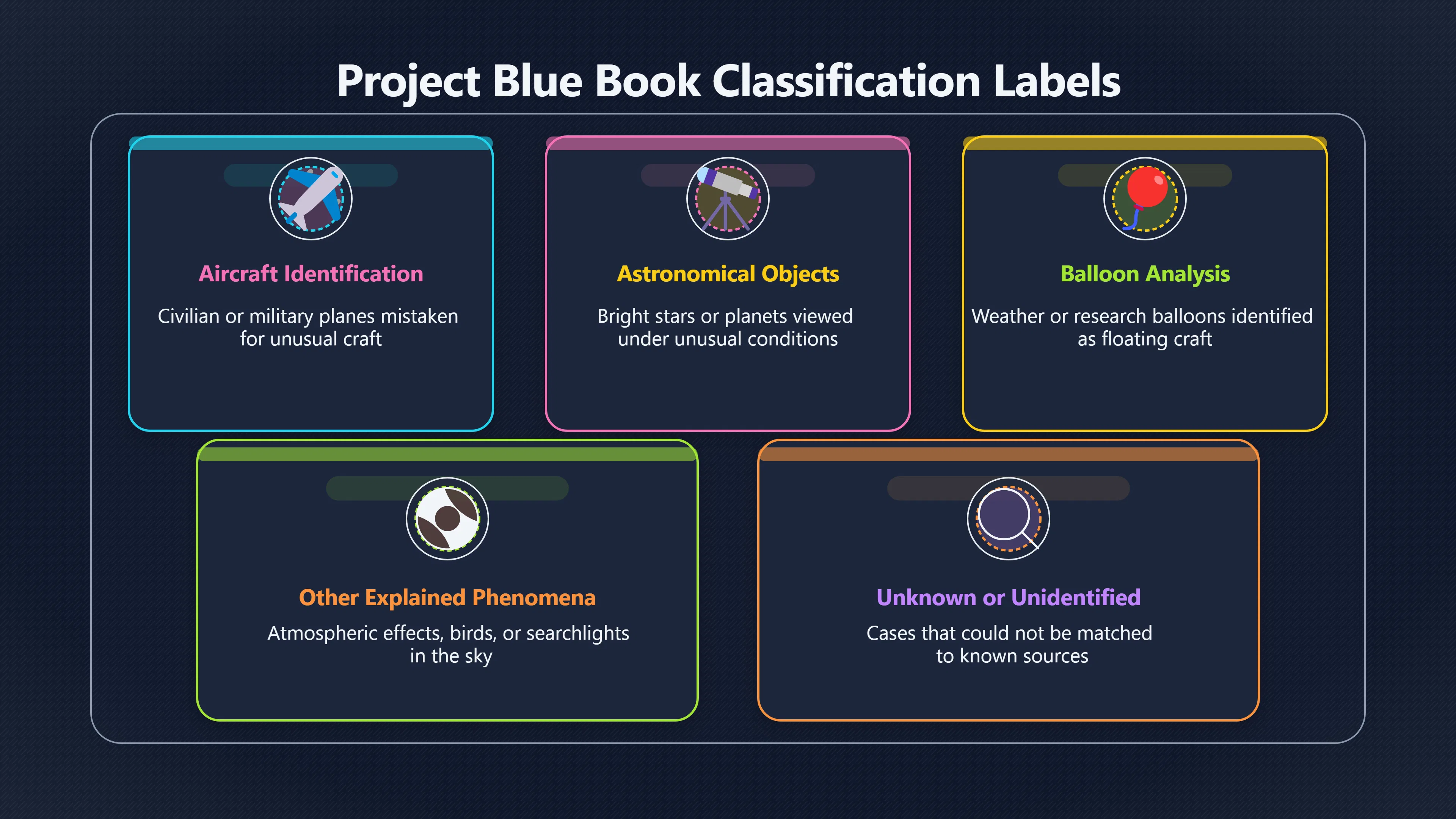
Project Blue Book applied broadly similar categories across the United States, including Massachusetts. Investigators attempted to place reports into recognised groups whenever possible.
The most common categories included:
- Aircraft – civilian, military or commercial aeroplanes whose lights, movements or appearance were mistaken for something unusual.
- Astronomical objects – bright stars, planets, meteors or other celestial phenomena viewed under unusual conditions.
- Balloons – weather balloons, research balloons or advertising balloons.
- Other explained phenomena – including atmospheric effects, reflections, birds, searchlights, satellites during the later years of the programme, or miscellaneous known causes.
- Insufficient information – reports lacking enough detail for a reliable conclusion.
- Unknown or unidentified – cases that could not be confidently matched to a known explanation after review.[Wikimedia Commons]upload.wikimedia.orgCommons The Project Blue Book ArchiveWikimedia CommonsThe Project Blue Book ArchiveSeptember 9, 2005 — They were advised of the main categories of conventional objects which…
For Massachusetts cases, these labels were applied to reports from ordinary citizens, police officers, pilots, military personnel and airport observers. The classification process was intended to be administrative and investigative rather than a judgment about extraterrestrial origins. An “unknown” case simply meant investigators could not demonstrate what had been seen.[af.mil]af.milUnidentified Flying Objects and Air Force Project Blue BookOf a total of 12,618 sightings reported to Project Blue Book, 701 remained "un…
How Investigators Tested Ordinary Explanations
The key question for Blue Book investigators was not whether a report sounded strange but whether it could be matched to a known source.
When a Massachusetts sighting entered the system, investigators typically compared witness descriptions against several possibilities:
- Aircraft operating in the area.
- Military flights and training activity.
- Balloon launches.
- The position of bright planets and stars.
- Meteor activity.
- Weather conditions and visibility.
- Radar information when available.
- Reports from additional witnesses.[Wikimedia Commons]upload.wikimedia.orgCommons The Project Blue Book ArchiveWikimedia CommonsThe Project Blue Book ArchiveSeptember 9, 2005 — They were advised of the main categories of conventional objects which…
Witness statements were especially important. Investigators wanted details such as direction of travel, apparent speed, colour, brightness, duration and angular position in the sky. A report that initially sounded mysterious might be reclassified after comparison with known aircraft movements or astronomical conditions. Conversely, if no conventional explanation matched the available facts, the case could remain unresolved.[Wikimedia Commons]upload.wikimedia.orgCommons The Project Blue Book ArchiveWikimedia CommonsThe Project Blue Book ArchiveSeptember 9, 2005 — They were advised of the main categories of conventional objects which…
This process helps explain why many Massachusetts sightings that attracted local attention eventually received routine classifications. The objective was to find the most probable explanation rather than to prove every detail beyond doubt.
Why Did Some Massachusetts UFO Cases Stay Unidentified?
The existence of unidentified cases is often misunderstood.
Blue Book’s own records show that hundreds of reports nationally remained unexplained at the end of the programme. Out of 12,618 reports investigated by Project Blue Book, 701 were ultimately classified as unidentified.[af.mil]af.milUnidentified Flying Objects and Air Force Project Blue BookOf a total of 12,618 sightings reported to Project Blue Book, 701 remained "un…
An unidentified classification did not necessarily mean a case was especially dramatic. Instead, several factors could prevent a firm identification:
Conflicting Evidence
Some reports contained details that pointed in different directions. A witness might describe movements inconsistent with a planet, while the timing and location seemed compatible with an astronomical explanation. Investigators could not always resolve such contradictions.[Wikimedia Commons]upload.wikimedia.orgCommons The Project Blue Book ArchiveWikimedia CommonsThe Project Blue Book ArchiveSeptember 9, 2005 — They were advised of the main categories of conventional objects which…
Credible Witnesses Without a Clear Solution
A small number of cases involved trained observers such as pilots, police officers or military personnel. Blue Book analysts recognised that witness credibility alone could not identify an object. Even when observers appeared reliable, the evidence might still be insufficient to determine exactly what had been seen.[Wikimedia Commons]upload.wikimedia.orgCommons The Project Blue Book ArchiveWikimedia CommonsThe Project Blue Book ArchiveSeptember 9, 2005 — They were advised of the main categories of conventional objects which…
Lack of Independent Confirmation
Many reports relied on a single observation. Without radar data, photographs or additional witnesses, investigators sometimes lacked the evidence needed to distinguish between competing explanations.[Wikimedia Commons]upload.wikimedia.orgCommons The Project Blue Book ArchiveWikimedia CommonsThe Project Blue Book ArchiveSeptember 9, 2005 — They were advised of the main categories of conventional objects which…
Ambiguous Physical Descriptions
Witnesses often estimated distance, size and speed incorrectly when viewing unfamiliar objects against the night sky. These uncertainties could leave investigators unable to reach a confident conclusion.[Wikimedia Commons]upload.wikimedia.orgCommons The Project Blue Book ArchiveWikimedia CommonsThe Project Blue Book ArchiveSeptember 9, 2005 — They were advised of the main categories of conventional objects which…

Why Missing Data Left Some Reports Unresolved
One of the most important distinctions in Blue Book records was the difference between “unknown” and “insufficient information.”
A report classified as insufficient information was not necessarily mysterious. It usually meant that investigators lacked the minimum details needed to test explanations. A witness might provide only a brief description such as “bright light moving rapidly”, with no reliable time, direction, duration or location. In those circumstances, almost any explanation remained possible.[Wikimedia Commons]upload.wikimedia.orgCommons The Project Blue Book ArchiveWikimedia CommonsThe Project Blue Book ArchiveSeptember 9, 2005 — They were advised of the main categories of conventional objects which…
By contrast, an unknown case generally contained enough information to permit investigation but not enough to support a convincing identification. This distinction is significant because later UFO debates sometimes merged the two categories, creating the impression that all unresolved cases were equally puzzling. Blue Book’s own classification system treated them differently.[Wikimedia Commons]upload.wikimedia.orgCommons The Project Blue Book ArchiveWikimedia CommonsThe Project Blue Book ArchiveSeptember 9, 2005 — They were advised of the main categories of conventional objects which…
Massachusetts files illustrate this problem well. Some reports generated extensive correspondence and follow-up interviews, while others consisted of only a short letter or newspaper clipping. The amount of information available often determined the final classification as much as the sighting itself.
What the Classification Labels Really Tell Us
The Massachusetts Blue Book record is best understood as a catalogue of investigative outcomes rather than a catalogue of extraordinary objects.
Most reports eventually received ordinary explanations consistent with aircraft, balloons, astronomical bodies or other known phenomena. A smaller group remained unidentified, but Blue Book used that label to acknowledge uncertainty, not to confirm exotic technology. Meanwhile, many weakly documented reports fell into the insufficient-information category because investigators simply lacked enough evidence to make a reliable judgment.[af.mil]af.milUnidentified Flying Objects and Air Force Project Blue BookOf a total of 12,618 sightings reported to Project Blue Book, 701 remained "un…
For readers examining Massachusetts UFO history, the classification attached to a case should therefore be treated as a measure of investigative confidence. An identified case reflects a plausible conventional explanation. An insufficient-information case reflects missing evidence. An unknown case reflects a report that resisted identification despite investigation. None of these labels, by themselves, establishes what the object ultimately was.
Amazon book picks
Further Reading
Books and field guides related to Why Did Some Massachusetts UFO Cases Stay Unidentified?. Use these as the next step if you want deeper reading beyond the article.
The UFO Experience: A Scientific Inquiry
Explains why some reports remain unidentified.
The Report on Unidentified Flying Objects
Shows how investigators reached or failed to reach conclusions.
UFOs: Generals, Pilots, and Government Officials Go on the Re...
Demonstrates how evidence quality affects conclusions.
UFOs and Government: A Historical Inquiry
Relevant to classification systems and unresolved cases.
eBay marketplace picks
Marketplace Samples
Live-tested eBay searches with available results related to this page.
Selected fromProject Blue Book poster oneBay.co.uk.

Endnotes
1.
Source: af.mil
Link:https://www.af.mil/About-Us/Fact-Sheets/Display/Article/104590/unidentified-flying-objects-and-air-force-project-blue-book/
Source snippet
Unidentified Flying Objects and Air Force Project Blue BookOf a total of 12,618 sightings reported to Project Blue Book, 701 remained "un...
2.
Source: upload.wikimedia.org
Title: Commons The Project Blue Book Archive
Link:https://upload.wikimedia.org/wikipedia/commons/2/21/Project_Blue_Book%2C_BBA-PBSR11-300.pdf
Source snippet
Wikimedia CommonsThe Project Blue Book ArchiveSeptember 9, 2005 — They were advised of the main categories of conventional objects which...
Published: September 9, 2005
3.
Source: Wikipedia
Title: Project Blue Book
Link:https://en.wikipedia.org/wiki/Project_Blue_Book
Additional References
4.
Source: unwritten-record.blogs.archives.gov
Title: The Unwritten Record Aliens at the Archives
Link:https://unwritten-record.blogs.archives.gov/2017/04/26/aliens-at-the-archives/
Source snippet
The Unwritten RecordAliens at the Archives - The Unwritten Record26 Apr 2017 — The report lists unidentifiable occurrences as the least f...
5.
Source: archives.gov
Title: National Archives Project BLUE BOOK
Link:https://www.archives.gov/research/military/air-force/ufos
Source snippet
National ArchivesProject BLUE BOOK - Unidentified Flying Objects25 Jun 2024 — Pro-UFO researchers claim that an extraterrestrial spacecra...
6.
Source: youtube.com
Link:https://www.youtube.com/watch?v=UlmwakUTo3M
Source snippet
Ep. 6: Blue Book: The Rise | Ruppelt, Battelle, and the Washington UFO Wave of 1952...
7.
Source: youtube.com
Link:https://www.youtube.com/watch?v=SYoXSa32EZI
Source snippet
The True Story Behind US Government Investigations Into UFOs | Project Blue Book...
8.
Source: youtube.com
Link:https://www.youtube.com/watch?v=xBytbIzJMiU
Source snippet
Ancient Aliens: Project Blue Book Proves UFO Phenomenon (Season 16) | History...
9.
Source: youtube.com
Title: Ancient Aliens: Project Blue Book Proves UFO Phenomenon (Season 16) | History
Link:https://www.youtube.com/watch?v=hYYVwXCpgj4
Source snippet
Witness Describes Undergoing Alien Medical Experiments | UFO Witness | Travel Channel...
10.
Source: youtube.com
Title: The True Story Behind US Government Investigations Into UFOs | Project Blue Book
Link:https://www.youtube.com/watch?v=qdTVsr4O4HA